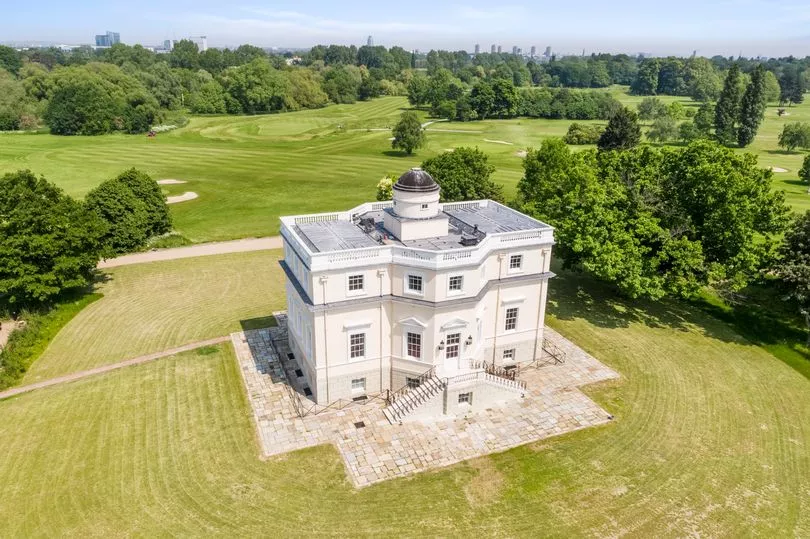
The King's Royal Observatory at Kew (Image: Jackson-Stops/Nick Ayliffe): Click image to enlarge
In the history of English watchmaking, two sets of watch trials were significant. The first and oldest were trials of marine box chronometers and deck watches that took place at Greenwich with the principal purpose of selecting timekeepers for the Royal Navy. The second were trials of watches that took place at Kew, and later Teddington, for watch manufacturers to obtain an independent assessment and certificate of the timekeeping of watches that were to be sold to the general public.
The establishments at Kew and Greenwich are both Royal Observatories, so they can be confused if the location is not specified.
This page is principally about the Kew trials, but the Greenwich trials are also briefly described.
The King's Royal Observatory at Kew, located within the Old Deer Park in Richmond, Surrey, was commissioned in 1769 by King George III for the purposes of conducting astronomical observations.
The Kew Observatory was soon used for testing watches, or at least one very special watch. John Harrison's fourth marine watch, referred to as H4, was taken in 1761 by Harrison's son William on voyages to Jamaica and Barbados. Although its performance was phenomenal, the Board of Longitude were not persuaded that it met all the requirements for a reward under the longitude Act. As part of his case, Harrison made a replica of H4, referred to as H5, that was tested at the King's Observatory at Kew between May and July 1772, when it too produced a phenomenal performance. The King took great interest in the tests. The records of the tests were made by Dr Stephen Demainbray, the King's Astronomer, who was in charge of Kew Observatory at the time.
After the trial of H5, the Kew Observatory returned to its regular duties until lobbying by English watch manufacturers for a system of public trials to rate watches on a similar basis to those already undertaken at the Geneva Observatory and the Winchester Observatory, Yale College.
The Swiss watch trials did not admit foreign entries, but the trials at Yale did. In the watch trial year ending 31 May 1881, a watch entered by the London firm Barraud and Lunds received 82 marks, the highest mark of the year. The Horological Journal commented that ‘The result of this trial shows that manufacturers of first-class English watches, so far from having anything to fear from either Swiss or Americans in these timing tests, are really able to distance all competitors. Probably the English watch trade would benefit from the establishment here of some recognised public authority for the rating of fine watches.’
Discussions regarding the setting up of English watch trials took some time. Greenwich Observatory was suggested as a venue, but Sir George Airy said the Observatory was too busy. The Kew Observatory was then suggested, and the Council of the British Horological Institute persuaded the Kew Committee of the Royal Society to undertake the exercise. Regular trials of watches began in May 1884 at the Kew Observatory under the direction of Mr George Mathews Whipple, the superintendent of the Observatory.
The Kew watch trials were not connected with the Greenwich trials of marine box chronometers and deck watches for the Royal Navy.
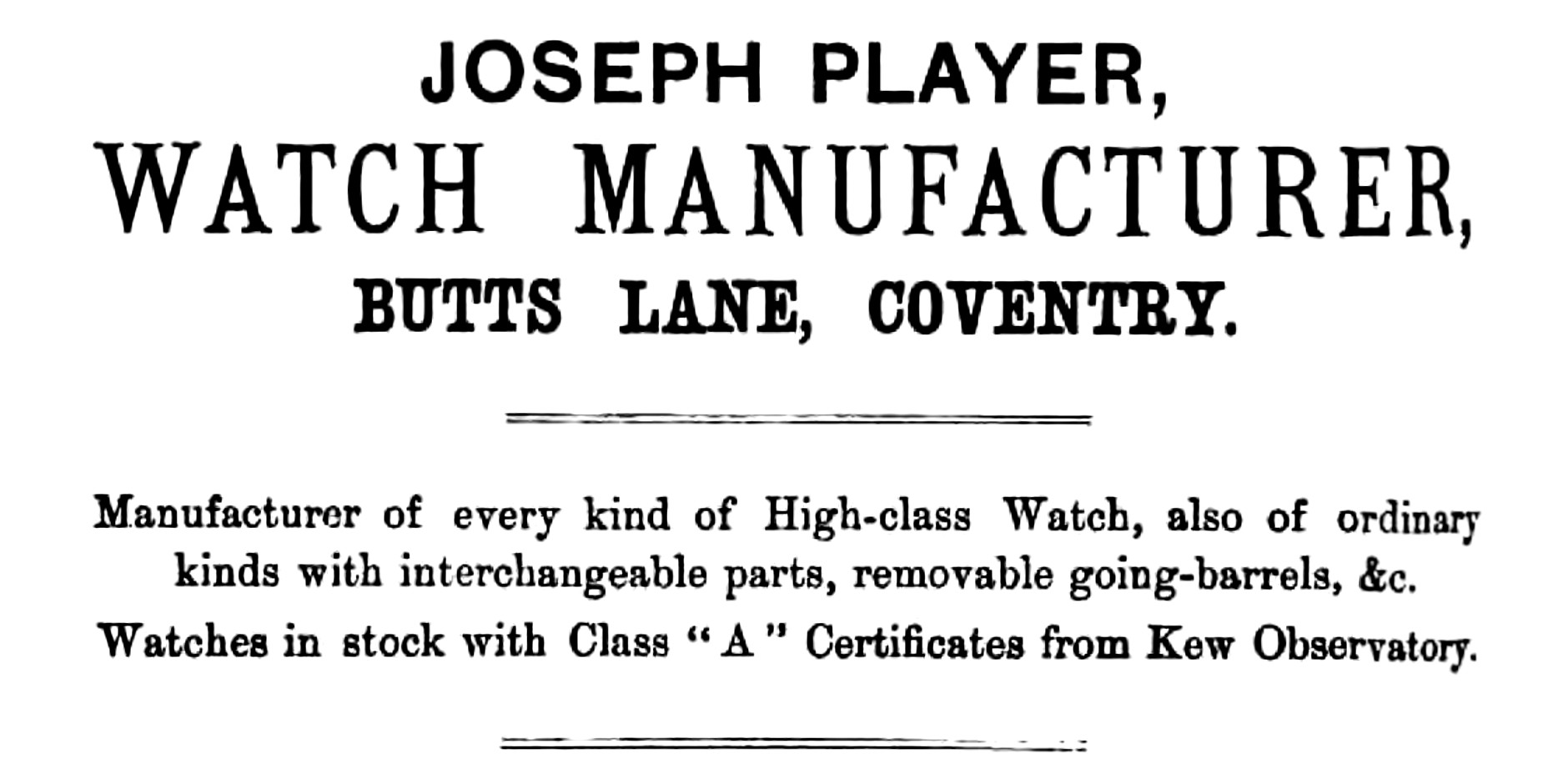
The original aim of the Kew trials was to promote English watches and drive technical improvements, probably with the idea of demonstrating the high quality of English watches to cock a snook at pesky foreigners. Watch manufacturers soon caught on to this idea, the advert reproduced here was published by the Coventry firm of Joseph Player in October 1884.
However, Swiss watch manufacturers were not slow to spot an opportunity to gain credibility in one of their most important export markets. They soon started to enter watches for the trials and eventually came to dominate the results.
The Kew trials were extended to include complicated watches such as chronographs, initially at the request of the Cyclists Union and later for the Metropolitan Police for motor car speed checks.
In August 1886, the Kew Committee announced that the Kew Observatory would also undertake the rating of box (marine and survey) chronometers. Because these were suspended in gimbals so that they were always horizontal, the trial did not involve changes of position. These were simple pass or fail tests; marks were not awarded, and the results did not feature in the annual reports published in the Horological Journal or elsewhere.
Watches could be submitted for trial in one of three classes, A, B or C. Marks were awarded for performance and watches that passed the trial were awarded a certificate showing which category trial had been passed, hence Kew A, B or C certificates.
The fees for the three classes were one guinea for Class A (21 shillings or £1.05 in decimalised currency), and 10s 6d, and 5s 6d for Class B and C, respectively. If a watch failed to obtain a certificate in the class for which it was entered, half the fee was charged. At the time, a good watch with a silver case retailed at around £5, which meant that the trial, especially Class A, was expensive for watch manufacturers.
The Class A trial was the most demanding and most competitive, with the results being closely studied and used in advertising. The Class B and C trials were less demanding, but were still taxing for watches of the time, so a Kew certificate of any class is well regarded.
In the first year, results were simply recorded as pass or fail, but from 1885 onwards, marks were awarded based on the variations in daily rate across all trial periods, variation in rate with changes in position, and variations in rate with temperature changes. A watch that just met the requirements for the class of trial would be awarded zero marks; a perfect watch that exhibited no change in rate during the trial would receive 100 marks.
For the first years, the results to the end of October were reported in the following January, but from 1892 results to 31 December the previous year were usually reported in March. The 1893 report was delayed to May by the untimely death of Mr Whipple.
| Kew Class A Records | |||
|---|---|---|---|
| Year | Maker | Escapement | Marks |
| 1885 | E. F. Ashley | Fixed | 86.1 |
| 1886 | E. F. Ashley | Fixed | 86.7 |
| 1887 | Jos. White | Fixed | 88.1 |
| 1888 | W. Holland | Fixed | 89.0 |
| 1889 | E. F. Ashley | Fixed | 89.1 |
| 1891 | Stauffer & Co | Tourbillon | 91.6 |
| 1892 | Baume & Co | Tourbillon | 91.9 |
| 1902 | H. Golay | Tourbillon | 92.7 |
| 1903 | P. Ditisheim | Tourbillon | 94.9 |
| 1912 | P. Ditisheim | Fixed | 96.1 |
| 1917/18 | P. Ditisheim | Fixed | 96.2 |
| 1919/20 | P. Ditisheim | Fixed | 96.9 |
| 1923/24 | P. Ditisheim | Fixed | 97.0 |
| 1926 | Zenith | Fixed | 97.2 |
| 1929 | Zenith | Fixed | 97.3 |
| 1933 | Omega | Fixed | 97.4 |
| 1936 | Omega | Fixed | 97.8 |
The table of Kew Class A records shows each new record high mark. In the years omitted from the table, the highest mark achieved did not exceed the existing record.
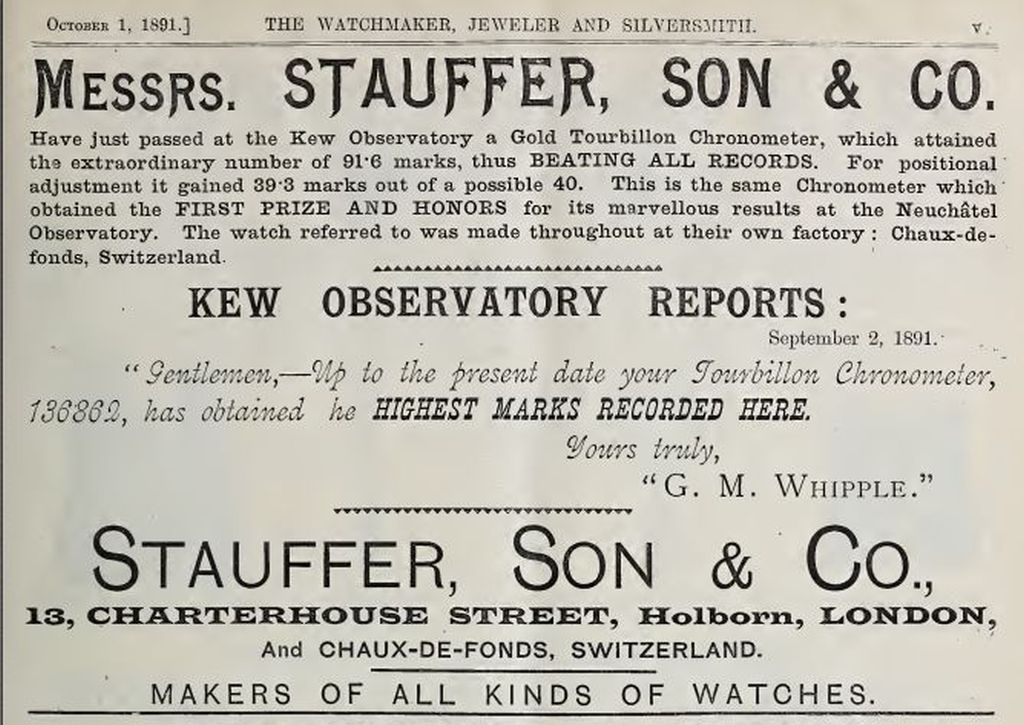
For the years 1885 to 1890, English companies held the record for the highest number of marks in Class A, but in 1891 a Swiss watch entered by Stauffer & Co took the record with 91.6 marks, a feat that Stauffer was quick to advertise as shown in the image here.
In 1892, a Swiss watch with a going barrel and tourbillon-mounted chronometer (detent) escapement with a single overcoil balance spring entered by Baume & Co achieved 91.9 marks, taking the record away from Stauffer. This was initially assumed by some to be a Longines watch, but Baume corrected this, stating that it was one of their own manufacture. Baume were so pleased with this achievement that they continued to advertise that they were holders of the record at Kew from 1891 to 1901 until 1925, forgetting in their enthusiasm that Stauffer & Co had taken the record in 1891.
It is notable that the record of 91.9 marks set in 1892 by Baume & Co was not exceeded until ten years later in 1902 by Golay, also with watch fitted with a tourbillon.
Golay's triumph was short-lived. In 1903, Paul Ditisheim seized the record with a huge leap of 2.2 marks to 94.9. The watch had a tourbillon and a Guillaume balance, the first appearance at Kew of this compensation balance, which reduced middle temperature error. This was the beginning of Ditisheim's domination of the Kew trial records.
Back to the top of the page.

It is sometimes thought that a revolving escapement, such as a tourbillon or karrusel, was needed to achieve high marks in observatory trials such as those held at Kew. However, analysis of results from the Kew trials shows that revolving escapements did not produce a significant increase in marks against fixed escapements. Over the 41 years between 1885 and 1926, watches with revolving escapements of either type achieved the highest number of marks 15 times, against 26 times for watches with fixed escapements.
An error of poise means that the rotating assembly of balance, spring and collet has a heavy point. When the watch is in the vertical position, this heavy point causes the watch to go faster or slower, depending on the amplitude and the vertical orientation of the watch. Errors of poise can be ironed out over a period of hours by rotating the escapement every minute or every few minutes. This is only necessary in the vertical positions, because in the horizontal positions gravity makes no contribution to the turning forces acting on the balance.
The tourbillon is a rotating escapement invented by Abraham Louis Breguet during the period between 1793 and 1795 when he was in refuge in Switzerland from the chaos of revolutionary Paris. After he returned to Paris, he was granted a patent for the invention in 1801.
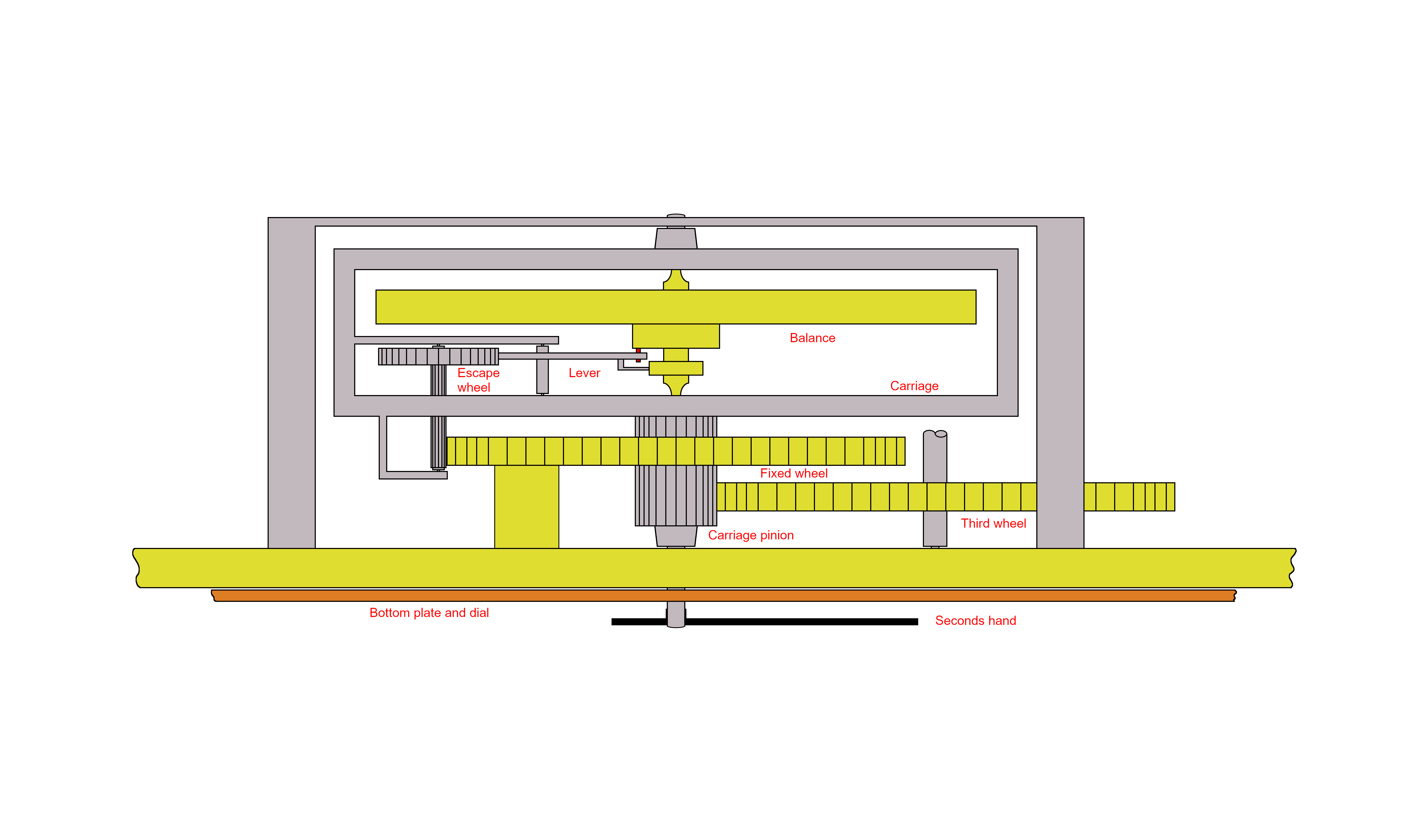
In Breguet's tourbillon, a carriage forms a rotating platform for the escapement and balance. The carriage is driven by the third wheel. The escape wheel is mounted on the carriage, and its pinion meshes with a wheel fixed to the bottom plate. As the carriage rotates, the escape wheel pinion is forced to roll around the fixed wheel, turning the escape wheel and providing the impulse to the balance. If the carriage completes one revolution per minute, its lower pivot can be extended to carry the seconds hand. Breguet's first two tourbillon watches had carriages with one-minute revolutions, followed by a series with four-minute revolutions made between 1808 and 1815, and then, around 1816, Breguet introduced a six-minute tourbillon.
The karrusel is a similar mechanism, but slower rotating, more robust and easier to make. It was invented in 1892 by Bahne Bonniksen, a Danish-born watchmaker working in Coventry.
The first watch with a tourbillon to appear in the published lists of highest marks at Kew was entered by Stauffer, Son & Co, in 1891. This set a new record of 91.6 marks, a significant jump of 2.5 marks from the previous record set by E. F. Ashley in 1889. The following year, a watch with a tourbillon entered by Baume & Co set another new record of 91.9 marks. This watch held the Kew record until 1902, when a watch by H. Golay, also with a tourbillon, established a new record, followed by another new record in 1903 set by a tourbillon watch by Paul Ditisheim.
The tourbillon watches entered by Stauffer, Son & Co in 1891 and Baume & Co in 1892 set off a period when the Kew results tables in the years between 1891 and 1906 were dominated by watches with tourbillon and karrusel escapements. However, there were also always a few fixed escapements, showing what a really good watch adjuster could achieve. For example, in 1897 when Usher & Cole of London achieved the highest mark of 88.4 with a karrusel, a watch with a fixed escapement by Fridlander of Coventry was a very close second, achieving 88.0 marks.
Large numbers of watches with karrusels were entered for the Kew trials by English watchmakers between 1895 and the First World War. However, karrusel watches were not as successful in the Kew trials as is sometimes claimed. A karrusel watch came first in the results only five times over the period of twenty years, and none established a new record. Only one of these five karrusel watches, entered by Victor Kullberg in 1905, achieved a better result than the 91.9 marks of the 1892 Baume watch, with 92.7 marks. By this time, the record was 94.9 marks, held by a Ditisheim watch entered in 1903.
As a further example, in 1911, of the 50 watches that obtained the highest number of marks, all of which achieved more than 86 marks, only six had revolving escapements. Two watches with fixed escapements entered by Paul Ditisheim received the highest number of marks, 94.8 and 93.1 out of a possible 100. The highest-placed watch with a revolving escapement was thirteenth, the other five were ranked thirty-seventh and lower. Evidently, a tourbillon or karrusel was not necessary to achieve high marks, and was not a guarantee of success.
On the chart of the highest Kew marks by year for the 41 years between 1885 and 1926, the performance of tourbillon and karrusel watches does not stand out saliently against the general trend of improvement in the performance of watches with fixed escapements.
There is a good reason why the Kew results do not show any benefit from a tourbillon or karrusel. This is because the temperature tests were performed only in the horizontal position where poise errors do not show. Tests in the vertical position were performed at only one temperature.
It is possible to poise a compensation balance at a single temperature, but when the bimetallic sections of the rims move in or out in response to changes in temperature, unless they move perfectly symmetrically, which in practice doesn’t happen, they will throw the balance out of poise. This makes it impossible to perfectly poise a compensation balance at a central temperature and at extremes of temperature. This is where a tourbillon or karrusel does an effect, reducing out-of-poise errors in compensation balances at different temperatures.
So far as is known, no tests have ever been performed to demonstrate the benefit of a tourbillon or karrusel in reducing poise errors in a compensation balance at different temperatures.
A balance that is ‘in poise’ means that the mass is distributed evenly so there are no heavy areas for gravity to pull on preferentially when a watch is in a vertical position. There are two methods of poising a balance, static and dynamic.
Static poising means using a poising tool with knife edges on which the balance staff is rested. An out of poise balance will rotate and move along the knife edges until its heavy point is hanging down. Material is then added or removed at the appropriate points until the balance does not move when it is placed on the knife edges.
Although it is a good starting point, static poising does not guarantee that a watch that the balance is fitted to will not have poise errors. The collet and inner part of the balance spring have an effect on poise. When the balance is fitted with the collet and balance spring, the whole assembly is often out of poise.
Adjusting poise errors in a running watch is called ‘adjusting to positions’ or dynamic poising. The rate of the watch is measured in four or more vertical positions and the location of a heavy spot noted. Material is then added or removed at the appropriate points on the balance until the rate is the same, or as close as can be reasonably obtained, in all the vertical positions. In the days before electronic watch rate machines were available, this work took a skilled adjuster many hours or days to perform, because each measurement of rate in the vertical positions required that the watch be run for several hours before its rate against a regulator, usually an accurate pendulum clock, could be recorded.
A balance that has been dynamically poised is likely to show as out of poise when tested statically.
Back to the top of the page.
In November 1912, watch testing was transferred to the National Physical Laboratory at Teddington, although the certificates awarded to successful watches continued to be called ‘Kew certificates’.
In the last set of trials conducted at Kew in 1912, a new record was set by a watch sent by Paul Ditisheim. The report of the year's trials said:
The first place was taken by the keyless, double-roller, going-barrel, bar-movement, lever watch, No. 36,175 (fitted with "Guillaume" balance), sent by Paul Ditisheim, La Chaux-de-Fonds. This obtained 96.1 marks, being 1.2 marks above the total obtained by a watch of the same maker in 1903, which has hitherto been the record at this Institution. In view of the transfer of all rating work to Teddington, this watch must remain the record for Kew.
The full records of the trial results were not usually published, but because Ditisheim's watch, No. 36,175 achieved the highest marks ever recorded at Kew, and in its final year of trials, the full rate sheet for the watch was published. This allows the method of calculating the Kew trial marks to be examined in detail and there is an analysis of these results at the end of this section.
The list of the top 50 watches from 1912 was not comfortable reading for English watch manufacturers. Victor Kullberg, London, came second with 93.1 marks; a creditable effort but not enough to beat Ditisheim, or Ditisheim's 1903 record of 94.9. Only three other English manufacturers made the cut; S Smith & Son at number 9, Robert Kunzler, Birmingham, at number 28 and E. Dent & Co., London, at number 38. All the other 46 places were taken by Swiss manufacturers apart from one, which was taken by the Waltham Watch Co., Waltham, Mass. Ditisheim had a second watch in the top 50 at number 12. The largest number of places was taken by Patek, Philippe & Co., Geneva, with 12 places, followed by Longines and Vacheron & Constantin, each with nine places, Golay, Fils & Stahl, Geneva, with 6 places, Stauffer Son & Co., London and Fabrique d’horlogerie Electa (Gallet & Co.) La Chaux-de-Fonds, each with three places and Audemars Piguet & Co. with one place.
In the 22 years from 1885 to 1906, national entries for the Kew trials were dominated by English makers. English watches obtained the highest number of marks 16 times, Swiss entries 6 times. English watches obtained the highest number of marks for the first six years until Stauffer, Son & Co and Baume & Co swapped the title for four years from 1891 to 1894. English manufacturers then took the lead again until 1906, achieving the highest marks 10 times compared to two for the Swiss.
The low point for Swiss watches was in 1902 due to a lack of entries. However, a watch entered by Paul Ditisheim in 1903 which achieved a new record of 94.9 marks, beating by a remarkable 2.2 marks a record of 92.7 set by H. Golay the previous year, was a sign of things to come.
English watches took the top place in 1904 (H. Golay) and 1905 (Kullberg) and 1906, when a double roller fusee single overcoil tourbillon watch entered by Charles Frodsham became the last English watch to obtain the highest number of marks with 93.9 marks.
From 1907, Swiss watches dominated the top places, led by regular demonstrations of excellence from Patek Philippe and Vacheron & Constantin, and startling leaps forward to new records by Paul Ditisheim, culminating in a remarkable 97 marks in 1923/2.
After Ditisheim's success in 1903 with a watch incorporating a Guillaume compensation balance, Swiss entries increasingly used this balance. The Guillaume balance virtually eliminated the middle temperature error, resulting in higher marks in the temperature compensation test. The Guillaume balance is sometimes identified in the Kew results quite incorrectly as an Invar balance, or as an Integral or Crausaz balance. All these names refer to the same type of balance.
Before 1913, Guillaume balances were reported a few times in the Kew results, but it seems quite likely that their use was being under-reported. However, in the trial results for the year from January 1913 to March 1914, almost every single watch is reported as having a Guillaume or Integral balance. This followed a letter by Guillaume that was published in the Journal Suisse d'Horlogerie in August 1912, where he pointed out the inconsistency of names used and the lack of consistency in reporting the use of the balance. This appears to have woken up the Kew authorities to the significance of the Guillaume balance, after which it was reported more consistently.
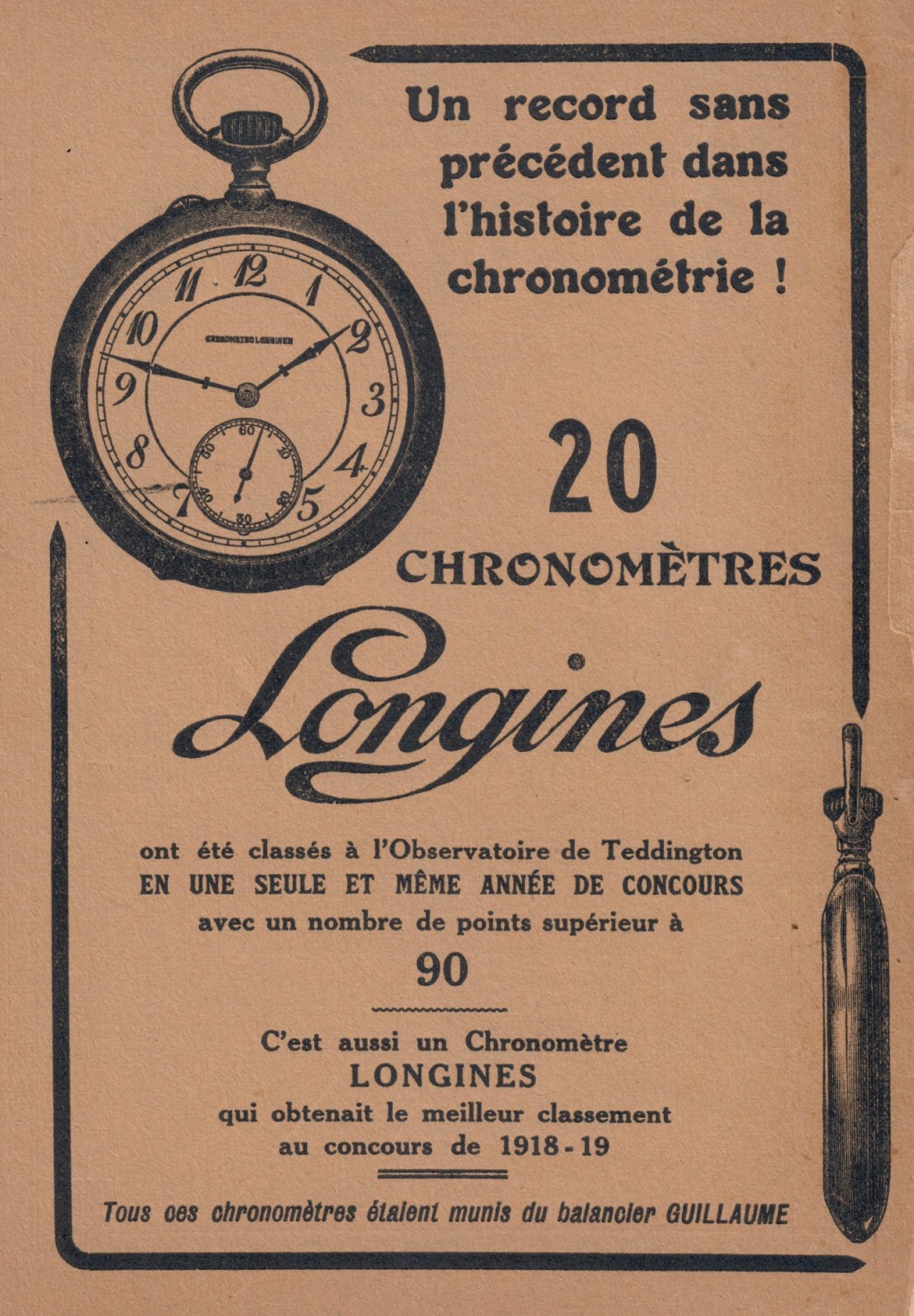
The advertisement here by Longines records a very good results for them in the trials from 1 October 1920 to 30 September 1921. The text of the advert says "An unprecedented record in the history of chronometry! 20 Longines CHRONOMETERS were classified at Teddington Observatory IN A SINGLE AND SAME YEAR OF COMPETITION with a number of points greater than 90. It was also a LONGINES Chronometer which obtained the best ranking in the 1918-19 competition. All these chronometers were fitted with the GUILLAUME balance."
In fact, ‘only’ 16 of the Longines chronometers obtained over 90 marks, the lowest scoring of the 20 obtained 88.4 marks; still a pretty remarkable result and endorsed ‘Especially good’. The watches were all double roller, going barrel, 2 day deck watches. They were all fitted with Guillaume balances.
Back to the top of the page.
The watch trials at the National Physical Laboratory continued until 28 February 28 1951, when they were superseded by the Craftsmanship Test.
Over the period of the Kew trials, including those conducted at the National Physical Laboratory, a total of 33,200 watches were tested. The highest number of marks achieved was 97.8, awarded to an Omega watch in 1936. The highest number of marks achieved by an English watch was 94.2 in 1922, awarded to a watch adjusted by Sidney Better.
The Craftsmanship Test was open to time-only watches of any nationality. There were four grades, la to 1d, the 1d test being equivalent to around 90 marks in the Kew Class A trial. Despite the name, watches were not judged on craftsmanship, but on stricter performance criteria than the Kew trials.
The Craftsmanship Test was designed ‘to encourage the reestablishment of watch craftsmanship in this country’. In that, it singularly failed. During its 27 years of operation from March 1951 to May 1978, only 12 watche passed any grade, and all but one was of foreign make. Only one watch passed the Grade 1a trial; a tourbillon deck-watch by Patek Philippe.
Back to the top of the page.
The Kew Class A trial was performed over 45 days divided into 8 periods of 5 days, plus five settling days on which the rate was not recorded. The rate on the first day of the trial was not recorded, and a day was allowed between changes in temperature for periods IV, V, VI and VII to allow the watch to stabilise at the new temperature. In each period, the rate of the watch was checked 5 times every day.
| Class A Trial Schedule | ||
|---|---|---|
| Period | Position | Temperature |
| I | Pendant up | 67°F (room temperature) |
| II | Pendant right | 67°F (room temperature) |
| III | Pendant left | 67°F (room temperature) |
| IV | Dial up | 40°F (refrigerator cold) |
| V | Dial up | 67°F (room temperature) |
| VI | Dial up | 83°F (oven heat) |
| VII | Dial down | 67°F (room temperature) |
| VIII | Pendant up | 67°F (room temperature) |
There was no test in the vertical position with the pendant down, because it would be very unusual for a pocket watch to be in the pendant down position.
To pass the Class A trial, the rate of a watch had to meet the following conditions:
It was initially intended that the trials would not be competitive and that all watches passing the Class A trial would awarded the same ‘pass’ certificate, which is why there are no comparative results for 1884.
From 1885, marks out of 100 were awarded for watches that passed the trial, with a watch that exactly met the criteria to pass being awarded 0 marks, and a watch that exhibited no variation in rate being awarded 100 marks.
Note that, in common with the Greenwich trials of box chronometers, the rate did not have to be zero. The time indicated could vary from mean time by up to 10 seconds per day, it was the variation in rate from day to day that was most important.
The time indicated by a watch with a constant deviation in rate from mean time can be corrected by adding or subtracting the daily rate each day, whereas the time given by a watch with a rate that varied from day to day cannot be corrected. Consequently, watches that exhibited the least variation in rate, whatever that rate was, were awarded the highest marks.
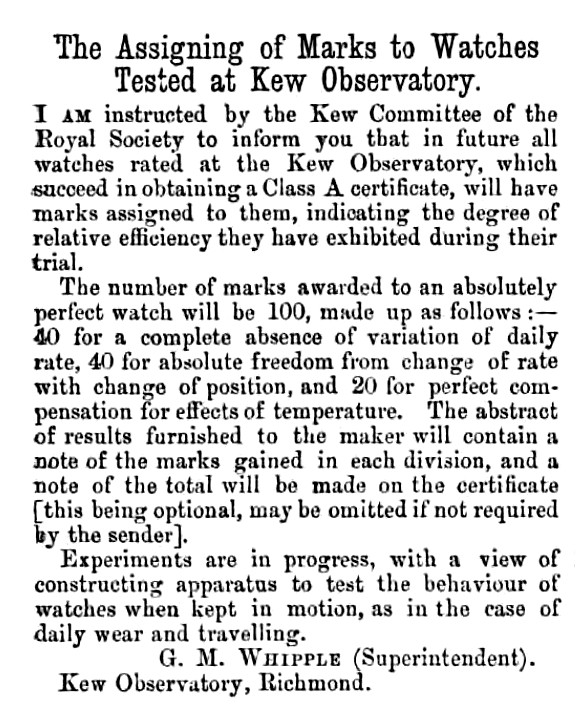
The 100 marks were allocated as stated by G. M. Whipple in the letter reproduced here:
Note that the marking scheme meant that a Class A certificate could be awarded to a watch that achieved zero marks in east test, although none such is currently known.
From 1885 to 1890 a Class A certificate was endorsed with ‘especially good’ when the difference described in (1) had in no case exceeded 0.75 second, when the differences described in (2) were less than 2.5 and 5 seconds respectively, and when the alteration of rate described in (3) was less than 0.15 second per 1° F.
From 1890 the endorsement ‘especially good’ was applied to any watch achieving 80 marks or more.
The Class B trials were a quicker and slightly easier way for a good quality watch to get a Kew certificate.
Class B trials were conducted over 31 days in two positions, pendant up and dial up, and three temperatures, room, refrigerator and oven.
The maximum allowed variation in daily rate was 2 seconds in any one position, 10 seconds between horizontal and vertical positions and \( \frac{1}{3} \) of a second per degree Fahrenheit.
The Class B trial consisted of 14 days in a vertical position and 14 days in a horizontal position with the dial up at the ambient temperature of the room, nominally 67° F, the one day in a refrigerator at 42° F, one day at ambient temperature and one one day in an oven at °F. A Kew Class B certificate was endorsed ‘Especially Good’ when,
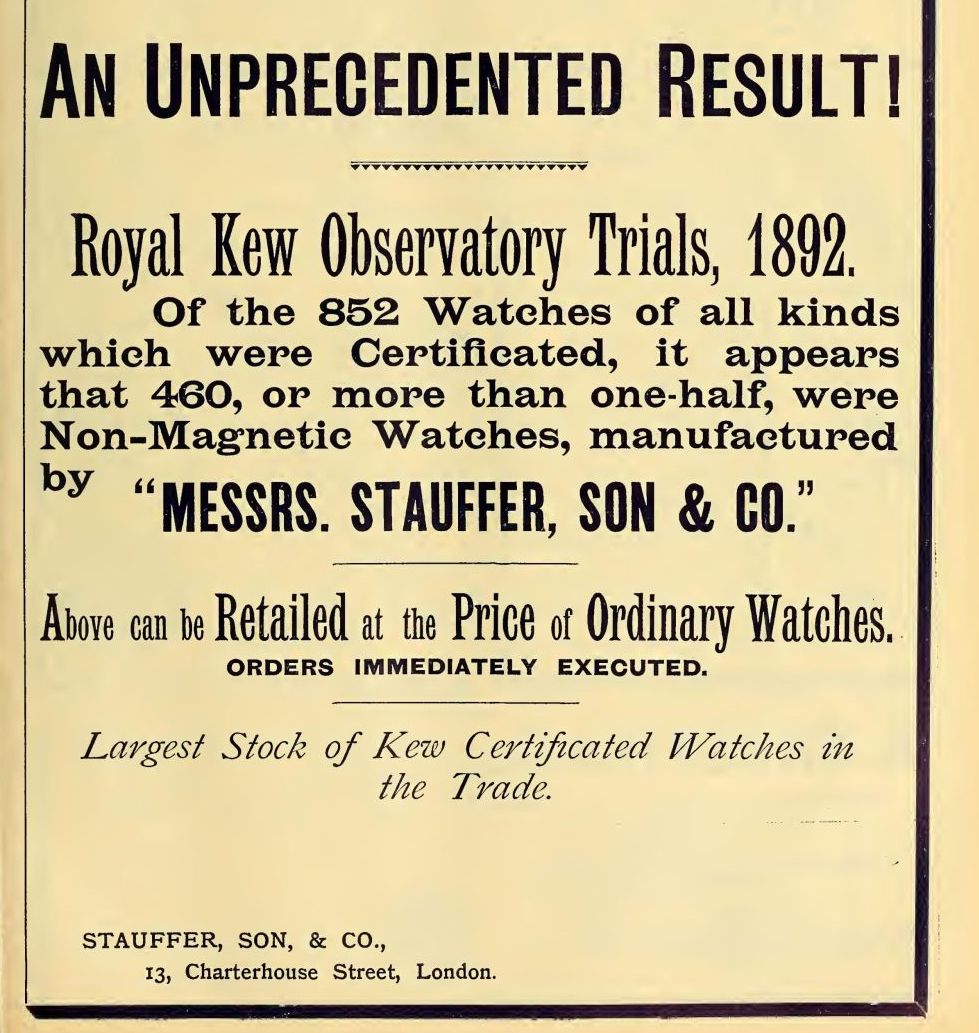
The London importers of Swiss watches Stauffer & Co not only scored highly in the Class A trials, but also entered very large numbers of watches for the Class B trials. The fact that they could do this on a commercial basis, rather than entering just one or two very specially adjusted watches, shows that their ordinary watches were very good quality.
The advertisement reproduced here shows the large number of watches that Stauffer entered for the Kew trials in 1892, over half the total number entered. Although some of these were entered for Class A, many were entered for the Class B trial.
Class C trials were conducted over 16 days at room temperature only and two positions, eight days pendant up and eight days dial up. The maximum allowed variation in daily rate was 2 seconds in any position and 10 seconds between two positions.
Class C trials were discontinued in 1897 due to lack of demand.
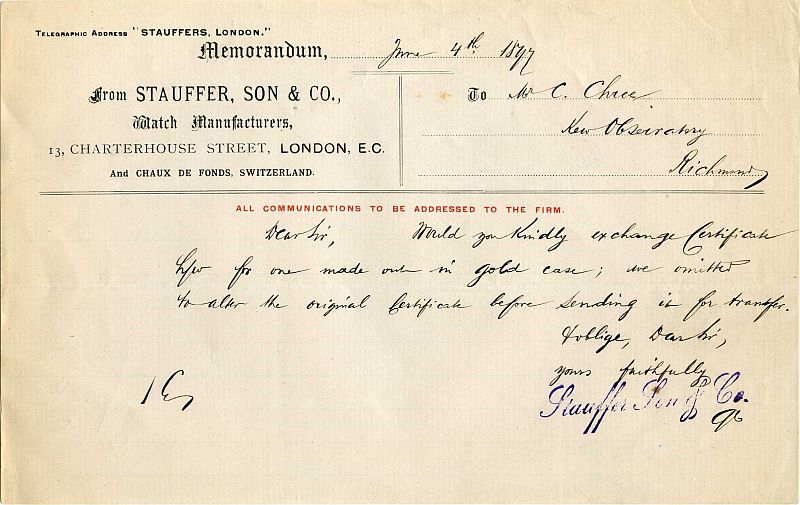
The letter shown here is dated June 4th 1897 and addressed to Dr Charles Chree at the Kew Observatory, Richmond. Dr Charles Chree F.R.S. (1860-1928) was Superintendent of the Kew Observatory at Richmond in Surrey, England, from 1893 to 1925, a remarkably long service of 32 years.
The letter asks Chree if he will exchange an enclosed certificate for ‘one made out in a gold case’, explaining ‘we omitted to alter the original certificate before sending it in for transfer.’ The certificate in question would be a Kew Certificates awarded to a watch that successfully passed the Kew trials.
Kew certificates were highly regarded and watch manufacturers would request Kew to reissue them in the name of a retailer or the final purchaser of a watch. In this instance, the watch was submitted for trial in a less expensive, probably silver, case which has been changed to a gold case before the watch was sold to a retailer. The original certificate had been altered to reflect either the retailer's or final customer's name, but the change of case material had not been noted.
When Swiss watches started to take the top places in the trials, English watch makers took decisive action; they ignored the foreigners and pretended they didn't exist.
In Smith & Sons Ltd. ‘Guide to the Purchase of a Watch’ there is an extract from The Times of London of 5 November 1898 over the caption ‘The record in watch making’ reporting one of Smith's watches gaining a Class A certificate endorsed especially good with the ‘extraordinarily high marks of 88.1’.
The report is careful not to claim that this is record result rather than just a matter of record, but anyone reading the article could be forgiven for gaining that impression. There was no mention in the report of any Swiss entry, or the high marks gained by Swiss watches such as the Stauffer watch that seven years earlier had gained 91.6 marks.
By the term ‘Chronometer’, the Kew Committee meant watches in boxes suspended in gimbals. These could be used for any purpose, but were often referred to as marine chronometers. Because they were maintained in the horizontal position by their gimbals, no trials were made in the vertical positions.
Chronometer trials occupied 35 days, divided into five periods of six days each, with an intermediate day at the commencement of each period of test to allow acclimatisation to the new condition.
| Period | Temperature |
|---|---|
| 1 | 55° F |
| 2 | 70° F |
| 3 | 85° F |
| 4 | 70° F |
| 5 | 55° F |
Back to the top of the page.
In the final year of watch trials at Kew, before the work was transferred to the National Physical Laboratory at Teddington, a watch submitted by Paul Ditisheim, No. 36,175, achieved the highest marks ever recorded at Kew. As a consequence of this, the full rate sheet for the watch was published. This allows the method of calculating the Kew trial marks to be examined in detail.
The summary of the result for Ditisheim watch No. 36,175, published in the report of the top 50 watches which obtained the highest number of marks at Kew during the year 1912, is reproduced below.
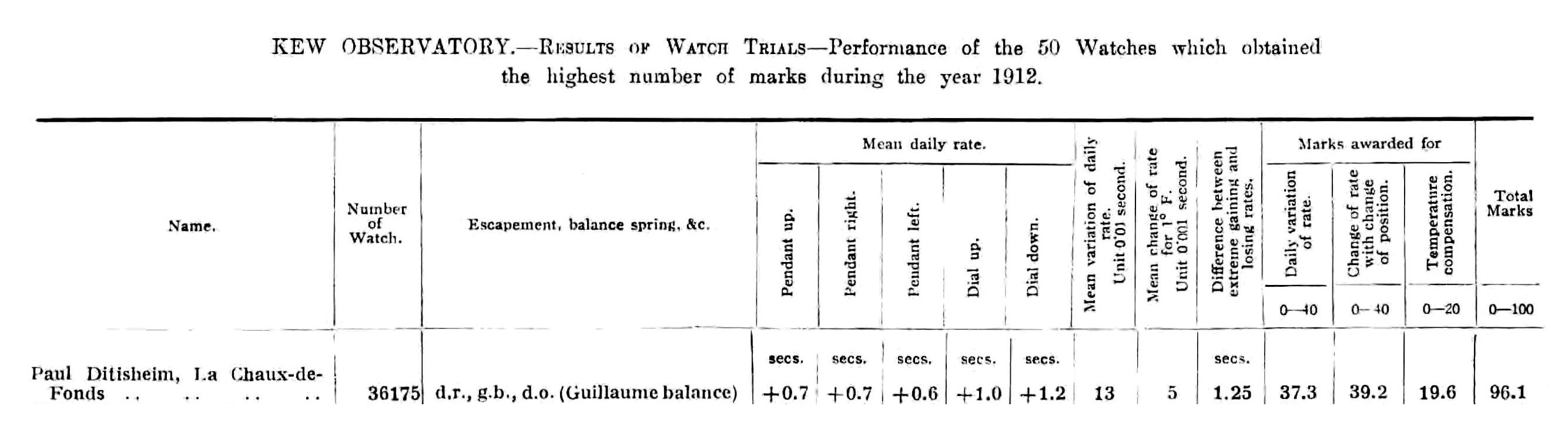
Marks were awarded for performance under three headings: daily variation of rate (0 - 40 marks), change of rate with change of position (0 - 40 marks) and temperature compensation (0 - 20 marks). The four columns to the right hand side of the table give the marks for each category and the sum total of marks.
Between the columns for Mean Daily Rate and the columns of marks are three columns headed ‘Mean daily variation of rate Unit 0.01 second’, ‘Mean change of rate for 1°F Unit 0.001’ and ‘Difference between extreme gaining and losing rates’.
The calculation of marks for temperature compensation is straightforward from the result quoted in the summary, but the marks awarded for daily variation of rate and change of rate with change of position cannot be calculated from the data given.
The marks awarded for temperature compensation are calculated as follows. A watch that had a variation of mean daily rate of one-third of a second per 1°F change of temperature would be awarded no marks, the marks rising to 20 for a watch that had no variation in rate with change of temperature, that is, one with perfect temperature compensation.
The column headed ‘Mean change of rate for 1°F Unit 0.001’ contains the number 5, that is a variation of 0.005 seconds per day per change of temperature of 1°F. This is converted into marks by multiplying 20 by the ratio of 0.005 to one third, remembering that increasing marks are awarded the smaller the ratio: 20 × ( 1- 0.005/0.3333) = 19.69, which would be rounded to 19.7. The figure actually given in the table is 19.6, probably due to rounding in the hand-made calculations at the time.
The daily variation of rate is defined as the daily variation of rate from the mean rate for the period. During each five day period, watches were rated at the same time each day by comparing their rate to the observatory standard clock. For each five day period, the mean rate was calculated from the daily rates, and then the mean variation of the daily rates from this mean rate. The mean rates in positions are quoted in the summary, but not the mean daily variations from these. The figure of 13 given in the column headed ‘Mean daily variation of rate Unit 0.01 second’, that is 0.13 seconds per day, has to be taken at face value.
The change of rate with change of position was calculated from the mean rates for six of the eight periods, excluding the periods in the refrigerator and oven to eliminate variations due to temperature. An overall or ‘grand’ mean rate was calculated from the mean rates for each period, and then the mean deviation of the period rates from this overall mean rate.
The column headed ‘Difference between extreme gaining and losing rates’ is something of an anomaly. This difference was not used in the calculation of marks and it is difficult to see why it was tabulated at all. For the Ditisheim watch that took the Kew record in 1912, it is the difference between the maximum gaining rate on day 17, +1.5 seconds per day, and the maximum ‘losing’ rate of day 41, which was actually a gaining rate of 0.25 seconds per day, giving a difference of 1.25 seconds per day.
The rate sheet for Ditisheim watch No. 36,175 at Kew during the year 1912 is reproduced below.
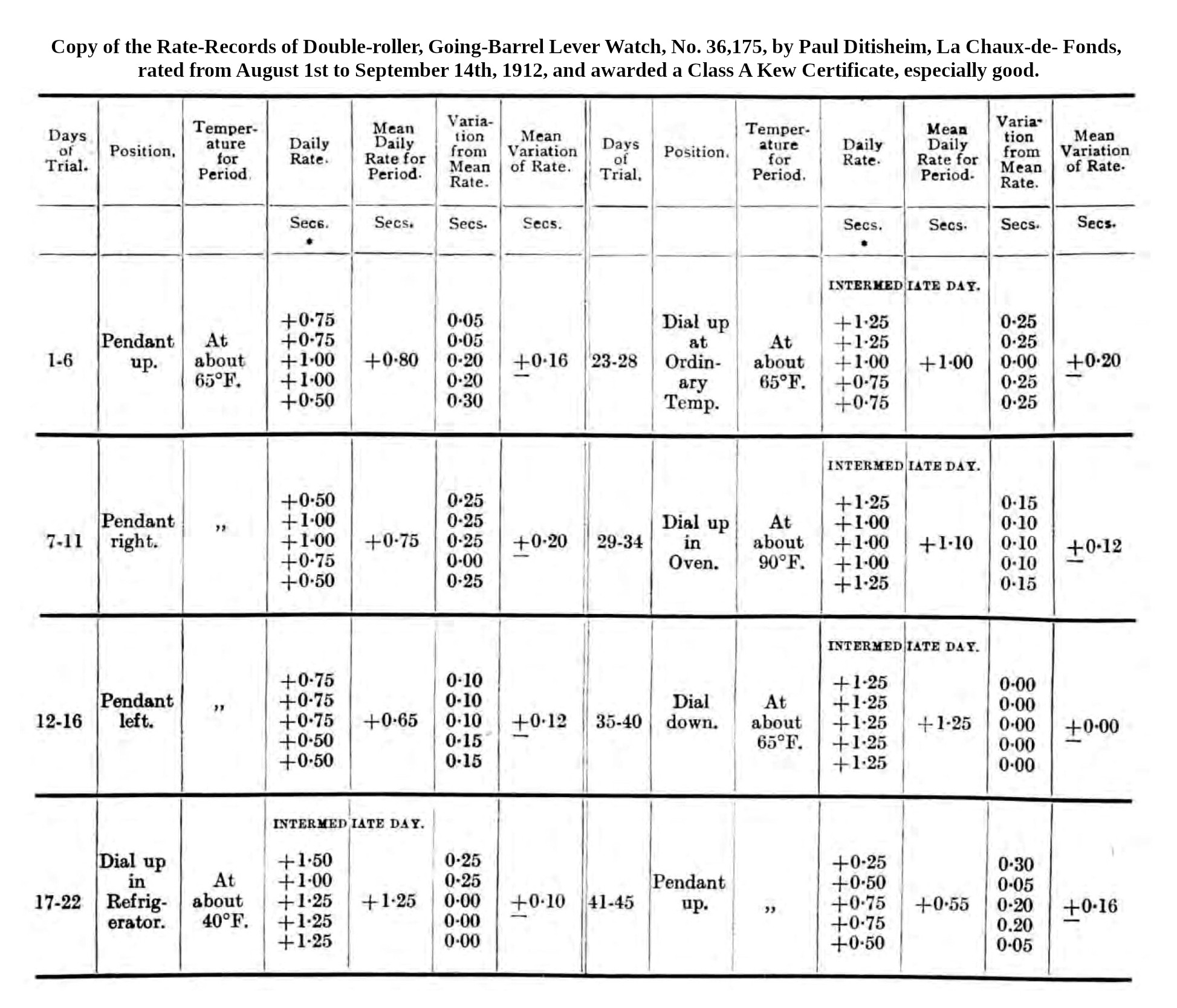
The tables below show how the calculations were performed. The Roman numerals show the period, the following letters show the position: PU pendant up, PR pendant right, PL pendant left, DU dial up, DU dial down. The blue and red colours show the periods of cold and heat.
| Constancy of Daily Rate | ||||||||
|---|---|---|---|---|---|---|---|---|
| Period | I PU | II PR | III PL | IV DU | V DU | VI DU | VII DD | VIII PU |
| Average departure of daily rate from mean rate for period (second per day) | 0.16 | 0.20 | 0.12 | 0.10 | 0.20 | 0.12 | 0.00 | 0.16 |
| Grand mean variation of daily rate | 0.13 | |||||||
The calculation of marks for constancy of daily rate includes all the periods of the trial.
| Constancy of Rate with Change of Position | ||||||
|---|---|---|---|---|---|---|
| Period | I PU | II PR | III PL | V DU | VII DD | VIII PU |
| Mean rate for period (second per day) | 0.80 | 0.75 | 0.65 | 1.00 | 1.25 | 0.55 |
| Grand Mean | 0.83 | |||||
| Variation of mean rates from Grand Mean (second per day) | 0.03 | 0.08 | 0.18 | 0.17 | 0.42 | 0.28 |
| Grand Mean | 0.19 | |||||
The calculation of marks for constancy of rate with change of position excluded the periods of cold and heat, to eliminate variations due to temperature.
| Constancy of Rate with Change of Temperature | ||||||
|---|---|---|---|---|---|---|
| Rate (sec per day) | Temperature (°F) | |||||
| Period | IV DU | V DU | VI DU | IV DU | V DU | VI DU |
| Mean rate and temperature | 1.25 | 1.00 | 1.10 | 40 | 65 | 90 |
| Grand Mean | 1.12 | 65 | ||||
| Departure from Grand Mean | 0.13 | 0.12 | 0.02 | 25 | 0 | 25 |
| Sum of departures | 0.27 | 50 | ||||
| Mean change of rate per 1°F change of temperature | 0.005 | |||||
The calculation of marks for temperature compensation uses data only from periods with the dial up, to eliminate variations due to changes in position.
The marks for each category are calculated from these results as follows:
Constancy of daily rate. Zero marks for 2 seconds to 40 marks for no variation: \( 40 \times ( 1 - \frac{0.13}{2} ) = 37.4 \)
Constancy of rate with position. Zero marks for 10 seconds to 40 marks for no variation: \( 40 \times ( 1 - \frac{0.19}{10} ) = 39.2 \)
Constancy of rate with temperature. Zero marks for \( \frac{1}{3} \) second to 20 marks for no variation: \( 20 \times ( 1 - \frac{0.005}{\frac{1}{3}} ) = 19.7 \)
Total marks: 37.4 + 39.2 + 19.7 = 96.3
The individual marks calculated here differ slightly from the published Kew results, giving an extra tenth of a mark for constancy of rate and temperature compensation. This is probably due to rounding in the original hand-made calculations.
Back to the top of the page.
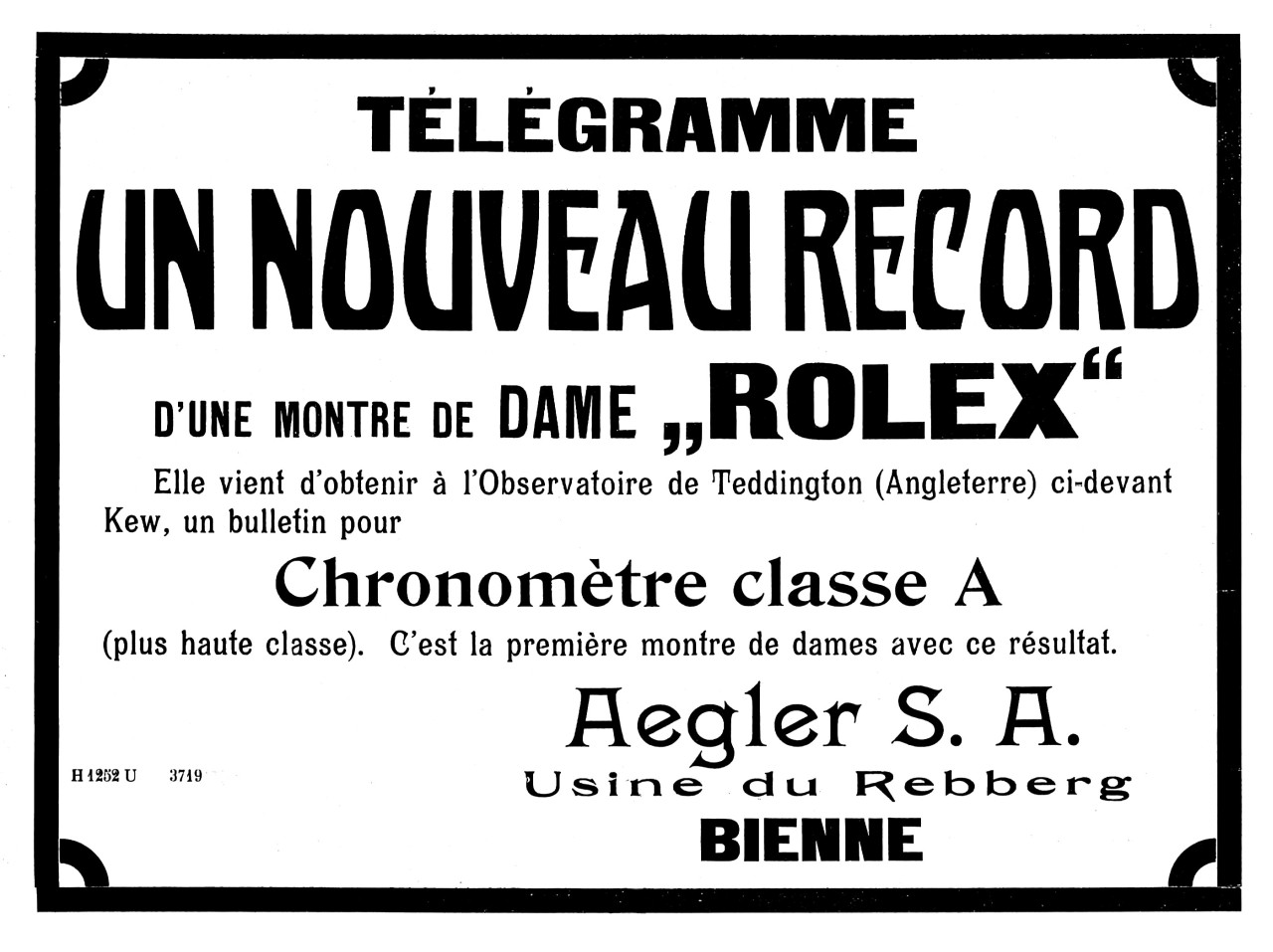
Wilsdorf and Davis for the Rolex Watch Co., Bienne and London, submitted to the National Physical Laboratory at Teddington two watches for the Kew Class A trial in early 1914, serial numbers 492257 and 492282. Both are described in the Kew register as keyless open face bracelet watches with 11 ligne movements. Neither watch passed.
The watch with serial number 492282 was resubmitted on 29 May and tried between 1 June and 15 July. This time it passed with 77.3 marks, just short of the 80 marks required to be endorsed ‘especially good’, and was awarded a Class A certificate. This was the first time that a Kew A certificate had been awarded to a wristwatch and it was a remarkable performance for such a small watch.
In the Vade Mecum it is said that the tests were carried out at Kew observatory, where watches had been tested since 1884. In November 1912 the watch and chronometer rating department moved from Kew to the National Physical Laboratory at Teddington, which is where the certificate was actually issued, although it was still called a Kew A certificate.
The marks awarded were
| Variation of daily rate: | 25.9 | out of a possible 0 to 40 |
| Change of rate with change of position: | 34.1 | out of a possible 0 to 40 |
| Temperature compensation: | 17.3 | out of a possible 0 to 20 |
| Total marks awarded: | 77.3 | out of a possible 0 to 100 |
A Class A certificate would be awarded to a watch that achieved the minimum performance requirements and was awarded zero marks in each category. The Rolex watch achieved 77.3 marks out of 100, an excellent result that was only 2.7 marks short of the 80 marks required for the certificate to be endorsed “Especially good”. However, to put this result in context, the watch that scored the highest number of marks in the trial was entered by Paul Ditisheim and achieved 94.0 marks, and the lowest scoring of the top 50 watches reported in the Horological Journal was entered by Vacheron & Constantin, scoring 85.7 marks.
The result was triumphantly announced in the Swiss trade press by Aegler. The advert here was published on 18 July, only a few days after the Class A certificate was awarded. It is headed "Telegram", showing how the news was quickly communicated to Switzerland.
The full text reads;
A NEW RECORD FOR A ROLEX LADY'S WATCH
It has just been awarded a certificate for Class A Chronometer (highest class) at the Teddington Observatory (England), formerly Kew. It is the first ladies' watch to achieve this standard.
Aegler S.A. Rebberg Factory BIENNE
Wilsdorf said that this was a red letter day in the development of the firm, a day that he would never forget. The ability of a wristwatch to maintain accurate time keeping could no longer be doubted.
Wilsdorf made chronometer-level performance central to Rolex’s strategy, and asked Aegler to submit representatives of all Rolex calibres for observatory testing. Initially, this may have been only a single movement of each calibre, simply to demonstrate that the calibre could pass the test, but independent testing and certification of Rolex calibres increased in importance as time went on, and became an central part of Rolex's strategy. Aegler subsequently submitted Rolex movements for observatory trials in large numbers. Although only a small proportion of the total production of Rolex watches were actually tested, these served to demonstrate that the standard was being achieved and maintained.
The Rolex Jubilee Vade Mecum erroneously states that the watch had undergone the same trials as ‘any large marine chronometer’, confusing the Kew watch trials performed at Teddington with the trials of marine chronometers and deck watches performed at Greenwich.
Back to the top of the page.
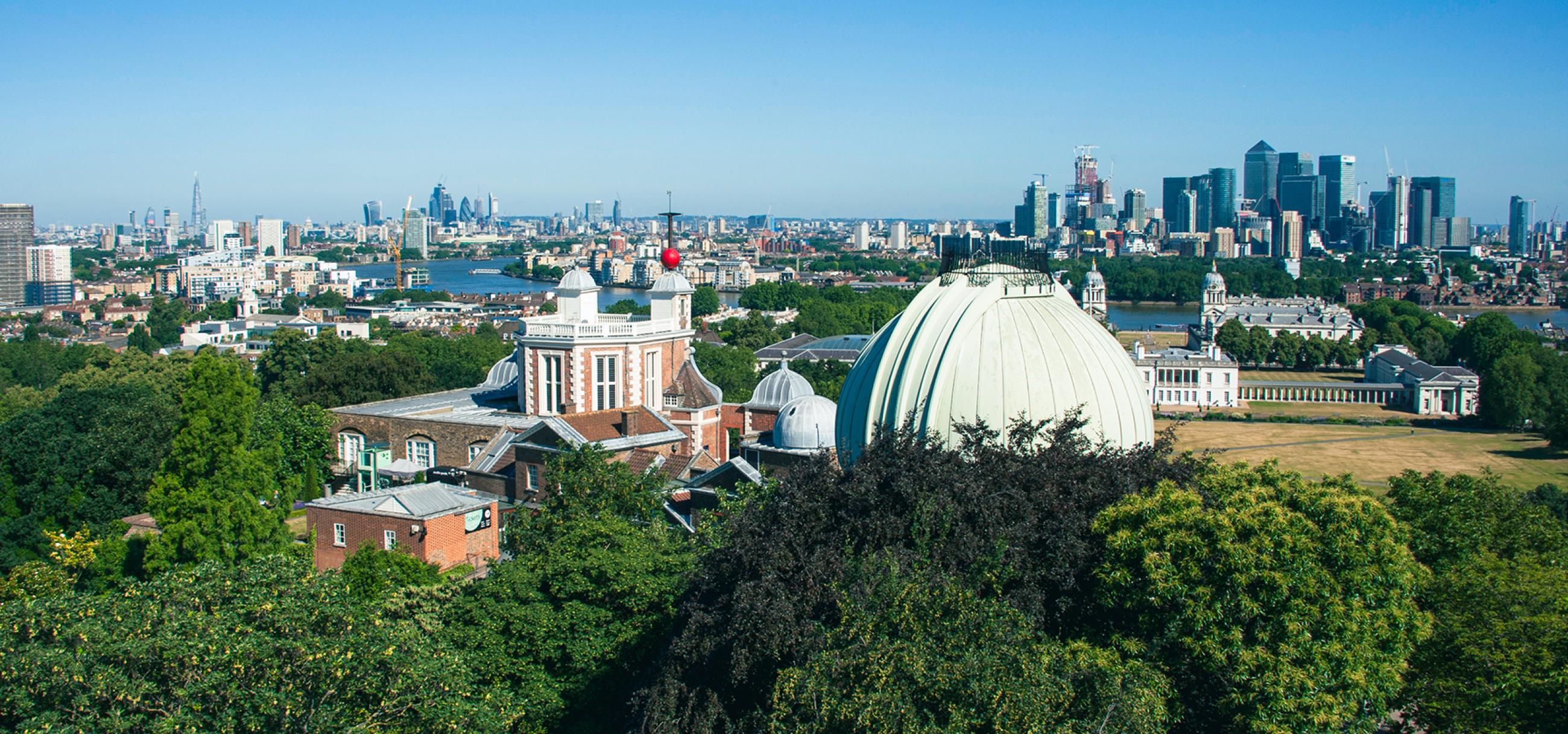
The Royal Observatory at Greenwich was founded in 1675 by King Charles II. It became the primary location for the scientific testing and calibration of marine chronometers, particularly during the 18th and 19th centuries. This was part of its broader mission to support navigation and astronomy for the Royal Navy.
In the photo here from the Royal Museums Greenwich website, the observatory is in the foreground with the river Thames snaking across the middle of the picture. In the middle ground on the right is the National Maritime Museum, with the city of London across the river in the background.
The head of the Royal Observatory at Greenwich was the Astronomer Royal, an official appointed by the Crown. The Astronomer Royal was responsible for conducting astronomical observations, improving navigation methods, and later overseeing the testing and rating of marine chronometers and deck watches.
There were broadly three separate periods of watch trials conducted at the Royal Observatory at Greenwich.
Between 1766 and 1802, trials were conducted for the Board of Longitude to determine the accuracy of chronometers. These were performed under the direction of Nevil Maskelyne, the fifth Astronomer Royal who held the office from 1765 to 1811. The rate of chronometers was recorded daily for one month, and then the total error divided by the number of days of the trial to give a rate the chronometer could be expected to keep during service.
From 1822 to 1835, a series of trials was held with the intention of stimulating improvements in the accuracy of chronometers. Each trial lasted twelve months.
Cash premiums were given for the chronometers with the best performance at the end of the year. Initially this was £300 for the best and £200 for the next best, and later £200, £170 and £130 for the best three.
At first, significant improvements were made in each successive year, but after a few years the rate of progress slowed. Eventually there was no significant improvement from year to year and after thirteen years the trials were discontinued in 1836.
To rank the results, chronometers were given a ‘Trial Number’ obtained by taking the difference of the greatest and least mean monthly rates and multiplying this by 2, and then adding the mean of the extreme variation of daily rates in each month.
In 1829, Dent chronometer No. 114 came first with a trial number of 2.27 seconds. This was the best trial number for any of the thirteen trials.
From 1840 to 1914, annual trials were held for the purpose of selecting marine chronometers and deck watches for the Royal Navy. The highest ranked chronometers were purchased by the Admiralty for use by the Royal Navy.
In 1866, the regime of testing was described by William Ellis, Esq., F.R.A.S., of the Royal Observatory, Greenwich. In addition to the arrangements for submitting chronometers to the observatory in January for the trial and other administrative matters, he described the conditions under which the chronometers were tested.
Rather than being tests to merely give chronometers a performance ranking, these were really Royal Navy acceptance tests with a view to identifying the best chronometers available that would perform well during voyages that could last several years. The tests commenced in January and finished at the end of July, a period of roughly twenty five weeks.
No attempt was made to create low temperature conditions artificially. The period under the shed outside the north window of the chronometer room from some time in January and into February were the coldest conditions the chronometers on test were subjected to.
From 1840 until 1849, the tests were performed only in natural temperatures. The oven-test was introduced in 1848. It lasted six weeks, during which time the temperature was varied from 75° to 100° Fahrenheit. In November 1885, the chronometer maker Kullberg supplied an apparatus for automatically regulating the oven, maintaining the temperature constant within narrow limits.
The gain or loss in seconds each week were recorded for each chronometer. From this data, two significant results were recorded; the difference between the greatest and least weekly rates during the whole period of the trial, and the greatest difference between any two successive weekly rates. The greatest difference between one week and the next indicates a sudden change of rate. The greatest difference between the least and greatest weekly rate may also result from a sudden change of rate, but is usually a measure of some gradual change of rate. Of the two, sudden changes of rate were regarded as the worst and greater importance was given to that result.
The chronometers were ranked by a ‘trial number’, calculated as follows
\[ Trial Number = a + 2b \]where a = Difference between the greatest and least weekly rates and b = greatest difference between one week and the next
The differences in rates were recorded in seconds, and minutes if necessary, so were not marks like awarded in the Kew trials. Because of this, a lower trial number indicated a lower deviation in rate, and therefore a better performance. A perfect chronometer that exhibited no variation in rate would have a trial number of zero.
In 1877, the Lords Commissioners of the Admiralty required that chronometers intended for trial at the annual competition of the year 1877 should be furnished with the Supplementary Compensation suggested by the Astronomer Royal, otherwise known as Airy's compensation arm or Airy's bar.
From 1887 the trials began on the first Saturday in July and ended in the second half of January. The temperature conditions were the same as before, but in reverse order, commencing with warm weather and ending with cold. The trial took place over 29 weeks; three periods of 7 weeks in the room and two of 4 weeks in the oven.
Although deck watches, also called chronometer watches, were rated at the observatory before, annual trials of deck watches for purchase by the Admiralty began in 1886.
The first trial commenced on 27 November and ended on 22 January 1887.
In September 1886, the following details of the trial were published.
‘The rating this year commences on Saturday, November 27th, and will be as follows :—
Orientation Location Duration Horizontal dial up in room for 2 weeks. Horizontal dial up in oven for 1 week. Vertical pendant up in oven for 4 days. Vertical pendant right in oven for 3 days. Vertical pendant left in oven for 3 days. Vertical pendant up in oven for 4 days. Horizontal dial up in oven for 1 week. Horizontal dial up in room for 2 weeks. Total duration of trial 8 weeks. The temperature in the oven will be about 80° to 85° Fahrenheit.’
It is unusual that watches were tried in vertical positions in the oven for two weeks. Testing at different temperatures and in vertical positions were usually carried out as separate procedures. Also, 80 degrees Fahrenheit, the temperature during the trial, was only a little above normal room temperature. However, the Admiralty trials were conducted to select watches for purchase by the Royal Navy and the conditions may have been chosen to simulate what they would be expected to encounter in service. The Navy's principal duties at the time involved voyages to British colonies in Jamaica, India and Australia and 80 degrees could be the expected average temperature.
A trial number for deck watches was calculated similar to the trial number for box chronometers. The trials in vertical positions introduced a new element, and weights were assigned to these in combining them with the trials dial up.
It was considered that when a watch is carried in a pocket, the pendant will generally be up, and that not more than one-third of the deviation when pendant right or left is likely to have practical effect. Half weight was been given to the pendant up deviations when combining them with the trial number dial up (a + 2 b), on the assumption that the deck watch would be usually lying dial up, and that it would not be carried in the pocket more than eight hours a day on the average.
The trial number was calculated as follows
\[ Trial \ Number = a + 2b + \frac{1}{2} \left( c + \frac{d+e}{3} \right) \]where
a = Difference between the greatest and least weekly rates dial up
b = Greatest difference between one week and the next dial up
c = Greatest difference between pendant up and dial up
d = Greatest difference between pendant right and dial up
e = Greatest difference between pendant left and dial up
Like the trial numbers for box chronometers, the trial number was a number of seconds, representing the deviation in rate during the trial. Unlike marks awarded at Kew and other observatory trials, the lower the trial number, the better the performance.
Between 1891 and 1895, a Class B trial was introduced for deck watches. Class A watches were required to be of good finish, fully jewelled, with sunk seconds dial, fine Breguet spring, well adjusted for temperature and horizontal and three vertical positions. Class B watches were required to be strongly made, of less expensive workmanship, and adjusted for temperature and horizontal and one vertical position.
Class A was a continuation of the previous deck watch trials and used the same method to compute the trial number. Class B used a simplified formula for the trial number, a + 2b + c/2.
| Watch orientation | Class A. | Class B. | ||
| Horizontal, | dial up, | in room for | 6 weeks. | 6 weeks. |
| Horizontal, | dial up, | in oven for | 1 week. | 1 week. |
| Vertical, | pendant up | in oven for | 4 days. | 1 week. |
| Vertical, | pendant right | in oven for | 3 days. | ) Not tried |
| Vertical, | pendant left | in oven for | 3 days. | ) with pendant |
| Vertical, | pendant up | in oven for | 4 days. | ) right or left. |
| Horizontal, | dial up | in oven for | 1 week. | 1 week. |
| Horizontal, | dial up, | in room for | 6 weeks. | 6 weeks. |
| Total duration of trial | 16 weeks. | 15 weeks. | ||
The mean temperature in the oven was between 80 to 85 degrees Fahrenheit. The watches were to be in strong dome silver cases, with crystal glass, each bearing a distinguishing number engraved on the plate of the movement.
After the termination of the trial, the Admiralty purchased as many of the best watches in each class as it required, at prices not exceeding £18 for class A, and £10 for class B. The price was to include a mahogany box with ivory label, cleaning after trial, and engraving the Government mark on the dial and plate of the movement, and the name of the maker, the number of the watch, the letters D.W., the Government mark, and the letter A or B on the ivory label of the box.