Blog: William Ehrhardt
Copyright © David Boettcher 2005 - 2026 all rights reserved.I make additions and corrections to this web site frequently, but because they are buried somewhere on one of the pages the changes are not very noticeable, so I decided to create this blog section to highlight new material. Here below you will find part of one of the pages that I have either changed or added to significantly.
This blog entry is part of my page about British Hallmarks
If you have any questions or comments, please don't hesitate to contact me via my Contact Me page.
21 years: 2005 - 2026
Vintage Watchstraps
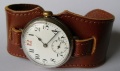
Straps for Wire Lug and First World War Officer's Trench Watches
Ehrhardt Watch Company
Copyright © David Boettcher 2005 - 2026 all rights reserved.William Ehrhardt (1831-1897) was born in Germany and served an apprenticeship as a watchmaker there. He came to England in 1851, the year of the Great Exhibition. He worked for a time with Upjohn & Bright watchmakers in London before settling in Birmingham.
In 1856 Ehrhardt set up a company at 30 Paradise Street, Birmingham. It seems his intention was to make watches by machinery. This was before John Wycherley set up his factory in 1866 in Prescot, Lancashire, and before Aaron Dennison formed the Anglo-American Watch Company in 1871 in Birmingham, so Ehrhardt was one of the pioneers of watchmaking by machinery in England.
Ehrhardt was not in England at the time of Ingold's doomed venture in the 1840s, but perhaps he was influenced by the reason for its failure, which was principally due to opposition from established English watchmakers. Ehrhardt chose Birmingham because it was away from the traditional centres of English watch manufacturing where watches were made by hand using craft skills and factory methods would be opposed, as Ingold had been. Ehrhardt wanted machine operators for his factory, not traditional watchmakers.
From 1856 to 1863 Ehrhardt's company operated from addresses in Paradise Street and Augusta Street in Birmingham. In 1864 the factory was moved to Great Hampton Street, and an advert with this address in 1872 says that the company had ... constructed machinery to make his patent keyless movement on the interchangeable system.
William Ehrhardt entered a sponsor's mark at the Birmingham Assay Office on 14 November 1867. This meant that he could send in watch cases to be assayed and hallmarked. It was usual for watch cases to be made by specialist watch case makers, of which there were many in the watchmaking areas of London, Coventry and Liverpool. However, Birmingham did not have such a conglomeration of independent specialists supporting watch movement finishers, which suggests that Ehrhardt's company made watch cases as well as movements, and probably dials and hands as well, so that unlike most English watch manufacturers, all the parts of a watch could be made and finished in the Ehrhardt factory.
In 1873 Ehrhardt was naturalised as a British citizen. In 1874 he built a new factory called “Time Works” in Barr Street to increase production. It is thought that by this time Ehrhardt's company had produced 200,000 watches.
Ehrhardt was granted a patent, No. 6406 dated 1894, for improvements in the hand setting mechanism of keyless watches. The invention was a mechanism that allowed the keyless work to be put into hand set mode by pulling the crown outwards away from the case. This is the way that watches are set today so it seems very familiar, but there were hundreds if not thousands of different mechanisms patented in the nineteenth century to effect this before the sliding pinion design invented by Adrien Philippe in 1845 was eventually adopted pretty well universally.

Ehrhardt trademarks
When William Ehrhardt died in 1897 his sons William and Gustav Victor carried on the business. In the obituary notice it was said that 500 watches were made per week with 400 personnel. In 1898 the business was incorporated as William Ehrhardt Limited with 250 employees.
Production peaked around 1900 when 250 persons were employed, including many girls who attended the machines, and 600 to 700 watches were made per week. The lower number of employees but greater number of watches made per week imply that Ehrhardt's sons had increased the productivity of the workforce by increased use of specialised machinery.
From around 1920 the company used the name “British Watch Company Ltd.” on some of its watches, most likely hoping to gain patriotic support in the face of growing imports, a sign of the pressure on the few remaining English watch manufacturers.
The company William Ehrhardt Ltd. was liquidated in 1923, by which date it was one of the very last English watch manufacturers. From 1923 until 1927 the Barr Street address was being used in adverts promoting a new company “G. V. Ehrhardt & Hereward Ltd.” as watch cleaners and repairers, but with no mention of watch manufacture.
Sponsor's Marks and Trademarks

W.E Cameo Sponsor's Mark

W.E Incuse Sponsor's Mark
The company used the two trademarks shown in the image above. The winged arrow trademark was registered on on 4 February 1878 and sometimes varies from the shape shown here with simpler and less detailed wings. The fir tree trademark was registered on 4 August 1911 and was used on watches that carry the British Watch Company name.
The sponsor's mark “W.E” incuse was entered at the Birmingham Assay Office on 14 November 1867 by William Ehrhardt, and also at the London Assay Office.
After the first incuse punch, further punches with “WE” and “W.E” in cameo within oval and rectangular surrounds were registered between 1880 and 1914.
The punch mark shown here with “W.E” in cameo within an oval surround was made by one of three punches registered between 1907 and 1914.
Production
The watches manufactured appear to have been initially full plate key wound with going barrels, with anticlockwise winding to simulate the presence of a fusee. Early models had English right angle lever escapements with pointed escape wheel teeth and the frames pinned together, later models had Swiss straight line lever escapements with club tooth escape wheels with the frames screwed together. The patent granted to Ehrhardt in 1894 shows that he was interested in keyless winding by that date, and later production included three quarter plate movements with keyless winding.
In an article in Antiquarian Horology Winter 1996 D. H. Bacon estimated the total output of Ehrhardt watches from the 1874 founding of the Time Works factory as 775,000 watches. This works out very approximately as about fifteen and a half thousand watches a year or 300 a week over 50 years. The rate was lower than this in the beginning and towards the end, and higher in the good years between 1885 and 1910.
William Ehrhardt Sponsor's Mark and Hallmarks

Ehrhardt Birmingham 1909/1910 Hallmarks - click image to enlarge

Movement - click image to enlarge
Thanks to Ken in the USA for the pictures.

Ehrhardt Birmingham 1888/1889 Hallmarks: Click image to enlarge. Thanks to Darren in Auckland for the picture.
Two sets of hallmarks are shown here from cases of watches made by the company of William Ehrhardt Ltd. of Birmingham, England. William Ehrhardt first entered a sponsor's mark at the Birmingham Assay Office on 14 November 1867.
Starting with the photos of the full case back and movement, if you click on it an annotated version should pop up. Reading from the top and then left to right the hallmarks are:
- The lion passant or walking lion with raised right forepaw, the standard mark for sterling silver.
- An anchor: the town mark of the Birmingham Assay Office.
- The date letter in the picture of the full case back is a capital "k" within a rectangular surround with curly base: the date letter of the Birmingham hallmarking year from 1 July 1909 to 30 June 1910.
- In the picture of the full case back the sponsor's mark is "W.E" within an oval surround, the registered mark of William Ehrhardt Ltd. This sponsor's mark was first entered at the Birmingham Assay Office on 20 February 1907.
The cropped picture from Darren W. in Auckland shows the earliest sponsor's mark entered by Ehrhardt at the Birmingham Assay Office in November 1867, the initials "W.E" incuse without surround. Several other forms of marks were entered by the Ehrhardt company over the years.
The hallmarks in Darren's image are an anchor, the Birmingham Assay Office town mark, a lion passant, the standard mark of sterling silver, and the date letter "o" in Blackletter (Gothic) lower case for the hallmarking year from 1 July 1888 to 30 June 1889.
Note that the Birmingham Assay Office used unique surround shapes for date letters specifically on watch cases in the nineteenth century that are not shown in any published tables. This is discussed in detail at Birmingham Date Letters.
If you have any comments or questions, please don't hesitate to get in touch via my Contact Me page.
Copyright © David Boettcher 2005 - 2026 all rights reserved. This page updated May 2025.
Back to the top of the page.
If you have any comments or questions, please don't hesitate to get in touch via my Contact Me page.
Copyright © David Boettcher 2005 - 2026 all rights reserved. This page updated May 2025.
Back to the top of the page.