Case Marks: Marks in Watch Cases
Copyright © David Boettcher 2005 - 2026 all rights reserved.This page is principally about hallmarking. A hallmark is a legally mandated mark applied by an independent testing authority (an assay office or “hall”) that shows the fineness of the precious metal an item is made of; gold, silver or platinum. Not all marks on watch cases are hallmarks! For instance, plated items are not hallmarked, a mark could be simply a manufacturer's trademark, and there are no American hallmarks.
Precious metal (gold and silver, and more recently platinum) objects have by law been tested and marked in England since at least the year 1300, and from 1478 they had to be taken to Goldsmiths' Hall in London, from which the term “hallmarking” originates. Other assay offices were later opened in centres where goldsmiths worked. The fineness of the metal is tested to make sure it meets legal requirements, and then it can be stamped with a hallmark. In addition to the fineness, hallmarks show where and when an item was hallmarked, and under whose responsibility it was submitted.
This page helps you to make a start on reading the hallmarks in your watch case by identifying in which country it was assayed and hallmarked. You are then directed to another page with more detailed information.
If you want to get a book about British hallmarking, Bradbury's Book of Hallmarks published by the Sheffield Assay Office is a long established reference. Make sure that you get a 2014 or later edition, because only those contain correct information about British import hallmarks applied to watch cases.
Be aware that most published tables of British hallmark date letters are only for British made sterling silver items. Different date letter punch shapes were often used on items made from gold, and after 1907 sometimes on imported gold and silver items. see Cautions about Hallmark Tables.
There is a lot of information on this page and I know it can be difficult to take it all in; if you are struggling to understand the hallmarks in your watch case please ask me for help via my contact me page.
I don't make any attempt here to cover manufacturer's trademarks. If you want to identify a trademark, an invaluable resource is Mikrolisk.
Background to Hallmarks and Case Marks
The testing (assay) and hallmarking of gold and silver items in Britain goes back to the year 1300. At first the wardens of the Goldsmiths' company would visit guild members workshops and stamp their work with the mark of the leopard's head. In 1478 the first permanent assayer was appointed and items had to be taken to Goldsmiths' Hall to be assayed and marked, the origin of the term "hallmarking". A system of variable letters, changed each year when new wardens were elected, was introduced to identify when, and therefore by whom, an item had been assayed. At first this was called the "assayer's mark" but is now commonly known as the date letter.
Because the date letter punches were changed when new wardens were elected each year, which took place part way through the year, hallmark date letters span two calendar years. This is not noted in most tables of hallmarks, which only show the year when the punch was first used. But please remember that an entry of, for example, "1914" really means 1914 to 1915.
Gold and silver watch cases submitted for hallmarking at a British assay office had first to be stamped with a mark identifying the person taking responsibility for the work, using a punch that had been previously registered at the assay office. Swiss watch cases were required to be assayed and hallmarked from 1882 but the identities of Swiss watch case makers are poorly documented before 1925, after that date all Swiss gold watch cases had to be stamped with a mark that identifies the maker.

There has never been a system of hallmarking in America. Watch cases made in America carry marks stamped by their makers that were not legally mandated or controlled until 1906 when the National Gold and Silver Stamping Act required an accurate purity mark. These are not hallmarks; they depend to a large extent on the manufacturer's honesty. American watch cases usually carry the maker's name and trade mark. It was not until 1961 that the American government mandated that jewellery manufacturers include a mark indicating the maker. Many American watch movements were imported into Britain and cased with British made watch cases which, if they are gold or silver, carry British hallmarks.
In Britain gold or silver watch cases, wherever they were made, should always have been assayed and hallmarked in a British assay office before sale. British laws on hallmarking were enacted long before watches were even invented! Foreign made watch cases were no more exempt from the law than British made cases, but hallmarking of imported watch cases was not enforced before 1907. There was a from a short period between 1874 and 1887 when a small proportion of foreign watch cases were hallmarked in the same way as British made watch cases, but apart from this most watches were imported into Britain either without hallmarks at all, or with hallmarks from their country of origin.
For a very quick guide to reading traditional British hallmarks, go to British Hallmarks: A Quick Guide.
Hallmarks on Imported Watches
Swiss made gold and silver watch cases were not hallmarked in Switzerland until hallmarks for watch cases were introduced by Swiss law in 1882. Before that date gold cases were usually stamped with their carat fineness by the case maker, and silver was marked with its millesimal fineness, usually 800, or sometimes just "fine silver".
British practice changed in 1907 when it was ordered that all imported gold and silver watch cases be assayed and hallmarked in a British assay office. From 1 June 1907 the assay offices were ordered to strike hallmarks on imported watch cases that were different from those struck on watch cases made in the UK. For instance the London Assay Office town mark for watch cases manufactured in Britain was a leopard's head, but the town mark used on imported watches became the zodiac symbol Leo on a crossed back ground in an oval surround.
An easy way to distinguish a British hallmark struck on an imported watch case after 1 June 1907 is to look at the town mark, the symbol that shows which assay office carried out the assay and hallmarking. The new town marks shown below were used from 1 June 1907 on imported watch cases to distinguish them from watch cases made in Britain.
 |
 |
 |
 |
 |
 |
 |
| London Zodiac sign of Leo |
Birmingham Equilateral triangle |
Chester Acorn and two leaves |
Sheffield Zodiac sign of libra |
Edindurgh St. Andrew's cross |
Glasgow Opposed "F"s prone |
Dublin Boujet (water carrier) |
| Town marks used by British assay offices on imported watches after 1 June 1907 | ||||||
If it is a silver watch case another clear indication is that the silver standard is given as ·925 in an oval surround rather than by the traditional mark for sterling silver made in Britain of the lion passant, a walking lion with raised right forepaw.
You can read more about this on my page about British assay and hallmarking, or in my article published in the November/December 2014 NAWCC Watch & Clock Bulletin as shown here.
Articles in the NAWCC Bulletin are copyright and usually only available to NAWCC members. However, after a request from the archivist of the Incorporation of Goldsmiths, who looks after the historical records of the Edinburgh and Glasgow Assay Offices, the editor of the NAWCC Bulletin has allowed the article to be made publicly available and it can now be downloaded by clicking on this this link: DOWNLOAD. My research has also been incorporated in the latest version of Bradbury's Book of Hallmarks, you can read about this at Bradbury's Book of Hallmarks. I will be publishing some corrections and additions to my NAWCC article that I will make available as a download here.
The following sections illustrate some characteristic marks to help you identify the type of marks you might find in a watch case and then link to a page that goes into more details about those marks.
Back to the top of the page.
“Foreign” Hallmarks


In circa 1874 some Swiss gold and silver watch cases started to be hallmarked in English assay offices with British hallmarks. Although at first only a few watch cases were hallmarked like this, the number quickly increased. English watch manufacturers objected to imported watch cases having British hallmarks because, they said, people could be deceived into thinking the watch was of English make, so the Merchandise Marks Act of 1887 specified new town marks to be struck as part of a composite hallmark with the word “Foreign” across the middle. These new hallmarks were to be applied to any foreign watch case sent to a British assay office to be hallmarked from 1 January 1888. This effectively put a stop to the practice of getting imported gold or silver watch cases hallmarked in Britain.
These ugly and derogatory hallmarks are rare; for a long time I thought that they had never been actually used, but there are images of two at Foreign Hallmarks.
In 1904 an Act of Parliament introduced new hallmarks for all imported gold and silver items that were not watch cases; the 1887 Act continued to apply to watch cases. The new marks for gold and silver items that were not watch cases included the town marks that had been specified for watch cases in 1887. Some of these town marks were found to resemble existing trademarks so were changed in 1906. The 1904 and 1906 laws regarding the hallmarking of imported gold and silver items did not apply to watch cases, because the section of the 1887 Merchandise Marks Act that concerned hallmarking of imported watch cases was not repealed and remained in force until 1907.
Back to the top of the page.
British Import Hallmarks from 1907

Sterling silver import marks
After 1 June 1907 all gold and silver watches imported into Britain were required to be assayed and hallmarked in a British assay office. They were stamped with new hallmarks that were intended to show that the item was imported and not of British manufacture. The picture here shows a set of London import hallmarks for silver. NB: For clarity this picture shows only the three assay office marks, the town mark, standard mark and date letter. It does not include the sponsor's mark, but a British hallmark must have all four marks, it is not complete and legal without a sponsor's mark.
Because the date letter punches were changed when new wardens were elected each year, which took place part way through the year in May of June, hallmark date letters span two calendar years. This is not noted in most tables of hallmarks, which only show the year when the punch was first used. But please remember that a table entry of, for example, “1914” really means 1914 to 1915.
The zodiac symbol of Leo ♌ was used to show that the item was imported and assayed and hallmarked in the London Assay Office, distinguishing it from native British silver items that continued to be stamped with the leopard's head. The symbol of Leo was not very well represented by the punch and, for some reason lost in the mists of time, was at first struck upside down as shown here. This was not corrected until 1950, from when the Leo symbol was stamped the correct way up.

9 Carat Gold Import Mark

Sterling Silver Import Mark
The mark ·925 in an oval surround was used on imported sterling silver instead of the traditional lion passant, similarly a decimal number in an oval surround was used to represent the fineness of Britannia silver ·9584.
The fineness of the legal standards of gold were shown in carats and decimals, as illustrated the picture of the import mark for nine carat gold. The first figure is a nine on its side, not a six. The ·375 is the decimal equivalent of nine carat: 9 / 24 = 0.375. The other legal standards for gold were represented similarly: (22 ·916), (20 ·833), (18 ·75), (15 ·625), (14 ·583) and (12 ·5).
In the same way that the symbol of Leo was introduced as a new town mark for the London Assay Office to use on imported items, other British assay offices used different town marks for imported items. Decimal fineness marks were used on imported gold as well as silver in place of the traditional British symbols. The date letters used on imported items were the same as those used on native items, and each assay office continued with its own unique sequence of date letters.
To go to my page about British import hallmarks click on this link: British import hallmarks.
Back to the top of the page.
British Traditional Hallmarks

British Traditional Hallmarks on Sterling Silver
The marks shown here, the walking lion passant of sterling silver, the leopard's head, and a date letter, are traditional British hallmarks on silver with origins that go back to the year 1300 in the reign of King Edward I. The lion passant, the walking lion with raised right forepaw, was introduced during the reign of King Henry VIII, the king who had six wives. Gold items were marked with similar hallmarks, with a crown or numbers identifying the gold standard.
A valid and legal British hallmark in a nineteenth or twentieth century watch case must have four marks; sponsor's mark, town mark, standard mark and date letter. For clarity this picture does not include the sponsor's mark, but a set of British hallmarks is not valid without a sponsor's mark.
For a very quick guide to reading traditional British hallmarks, go to British Hallmarks: A Quick Guide.
British hallmarks like this were applied to all gold and silver items made in Britain, and they were also applied to some foreign watches between about 1874 and 1887 until the English watchmakers got this stopped. If you have such a foreign watch with native British hallmarks, you can read about this on Foreign watches with British hallmarks.
After 1 June 1907 all imported gold and silver watches were assayed and hallmarked in British assay offices but they were not marked with the traditional British hallmarks, instead new British import hallmarks were stamped on imported watches.
The leopard's head shown here, when used on its own, is the mark of the London Assay Office at Goldsmith's Hall. Other assay offices have their own "town marks"; symbols that show where the item was assayed and hallmarked. The town marks most often seen on English watches are the leopard's head of London, an anchor for the Birmingham assay office, and a sword between three wheat sheaves for the Chester assay office, most used by Liverpool watchmakers.
To go to my full page about British hallmarks click on this link: British hallmarking.
Back to the top of the page.
Sponsor's Marks


In order to send any item to a British assay office to be tested and hallmarked, a person had first to enter their details and a unique punch mark at the assay office they wanted to use. The punch mark is usually the registered person's initials within a shaped surround. This is called the "sponsor's mark" and is one of the four parts of a legal British hallmark. The sponsor's mark was applied to each item before it was submitted for hallmarking, and can tell us interesting information about where a watch case was made, or imported a watch.
This mark is sometimes erroneously called the "maker's mark" due to misunderstanding its exact purpose and use. This can be very misleading at the best of times, and in the case of an imported watch it is just simply totally wrong. The term "sponsor's mark" should always be used, irrespective of whether the item is British or imported. The sponsor was the person who took responsibility for an item when it was submitted for hallmarking, making a legal declaration of where it was made and bearing the penalty if an item was found to be substandard. The mark was never intended to show who made an item; there was no requirement for a sponsor to be involved in any way in the manufacture of an item submitted for hallmarking and there has never been a requirement for the assay offices to know who actually made an item.
To go to my page about British sponsor's marks click on this link: Sponsors Marks.
Back to the top of the page.
Swiss Hallmarks

Silver 0·925 from 1933

Swiss Hallmarks for Watch Cases from 1882
Left to Right: Gold 18, 14 carat, Silver 0·875, 0·800
The Swiss hallmarks shown here were introduced in 1882, following an Act in 1880 defining the legal standards of gold and silver.
There were two legal standards for gold. The hallmark for 18 carat, 0·750, gold was the head of Helvetia, the female national personification of Switzerland or Confederation Helvetica. The hallmark for 14 carat, 0·583, gold was a squirrel.
There were two legal standards for silver. The hallmark for the higher standard of 0·875 was a rampant bear, a standing bear with raised forepaws. The hallmark for the lower standard of 0·800 silver was a capercaillie or wood grouse.
The legal standards for gold and silver were minimums with allowed tolerances, they did not stop case makers from using finer grades of material. Over the years after 1880, some additional grades that could be assayed and hallmarked were introduced to meet the requirements of foreign markets.
In 1888, in response to the British Merchandise Marks Act, the Swiss authorities introduced an additional grade of silver of 0·935 that was intended to be the equivalent of British sterling silver, the minimum standard of silver that the Act permitted to be imported. The Swiss bureaux de contrôle were authorised to assay this standard and hallmark watch cases that met it with a hallmark of three bears; one small bear above two large bears as shown in the picture here.


Swiss Bear. Click image to enlarge.

Swiss Federal cross
In 1933 the fineness of the Swiss legal higher silver standard was raised from 0.875 to 0·925. The punch mark of a standing bear for the higher silver standard was replaced by a duck.
Marks such as “Fine silver” without a fineness mark usually indicate a Swiss origin from before the federal law regarding the hallmarking of watch cases came into force in 1882.
Swiss watch cases are sometimes seen with fineness marks such as 56, 58 or 72 on gold cases, or 13, 14 or 84 on silver cases. The marks on gold cases, and the 84 on silver cases, are Russian “zolotnik number” fineness marks. The 13 and 14 refer to fineness based on 16 ounces to the pound, where pure silver would be 16. A fineness of 13 ounces of fine silver to the pound would be a fineness of 0.813, or approximately 0.800, 14 ounces of fine silver to the pound would be a fineness of 0.875.
French names of parts such "cuivre", "ancre", rubis or "spiral" indicate a Swiss of French origin. If a watch with these marks has a silver or gold case without hallmarks it is likely to be Swiss from before 1882; French gold and silver watch cases carried French hallmarks long before hallmarks for watch cases were introduced in Switzerland.
The Swiss Federal Cross mark, sometimes accompanied by the word “Brevet” or an abbreviation thereof often indicates a Swiss patent.
The complexities of Swiss hallmarking cannot be fully explained in this one very short section.To go to the full page about Swiss hallmarks and other Swiss marks click on this link: Swiss hallmarks.
Back to the top of the page.
Swiss Poinçons de Maître
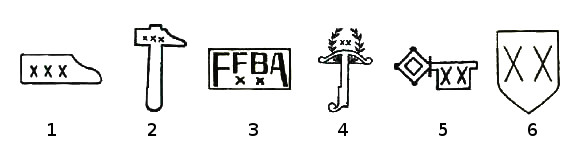
In Switzerland in the 1920s a system of responsibility marks called “poinçons de maître” was introduced for watch cases. Poinçon is pronounced with a soft c like "pwan-son" and means punch, so a poinçon de maître is literally a “punch of the master”. This system was introduced to provide traceability back to the case manufacturer for precious metal cases. It is always seen on gold and platinum watch cases after that date, but rarely on silver cases.
To make the marks relatively inconspicuous a system of the symbols shown here and registration numbers was used. When one of the symbols shown in the picture was stamped in a watch case, the XX or XXX was replaced by the registration number indicating the maker of the watch case.
To go to my page about Swiss poinçons de maître click on this link: Poinçons de Maître.
Back to the top of the page.
First World War and Gold Cases
Before the First World War (1914-1918) London was used by many Swiss companies and importers of Swiss watches as the route by which they could access the large market of the British Empire. One such company among many was Wilsdorf & Davis, a company founded in London in May 1905 to import and wholesale Swiss watches, which later became Rolex. London was the company's export centre for every market in the world and by 1914 it had grown to such an extent that it occupied a large suite of offices and had a payroll of more than sixty employees.
During the First World War, in September 1915, in order to conserve foreign currency reserves as part of the war effort, Reginald McKenna, Chancellor of the Exchequer in Herbert Asquith's coalition government, imposed an ad valorem customs duty of 33⅓% on imported luxuries, including clocks and watches. These “McKenna duties” meant that any watches imported into London, even if only for checking with subsequent export abroad, would be subject to this new high rate of duty. The duties included motor vehicles, musical instruments and cinema film. It was initially intended to include hats, but it proved too difficult to formulate a precise definition of a hat.
The McKenna duties had a major effect on the import of Swiss watches in gold cases. The high cost of gold meant that a large part of the cost of a gold watch was due to the cost of the metal in its case, which is also why so many watches have been stripped of their gold cases over the centuries.
In August 1916 the Horological Journal reported that “... some Swiss gentlemen are interested in a scheme for starting a factory in Birmingham for the manufacture of watch cases. Premises have been taken, machinery installed and workmen have been obtained. The products of the factory will be modelled on Swiss lines. The avoidance of the heavy import duties is, no doubt, the cause of the enterprise.” The identity of this watch case factory, if it ever existed, is not known.
In late 1916, further restrictions on imports of precious metals were introduced by Royal Proclamation under Section forty-three of the Customs Consolidation Act, 1876. In November 1916, importation of jewellery and all manufactures of gold and silver other than watches and watch cases was prohibited. This was followed shortly afterwards by a revision in December, which prohibited the importation of gold, manufactured or un-manufactured, including gold coin and articles consisting partly of or containing gold; all manufactures of silver other than silver watches and silver watch cases, and jewellery of any description.
Note that the wording changed in the December revision from allowing, as exceptions, the importation of gold and silver watches and watch cases, to allowing only silver watches and silver watch cases. This was not made widely known in advance and several members of the British Horological Institute complained that they only became aware of the prohibitions when goods in transit were suddenly seized by British Customs.
The importation of watches, movements and parts, if of gold or containing gold, which principally affected gold watch cases, was prohibited from December 1916 for the remaining duration of the war.
English Watch Case Manufacturers
Because of the restrictions on the importation of gold watch cases, British companies started to make gold watch cases to house Swiss movements. The best known of these was the Dennison Watch Case Company, which had been established in Birmingham in 1874 to manufacture watch cases for movements imported from the Waltham Watch Company in America. However, the opportunity presented by the duty, and then the outright ban on imports of gold cases, resulted in a number of other manufacturers not previously engaged in manufacturing watch cases to begin to manufacture specifically gold watch cases and bracelets.

1917 Customs Notice: Cases Sent Abroad
It might be assumed that bare Swiss movements would be imported to be fitted into these British made gold cases, but in fact it appears that gold cases were sent to Switzerland to be fitted with movements, a practice that had evidently been going on before the ban which brought it to light.
In November 1917, new regulations issued to the Customs and Excise stated that watch cases that were exported for the purposes of being fitted with movements abroad and subsequently returned to this country could be dealt with under existing regulations prescribed for the exportation of watches for repair abroad.
The finished watches could be imported without payment of duty on the value of their cases, provided that the full value of the movements was declared, including the cost of fitting them in the cases, freight or postage and insurance, and duty paid on the total value excluding the case.
Although at first sight this might seem unlikely, but in fact it makes perfect sense. Watch case makers were not watchmakers and could not be expected to fit movements to the cases they made. Watch case workshops were dirty and dusty places due to the polishing of gold and silver cases, apart from all the hammering, banging and soldering that went into making a case, an environment far from ideal for fitting movements into cases.
Watchmakers usually received cases from case makers and fitted the movements to them, and then put the complete watch under test for a period of at least several days before releasing them to be shipped out to customers. Only by doing that could they be sure that the watch was performing as they and their customers expected. They did not like to trust this work to another company. Swiss watch movements were exported to America and cased there, because of the time and distance involved. However, there was a well developed transport network of railways and shipping agents such as Stockwell & Co that moved packets of watches quickly and easily between Switzerland and Britain.
This arrangement was similar to that which facilitated the hallmarking of Swiss gold and silver watch cases with British hallmarks. The cases were sent by the case maker from Switzerland and received in a Bonded Warehouse, a warehouse under bond to the Government for the liability of Customs Duties where goods can be stored without paying the duty. From there, they could be sent to an assay office to be hallmarked. After hallmarking they were returned to the bonded warehouse and subsequently transported back to Switzerland to be finished and supplied to a watch manufacturer. A similar arrangement worked in reverse for British made gold cases that were sent to Switzerland to be fitted with movements.
The Customs notice reproduced here shows that not only were provisions made for British made watch cases to be exported to have movements fitted abroad, but also that watches were sent back to their manufacturers abroad to be repaired. This applied to Swiss watches where the import agent didn't have the capability to repair them and it was preferable to send them back to the factory for repair, something that still happened today. These regulations allowed for a watch repaired abroad to be reimported after payment of duty on the cost of repairs, not on the full value of the watch.
Silver cased watches were not so affected by the McKenna duties and their import was never banned, because the cost of a silver case made up a much smaller proportion of the total cost of the watch than a gold case, so it was not worthwhile having silver cases made in Britain for this reason, although Dennison continued to make cases for American movements. Swiss watches continued to be imported in Swiss made silver cases for sale in Britain throughout the war and the period of the higher tax.

Chester Assay Office Hallmarks for 1938 to 1939
To avoid paying the McKenna duties on watches that were not destined for sale in Britain, many companies started exporting directly from Switzerland to other countries. One such was Wilsdorf & Davis, incorporated in London in 1915 as the Rolex Watch Company Limited. Before the war this company was principally based in London with a small branch office in Bienne. As a result of the import tax, Rolex transferred to that office the management of exports to third countries, and then later moved the Rolex headquarters there. If it hadn't been for the McKenna duties, Rolex might still today be a British Company based in London!
The McKenna war duties, and the outright ban on importation of gold watches for the final two years of the war, started a trend for putting Swiss watch movements into British made gold cases that continued long after the First World War had ended. The McKenna duties were technically repealed in 1938, but the charges on imported goods were continued by Treasury Order under the provisions of the Import Duties Act 1932, which made it easier for changes to be made in the rates charged. The continued levy of duty especially affected gold cases and gave a significant price advantage to British manufacturers of watch case that continued for many years.
The case back in the picture here with Chester Assay Office Hallmarks for 1938 to 1939 illustrates this. The hallmarks in this case are Chester Assay Office hallmarks for a British made rather than imported item. The town mark is the three wheat sheaves around an upright sword, the traditional town mark of the Chester Assay Office. After 1 June 1907 this was only used on watch cases actually made in Britain, it was not used on imported watch cases hallmarked at Chester, they got the town import mark of an acorn and oak leaves instead. The standard mark is the crown and "·375" of nine carat gold, the date letter is the "N" in "Court hand" script of 1938 to 1939. The sponsor's mark B & S was entered by B H Britton & Sons, the punch that made this mark was registered in May 1931.
The patent number seen in the case, 378233, for "Improvements in watch cases" was granted to Charles Henry Britton, Walter Britton and Herbert Britton of 35 Hockley Hill, Birmingham, on 11 August 1932 with a priority date of 15 September 1931. The object of the invention was to provide an improved construction of a two piece watch case with a neat and attractive appearance that could be cheaply manufactured. The case was made from a short piece of tube that formed the middle part of the case. This was pressed or rolled at both ends to provide the recess for the glass at the front and an undercut at the rear for the case back to snap on to.
Back to the top of the page.
German Crown and Sun or Moon Marks


These marks of the Half Moon and Imperial Crown, Halbmond und Reichskrone, on silver, or the Sun and Imperial Crown, Sonne und Reichskrone, on gold, are often seen on Swiss as well as German made watches. They could be stamped in Switzerland by the case maker and the watch might never have been anywhere near to Germany. For more on this strange arrangement see German Marks.
Back to the top of the page.

Fake hallmarks: Click image to enlarge
Imitation or Fake Hallmarks
If you have a set of hallmarks that are stubbornly resisting your attempts to identify them, consider that they might possibly not be genuine. Hallmarks have been imitated and forged in the past, and no doubt will be in the future; you can't always trust everything that you see.
The marks here that look at first glance as if they might be British hallmarks; there is a leopard's head, a lion and a date letter. But these are not British hallmarks. They were stamped into a watch case with the intention of giving that impression and deceiving a potential purchaser into thinking that the watch is English.
How can you tell whether hallmarks are genuine or fake? These are pretty easy to spot because it has 0.875 fineness mark in an oval in the centre, a legal Swiss standard of fineness that corresponds to the Swiss bear mark that can be seen very faintly below the lion mark at the top. The 0.875 fineness is below the minimum British legal fineness for silver, which was and still is sterling silver of 0.925 fineness, and therefore this watch case could not have been legally be hallmarked in a British assay office so the three marks that look like British hallmarks are clearly fake. However, it is not always so easy and the only way to learn how to identify fake hallmarks is to look at lots of genuine examples and then the differences start to jump out at you.
I have provided a lot of examples of genuine British hallmarks on the page at British hallmark examples. There is also a page that shows examples of fake hallmarks at fake hallmarks.
But if you are still stuck, you are welcome to ask me for help via my Contact Me page.
Back to the top of the page.

"Watch Case Makers of England" by Philip Priestley
Watch Case Makers of England 1720-1920
If you are interested in the sponsor's marks found in gold and silver watch cases, an invaluable reference is Philip Priestley's Book "Watch Case Makers of England 1720-1920." This book contains the results of painstaking research into the case makers of London, Liverpool, Prescot, Chester, Coventry, Birmingham and other provincial towns, and has extensive appendices of hallmarks to enable you to identify who entered a sponsor's mark for watch cases at the London, Chester and Birmingham assay offices.
The book doesn't only cover watch case makers of England, as its title suggests, but also records the sponsor's marks entered by watch importers such as Arthur Baume for Longines and Charles Nicolet for Stauffer & Co., and also sponsor's marks entered by assay agents such as Arthur George Rendell for Robert Pringle and Sons and George Stockwell for Stockwell and Company.
Philip has also written books on watch case sponsor's marks covering the earlier period of 1631 - 1720 and the watch case maker Dennison.
Philip passed away in March 2018. At the time he was working on the book "British Watchcase Gold and Silver Marks 1670 to 1970". This was completed by his widow and the editorial team of the NAWCC and is now available to purchase on line. It includes all the material of the two earlier books about watchcase marks, and a lot of additional information.
Back to the top of the page.
American Hallmarks
The term "hallmark" originated in 1478 when London gold and silver smiths were first required to take their work to Goldsmiths' Hall to be assayed and marked. Today it is used to mean a control mark applied to precious metals after assay (testing) by a legally authorised body that is independent from the manufacturer of the item. This provides a reliable indication of the fineness of the precious metal which is otherwise difficult for a purchaser to assess without specialised equipment.
There has never been an equivalent system of independent assay hallmarking in the United States of America and so there are no such thing as “American hallmarks”. There are independent assayers who will test the precious metal content of items, but this is not required by law. Any fineness marks on US made items are applied by the manufacturer, who takes responsibility for their veracity and is liable for prosecution under trade representation and consumer rights laws if they falsely mark something.
Watch case manufacturers stamped their own marks onto watch cases to show the fineness of the metal. The customer must either rely on the veracity of those marks or make their own tests. In the case of a well known watch case maker relying on the marks will be safe, but one must always be alert to the fact that the marks might not be what they purport to be: caveat emptor.
The US Code of Federal Regulations 16 CFR § 23.3 - "Misrepresentation as to gold content" contains the following "An industry product or part thereof, composed throughout of an alloy of gold may be marked and described as “Gold” when such word “Gold,” wherever appearing, is immediately preceded by a correct designation of the karat fineness of the alloy, and such karat designation is of equal conspicuousness as the word “Gold” (for example, “14 Karat Gold,” “14 K. Gold,” “14 Kt. Gold,” “9 Karat Gold,” or “9 Kt. Gold”)." This shows that an alloy of 9 Karat can be described as gold in the US, but as this is simply an example of how such an alloy is described it doesn't preclude an even lower fineness.
Back to the top of the page.
Canadian Hallmarks
A Bill to regulate the sale and provide for the better marking of gold and silver wares was introduced into the Canadian Senate in 1906 known as the “Gold and Silver Marking Act, 1906”. This specified acceptable standards of fineness and how items were to be marked but did not require independent verification so there was no system of hallmarking in Canada.
Back to the top of the page.
German Sun, Moon and Crown
Halbmond und Reichskrone (Half Moon and Imperial Crown): Silver ≥ 800‰ fine
Sonne und Reichskrone (Sun and Imperial Crown): Gold ≥ 585‰ fine
Before 1871, German states were independent and Sovereign and framed their own laws. Each state, city state or city had their own stamps, or “Feingehaltstempel”, for gold and silver. After the unification of the 39 sovereign German states into the German Empire in 1871, universal laws affecting all states began to be introduced. In 1884 the "Gesetz über den Feingehalt der Gold und Silberwaren" or "Act on the Fine Content of Gold and Silver Goods" was passed.
The Act specified minimum standards of 585‰ (58.5% fine) for gold and 800‰ (80% fine) for silver. The imperial crown, the Reichskrone, within a circle representing the sun ( Reichskrone und Sonne) was to be stamped on gold, and a crescent or half moon with the imperial crown (Halbmond und Reichskrone) was stamped on silver. The fineness of the metal was also expressed numerically, together with a trademark identifying the company or business which stamped and guaranteed the marks. There were no other tiers of fineness such as 18 carat for gold or sterling for silver; so long as an item was of at least the minimum standard fineness, it was legal.
Who Stamped the Marks?
There were no official independent German assay offices, so these marks were applied by the manufacturer of an item rather than in an independent assay office. They are therefore not hallmarks, a term that originated in 1478 when London craftsmen were first required to take their work to Goldsmiths' Hall to be assayed and marked. A hallmark means that an item has been assayed and stamped (hallmarked) by someone independent of the manufacturer.
Because the German law required that manufacturers stamp their own products with the specified gold and silver marks, this meant that Swiss watch case manufacturers stamped the German control marks of the sun or moon with the imperial crown on gold and silver.

Swiss Hallmarks with German Sun and Reichskrone: Click image to enlarge.
These marks had to be stamped on imported items as well as German made items, so the sun and crown or half moon and crown can be seen alongside Swiss hallmarks Swiss watch cases that were imported into Germany, or it was thought might be imported into Germany.
The German definition of the minimum fineness of gold as 585‰, which is slightly finer than 14 carat gold, caused a change in Swiss hallmarking of watch cases that might be exported to Germany. The Swiss case maker struck the German fineness mark in the case.
The image here courtesy of Peter O. shows a German sun and crown mark alongside a Swiss Hallmark for 18 carat gold in a watch case back. The German sun and crown mark was stamped in Switzerland by the Swiss case manufacturer after the case had been assayed and hallmarked in a Swiss Bureau de Contrôle. This is explained further in the following section.
For the meaning of the small symbol of a hammer with a number on its head see Swiss Poinçons de Maître.
Not only Germany!
It would be natural to think that these marks were only stamped in Germany. However, when they are in Swiss watch cases, they were not stamped in Germany at all but in Switzerland, and they were not stamped on items that were to be exported only to Germany.
John Matthews observed that there are a significant number of Swiss watch cases in the UK, Scandinavia and other northern European countries having both Swiss and German hallmarks with no evidence of their passage through Germany. He was informed by the Swiss authorities that for watch cases and jewellery in gold and silver that might be exported to Germany, after they had been assayed and hallmarked in a Swiss assay office (Bureau de Contrôle) the Swiss manufacturer would stamp them with the appropriate German mark.
In fact, there are no German official Assay Offices like the independent assay offices in Britain and Switzerland. In Germany the fineness stamps are applied by the manufacturer, who is legally responsible for their veracity. For Swiss made watch cases, it was the Swiss watch case manufacturer who stamped the mark. Because they were not stamped by an independent organisation, these German marks should not be called hallmarks.
This means that the presence of one of these German marks does not prove that an item has ever actually been in Germany. It is possible that the item, although obviously at one time intended to be exported to Germany, could have been directed to a different market after being stamped in Switzerland and never actually passed into or through Germany at all.
Pforzheim
Pforzheim, near to Stuttgart in the federal state of Baden-Wörttemberg in the south west of Germany, has long been known known for its jewellery and watchmaking industries.
The watch making industry of Pforzheim seems to have principally comprised companies that either imported Swiss watches, or imported watch movements from Switzerland and put them into locally made cases.
One case maker in Pforzheim was Friedrich Pfisterer, who registered a trade mark EFPE in 1937.
Importing bare movements and putting them into cases made in a country reduced import charges. Watch movements were cheap compared to the cost of silver, and particularly gold, watch cases, which were expensive because of the intrinsic cost of the precious metals. The import duty on a watch in gold or silver case was much higher than on a bare movement. When stainless steel came into use for watch cases in the 1930s, this financial incentive was largely removed except for jewellery watches.
D.R.G.M.
D.R.G.M. or DRGM stands for Deutsches Reichs Gebrauchs Muster or 'German Reich Use Template', which was a German version of the British 'Registered Design'. It was used to register designs, that is the specific appearance of items, from 1891 to around 1945. A registered design differs from a patent in that it is what the item looks like that is registered, not how it works. In a patent, the specific implementation of the invention is not important, a registered design is almost exactly the opposite in that it is only what the thing looks like that is important.
D.R.G.M. 6392 was the reference of a celluloid watch protector, a sort of clear celluloid case that slipped over a watch to protect it from bumps and knocks – like today's mobile phone protectors.
Back to the top of the page.
French Hallmarks

French Chimera Hallmark

French Owl Hallmark

French Cygne (Swan) Mark
Since the Middle Ages over 5,000 different punches have been used in France to hallmark silver and gold. The huge number of different punches and the complexity of the French administration of hallmarking means that this is a massive subject that requires an encyclopaedia to cover it, which I am not going to attempt here.
In 1838 the mark of a winged beast called a Chimera was authorised to be struck on imported gold and silver watch cases.
A French mark that comes up quite often on Swiss watches is that of a swan or cygne. Even this mark is rather difficult to pin down. It was used for items that were not hallmarked in France in the normal way and so was principally used on imported items, such as Swiss watches imported into France. The swan does not show the actual fineness, it only shows that the item meets the minimum French legal standard, which for silver was 800 millièmes or 800 parts per thousand (0·800 or 80% silver), and that it is therefore legal in France to describe it as a silver item.
The owl is also a French import mark, used on gold. When it was struck, the X in the image on the owl's chest was replaced by a number that identifies at which French assay office the item was tested and marked. The owl does not show the fineness of the gold, it simply shows that the item meets the minimum French legal standard for gold, and that it is therefore legal in France to describe it as a gold item.
Back to the top of the page.
Russian Hallmarks
In Russia before the revolution fineness was expressed in zolotniks, which was derived from the Russian for gold, zoloto, and which was also the name of a gold coin.
There were 96 zolotos to a pound weight, and the “zolotnik number” is a ratio of this like carats, e.g. 56 zolotniks = 56/96 = 0.583, the fineness of 14 carat gold. Similarly, 72 zolotniks = 72/96 = 0·750, the fineness of 18 carat gold.
A fineness of 58 zolotniks was popular in Russia, corresponding to a decimal fineness of 0.604 or 14½ carats.
Silver watch cases are often seen stamped “84 0.875”, which refers to 84 zolotniks = 84/96 = 0.875 for silver. When this is seen in a Swiss watch case, often with the Swiss hallmark of a rampant bear, then the watch was made for the Russian market. The cases of Omega and Tissot watches often carry this mark, exports to Russia being a large part of their production.
Back to the top of the page.
Polish Hallmarks
Poland appears to have started hallmarking gold and silver in 1920. A male head with a helmet was used for gold (zloto) and a female head covered with a scarf was used for silver (srebro). Three standards of gold were recognised, 960, 750 and 583. Three standards of silver were recognised, 940, 875 and 800.
Back to the top of the page.
Watches with British Sponsor's Mark but No British Hallmarks
Sometimes Swiss watches are seen with a British sponsor's marks but no British import hallmarks. This is because the case was stamped with the sponsor's mark in Switzerland by the case maker but then not imported into Britain.
It was easy to for someone with a British registered mark to arrange for this to be stamped as part of the watch case manufacturing process, avoiding the need for the mark to be stamped later as a separate operation. This was done for watch cases that were intended to be imported into Britain, but the lack of British hallmarks shows that the importation never actually took place. The watches with these pre-stamped cases were sent directly from Switzerland to countries such as Canada and Australia.
The reason for this goes back to 1915. With the first World War (WW1) starting to impose a severe strain on the British economy, the Government imposed an ad valorem duty of 33.3% on imported luxuries, including clocks and watches, to conserve foreign currency reserves as part of the war effort. This meant that any watches imported into Britain, even if only for checking before subsequent export abroad, would be subject to this high rate of tax. Prior to this, many watches were imported to Britain before being re-exported to the Empire. Britain had large overseas territories at the time which were a big market.
To avoid paying the tax on watches not required for the British home market, many companies, including Wilsdorf & Davis, Rotherham and Sons, and Baume & Co., made arrangements to export watches direct from Switzerland to the British Empire, bypassing Britain and avoiding the high import duty. Because there was at least a possibility that watches ordered by these companies might end up being exported to Britain, cases were stamped with their sponsor's mark during manufacturing. If the watch was not imported into Britain it would carry the sponsor's mark but no hallmarks.
I have also seen cases stamped with the GS of Stockwell & Co. or the AGR of Robert Pringle & Sons but with no British hallmarks. Stockwell and Pringles acted as Assay Agents for a number of Swiss companies who did not have British based offices, so cases that they would have been responsible for having hallmarked if they were imported into Britain were likewise stamped with their sponsor's marks during manufacture.
Back to the top of the page.
Hallmarking Years
Before 1975, at all British assay offices, the hallmarking year did not run from 1 January, and, therefore, the year denoted by the so-called date letter does not indicate a calendar year. That was not its purpose.
The date letter was originally called the ‘assayer's mark’. It was introduced in 1478 to show who was responsible for the assay. Date letters were, therefore, changed when new Wardens were elected. This was usually about halfway through the calendar year, so a hallmark date letter refers to parts of two calendar years.
Most tables of hallmark date letters show only the first year in which the date letter was used. You need to remember that an item could equally well have been hallmarked in the first part of the following year. The ‘Bible’ of hallmarks, Jackson's Silver & Gold Marks, not only shows the correct date range for each date letter, but also the variants used on the different standards of gold and silver. For example, the surround of the date letter used on gold is often different from the one used on silver.
Each assay office used its own cycles of date letters, which depended on when the office was set up and the date on which the wardens were elected, which is also when the date letter punches were changed. Because of this, date letter tables are unique to each assay office. You cannot use a date letter from one assay office to read the date of a hallmark struck by a different assay office.
The time of year when date letters were changed often varied, particularly in the early years. For precise dating of early letters, reference to Jackson's is recommended. However, before 1975, the hallmarking years of the assay offices that frequently hallmarked watch cases were broadly as follows:
- London Assay Office. The assayer's mark, now often called the date letter, was introduced in 1478. Cycles of twenty letters are used; j, w, x, y and z were always omitted before 1975. Before the Restoration, the date letter punches were changed on the Feast Day of Saint Dunstan, 19 May. During the Reformation, the worship of saints was proscribed, so in 1547, the Goldsmiths broke up their silver-gilt statue of St. Dunstan and changed their feast day to the Holy Trinity. From the Restoration of Charles II in 1660, until 1973, the London hallmarking year ran from 29 May to 28 May the following year.
- The Chester Assay Office hallmarking year ran from 5 July from 1701 until 1839, then from 5 August until 1890, after which it ran from 1st July, neatly bisecting the calendar year. The Chester Assay Office closed in August 1962.
- The Birmingham Assay Office hallmarking year ran from 1 July to 30 June the following year.
- The Edinburgh Assay Office hallmarking year ran from the start of October to September the following year. The new wardens were elected on Michaelmas day, 29 September. The new date punches were used from the first hallmarking day in October.
- The Glasgow Assay Office hallmarking year ran from 1 July to 30 June the following year. The Glasgow Assay Office closed in 1964.
- From 1825 until 1840, the Dublin Assay Office changed its date letter punches on 28 May. From 1845 until 1931, the letter was changed on 31 June. The ‘Q’ of 1932 was used from 1 January.
There were a number of other assay offices, Sheffield (first Monday in June), Exeter (since 1701, on the 7th of August), Newcastle upon Tyne (from 1702, on the 3rd of May), etc, but since these assay offices were not routinely used to hallmark watch cases, they have not been included in the list. If you have one that you want to know the dates of the hallmarking year for, please feel free to ask.
Date Letters Cautions
When you first pick up a book of hallmarks such as Bradbury's Book of Hallmarks, you might think that it is easy to use the tables to discover all that you need to know about a hallmark. This is not the case! Although such books are useful summaries, they are very condensed and contain only the very basics.
Hallmarking has an extremely long history and can be surprisingly complicated and difficult to interpret correctly. As a “for instance”, here are two things you need to be cautious about which most published works don't mention:
- The shapes surrounding date letters on gold may different from those on silver, particularly if they are London Assay Office hallmarks. Most guides only show surround shapes for date letters on silver.
- Because of the difficulty of making very small cameo punches with details on the nose, which forms the surround to the mark, different (simpler) shapes were often used for small items and watch cases.
If you read the rest of this section, you will know more about the complexities and variations in date letters than many “experts”.
Date Letter Surrounds on Gold

London date letter "H" for 1883/84 from Bradbury, and same date on 18 carat gold
The picture here has superimposed at the top the entry from Bradbury of the London date letter "H" for 1883 to 1884. It also shows an "H" date letter mark on an 18 carat gold watch case for the same hallmarking year 1883 to 1884. But the shape surrounding the letter is different, so how can it be the same year?
The reason for this is that the surrounds shapes used on gold were often different from those on silver, but most reference books show only the marks used on silver.
Surround shapes were also different for different standards of gold. The date letter in this 18 carat gold watch case is rectangular, which is the shape used by the London Assay Office on the "higher standards" of 18 and 22 carat gold for date letter cycle XXI. The surrounds around date letters marked by the London Assay Office on the "lower standards" of 15, 12 and 9 carat gold during this cycle were round.
Why do most books only show the marks on silver? Most collectors of hallmarked plate collect silver, for the simple reason that items made from gold such as plates, spoons and cream jugs are virtually non-existent and extremely expensive. I expect that the only person who has a collection of gold plate is Her Majesty the Queen, and I doubt that she needs to consult a book to know about it. Watches and wedding rings are the only gold items most people will ever own or handle, and tables do not usually reproduce the date letters found on them.
Jackson's
There is only one book that I am aware of, Jackson's Silver and Gold Marks, that shows the London Assay Office date surround shapes for the higher and lower standards of gold in addition to those for silver for each cycle of date letters. Why did Jackson choose to list the different surround shape marks for date letters on all the standards of gold and silver? Well, Sir Charles James Jackson was, inter alia, a barrister, and very thorough one, which is why his book is regarded as the bible of British silver collecting.
There is a reasonably priced pocket version of Jackson's available that shows the different shapes of most date letter surrounds for both gold and silver.
However, there is an additional caution. The date letters shown in the tables in Jackson's are more reliable than those found in most reference books and online tables because Jackson took copies of date letters from real examples, but these were large items such as church silver, candlesticks, jugs etc. The punches used on watch cases were necessarily much smaller than those used on such large items. From examining proofs of date letter punch marks at Goldsmiths' Hall that it is known that the punch marks used on watch cases are often quite different, principally due to the difficulty of cutting such small punches.
Even Jackson's doesn't show all of the variations in the punch marks. Punches were made in various sizes, and those for watch cases were at the smallest end of the range. The marks were combined in a single "press punch" so that they were all struck in one go using a fly press. The surrounds around the marks on the press punches used on watch cases were often different to those used on larger pieces of plate of the same metal. For instance, on silver instead of the base of the surround around the date letter having a small point it was rounded. This was most likely done because of the difficulty of making the point on a very small punch.
Birmingham Date Letters

Birmingham 1899 / 1900 Hallmarks on a Sterling Silver Watch Case.

Birmingham Assay Office Hallmarks on a Sterling Silver Watch Case.

Birmingham 1886 / 1887 Hallmarks on a Sterling Silver Watch Case.
Some Birmingham hallmarks have surrounds for the date letter that are different shapes from those shown in published tables, especially those used on watch cases.
The shapes of the surrounds for the Birmingham Assay Office date letter cycle from 1875 to 1900 shown in Bradbury's and Jackson's are round or rectangular. Bradbury notes that from 1872 to 1894 Birmingham date letters on silver are also found in a rectangle with cut corners.
That is not the full story. The surrounds for Birmingham Assay Office date letters found on watch cases during this period are usually shaped like a knight's shield with a pointed base. Sometimes these have a flat top, sometimes cut top corners.
Two of the images here show Birmingham Assay Office (anchor) hallmarks for sterling silver (walking lion) with these different date letter surrounds. The date letter with the flat top doesn't correspond to any Birmingham Assay Office date letter in Bradbury's or Jackson's and is a mystery. It must be from 1876 or later because the sponsor's mark A.L.D in cameo within a rectangular surround was first entered by the Dennison Watch Case Company on 20 April 1876. The date letter Z with a surround in the shape of a shield with a flat top with cut corners is for the Birmingham hallmarking year from July 1899 to June 1900.
Not all the surrounds to Birmingham date letters during this period are this shape. The date letter “m” shown here for 1886 to 1887 found in a watch case has a rectangular surround with cut corners. This shape was probably chosen as being a better fit around the letter m.

Birmingham “v” 1895 to 1896: Click image to enlarge
The Birmingham Assay Office told me that the outline around hallmarks for watch cases are not shown in Bradbury, and that the punches used on watch cases often create different shapes. I have at least one example of a watch case with Birmingham hallmarks and the "k" of 1909/1910 that is the same shape as shown in Bradbury, so it appears that this was principally a nineteenth century practice as indicated by Bradbury. The surrounds around date letters in some cycles are also different on gold cases from those on silver.
It should also be noted that the representations of date letters found in most tables are not necessarily totally accurate, and that variations can occur simply due to the smaller size of the punches used on small items such as watch cases. The most accurate representations of date letters are found in Jackson's, which are taken from real examples, although that usually means larger items of plate rather than small items like watch case.
Even Jackson's can't be taken as perfectly correct on all matters pertaining to Birmingham Assay Office date letters. The date letter for 1895 to 1896 has caught me out more than once. As can be seen from the photograph here, at first glance it looks like a Blackletter (Gothic) lower case “b”, which would make it the date letter for 1876 to 1877. However, it doesn't look much like the “b” reproduced in Jackson's or any other reference. The sponsor's mark was entered by Alfred Bedford, who was the manager of Waltham UK and helped to set up the Dennison Watch Case company in the 1870s. Bedford first entered a sponsor's mark at the Birmingham Assay Office in 1876, so that would fit, but the watch has a much later Waltham movement and doesn't appear to be a marriage.
The Birmingham Assay Office confirmed to me that the date letter is actually the Blackletter (Gothic) lower case “v” of 1895 to 1896.
Birmingham Import Hallmarks

Birmingham import hallmarks for 1914 to 1915.
From June 1907, foreign items that were hallmarked in a British assay office were required to be stamped with import hallmarks to distinguish them from items made in Britain. Instead of the town mark of an anchor, the Birmingham Assay Office was identified by the sign of an equilateral triangle. This was surrounded by an an oval for silver or a rectangle with cut corners for gold. Instead of the lion passant, sterling silver was identified by its decimal fineness ·925.
The Birmingham Assay Office import hallmark for sterling silver in image here has the date letter “p” for 1914 to 1915 within a rectangular surround with cut corners and a flat base. This is different from the letters shown in Bradbury and others which have a curly pointed base for the surrounds of Birmingham date letters in the cycle from 1900 to 1924. This suggests that the Birmingham Assay Office, in common with other assay offices, used different shaped surrounds for date letters on imported watch cases.
The sponsor's mark JR in cameo within a diamond was entered at the Birmingham Assay Office under the name of John Rotherham of Rotherham & Sons. These hallmarks are in the Borgel case of an Electa wristwatch.
Back to the top of the page.
Plate vs. Plated: Silver Plate, Sheffield Plate, Electro Plated
Because gold and silver have always been expensive, many cheaper ways to make items look like gold and silver have been developed over the years. These can be broadly divided into two categories; plated, where a thin layer of the precious metal is applied to the surface of an item made from base metal, and alloys, mixtures of metals making an alloy whose colour resembles that of the precious metal.
If any item is described as silver or gold and doesn't carry any hallmarks, it pays you to be very careful. Ask the vendor how they know it is what they say it is, and be cautious about the answer. With the difference in price between precious and base metals, it could be an expensive mistake. And if it has been tested with one of the testing kits available, bear in mind that they can only test the surface of the metal; it could be just a surface plating. Hallmarking guarantees that the metal is the same all the way through.
Plating
The term "plate" was derived from the Spanish for silver, "plata". It is used in England by the assay offices and others to refer to items made entirely of silver or gold of whatever form; chalices, candlesticks, jugs, etc., – even dining plates.
With the introduction of Sheffield plate, and then later electroplating, it became easy confuse the term "plate" between items made of the solid metal and items made of base metal overlaid ("plated") with silver or gold. Because of this I try to avoid the use of the term plate, but the reader should be aware that some older books, Bradbury in particular, when they say "plate" actually mean solid silver or gold, not plated items.
Sheffield plate was invented by Thomas Boulsover around 1743. It was made by fusing sheets of sterling silver to a base of a copper ingot, the sandwich was then rolled thinner to produce thin sheet material. The resulting material was termed Sheffield "plate" rather than "plated", possibly because a sheet of solid silver was used, and this seems to be where the confusion started. This process puts relatively thick layers of metal onto the base metal, which will wear for many years before the base metal shows through.
Sheets of Sheffield plate were made into household items that looked identical to more expensive solid silver items. Because the copper core would shown through on cut edges these were either rolled over so that the copper didn't show, or silver wire was soldered to the edges to cover the copper. Items of Sheffield plate could not be hallmarked, but makers devised their own marks which sometimes resemble hallmarks.
Gold Filled and Rolled Gold Plate
When the same process as Sheffield plate is done with gold the result is called "gold filled" (which may have the initials GF) or "rolled gold plate" (which may have the initials RG or RGP) depending on the thickness of the gold over the base metal, gold filled should be thicker and constitute at least 1/20th of the weight of the metal in the entire article, and therefore wear longer, than rolled gold which must constitute at least 1/40th of the weight of the metal in the entire article.
The thinnest layers of gold or silver are applied by electroplating, in which gold or silver is deposited onto base metal electrochemically. This can range in thickness from ½ micron (1 micron is 1 millionth of an metre; one thousandth of a millimetre or 0.00004 inches) upwards. The quantity of gold or silver used on electroplated items is so small that it costs very little.
The electroplating process involves dissolving metal salts such as gold cyanide or silver nitrate in an electrolyte and then using an electric current to deposit pure metal from the dissolved metal salt onto the item being plated. Different colours of plating, e.g. rose gold, can be achieved by using the right mixtures of plating solutions.
Electroplated gold items may have the initials GP or GEP. Electroplated silver items may have the initials EPNS, for ElectroPlated Nickel Silver. Gold is very soft and gold plate that is only ½ a micron thick will wear through very quickly. Better quality plating of between 1 to 20 microns will last longer, and heavy electroplating of around 100 micron thickness will last a lot longer. If you are buying an item that is plated and it means a lot to you or the person you are going to give it to, then find out about the quality and in particular the thickness of the layer of plating.
If you have any comments or questions, please don't hesitate to get in touch via my Contact Me page.
Copyright © David Boettcher 2005 - 2026 all rights reserved. This page updated January 2026.
Back to the top of the page.