If you click on any of these headings, it takes a few seconds to load the section, especially if you are on a slowish internet connection.
OmegaOmega Marine
Omega Marine Standard
Tissot
IWC
Stauffer Son & Co.
Stauffer & IWC
Gallet & Electa
Longines
Gallet
The Earliest Wristwatches
Although many firms claim to have invented the wristwatch, there is a serious question as to whether such a simple development really required to actually be "invented" as such - surely it is obvious? There is certainly no patent on the invention of the wristwatch, and I very much doubt that would could have been obtained given the obvious nature of the idea. Something that would be intuitively obvious to even the most casual observer cannot he patented.
In their monumental "Technique and History of the Swiss Watch" (ISBN 0 600 03633 2, and weighing in at nearly 2.5kg, a truly monumental book!) the authors, Eugène Jaquet and Alfred Chapuis, relate the following story on the origin of the wristwatch: "Much has been written about this subject, and we ourselves have heard the following story from an old engraver: A good woman, seated on a bench in a public park, was suckling her child. In order to observe the time, she had attached her watch around her arm. A passer-by was struck by this naive ingenuity. On his return home, he soldered two lugs on to a lady's watch, and added a strap."
Are Jaquet and Chapuis really, seriously, expecting us to believe that the combined brains of the watch industry, which had produced such mechanical complications as the chronograph, minute repeater, perpetual calendar, and the tourbillon, were unable to come up with the idea of soldering two bits of wire on to a watch case so that a strap could be attached? I don't think so!
Jaquet and Chapuis were two very eminent horologians. Professor Eugène Jaquet was Principal of the Geneva School of Horology, and Alfred Chapuis was Dr. honoris causa of the of the University of Neuchâtel. The rest of Technique and History of the Swiss Watch is written in a scholarly and serious way, so the way this episode is written indicates that it was included as a humorous remark. Just about every watch manufacturer claims to have been the first to make a wrist watch, and I think this was Jaquet and Chapuis poking fun at these claims. Notice how they say "... and we ourselves have heard the following story ..." They are not saying they endorse the story, they are just pointing out that strapping a watch to ones wrist is merely "naive ingenuity" not a technical breakthough which deserves geat merit.
So if wrist watches were an obvious invention, which women had been wearing for centuries, why did it take so long for men to catch on to the idea of the wrist watch? There are two aspects to this question: technical and fashion. Could a watch small enough to be worn on the wrist keep accurate time? And would a "real" man wear something that looked like a bracelet? Rather than a massive technical breakthough where some genius had a flash of inspiration, the real story of the mans wristwatch is of how it overcame these technical and social fashion barriers.
1868 Patek-Philippe Bracelet Watch
The very first wristwatches we know about were small watches on bracelets (bracelet-watches or montres-bracelets) intended for ladies. An account book of Jaquet-Droz and Leschot of Geneva mentions, in 1790, "a watch to be fixed to a bracelet,". When Eugène de Beauharnais married Princess Auguste-Amélie of Leuchtenbergin 1809, the Empress josephine presented her daughter-in-law with two bracelets, one containing a watch, the other a calendar. These were made in 1806 by the Parisian jeweller Nitot.
In 1810 the famous French watch maker Bréguet was comissioned by the Queen of Naples to make a wristwatch, which was completed in 1812. Patek Phillipe made the key-winding lady's bracelet watch shown on the left in 1868 for the Countess Koscowicz of Hungary. By the end of the nineteenth century, many if not most watch makers were producing bracelet watches, often with elaborate enamelling and jewelling of saphires, rubies, or diamonds.
But these earliest wrist watches were not serious watches; they were worn by ladies as novelties, or elaborate jewellery. Wrist watches were regarded as too small to be properly engineered in order to keep time accurately; and too prone to damage by shock, or contamination with dust and moisture due to their exposed location; and, perhaps most damningly so far as men were concerned, effeminate: because wrist watches were something worn by ladies.
A gentleman who wanted to keep track of time wore a pocket watch, usually tucked into a pocket of a waistcoat, a garment introduced by King Charles II in the 17th century, on the end of a long "Albert chain," a chain introduced by Prince Albert, the consort of Queen Victoria, which had a clip at one end to attach to the bow of the pocket watch and a bar at the other to fasten it to a button hole to prevent the watch being dropped. This was a long standing fashion of how a true gentleman dressed to present himself to the world.
Apart from fashion, there was another challenge to makers of wristwatches. Pocket watches had developed from miniaturised spring driven clocks in the 15th or 16th century, and had been gradually made smaller and slimmer. But there was a general perception that an accurate watch needed to be of a certain size, and that to make it small enough to be worn on the wrist would be to sacrifice accurate timekeeping.
The final challenge that a wristwatch had to deal with was hazards. The environment within a waist coat pocket is relatively benign; warm, dry and relatively protected from shocks. But strapped to the end of an arm, the wrist watch is exposed to all manner of hazards and rough treatment, it is prone to getting knocked, exposed to dust and splashed with water. All of these hazards presented problems to watch movements of the time, which did not live in hermetic cases, and therefore would get gummed up if dust mixed with the oil, rusty if moisture got in, and were prone to shocks breaking the delicate pivots of the balance staff, only a few 10ths of a millimetre in diameter.
The true story of the wrist watch, or at least of the mans wrist watch (because as we know ladies wristwatches had been available for centuries) is of how it overcame these technical and social barriers to become an essential part of every mans wardrobe - just as the finest and most complicated wrist watches still are today, despite the fact that, with every gadget from phones to computers having a clock built in, they are no longer needed to tell the time!
From Pocket Watch to Wrist Watch
The development of the mans wrist watch from the pocket watch was a gradual process, not an overnight event. Although there were many twists and turns along the way, and almost every manufacturer now claims to have been the first to make a man's wrist watch, the true story behind the man's wrist watch is broadly as follows.
It all began in the second half of the nineteenth century with the needs of the military for the precise timing of manoeuvres, combined with the difficulty of using a pocket watch during such manoeuvres. Faced with the difficulty of pulling out a pocket watch every few minutes (not the easiest of acts at the best of times, but made especially difficult if one was wearing a military great coat and crouching in a trench under enemy fire) or using one hand to hold the watch up to your face as the vital last few seconds ticked by, whilst holding the horse's reins with the other, and yet still needing to wield a pistol, officers soon recognised the utility of strapping a watch to the wrist. Thus began the development of the man's wrist watch. At first pocket watches were adapted by being placed in leather cups with wrist straps, and then by having lops of wire called lugs soldered onto the case to take a leather strap.
Manufacturers noted this demand and, recognising that a standard pocket watch was rather too large to be comfortably worn on the wrist, started producing purpose made wrist watches. These were initially based on smaller movements originally designed for ladies watches, placed into purpose designed cases with wire lugs to take a leather strap. Although taken up by aviators, automobilists and the military, these wrist watches did not find favour with the general public. They were regarded as too small to keep accurate time, too vulnerable to damage or dust and water, and simply not the fashionable thing for men to wear.
Developments in accuracy and case design ensued, and by the time of the First World War (WW1) almost every manufacturer had a mans wrist watch in their range, even if they weren't selling many of them. The war changed the perception that wrist watches weren't for men. Many officers recognised the drawbacks of using an officially issued pocket watch and purchased their own wrist watches. Civilians started seeing men home on leave wearing wrist watches, and of course after the war men who were demobilised continued to wear the wrist watch they had worn on active service and this gradually changed the fashion so that the wrist watch became first an acceptable, and later an essential, mans accessory.
1901 Goldsmiths Advert
Some Salient Events and Manufacturers
In the paragraphs that follow I have used some of the salient events of history and the records of some of the most significant manufacturers to illustrate stages in the development of the wrist watch, along with some diverse bits of information that I thought were interesting or relevant when I was writing the item. I hope you find this interesting, and if you have any comments or suggestions, please let me know.
Military Requirements - The Second Boer War
The second Boer War was fought between the British Army and descendants of Dutch settlers called Boers (farmers) between 1899 and 1902 in Southern Africa. It was a long war involving large numbers of troops from many British dominions. The Boers operated as self-organising commando units, they were used to life in the saddle and to hunting with a rifle; they knew the terrain, and were highly motivated. Against such a highly mobile adversary, British officers were forced to develop the technique of using precision timing to coordinate troop movements and synchronize attacks against the Boer's positions.
Strapping a watch to ones wrist so that it could regularly be checked quickly and easily whilst on horseback, rather than having to fumble about with a pocket watch, was essential under precisely timed and fast moving battlefield conditions.
Pictured right is an advertisement for a military pocket watch, "The Companys Service Watch," which appeared in the 1901 Goldsmiths Company Watch and Clock Catalogue. It was described as "The most reliable timekeeper in the World for Gentlemen going on Active Service or for rough wear." The "UNSOLICITED TESTIMONIAL" at the bottom of the advert, dated June 7th 1900, states "Please put enclosed Watch in a plain Silver Case. The metal has, as you can see, rusted considerably, but I am not surprised, as I wore it continually in South Africa on my wrist for 3½ months. It kept most excellent time, and never failed me. Faithfully yours, Capt. North Staffs. Regt." (emphasis added).
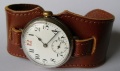
The pocket watch would have been mounted in a leather cup sewn onto a leather wrist strap like the one illustrated below, and the writer was obviously on active service during the height of the Anglo-Boer war referred to above. Was it a wrist watch then? A moot point.
The watches in the Goldsmith's advert are cased in Swiss patent Borgel cases, where the movement, dial and bezel are fixed to an externally threaded carrier ring, and this whole assembly then screws into the threaded case from the front. Patented by François Borgel in 1891, this design was an early attempt at making the case less permeable to water and dust. These watches would have been imported complete with case by Goldsmiths from Switzerland. You can read more about these Borgel cases on my Borgel page.
Pocket Watch Wrist Strap
Interestingly, the same 1901 Goldsmiths catalogue contains two pages of advertisements for ladies wrist watches mounted on either rigid or flexible bracelets, and 12 pages of adverts for men's pocket watches, but no adverts at all for men's wristwatches. Men's pocket watches by this date had reached a high degree of sophistication. The cheapest and simplest watch advertised is a silver keyless watch with a jewelled lever movement, compensation balance, enamel dial and crystal glass at £2:10.
The most expensive watch illustrated is a Gentlemen's gold, London made, keyless repeater, with chronograph registering minutes, seconds, and fifths of seconds, and a perpetual calendar showing day, date and month, and a moon phase indicator, with fully jewelled movement, BréguetSay: "Bre-gay". An overcoil hairsping where the last coil is raised above and parallel to the others with a smaller radius. Invented by Abraham-Louis Bréguet in 1795, the overcoil form allows the hairspring to expand and contract concentrically, which improves timekeeping and is still in use today. hairspring, compensation balance, adjusted for all temperatures and positions, guaranteed to keep most accurate time, for the princely sum of £200. No wristwatch at the time could hope to compete with such a display of English horological excellence! (and not many have since, come to that!)
The Goldsmiths Company catalogue notes either that "These watches are made abroad specially to the order of the Goldsmiths and Silversmiths Company, Ltd., who examine them in London and guarantee them." or that "Some of the intricate parts of these watches are made abroad" without even mentioning where (although this was presumably Switzerland) let alone a makers name.
1912 Borgel Advert
Public Acceptance
A number of companies were producing men's as well ladies wrist watches in the first decade of the twentieth century, or at least had them available in their range, and had perhaps made the odd one or two to special request. However, the vast majority of the wrist watches that were actually sold, as opposed to just being available in the manufacturer's catalogue, were ladies wrist watches. The idea of a man wearing a watch on his wrist was gradually gaining acceptance with military men, sportsmen and automobilists, but not with the wider public.
This advert appeared in a 1912 issue of Revue Internationale de l'Horlogerie. The cases illustrated at the bottom of the advert are Borgel one piece screw cases, the same as the ones in the Goldsmiths catalogue. But there is also a new twist: unlike the pocket watch in the Goldsmiths advertm which had to be strapped to the wrist by a purpose made leather strap, the case at the bottom right of the advert has been adapted with wire lugs to take a "bracelet" and be worn as a wrist watch!
The advert goes on to say that this wrist watch case has been "specifically requested by motorists and members of the English and colonial army." So by 1912 watch manufacturers were beginning to wake up to the idea that certain activities, and military men in particular, were starting to demand wrist watches. The earliest known Borgel wrist watch like the one in the advert is dated by London hallmarks to 1910/11. But wrist watches were still a long way from public acceptance and fashionability.
There was still the general view that a watch worn on the wrist, being necessarily smaller than a pocket watch, and subject to being more generally knocked about, exposed to dust, water from hand washing etc. would never be able to keep accurate time, and it was still perceived by some as unmanly. Two things now conspired to bring about a more rapid change in the fortunes of the wristwatch: the commitment of one Hans Wilsdorf; and the occurrence of the first World War.
Hans Wilsdorf
Hans Wilsdorf, with financial help from his brother-in-law Alfred Davis, founded the watch importing and distribution firm of Wilsdorf & Davis in London in 1905. Wilsdorf was convinced that the wristwatch was the way of the future, and soon contracted the firm of Hermann Aegler to manufacture wristwatchs for him. Wilsdorf was a perfectionist, and never ceased pressing Aegler to improve the timekeeping of the watches they made for him, which he now insisted be branded "Rolex" - a name Wilsdorf had invented.
In 1910 Aegler submitted a Rolex wrist watch to the Bienne testing station. It received a First Class certificate and thus became the first wristwatch to be officially certified as a chronometer in Switzerland. On July 15th 1914, a Rolex wristwatch received a Class A precision certificate from the Kew Observatory in Greenwich, which had previously only been achieved by marine chronometers. Wilsdorf remarked that this was a "red letter day" in the development of his firm, which he would never forget. The ability of a wristwatch to maintain accurate time keeping could no longer be be held in any doubt. You can read more about Hans Wilsdorf and the Rolex story on my Rolex page
World War One - WW1 - Officer's Trench Watches
Now that the wristwatch had been shown to be capable of being an accurate time keeper, it was only social acceptability that held it back. The first World War (World War One, 1914 - 1918) first required, and ultimately legitimised, the wristwatch. The standard timepieces issued to officers were still pocket watches, but these were impractical to use in the cramped conditions of the trenches, and in the open cockpits of early aircraft, and many officers soon purchased their own wristwatches, hence these watches are often referred to as "officers" or "trench" watches. The fact that they were purchased by individuals rather than being issued by the military authorities accounts for the enormous variety of WW1 era wrist watches, which makes them so interesting to collectors.
Canadians advancing on Vimy Ridge, April 1917
As the war progressed and the techniques of warfare developed, the role of the wrist watch changed from being a convenience, to a life or death requirement when the "creeping" or "walking" barrage was introduced to protect advancing troops. A creeping barrage involved artillery fire moving forward in stages, so that the shells were falling just ahead of the advancing infantry. First used at the Battle of the Somme in 1916, it was soon appreciated how important it was for the attacking troops to follow the barrage closely, "leaning on the barrage", not allowing time for the defenders to emerge from their dug out shelters. This strategy required precise timing by both the heavy artillery and the infantry. Failure to achieve this would result in the artillery killing their own soldiers, and there was no opportunity to stop during the advance to fish out a pocket watch. The creeping barrage was used to great effect in the Canadian success at Vimy Ridge in April 1917.
The takeup amongst military men during WW1 was so remarkable that the 1916 Annual General Meeting of H. Williamson Ltd., a wholesaler of clocks, watches and gold and silver ware, was told that "The public is buying the practical things of life. Nobody can truthfully contend that the watch is a luxury. In these days the watch is as necessary as a hat - more so, in fact. One can catch trains and keep appointments without a hat, but not without a watch. It is said that one soldier in every four wears a wristlet watch, and the other three mean to get one as soon as they can. Wristlet watches are not luxuries; wedding-rings are not luxuries. These are the two items jewellers have been selling in the greatest quantities for many months past." (Emphasis added) Williamson's watch factory in Coventry, an important English watch making town, was set up by Charles Hutton Errington in the 1880's and acquired by Henry Williamson in 1895. The firm was one of the first in the UK to recognise the important new market for wristwatches and owned the Buren watch factory in Switzerland.
The war also led directly to some serious problems for British importers of Swiss watches. In 1915 the British Government imposed an "ad valorem" duty of 33.⅓% on imported luxuries including clocks and watches to conserve foreign currency reserves as part of the war effort. This meant that any watches imported into London, even if only for checking for subsequent export abroad, would be subject to this high rate of tax. As a result of this, companies like Rolex, Rotherham and Sons, George Stockwell and Baume & Co. etc. set up Swiss offices and sent watches direct to their outlets overseas, bypassing London and the 33.3% import tax. Rolex opened their Bienne office in 1915, and subsequently the Rolex headquarters moved from London to Geneva. Prior to that Rolex checked all Swiss made watches in London before re-exporting them to the Empire.
1917 British Military Wristwatch
British Military Wrist Watches
In his book "A concise guide to Military Timepieces 1880-1990", Wesolowski remarks that: "Probably as a result of popular demand, the War Department procured a variety of wristlets for evaluation and issue, circa 1917. All the wristlets that were made available have a number of different unsigned Swiss 15 jewel lever movements, while the case designs came in two types. Some had snap-back cases, which could not form an adequate hermetic seal and consequently were judged unsuitable for field conditions; many of these were sold off as surplus in the 1920s and bear the broad arrow cancellation mark. Other wristlets came with screw-back cases which offered better protection. All the wristlets had black enamel dials and radium numerals and hands."
The picture to the left is of one such watch in my collection, identical to one of the watches pictured by Wesolowski with the "pheon" or broad arrow on the case back which denotes it as War Department property. The watch has a screw back and bezel case made from nickel, and the movement is one of the apparently unsigned Swiss 15 jewel lever movements Wesolowski refers to. Thanks to fellow watch collector Cary Hurt, this movement has been identified as made by A Schild, and during a recent service the tell tale letters AS in an oval were found on the top plate underneath the dial.
The Schild family, along with the Girards, set up the first factories making ebauches in Grenchen, and this became the principal industry in the area. Adolf Schild set up A Schild & Cie in Grenchen in 1896 with the intention of making high quality ebauches with all the parts being interchangeable, and did much research into tooling to achieve this. In 1914 the company won a gold medal at the Swiss National Exhibition in Berne for the interchangeability of its parts. A Schild made the movements for John Harwoods revolutionary self winding watch, and supplied ebauches to many Swiss watch manufacturers including Gruen and Girard Perregaux. It would be interesting to know who was responsible for casing up this particular movement and submitting it to the British War Department for appraisal.
Other Military Wrist Watches
American forces seem to have been issued with wrist watches as soon as they entered the war in 1917. I have also come across a suggestion that Ingersoll "Radiolite" wrist watches were issued to British tank crews at the battle of the Somme in September 1916, but so far as I have been able to ascertain, the Ingersoll watches issued to these tank crews were pocket watches. If you can add anything to this, please get in touch.
Shrapnel Guards
To protect the delicate glass crystal of the wristwatch, many manufacturers offered shrapnel guards made of pierced metal. These slipped onto the wrist strap, and the piercing allowed the wearer to read the time through the holes.
Wrist Watches become Fashionable
The public soon became used to seeing battle hardened military veterans coming home on leave from active service, and still wearing their wristwatches. After the war was over, thousands of veterans were demobilised and went back to civilan life. Of course they continued to wear the wrist watch that had served them faithfully and survived the terrible conflict with them. Seeing these battle hardened veterans wearing their wrist watches changed the public perception that wearing a wristwatch was not manly, and sales of wrist watches to the man-in-the-street started to take off.
In December 1917 the Horological Journal, the journal of the British Horological Institute, noted that "The wristlet watch was little used by the sterner sex before the war, but now is seen on the wrist of nearly every man in uniform and of many men in civilian attire."
By 1930 sales of wristwatches had overtaken those of pocket watches. In 1937, at the Paris International Exhibition, one commentator wrote "Who would have thought only a few years ago, that the wristwatch would one day be presented in so many forms, and in such variety?" The age of the pocket watch was over.
The British Watch Trade
The attitude of the British watch trade to mens wrist watches seems to have been the same as their attitude to imported Swiss pocket watches. The best watches in the world were English, and they were pocket watches.
People could buy cheap watches, and even wrist watches, if they wanted, but the English watch industry would sail on unaffected, still producing small quantites of very expensive pocket watches at great labour with very little use of machinery, unlike the Swiss and Americans who had mechanised and produced many more watches, more cheaply and of uniform high quality. And so, like the dinosaurs, unwilling or unable to adapt to changing circumstances and changing fashions, the English watch manufacturers, slowly, one by one, died out.
1915 Electa Watch with fixed wire lugs
Anatomy of a Trench Watch
The easiest way for a manufacturer to satisfy the demand for wristwatches was to add small loops of wire, called lugs, to an existing design of pocket watch. Pocket watches called "Hunters," because they had a hinged metal cover to protect the crystal during rough wear, already had the dial arranged with the winding stem at 3 O'Clock and the seconds dial at 6 O'Clock, so it was a simple matter to convert such movements to wristwatches by putting them into a plain case with simple loops of wire, called fixed wire lugs, to take a leather wrist strap.
Pictured left is one such watch by the Swiss company Gallet et Cie., who made watches with the brand name Electa. This watch exhibits many of the typical features of a trench watch: You can see the fixed wire lugs which give this type of watch one of its names, wire lug. They are just simple loops of wire soldered to the sides of the case.
In addition to the fixed wire lugs, which in this case take a 12mm strap, the dial has "railway" style outline numerals, intended to take luminous paint which has long since worn away or been removed; the hands are "cathedral" style, like a leaded stained glass window, alternatively referred to as "poire - squelette" (pronounce " skelette"); there is a subsidiary seconds dial at 6 o'clock; and finally the large "onion" winding crown is very typical. These crowns are often worn down so that the fine ribbing or fluting, which is so well preserved on this one, has disappeared.
The watch is in a silver case of the "Borgel Patent" design, hallmarked with London import marks for silver, and the date mark for 1915. The Borgel case was an early attempt to make watches resistant to dust and moisture, a serious problem for a wrist watch in its exposed location.
François Borgel's Marque de Fabrique
The Borgel case is a one piece case with no opening at the back. The movement, dial and bezel are mounted on a threaded carrier ring, and the whole assembly screws into the case from the front. The winding stem is split, and the part which carries the crown is attached to the case by a spring. This allows the part stem to be withdrawn by pulling on the crown so that the movement can be screwed in.
Because the stem is split so that the movement can be screwed in, the method of setting the hands is unusual. Normally the crown winds the spring as usual, but when the pin just below the crown is pressed in, turning the crown then moves the hands. This is often referred to as nail-set, because you use a finger nail to press in the pin.
You can see another example of a Borgel cased watch in the Goldsmiths Company advert above, which shows the movement of the central watch in its screwed carrier ring and its relation to the case clearly. The two watches below that one also show the pin-set detail to the right of the stem, but the illustrator has included hinges on these two possibly in error. You can read more about Borgel cases on my Borgel page.
The case is also marked "A·G·R", which refers to Arthur George Rendell of Clerkenwell Road, London who were importers of Swiss watches from 1907. You can read more about case marks on my Case Marks page.
When is a Trench Watch a Soldiers Watch or is it a Ladies Wristlet?
A correspondent posed the question: "There are many so called "Trench Watches" listed on auction sites (not just eBay), that are in reality ladies wristlets. Given that the introduction of the first wrist watches (or Wristlets) were for ladies, which men of that perod, considering them something "that real men would not wear", continuing to prefer a pocket watch, how can one tell whether a so called "trench watch" is a mans or a ladies watch?"
My reply was: I think it is a bit like like men's versus ladies shorts, (I mean the garments, not liquor!) the difference is in both the size and the style. Mens watche's, like their shorts, would tend to be larger and more manly looking, ladies smaller and more feminine. My grandfather's watch is larger than my grandmother's at 34mm versus 28mm, but it is also clearly more manly in style, even if they were the same size.
I tend to regard any trench watch smaller than about 30mm diameter, excluding lugs and crown, as a de-facto ladies watch. However, I have had at least one correspondent swear to me that a 28mm watch belonged to their grandfather. It is entirely possible that a man of small stature with a small wrist, as many were in those days due to poor diet - the army found that many men called up were unfit for service dues to this - could not wear a larger watch and so chose a "ladies" size watch. So in this case the exception proves (tests) the rule, which must change as follows: "Men wore large wrist watches" => "Most men wore large wrist watches".
I have also noticed that gold watches, presumably on account of the cost of the gold used to make the case, do seem to be smaller than silver watches. I have not dome a survey to establish whether this is generally true (which would be difficult because so many gold cases have been scrapped over the years) it is just an off-the-cuff observation based on the examples I have seen.
Any wrist watch with what I would call a "fancy" dial - e.g. guilloche with gold numbers, gold dots, jewels etc. also goes into the ladies category. But again, who can say? I see men wearing ear rings and although I wouldn't do it personally, I can't make a rule that says it doesn't happen.
Note that this doesn't apply to watches made in the 1930s and 1940s when there was a trend to smaller watches. I am not an expert on this area so I can't say exactly when and why it happened, but some watches that are clearly mens from the middle 1930s are only 28mm diameter.
So in answer to the question: there is no definitive rule or way of telling whether a watch is a mans or ladies watch. My personal rule is that "I know it when I see it", based on the foregoing. Many things which are clearly ladies watches are described as trench watches, presumably in the majority of cases because the vendor thinks this will lead to a higher price. I think we just have to accept this as a fact: that the term is now being used to describe a type of watch, one with fixed wire lugs, and not necessarily one that was actually used, or likely to be used, in the trenches. As with anything, caveat emptor: do your own research, look closely at what you are buying, and don't trust the salesman's patter to be entirely accurate.
Who Made My Watch?
If you have a Swiss watch from the nineteenth or early twentieth century, you might never find out who made it - branding like we are used to today just didn't exist at the time, particularly on mass produced Swiss watches. To discover why, we need to go a little into the history of watch making.
The Earliest Clocks and Watches
Mechanical clocks appeared in Europe during the 13th century. These were usually installed in towers, and used bells to sound the hours, hence the name "clock" from the Medieval Latin word clocca (bell). Their purpose was to sound the canonical hours, the times during the day at which prayers were said. They were weight driven mechanisms, and as time went past smaller versions started to be made for use in houses. At some stage, dials and hands were added, with a chapter ring marking out the hours.
For some two hundred years, clocks were driven by falling weights. Although flat pieces of steel had been used as springs in locks etc. for many centuries, the invention of the spiral coiled flat spring in the 15th century meant that a spring could be used to drive the clock mechanism instead of weights. Clocks could now be made small enough to stand on a table instead of hanging on a wall, and for the first time could be moved around while they were going. Inevitably these spring driven clocks, usually in the shape of a drum or tambour, were made smaller and smaller as their makers showed off their skills, and eventually became small enough so that they could be carried on the person as ornaments, initially on a neck chain, and then hanging from the belt. These were the first watches.
The first watches used the verge and foliot escapement as found in lantern clocks. There was no balance spring, and the timekeeping depended entirely on the inertia of the foliot as it was accelerated one way and the other by the crown wheel, or escape wheel, under the force of the main spring. In the 17th century the foliot, a bar pivoted at its middle on the verge staff with weights at its ends, was gradually superceded by the balance wheel, which had a higher moment of inertia for a given size. The changing force of the main spring as it ran down, and friction in the train of gear wheels between the main spring and the escape wheel meant that the accuracy of time keeping was poor, and consequently these watches were only fitted with a single hour hand.
The earliest watches were more novelties than accurate instruments, and were sold to princes and very wealthy customers. The first centre of watch making was in Southern Germany, where the numerous principalities meant a good number of princes to support the trade. Each watch was hand made, with elaborate decoration, and encased in precious metals with exotic enamel and jewel decorations. They were made in very small numbers, and guilds sprang up as the established watch makers sought to restrict who could enter the trade, and thus keep supply restricted and prices high.
In the middle of the 17th century, around 1657, a small spiral spring called the balance spring was added to the balance wheel. The balance spring and balance wheel assembly has its own natural frequency of back and forth rotations, making the timekeeping of the watch less sensitive to changes in the force delivered by the main spring. The accuracy of timekeeping was improved so much that it was worth adding another hand to the watch to indicate minutes.
Watch Making in Switzerland
Geneva has a long history of horology. Clocks were known there in the ninth century, probably imported from southern Germany, and were quite common by the eleventh century. Watch making came to Switzerland in the 16th century, in 1587 when it was introduced to Geneva by Charles Cusin of Autun in Burgundy. A hundred years later there were over 100 watchmakers registered in Geneva, who employed more than 300 workmen and manufactured nearly 5,000 watches a year. Watchmaking received a considerable boost when Calvinist reforms banned the wearing jewellery and goldsmiths offered decorative watches as an alternative.
In 1601 the Watchmakers Guild of Geneva of Geneva was established to control the trade in and around Geneva. The guild ensured that the quality of watches made by its members was maintained at the highest levels, but also restricted practices that could have reduced the cost of watches. Mass production was banned, the number of apprentices kept artificially low, and entry to the guild (and thus permission to make watches) strictly controlled. As a result of this, the reputation of Geneva watches for quality was kept very high, as were the prices.
The manufacture of small numbers of very expensive watches by members of the watchmakers guilds was hardly an industry. These watchmakers were located in Geneva and other large cities in Switzerland, Southern Germany and France. Cities with large populations of wealthy aristocrats and merchants who were prepared to pay a high price for an item they could show off to their peers. Then in the later half of the 17th century, the birth of one man, a man who was not prepared to go along with the accepted order of things, changed everything.
Daniel JeanRichard and the Birth of the Swiss Watch Industry
In 1672, Daniel JeanRichard was born in Les Bressels, La Sagne, which is about half way between Le Locle and La Chaux-de-Fonds, in what is now the Swiss canton of Neuchâtel. This area is in the Jura mountains, high above the town and lake of Neuchâtel, far removed from the then Swiss watchmaking centre of Geneva. Geneva itself is 373.6 meters (1225.7 ft) above sea level, already high enough. Neuchâtel is higher at 430 m (1,411 ft), but Le Locle is 945 m (3,100 ft) above sea level, much higher still. Due to the altitude and the lack of water, with porous sandstone underground, the land around Le Locle is ill suited to farming.
Some records give JeanRichard's birth year as 1665, but Jaquet and Chapuis refer to documentary evidence from local archives which shows that it was 1672. The ancestors of the family JeanRichard were called Richard, but one of them had been given the christian name Jean and for some reason this was carried forward as the unusual double second name JeanRichard during the following centuries. Little is known of Daniel JeanRichard's background. There are suggestions that he was a blacksmith or a locksmith, and Kathleen Pritchard, in "Swiss Timepiece Makers 1775-1975" says he was "probably" a goldsmith. It is known that there were watches in Le Locle before JeanRichard was born, and also that there were goldsmiths working in the mountains.
But it is Daniel JeanRichard who is credited with bringing watchmaking to the region, beginning a revolution that would turn a rural farming community, struggling against poor soils and long hard winters, into the watch making centre of the world. It is a remarkable story.
The first recorded mention of Daniel JeanRichard is by the banneret Frédéric Samuel Osterwald who, in 1766 published a description of the mountains and valleys of the Principality of Neuchâtel and Valangin. In this book Osterwald says that "a man named Peter, a horse dealer, returning to his homeland in 1679, brought with him a watch made in London, an item absolutely unknown in the mountains." The watch had become broken and the dealer, noting the aptitude of the young Daniel JeanRichard with mechanical things, asked him to repair it. JeanRichard took the watch apart and repaired it, making notes and drawings of the parts in the process. Based on these notes and drawings, JeanRichard proceeded to make a replica of the watch. But first he had to make the tools he needed, taking a year in the process. He learned that in Geneva the watchmakers had machines for dividing wheels equally and cutting the teeth. He went to Geneva, but the guild watchmakers kept the machines secret. Returning home in frustration, he reinvented the machine himself. Once he had made all the tools he needed, it took him a further six months to make his first watch.
Although there is probably quite a lot of truth in this charming story, the story of the horse dealer and the broken watch is probably legend, and similar tales are told in watch making areas of France and Germany.
What is known is that 1691 at the age of 19, Daniel JeanRichard opened a watch workshop near Le Locle, and proceeded to revolutionize the watch industry. He defied the restrictions of the guild system and employed local farmers, who had little work during the long winters, to manufacture individual components for him, which he would assemble into watches. This system of division of labour was called établissage. JeanRichard taught the farmers to specialise in making certain parts, so that with experience they could produce high quality individual parts very cheaply compared to the guild system, where a few craftsmen made all the parts of a watch. He also increasingly mechanized watchmaking, designing and improving tools and machines so that less skilled workers could still produce high quality parts. This system of increasing specialisation and mechanisation produced high quality watches at low prices.
After setting up his workshop in Le Locle, Daniel JeanRichard first taught horology to his five sons, and then other young people curious to learn took up apprenticeships with him and became masters, who in their turn trained new artists. Without the restrictions on the number of apprentices that the Geneva watchmakers had, the number of apprentices and new masters grew rapidly in the mountains. From its introduction to Le Locle by Daniel JeanRichard, watchmaking spread all over the Jura range of Neuchâtel and Berne and the adjoining districts of Soleure and Bâle.
When Osterwald recorded his journal in 1766 he noted that "at least 15,000 silver or gold watches were made each year in Le Locle and La Chaux-de-Fond collectively, without counting a very great number of simple and complicated clocks." By 1855 the watchmakers in the Jura mountains were producing nine times as many watches as those of Geneva. The Kelly Directory of 1901 lists 713 Swiss watchmakers. Of this 713, 258 are located in La Chaux-de-Fonds, 37 in Le Locle, 88 in Bienne and 47 in Tramelan, a total of 430 compared to just 75 in Geneva. A clear indication of how the descendants of the farmers in the mountains had overtaken the guildsmen on the shores of Lake Geneva.
At the beginning of the 20th century, more than a half of all watches distributed around the globe were produced in the region of Le Locle and La Chaux-de-Fond.
Daniel JeanRichard died in 1741, but he is still hailed as a hero in Le Locle and La Chaux-de-Fonds. In the center of Le Locle, in front of the post office, is a statue of him in a workers apron, examining a watch. There is a Daniel JeanRichard museum in La Sagne, and a street is named after him in La Chaux-de-Fonds. The picture below is the banner from the front page of La Horlogère Suisse, a trade paper published in La Chaux-de-Fonds. At the top, in the centre, is a picture of the local hero, Daniel JeanRichard.
So Who Did Make My Watch?
Unlike the presigious names of the Geneva makers, many of which are still with us today, the name of the individual little establishments who assembled watches in an obscure mountainous part of Switzerland he had never heard of would have meant nothing to the man in the street in England. Many of the watches made at the time were made in very small batches, assembled from components sourced from specialist individual small workshops. The name of the "maker" of such a watch is impossible to ascertain.
However, in the 19th century, some industrialists spotted the advantage of bringing some, or all, of the individual specialists under one roof, or into one factory. These larger enterprises did have recognisable names, and supplied complete ebauches rather than individual components. They were factories like Schild, Stauffer & Son, and Fontainemelon. And other manufactures that we do recognise today, like IWC and Longines, whose machinery could produce more than they could sell, supplied ebauches to other makers. (I need to do some more research in this area, so this section is unfinished. Well, the whole web site is unfinished, and probably never will be finished; but this bit is more unfinished than the rest!)
Sometimes the maker can be interpreted from marks stamped on to the movement and sometimes a maker's mark is revealed when the dial plate is removed. If you have the watch overhauled, make sure the watchmaker looks out for this and any other tell-tale signs, and if possible get him to photograph the movement from the under-dial side. One very experienced watchmaker spotted that one of my watches was an Omega, even though it wasn't marked in any way, he just recognised the movement from the shape of the plates after servicing many over the years.
Until the 1920s, the only form of branding as such was usually the name of the jeweller who retailed the watch, and who would be a known and trusted name in his city or town. The jeweller had his name printed on the dial in the open white space left between the central hand boss and the "12" - but because this was done in indian ink or similar onto the enamel dial after it had been fired, it was not very permanent and has usually worn off or become very faint. Under the direction of Hans Wilsdorf, Rolex was one of the first companies to promote heavily their own brand. This was because at the time, Rolex didn't manufacture their own watches and needed some way to distinguish their products from identical items available from other wholsesalers. In the face of resistance from retailers, it was not until 1921 that Wilsdorf and Davis started putting "Rolex" on a small proportion of their watch dials and taking out adverts to promote their "brand", and only several years later were all Rolex watches were so marked. Other manufacturers followed suit, and gradually the public began to look out for the brand names that could project their image best.
Some Early Makers of Wrist Watches
The list of makers below is not intended to be exhaustive or definitive. It is a collection of makers of early mens wrist watches with interesting tales to tell. It begins with Girard-Perregaux, who claim to have been the first to make significant quantites of wrist watches. Unfortunately they are unable to produce any factual evidence to support this claim, and some doubt its veracity. The next entry is Cartier, and the wrist watch they made in 1904 is well documented, but was a single item made following a very specific request, so that doesn't qualify them as the first mass maker of wrist watches. And then follow a parade of well known industry names, who all claim to have been the first to make wrist watches.
But who was the first factory to start mass producing and selling wrist watches to the general public? The simple answer is that we don't know, and probably never will: because there wasn't just one visionary pioneer who saw the future and single handedly converted the public's taste and fashion from pocket watch to wrist watch. The demand arose first from adventurers, sportsmen and automobilist, and then the big demand came from military requirements during WW1. Manufacturers responded to it by taking watches they already made and adding attachments for straps. It wasn't very difficult to do, and it seems to me that they all climbed onto the bandwagon at about the same same time, in the years between 1900 and 1920.
Similar to German Navy Watch © Girard-Perregaux
Girard-Perregaux
In 1879 the German Emperor Wilhelm I visited the Berlin Trade Fair and saw some experimental wrist watches made by Girard-Perregaux of La Chaux de Fonds in Switzerland. He gave an order for 1,000 of these for the German Imperial Navy, and as many as 2,000 such wristwatches were delivered in 1880, so Girard-Perregaux claim to be the first manufacturers of wristwatches in significant volume.
Unfortunately, not much is known about these wristwatches because the archives of Girard-Perregaux were partially lost some years later, and it is thought that all the watches are lost too. This is a little surprising if there were thousands produced, and hopefully one will turn up one day. But in the absence of such evidence, some have claimed that the story isn't factual.
It is believed that they were 10 or 12 lignes,A ligne, or line, is 1/12 of an old French inch, which itself is 1.0657 of an English inch. So a ligne is 2.256mm. with a small seconds hand, in gold cases to resist the corrosive effects of salt water, on chain wrist bands, and with a grid-like metal cover over the dial. To the left is a picture kindly provided to me by Girard-Perregaux of a watch thought to be similar to the German Navy Watch. It shows a gold watch with fixed wire lugs holding it to a leather strap. To protect the crystal there is a metal grill attached to the case with a hinge at 12 O'Clock, and a push release at 6 O'Clock to open the grill and look at the dial.
A modern Cartier Santos
Cartier
In 1904 Louis Cartier made a wristwatch for the aviation pioneer Alberto Santos-Dumont. Santos-Dumont had won the Deutsch prize for flying his airship from the Park Saint Cloud to the Eiffel Tower and back in under 30 minutes. He celebrated his success at Maxim's, where he complained to Cartier about the difficulty of checking his pocket watch while flying. Cartier went to work and produced a watch to be worn on the wrist with a leather strap and a small buckle. Santos-Dumont never again took off without this wristwatch, and Cartier started selling Santos-Dumont wrist watches to the public in 1911, and is still selling them today, which is some achievement.
Omega
Another maker of very early wristwatches was the manufacturer founded as an assembly workshop in La Chaux-de-Fonds in 1848 by the 23 year old Louis Brandt. Louis Brandt died in 1897 and his sons Louis-Paul and César moved the firm to Bienne, operating there as Louis Brandt & Fils (Louis Brandt & Sons) until in 1891 the name was changed to Louis Brandt & Frère (Louis Brandt & Brother).
As early as 1892, in partnership with Audemars Piguet, Omega produced the worlds first minute repeater wristwatch, ringing the hours, quarter-hours and minutes on command.
First Omega wristwatch 1900
In 1894 a completely new 19 ligneA ligne, pronounced line, is 1/12 of an old French inch (27.07mm), which itself is 1.0657 of an English inch. So a ligne is 2.256mm. pocket watch movement was introduced which proved extremely successful. Its salient points were the simplicity of its construction, and the interchangability of its parts which were made by ground breaking new automated production processes. The company's banker, Henri Rieckel, suggested the name "Omega" for the new watch.
The new calibre won a gold medal at the 1896 Swiss National Exhibition in Geneva and made Omega the principal watchmaker in Switzerland, both technically and numerically. The overwhelming success of watches bearing the Omega name led to it being adopted as the sole name used for watches by the company from 1903. Omega began producing wrist watches in 1900, and men's wrist watches from 1902
The picture to the left shows an Omega ladies' wristwatch manufactured in 1900 with a LépineInvented in 1760 by the French watchmaker Jean-Antoine Lépine (1720-1814) this is a movement or calibre with the upper plate and pillars replaced by bridges to hold the wheels, which makes the movement easier to service, and with the balance placed to one side instead of on top of the movement, which makes the movement thinner. This should not be confused with the Lépine style, which refers to watches having the pinion of the second hand in line with the projected axis of the winding stem movement in a double hinged silver case, with white enamel dial, railway minute track, skeleton Arabic hour numerals and blued steel pear-shaped hands. This was the first mass-produced wristwatch manufactured by Omega, and also one of the first industrially made wristwatches in the world.
Omega started making men's wristwatches in 1902, and Britain's Royal Flying Corps chose Omega wristwatches in 1917 as for its combat units, as did the American army in 1918.
The 1932 Omega Marine
In 1932, with Rolex still having a firm grip on waterproof watch crowns through the patented screw down Rolex Oyster crown, Omega introduced a waterproof wrist watch based upon Swiss patent CH 146310 granted to Louis Alix of Geneva. This patent was also taken out in France, Britain, the USA and Germany. The design overcame the problem of making the winding stem water proof without infringing Rolex's patents by the simple expedient of sliding the whole watch inside a second outer casing. The watch was called the Omega Marine.
Louis Alix patent CH 146310
The Omega Marine watch movement, dial, and hands were contained in a rectangular section interior case. This interior case had a shoulder at the end with a groove which contained a gasket. The interior case slid into a rectangular section outer case, the end of which contacted the gasket in the shoulder of the interior case, forming a water tight seal. A large spring clip on the back of the outer case held the two parts of the case together. The clip was necessary to provide the initial seal between the inner case, the gasket, and the outer case, but as the watch was submerged, the air pressure inside the case would remain constant while the water pressure outside the watch increased, pressing the two parts of the case more firmly together, increasing the force on the gasket and making the seal more water tight.
In his patent, Louis Alix suggests that the gasket, the item labelled "q" in the figure, should be made of rubber ("caoutchouc"). In the book OMEGA - A Journey through Time1 this gasket is said to be leather, which I rather doubt because leather is not a very satisfactory gasket material and I don't think it would serve very well in this application.
Louis Alix's design for the case, shown in the figure from the patent, was for the case to have a curved shape of an arc of a circle. He doesn't explain why: it may have been to follow the shape of the wrist, or it may have been a purely aesthetic consideration, this was the age of Art Deco after all. I don't think this curved shape was actually ever produced, all the pictures of Omega Marines which I have seen (I have never been lucky enough to actually handle one) have been straight. The elegant curved shape envisaged by Alix would have been extremely difficult to make.
The patent illustrated a slim crown recessed into a depression on the side of the interior case, but this was not very practical and production models had the crown at the top of the movement, at the 12 o'clock position like a pocket watch. This can be seen in the second of the two pictures here, kindly provided to me by Mike Katz.
The outer case had a sapphire crystal in the front so that the dial of the watch in the interior case could be seen. Sapphire was chosen because it was much stronger than glass. I don't know how the joint between the sapphire crystal and the outer case was sealed. The watch strap was made of seal skin, which was thought to be more resistant to water than ordinary leather
Omega advertised the Marine watch as the first divers watch. In 1936 one of these watches was sunk to a depth of 73 metres in Lake Geneva for 30 minutes. In May 1937 the Swiss Laboratory for Horology in Neuchâtel certified the Omega Marine as being able to withstand a pressure of 13.5 atmospheres, equivalent to a depth of water of 135 metres. The information on these tests seems to have only been made public, or at least relatively widely known, in 2007 with the publication of the book "Omega, a Journey Through Time"1. I would be interested to know if anyone has any advertising or other literature from the 1930s showing exactly what Omega did claim for the Marine.
The Omega Marine was worn and endorsed by Dr William Beebe, the American naturalist and explorer who took up underwater exploration in the late 1920s, and Commander Yves Le Prieur, a French Naval Officer and pioneer of self-contained underwater breathing apparatus.
Dr Beebe is probably most famous for his 1934 descent in the "Bathysphere" to a depth of 3,028 feet beneath the ocean surface. But Beebe was also a pioneer of helmet diving from 1925, and in 1936 he made a helmet dive in the Pacific wearing an Omega Marine. Afterwards he wrote "I wore my Omega Marine in the Pacific Ocean at a depth of 14 metres, where the pressure is twice the normal one. My watch sustained this test with success. Its tightness to water and dust and its robustness to corrosion represent a true progress for watchmaking science."
In 1924 Commander Prieur of the French Navy invented a hand-controlled self-contained underwater breathing apparatus or aqualung, which for the first time allowed a diver to swim free without any connection to the surface. He went on to create a second version with an automatic pressure reducer which was adopted by the French Navy in 1936. In the 1957 book "The Silent World"2 by Captain Jacques-Yves Cousteau and Frédéric Dumas there is a picture of Prieur, dating probaly to the 1940s, diving with his aqualung and wearing an Omega Marine.
I don't know how many of the Omega Marine were actually made, but because it was not an automatic it would have to be manually wound every day. To wind the watch or set the hands obviously meant removing the inner case from the outer. In addition to being a nuisance, this would have made the sliding surfaces wear quickly, and imposed wear and tear on the sealing gasket. The Omega Marine would also have been an expensive watch to make, and hence expensive to buy. I would have guessed that this, together with the inconvenience of its design in daily use, would have restricted its popularity to those who really needed a fully waterproof watch, which is why it is scarce and valuable today.
However, in A Journey Through Time1, numerous examples of the Marine are illustrated in mixtures of steel and gold, as well as 18 carat gold versions retailed by Tiffany and Cartier in New York. The case design naturally lent itself to the art-deco style in vogue at the time, and Marine's with art-deco dials and strap lugs were produced. Obviously these precious metal cases and art-deco design features weren't necessary in a diver's watch, and are in stark contract to the strictly functional steel cases and easy to read dials of today's diver's watches. It would seem that, just as today, watches with unusual technical features attracted the attention of those who like something different, perhaps because they like impressive gadgets, or to impress their friends, and the Omega Marine sold to many people who wouldn't dream of diving deeper than their local swimming pool.
In 2007 Omega added a reproduction of this watch, the Marine 1932, to its Museum Collection of vintage timepieces. The double case was made in contrasting 18-carat red and white gold, and the series was limited to 135 pieces to commemorate the 1937 official certification of the watch's water resistance to a depth of 135 metres.
The watch in Mike Katz's pictures is actually a version of the Marine produced by Omega's sister company Tissot. It is branded "Omega Watch Co. Tissot" in the case back and on the movement. Paul Brandt began the process of bringing Omega and Tissot together in 1925, and by 1930 Paul Tissot-Daguette was managing director of Omega as well as a director of Tissot. The two companies became subsidiaries of a multi-national holding organisation, Société Suisse pour l'Industrie Horlogére (SSIH) to produce a complete range of watches, and for joint sales promotions.
References
1: OMEGA - A Journey through Time; by Marco Richon (Curator of the Omega Museum). Published 2007 by Omega Ltd., Bienne Switzerland. ISBN 978-2-9700562-2-5
2. The Silent World (subtitle: A story of undersea discovery and adventure, by the first men to swim at record depths with the freedom of fish) 1953. Co-authored by Captain Jacques-Yves Cousteau and Frédéric Dumas and edited by James Dugan.
Louis Alix
So who was Louis Alix, the designer of the Omega Marine waterproof case? There seems to be very little known about him. He is recorded in his patents as "Louis Alix of 1 Rue du Commerce, Geneva, Switzerland, a citizen of the French Republic."
The registration announcement for patent CH 146310 shown here appeared in the 30th May 1931 edition of La Fédération Horlogère Suisse. It records Alix's occupation as sertisseur-joaillier, which means jewel setter. Whether this is setting jewels for jewellery or for watch movement bearings is not clear, and I have not been able to establish which this means, or whether there would be a difference between the two terms. I find it easier to believe that a person involved in the manufacture of watches in the 1930s would be interested in designing one of the first waterproof cases, and more difficult to understand how someone setting decorative jewels would be interested in such a technical rather than aesthetic matter, but I really don't know the answer.
I have found four Swiss patents granted to Louis Alix between 1930 and 1941. The first one is the patent for the Omega Marine case, CH 146310, with a prority/registration date of 10th March 1930 and a publication/grant date of 15th April 1931. This patent was also granted in France as 710316, Britain as 365356, USA as 1907700 and Germany as 567213. The French patent reference is always shown with the letters "S.G.D.G" which stand for "Sans Garantie du Gouvernement" or "Without Government Guarantee", the French Government for some reason, while being happy to grant exclusive rights to the inventor, also being careful not to imply any guarantee that the thing will actually work!
Alix's second patent, number CH 160827 was published on 31st March 1933. It was for a spring loaded "bouton de manchette", or cufflink. I find it difficult to think of a watchmaker being interested in designing improved cufflinks, so maybe this does point towards him being more of a jeweller than a watch maker.
His third patent, number CH 204295 "Remontoir de montre étanche" (Crown for a waterproof watch) published 30th April 1939 returns to watchmaking. It is a design of screw down crown for a waterproof watch which appears to be intended to circumvent the Rolex Oyster screw down crown patent. It is absurdly complicated and inelegant, and I am confident just from looking at it that it was never actually used.
The fourth patent, number CH 223807 published 15th October 1942 was titled "Procédé de fabrication de montres et montre obtenue suivant ce procédé" (Method of manufacturing watches and watches produced by this method.) This patent was for making watch cases, or parts of watche cases, from aluminium because of its corrosion resistance and ability to be coloured by anodising. The claims are extremely general in nature and I am surprised that a patent was granted just on the idea that aluminium could be used to make a watch case. However, as aluminium watch cases are very thin on the ground, even I would say almost non-existant, I think it is safe to say that this patent was also not a great success.
So that is all I have discovered about Louis Alix to date. He was a jewel setter, probably in the jewellery rather than the watch trade, and an amateur inventor. The curved shape he proposed for the watch case would have been very difficult and expensive to make, and indicates that he was not engaged in watch case manufacturing, or he would have designed something more practical.
Alix must have hit it lucky with the design of the Omega Marine case at just the time Omega were on the look out for a waterproof case to catch up with, or even get ahead of, Rolex. The design of the Marine case was not even all that original, because cases where the whole watch was contained inside a waterproof outer case had been granted to Jean Finger and Frederick Gruen in the 1920s, and Rolex had even produced a watch called the Rolex Hermetic using the Jean Finger patent. But Alix got his patent because his rectangular sliding case was novel, Omega spotted it and snapped up the rights, and the rest, as they say, is history.
The 1939 Omega Marine Standard
In 1939 Omega introduced another rectangular waterproof watch called the Marine Standard. This watch had a simpler case than the 1932 Omega Marine, presumably to make it cheaper to make, and it also had the crown on the ouside of the case so that it was easy to wind every day and set the hands to the correct time. The Omega reference number for this watch was CK 3635, and it contained an Omega calibre T17 movement.
Crystal sealing gasket detail
Waterproofing was achieved by rubber gaskets for the crystal and in the case back, which sealed the joint between the case back and the middle part of the case containing the movement. The case back was held in place by two very distinctive clips. I don't know how the winding stem was made waterproof, it must have had a gland of some kind, but I don't know what material this was made from, or details of its design and how it was fitted. The case of the Omega Marine Standard was designed by Frédéric Baumgartner, a Geneva based case maker.
Frédéric Baumgartner obtained three patents on the design of this case. The first, CH 215449 was registered on the 28th of August 1940 and concerned a method of sealing the joint between the crystal and the case. The second patent, CH 216460 was also registered on the 28th of August 1940 and concerned a design of clip back case. The third, CH 220263 was registered on 30th June 1941, and reflected another design of clip back case.
The first patent CH 215449 shows how the joint between the crystal and the case can be sealed by a rubber gasket. The crystal and gasket are fitted from inside the case before the movement goes in. The figure from the patent shows how the rectangular plastic crystal 3 was moulded with an annular groove 4 with a lower shoulder 5 and an upper shoulder 6. A sealing ring or gasket 7 rests on the shoulder 5. The bezel presents an annular projection 8 which enters the groove 4 of the crystal, and the upper edge of the groove 4 in the crystal engages over the shoulder 6 of the bezel, while the lower shoulder 5 of the crystal presses the sealing ring against the bezel. To mount the crystal and sealing ring in the bezel, they are simply pushed upwards until the projection 8 of the bezel clips into the groove 4 in the crystal, holding the crystal and gasket in place.
The second and third patents, CH 216460 and CH 220263 concern the design of the case. In CH 216460 the crystal is mounted in the same way as in patent CH 215449, simply clipped into place from inside the case. However, the next patent, CH 220263 shows the crystal inserted into the bezel from the front, but does not indicate any method of sealing. I don't think this method of mounting the crystal was used in any of the rectangular clip back Baumgarner cases.
Both patents CH 216460 and CH 220263 show an inner case which is open at the back, and is enclosed in an outer case with two hinged clips. The case back is separate and has a groove around its outer edge which carries a gasket. When the case is assembled, the two clips on the outer case hold the case back against the inner case, and a seal is made between the inner case and the gasket in the case back. The difference bewtween the two patents is that the first, CH 216460, shows the inner case welded to the outer case whereas the second, CH 220263, shows the inner case as a sliding fit into the outer case.
The design which was actually used for the Omega Marine Standard was a mixture of the designs shown in the patents. The inner case was separate from the outer case, as shown in patent CH 220263 and as can be seen in the photographs kindly provided to me by Jeff Chiang. The crystal was fitted to this inner case from inside, clipping into the bezel and securing the gasket as shown in patents CH 215449 and CH 216460. To assemble the watch, first the crystal and gasket were clipped into the inner case. Then the movement and dial were inserted into the inner case and the crown and winding stem inserted and fixed in place. The inner case was then placed inside the outer case, and the case back with gasket offered up. Finally the two clips were sprung into place in grooves in the case back, holding the case back and gasket firmly against the inner case, and holding the inner case inside the outer case.
Although increasing water pressure would press the case back harder onto the gasket, increasing the seal, it would have the opposite effect of pressing the crystal into the case and reducing the pressure on its gasket, thus weakening the seal. The seal between the crystal and the inner case was hence the weakest part of the design, and limited its water resistance to 10 metres.
I have not been able to find a patent for the method of sealing the winding stem where it enters the case. This was not a problem for the 1932 Omega Marine, because the crown and stem were completely contained within the outer case and therefore no seal was required for the winding stem. But on the Omega Marine Standard, the crown is on the outside of the case, and therefore the opening in the side of the case which the winding stem passes through must be sealed somehow. I have no idea how this was achieved, it wasn't by a screw down crown as in the Rolex Oyster, so must have had some sort of gasket or gland. If you know the details, please get in touch.
The clips holding the back in place are very distinctive, enabling recognition of this case design from just a view of the back of the case. You can see the clips in one of the pictures, and in the figure from the patent. Although the outer case and inner case look as though they were forged, they must have been very precisely made or machined, because the clips work to hold the whole assembly together just on the small amount of "spring" available from the case back gasket.
I have never seen an Omega Marine Standard with the Baumgartner patents marked on it. There is usually a list of the patents for the Louis Alix patented design of the 1932 Omega Marine described above in the case back. This may have been because Baumgartner was a bit slow in getting his patents registered in 1940 and 1941, some time after the Marine Standard was actually introduced in 1939, and the Louis Alix patent numbers were stamped into the cases to provide some vague warning that the design was patented before that was actually the case. I can't think of any other reason, because the two designs are totally different.
Baumgartner also supplied cases Tissot for a Tissot version of the Omega Marine Standard, at least some of which were called "Aquasport". The cases of these Tissot versions of the Marine Standard which I have examined are obviously an evolutionary development of the Omega Marine Standard design.
In the Tissot version of the Marine Standard that I have seen, there is no separate loose inner case carrying the crystal. There is instead what looks like a friction fit inner case that traps the crystal and a gasket between it and the outer case. On the Tissot which I have, I not been able to remove the inner case from the outer case, and think these inner cases may have been press fitted together at the factory, in which case a damaged crystal would probably need a trip back to the factory to be replaced. One of the benefits of this modification is that the clamping force of the clips on the back compresses the crystal gasket as well as the case back gasket, which is an improvement over the design of the Omega Marine Standard.
In addition to Omega and Tissot, I believe that Baumgartner supplied these clip back cases to Jaeger LeCoultre, Movado, Longines, and possibly others. Watches in these cases are also seen marked Bravingtons, a renowned jewellers in Kings Cross, London, who retailed watches under their own name. If you have any information on any of these other makes, please get in touch.
Frédéric Baumgartner
An interesting question is why Frédéric Baumgartner with apparently no previous history of making waterproof cases should suddenly produce one, and it appears, only one. Before trying to answer this question, we should look for evidence that this was in fact Frédéric Baumgartner's first and/or only foray into the field of waterproof watch cases.
I have found 8 Swiss patents granted to Frédéric Baumgartner of Geneva starting with a 1928 patent for the design of a protective case for a pocket watch similar to the Movado Ermeto. This case is to protect a watch against knocks by other items being carried in the same pocket or purse, and there is no provision for making it waterproof. A UK version of this patent gives Baumgartner's address as 13 Coulouvrenière, Geneva. Apart from the three patents for the clip back case used for the Omega Marine Standard, registered in 1940 - 1941, none of the other patents concern waterproof watch cases.
| Number | Priority date | Title | Subject |
|---|---|---|---|
| CH220263 | 1941-06-30 | Boîte de montre étanche | Third waterproof watch patent. |
| CH216460 | 1940-08-28 | Boîte de montre-bracelet | Second waterproof watch patent. |
| CH215449 | 1940-08-28 | Boîte de montre étanche | First waterproof watch patent. |
| CH205590 | 1938-05-09 | Montre-bracelet | Method of attaching strap to watch case. |
| CH187166 | 1935-11-11 | Montre-bracelet | Method of attaching strap to watch case. |
| CH148031 | 1929-09-23 | Pièce d'horlogerie | Flip open case for a small clock. |
| CH138646 | 1929-09-23 | Pièce d'horlogerie | Flip open case for a small clock. |
| CH135793 | 1928-12-01 | Montre | Protective case for pocket watch. |
From the evidence of these patents, the three patents granted for the design of the rectangular clip back case used for the Omega Marine Standard were Frédéric Baumgartner's only patents concernig waterproof watch cases.
1939 Baumgartner Advertisement
1939 Taubert Advertisement
This quarter page advert is from the 1939 edition of La Classification Horlogère des Calibres de Montres et des Fournitures d'Horlogerie Susisses by AF Jobin. The advert says that Frédéric Baumgartner are a Manufacturer of Jewellery-Watches (Manufacture de Bijoux-Montres) and that they make watch cases in gold, platinum and staybrite stainless steel, and of very fine quality (Qualite tres soignee).
There is no mention of waterproof watch cases in the Baumgartner advert, even though it was created shortly before the Omega Marine Standard was launched. Contrast the Baumgartner advert with the full page advert from Taubert & Fils, also a Geneva watch case maker, but this time one specialising in waterproof watch cases. The watch in the Taubert advert is not exactly strapped around the submarine, more draped across it. But the meaning is clear, the watch is being dashed by waves but is not harmed by them, and just in case it is any doubt, the headline drives the point home "The waterproof watch par excellence". To me these two adverts are clearly from companies specialising in different areas: Baumgartner in jewellery watches of very neat quality, Taubert in waterproof watches.
So why did Frédéric Baumgartner suddenly start making waterproof cases, and then after producing one successful design, equally suddenly stop? Perhaps the imputus to make a waterproof case was fashion. After Rolex launched the waterproof Oyster in 1926 the idea took off rapidly, and in the 1930s every watch maker wanted to have a waterprood model in their range. Perhaps Baumgartner found that the difficulties of maintaining the high production standards required to guarantee that every case was waterproof meant the exercise wasn't profitable for them, and just gave up after the height of the fashion had passed.
Patek Philippe case back
Members of the Swiss union of watch case makers mark cases made of precious metal with a stamp, or Poinçin de Maître (Punch of the Master) consisting of a symbol called a collective responsibility mark, and a unique number which is assigned to each maker. The mark shown here is an 18 carat gold Patek Philippe case back and consistes of a small Geneva key with the number 2 on the lever. Thanks to TimeZone member candle7 for permission to use the image, and for the information that the watch is a 1962 Patek Philippe ref. 3434. It is not a waterproof watch.
The collective responsibility mark of the Geneva key and number 2 was registered to F. Baumgartner SA of Geneva, and the Classification Horlogere Suisse confirms that F. Baumgartner SA of Geneva, case maker, was Frédéric Baumgartner.
Frédéric Baumgartner's registered Poinçin de Maître was cancelled on 4 May 1973, so the firm must have been trading up until around that date, but there were no more patents granted to them for waterproof cases. They could have produced waterproof cases of different designs which were not patented. After the patenting frenzy of the 1920s and 1930s, many of the basic features needed for a waterproof case, screw down crown, screw back etc. came off patent and could be copied by anyone, so they could have made screw back cases with screw down crowns without a patent. The only way to tell will be to look for Baumgartner's Poinçin de Maître of a Geneva key with the number 2 on its lever in a gold or platinum case. If you have a watch with a waterproof case from the 1930s or 1940s or later in gold or platinum, please look out for this tiny mark inside the case back and if you find one, please let me know!
Tissot
Charles Tissot & Son, Le Locle, Geneve, La Chaux de Fonds, was founded in 1853 as Charles F. Tissotby by Charles Félicien Tissot-Daguette with his son Charles Emile Tissot-Daguette. They developed a strong market in Russia but this was lost due to the Russian revolution in 1917. Tissot produced their first wristwatch in 1900. There were close family connections between Tissot and Omega.
Omega and Tissot
After the stock market crash of 1929 and the subsequent financial crisis, the market for watches collapsed in Europe. In 1930 Paul Tissot-Daguette was Managing Director of Omega, and Tissot and Omega formed a joint marketing organisation, Société Suisse pour l'Industrie Horlogére (SSIH) so that between them they could produce a complete range of watches but maintain separate companies.
The Omega and Tissot factories produced movements for both brands, the Omega factory specialising in more complex movements, such as some automatic self winding movements, and Tissot the simpler movements. Where essentially the same movements were produced in both factories, most parts are interchangable. But there are usually some differences between Omega and Tissot variants to prevent swapping movements between brands by watchmakers. Usually the dimensions were sightly different, but as Tissot tended more to the medium price range, some Tissot details were cheaper, such as Omega using a Breguet overcoil balance spring whereas the Tissot counterpart would have a flat spring.
1899 IWC Wrist Watch
IWC - International Watch Company
The International Watch Company, or IWC, was set up in Schaffhausen in the German-speaking region of Eastern Switzerland, in 1868 by the American engineer and watchmaker Florentine Ariosto Jones. Jones was in Switzerland to try to establish a factory using American mass production techniques and Swiss labour to make cheap watches to be imported to America. He received a poor reception in the traditional French speaking part of Switzerland and was attracted to Schaffhausen, far to the north and east of the traditional heart of the Swiss watchmaking industry, by Henri Moser, a watch maker and watch merchant who had set up a dam across the Rhine in 1868 which provided plenty of power for Jones' proposed factory.
Jones imported machine tools from USA, or had them made in-house, and brought together Swiss craftsmanship with the standardised precision of machine tools to increase the precision of the movements, and interchangeability of parts, which simplified assembly and repair work. The enterprise soon ran into financial difficulty, and was taken over by Johann Rauschenbach in 1879. Rauschenbach transformed the business and set it on a sound foundation.
IWC say on their web site that at the end of the nineteenth century they began producing men's wrist watches. These were fitted with calibre 64 movements that had previously been used for ladies' pocket watches, because the movement diameter of 12.5 ligneA ligne, or line, is 1/12 of an old French inch, which itself is 1.0657 of an English inch. So a ligne is 2.256mm. (28.2 mm) was the right size for a man's wrist watch.
One of these wrist watches in a 14 carat red gold case with hinged lugs, pin set hands, enamel dial with Roman numerals, an IWC movement calibre 64-12.5 with 15 jewels, three screwed chatonsJewel bearings are normally set into the main plate and bridges of a watch. A chaton is separate setting or holder for jewel bearing, enabling it to be easily replaced in the future. bi-metallic balance wheel, and BréguetSay: "Bre-gay". An overcoil hairsping where the last coil is raised above and parallel to the others with a smaller radius. Invented by Abraham-Louis Bréguet in 1795, the overcoil form allows the hairspring to expand and contract concentrically, which improves timekeeping and is still in use today. hairspring, was sold on 30 December 1899 to Scholokoff in St. Petersburg.
Stauffer, Son & Co.
The firm of Stauffer, Son & Co. was established for watch manufacture in La Chaux-de-Fonds in 1830. Pritchard records that by the 1860s Stauffer, Son & Co. had established a London branch, Stauffer & Co., to import watches to Britain. This firm was a trading partnership between Jules Stauffer (1808 - 1884) and Francis Claude, at 12 Old Jewry Chambers. It is not recorded exactly when this branch was established.
Jules Stauffer married Anne Blewitt from Bristol in England on 6th December 1837. The 1851 Census shows Jules and Anne Stauffer living at Courland House, Wandsworth Road, Clapham aged 42, occupation described as a Watch Manufacturer born in Switzerland. For some reason the census enumerator has added "Retired" to the occupation after it has been written. The family now has three children aged 7, 5 and 3, and a servant. Although Pritchard says the London firm was established "by the 1860s" these facts indicate that Jules Stauffer was resident in London well before this date.
The British arm was presumably called Stauffer & Co. after Jules Stauffer, who might be the son referred to in the name of the Swiss watch firm, Stauffer, Son & Co. The name Stauffer & Co. must have been the legal title of the British firm but they seem to always use the trading name Stauffer, Son & Co. in advertising and correspondence. On 3 January 1857 Jules Stauffer is recorded in The Times as speaking at a meeting of Swiss nationals in London.
The Times, August 1845
A report in The Times of a theft in 1842 of five watches being exported to India by a well known clock and watch retailer, A B Savory & Sons, of Cornhill London. The report stated that three of the watches were marked with the maker's name A B Savory and Son, and in the remaining two the maker's name was Stauffer. I am not sure yet whether these watches were imported by Savory, or imported by Stauffer & Co. and supplied wholesale to Savory.
When Jules Stauffer retired, Charles Nicolet became a partner in the firm. Again, the date is not recorded, but Jules Stauffer's death on the 4th of May 1884 in Brussels aged 76 was reported in The Times. His addresses were given as No 12 Old Jewry Chambers, and Clapham, Surrey. If Jules Stauffer retired at 65, that would have been in 1873. In 1874 Claude retired and Nicolet took over complete control of the London branch. Stauffer & Co. were listed as wholesale watch manufacturers and importers in trade directories of the period .
Charles Nicolet's initials CN were registered with the Assay Office on 1st March 1877 as a sponsor's mark for assay, and these initials appear with the hallmarks in watches imported by the London branch. In 1876 an Act, first passed in 1867, was reenacted, that all foreign plate imported should be marked with the letter F in an oval cameo in addition to the usual marks. It may have been this act which persuaded Nicolet to register his mark and details as a sponsor with the assay office, or it may have been just that he wanted to bring this aspect of the business under his control. Imported gold and silver was required to be properly marked even before the 1867 Act which introduced the F mark. Before Nicolet registered his own mark, Stauffer & Co. may have used an agent as sponsor or, as a wholesaler, may have been supplying companies which themselves acted as sponsors and had the items assayed for retail. It is possible that they retained the services of A B Savory & Sons for this purpose.
The following letter appeared in the journal of the British Horological Institute in September 1885. I think it is very interesting, so I have reproduced it here in full.
THE HOROLOGICAL JOURNAL.
SEPTEMBER, 1885.
Machine Watchmaking in Switzerland.
WATCHMAKING by machinery on the gauge and interchangeable system is not, as some people have been led to believe, an American invention. George Leschot built up in Geneva, in 1840, the complete machinery for making watches on that system, and it was only in 1850 that the first attempt was made in America. The machinery made by Leschot having proved successful, was the starting-point of all the various watch manufactories now in existence, some of which are turning out watches of the highest standard. Amongst these is Messrs. Stauffer, Son, and Co.'s "Atlas" watch factory in the Jura, which has nothing to envy in the way of tools or machinery the Waltham or the Elgin, or any other watch factory; and a visit to that establishment on a working day would convince the most sceptical of that fact.
Having had the good fortune of visiting it, and noticing at the same time the contents of the last issues of your valuable paper, I cannot resist the pleasure of describing to your readers in a summary way (treating it in detail would be too long a subject) what I have seen.
The building, to begin with, is an oblong structure of several stories high, situated on high ground, thus obtaining splendid light through the spacious windows. Starting from the left-hand side, we find the gasworks supplying all the necessary gas for the purposes of melting, soldering, gilding, and lighting, and for all other various manipulations. Next comes the steam engine of 30 horse-power, with its two boilers, one of which is specially reserved for heating purposes in winter; then the principal building containing the 300 machines which produce rapidly all the various pieces of the 60,000 watches, minimum number, manufactured yearly by this firm.
Then, to complete the whole, a large rectangular building of more recent construction, where are the offices and the workshops for finishing, which, owing to the rapid extension of business, had to be moved from the other building. If we add to it a clock tower with an electric clock manufactured on the premises, with four dials lit up in the evening, and a powerful electric light of 1200 candles, with voltaic bow, to light the surroundings, we shall have a fair idea of the aspect of this establishment.
The inside is divided into fourteen different workshops. The first is the forge, so called because it contains the forge for the engineers, and the big hammer to prepare the various metals. Next to it is a large flatting machine, where the metal bands are dressed,, and the punching machine, with which, by means of punches carefully made, the works of the watch are cut with the greatest precision, so much so that the workmen are not allowed to do anything to them, for fear of spoiling them.
This machine, working at the rate of thirty rounds a minute, makes one piece each revolution, which makes, for a day's work of ten hours - allowance being made for the workmen to attend to the machine - the number of 18,000 pieces per day for this machine alone.
Passing to the next room, where we find the pieces being drilled, turned, dressed, by a multitude of machines of the greatest accuracy and ingenuity. Amongst these we may mention the large turning machines for the plates, where the plate gets loose and falls by stopping the rotation, and vice versa. The stoning machine, which is automatic, where the watch pieces are dressed; machines to file the sides of the steel pieces, thus executing with precision and without difficulty a work difficult to do by hand. The automatic machines to cut the keyless and other wheels - the machine to number - a perfect gem, which renders immense service - and others which would be endless to describe.
From here all the different pieces pass into another department, where the pinions are pivoted, and where all the motion works with the barrel are put together. To this department belongs also the jewelling, where we notice several jewelling machines, which are the very best of their kind. The best proof of this is that these machines set all the jewels of a plate, small or large, thin or thick, without once taking off the plate in the course of the operation, which is a high standard of security and regularity. For watches with jewels set in gold and screwed on the plate - as all are for the English market - the accuracy is not less striking. There are several small special machines for that purpose, each of which can produce at least 300 jewel-holes, set in gold, per day, while other machines, constructed with the greatest precision, make the sinks to receive them. From here we pass into the workshop where the keyless work is adjusted to the watch - next to the one where all the escapement in made and then to the finishing and regulating department, from which the watch emerges ready to be worn.
I have not mentioned the workshops where the watch cases are made. By means of large and solid presses, large parts of metal are transformed into backs of cases, bezils, and bands. By these means solder is not used, but for the joints and pendants; the parts thus struck are passed on to large tools for the finishing purpose. They are of such great regularity, that but for the slight deviation caused by the soldering of the pendants and joints, the interchangeabiliy is complete.
All the machines we have mentioned are made on the premises, in a workshop well stocked with tools and under the supervision of an engineer who elaborates all the necessary plans.
This firm, taking advantage of every improvement, have engaged an able electrician, who is introducing at present the making of electric horology. In passing through I also noticed a new system of electric clocks which appeared to be of great simplicity, and at the same time of a security in working quite unknown to this day, and for which one may predict a bright future. It is right to state that the firm have protected this invention in all countries.
Amongst the calipers of the Atlas Lever Watches, keyless and non-keyless, two of them commend themselves more particularly to the English market. These are "full plate" and "three-quarter plate," made in different sizes, from the smallest to the large four-in-hand watch, with a twenty-six line movement, which is the largest watch movement yet made.
J. LECLUSE.
Here is the movement of a pocket watch produced in the Stauffer Son & Co. Atlas factory. You can see straight away that even though it is a fairly simple pocket watch movement, it is nicely made and finished. Some notable features are:
- Cylinder escapement
- Brass balance wheel, no temperature compensation
- Going barrel - no fusee - typical Swiss arrangement
- Fully bridged - no top plate, unlike the full and three quarter plate movements described by Lecluse.
- Key wind and set
- Jeweled to the third wheel with clear jewels
- Gilded plates and bridges, blued screws
The movement is marked "Stauffer Cx De Fonds" for Stauffer Son & Co. Chaux-de-Fonds and has the SS&C in a shield trademark registered by Stauffer Son & Co. in 1880. I don't know when the movement was made, but it was presumably after the 1880 date of registration of the trade mark. It might be thought odd that key winding watches were still being produced after keyless winding was introduced in about 1850, but Lecluse's letter of 1885 refers to key winding watches, amusingly he calls them "non-keyless", and in fact key wind watches were produced into the 20th century. I guess that together with the cylinder escapement this kept the cost down.
The Watchmaker Jeweller and Silversmith reported watches, chromometers and repeating watches exhibited by Stauffer & Co. at the 1885 Inventions Exhibition in London. The firm moved to 13 Charterhouse Street, Holborn, London, on 23rd Feb. 1887. In 1889 Charles Nicolet was recorded in report in The Times concerning some stolen watches as "Charles Nicolét trading as Stauffer & Co. Charterhouse Street." From 1892 the company name was changed to Nicolet Fils et Cie, indicating that Nicolet had taken over the whole company, Swiss factory and all, but the Stauffer name and the SS & Co and S&Co. marks continued to be used, and they also registered Atlas as a trade mark. After this the name of the company appears to fluctuate between variations of Nicolet and Stauffer, and later Atlas, but as they carried on using the Stauffer brand over the period I am interested in, that is the name I will use.
Pritchard gives Charles Nicolet's lifetime as 1856 - 1944. This is at variance with an obituary in the British Horological Institute's Journal of June 1940 which reports the death of Charles Nicolet at Montreux, Switzerland at the age of 88. The obituary reports that he had been in poor health for some time prior to his death, and since his retirement the business of Stauffer Son & Co. had been controlled by his son George Nicolet. The 1911 census gives Charles Nicolet's birth year as 1853, which agrees with the obituary.
In July 1894 the British Horological Institute's Journal reported the death of Mr A Nicolet-Rossel, late senior partner of the Swiss firm Stauffer Son & Co. which took place at Chaux-de-Fonds on the 27th June.
Kew Observatory Trial Successes
In 1891 the following editorial appeared in the Feuille D'Avis De Neuchatel.
Watchmaking. - A watch factory in La Chaux-de-Fonds, the firm Stauffer Son and Co., has just achieved at the Kew Observatory in England, a serious success. One of their watches, a pocket chronometer, observed in this institution, earned 91.6 points out of 100 which is the maximum. That matches the highest known in the observatory, or the figure of 89.1 points obtained by British manufacturers which had not been exceeded up to now.
I understand that this success was repeated in 1893 but I have not found the evidence for this yet.
Complications - Chronographs, Counter, Split Seconds
The letter by Lecluse does not mention any complicated watches. The highly automated factory Lecluse describes is more suitable for turning out large quantites of high quality standard watches that would have a wide appeal, which they would need to have to sell at over 1,200 per week!. However, in the 1890s, about the time that the company name was changed to Nicolet Fils et Cie, there appears to also be an addition of complicated chronograph watches to the Stauffer range. This seems to coincide with the takeover of the Stauffer firm by the Nicolet family, presumably when the last Stauffer died without heir.
In 1892 a patent was granted to Georges Nicolet of Nicolet Fils et Cie. The Swiss patent is number CH 4821, Perfectionnement apporté aux mécanismes de chronographes-compteurs (Improvement made to the mechanisms of counter chronographs). The first chronographs had a simple seconds hand to show elapsed seconds. A counter chronograph is one that can record minutes and sometimes hours by additional indicators on the dial.
This Georges Nicolet could not have been the son of the London based Charles Nicolet, because the 1911 Census records George Nicolet's birth year as 1882, so he would have been only 10 in 1892 when the patent was granted.
A Stauffer, Son & Co. 1901 patent CH 24,577 "Mécanisme de chronographe" is itself quite interesting, not just from a technical viewpoint. This entry from a December 1902 edition of La Federation Horlogere Suiss refers to the same Patent CH 24,577. It seems that Stauffer Son and Co. ayant cause de l'inventeur, successor of the inventor somehow acquired the rights to this patent from Henri Onésime Stauffer of Ponts-de-Martel. The name which appears on the published patent is Stauffer Son & Co., so Nicolet must have acquired the rights between registration and publication.
Henri Onésime Stauffer founded his own watch making company in 1850, and won Honourable Mention for finished watches at the 1881 National Exhibition of Horology in La Chaux-de-Fonds. He seems to have specialised in repeating watches, so the patent CH 24,577 may be one that he decided that he didn't want to pursue and made it over to Stauffer Son. and Co. who did make use of it.
Les Ponts-de-Martel is a municipality in the district of Le Locle, and Jaquet and Chapuis mention that "This district has long been known for its highly complicated watches, and for excellent watches in general". Henri Onésime Stauffer received many Swiss and US patents, including for repeating and chronograph watches. It was an improvement to his 1887 patent for a repeating watch that was improved by Charles Meylan of New York, whose 1888 patent US 390,501 was used in the third model of repeating watch produced by Waltham. The Waltham Watch Company remains the only American watch manufactory that produced a repeating watch, and these were made in very small numbers.
The early Waltham repeaters are thought to have used Swiss designs and parts by George Aubert of Vaud. The repeating mechanisms, after having been acquired abroad, were then fitted to the movements by the New York agents for Waltham. Whether Henri Onésime Stauffer supplied parts for the movements made to the Charles Meylan patent is not known, but would appear unlikely, he probably just provided the inspiration for Meylan, although he may have received some payment for the use of his patented design.
The Gordon Bennett Cup Races
The 1892 and subsequent patents seem to mark the entry into the world of high quality complicated chronograph watches by Nicolet Fils et Cie, trading as Stauffer Son & of La Chaux-de-Fonds and London. The first major sporting event to which they supplied split second counter chronographs for timing to that I have been able to find evidence of was the 1903 Gordon Bennett cup race held in Ireland, and the subsequent 1904 and 1905 races held in Germany and France respectively.
The Gordon Bennett cup for motor racing was one of three trophy cups created by James Gordon Bennett, Jr. (1841 - 1918). Gordon Bennett was publisher of the New York Herald newspaper, which had been founded by his father, James Gordon Bennett, Sr, and was extremely wealthy. He was educated primarily in France, and emigrated there in 1877 after an incident in New York which gave rise to the saying &Gordon Bennett!& as an expression of incredulity.
The Gordon Bennett cup races of 1900, 1901 and 1902 were held as part of races between major towns on public roads over one day. After the 1901 Paris-Bordeaux race, in which at least eight people had been killed, and severe accidents during the 1903 Paris-Madrid race, which had to be halted at Bordeaux because there had been so many accidents, the 1903 and later Gordon Bennett cup races consisted of competitors completing three timed laps of closed circular course. This required much more precision in timing than the city to city dashes, where the first to arrive was the winner. For the 1903 race, Stauffer Son & Co. supplied 91 split second counter chronographs, which were highly praised by the chief timekeeper and others after the race.
This must have been quite a red letter day for Stauffer because after the race the La Federation Horlogere Suisse published the following editorial:
Le Chronometrage de la Course Gordon Bennett
le 2 juillet 1903
Chronograph watches, manufactured in La Chaux-de-Fonds by the house Stauffer, Son & Co., and including 91 pieces were used exclusively to settle the International Automobile Race of Ireland (Gordon Bennett Cup Race) and as the announcement in one of our previous issues, have discharged their duties in an extraordinary manner, exceeding the most optimistic hopes, because without exception, each of these watches has worked perfectly for the duration of the race, an entire day, despite the very severe handling and treatment that these watches have been submitted to throughout the day. The following excerpts from the press are exceptional praise:
Le Matin (Paris), July 3. - "The timing was perfect."
The Autocar (London) 6 July. - "The 3 watches of the "Chief Timer" of the Race, M. T. H. Woollen, which were together in a box, have operated for the duration of the race, and have shown a variation between them l/5 part of a second throughout the day. These are Split Chronograph watches manufactured by the house Stauffer."
The Automobile Club Journal (London) 9 July. - 'Stauffer Chronograph watches, employed to settle the race, have operated smoothly, with no fault, and we have no hesitation in declaring that they are the best chronographs that have ever been manufactured."
Considering the large quantity of Chronograph watches employed for the timing of the race, the long-term observations, and severe handling during these observations, the result obtained has been of great honour to Swiss watchmaking, and in particular to the house that produced them.
A correspondent in Sydney Australia sent me this picture of a mark in the back of a watch from his late father's collection - a Stauffer/Nicolet split second silver chronograph in excellent working condition. The picture is of the Gordon Bennett motor racing cup. As The Times, Friday, Jan 30, 1903 described it "it is not a cup at all, but a model of a motor car carrying two figures in anything but motor costume." The two figures are in fact female, balanced precariously on the motor car and clad in very diaphonous dresses.
Subsequently Stauffer Son & Co. supplied split second counter chronographs for the 1904 and 1905 Gordon Bennett cup races, and may other sporting events, and they also entered chronographs for the Kew Observatory time trials with success. In 1907 the La Federation Horlogere Suisse published the following editorial:
"New success
The extraordinary fame that has accrued during the last years to the split second counter chronograph watches of the firm Stauffer, Son & Co, of our city, is recently justified by the brilliant results obtained at the Kew Observatory during the year 1906, their watches of this type have obtained 1st, 2nd, 3rd places out of 18 observed.
This success is even more remarkable than the previous year. In 1905 the firm Stauffer, Son & Co. had already won the first three places in this same category of split second chronographs.
In addition, their watch that got 1st place in 1906, with 88.7 marks, constitutes a record for all Swiss made split second watches that ever passed at the Observatory at Kew, and also beats all split second watches made in England with the same escapement, ordinary lever, without cage (tourbillon?) or rotating platform (karrusel).
These excellent results maintained for so long, give to the split seconds watches of Stauffer, Son & Co. an almost official reputation in the sports world of all countries, and these watches were used (often to the exclusion of any other watches) for the official timekeeping of all important races in recent years.
Our most sincere congratulations."
This advert from the 1920 edition of the Indicateur Davoine states that Stauffer, Son & Co. are manufacturers of chronographs which have won first prizes and first class awards from Kew, Neuchatel and Geneva, and been adopted by the English Admiralty. The telegraphic address is the factory name Atlas, Chaux-de-Fonds. The advert refers to Systèmes Brevétes, or patented systems.
Considering that Stauffer Son & Co seems to have beem a successful watch manufacturer, with a large modern factory in 1885 and Kew and other observatory trial winning chronographs used at many large sporting events, it is strange that they seem to have disappeared without trace. The Stauffer name seems to have been dropped from the Swiss watch making operation in the 1920s in favour of Atlas Watch Co, although the London firm continued to use the name Stauffer Son & Co.
Stauffer, Son & Co. and IWC

Marks on an IWC movement
According to IWC, from 1894 the London branch of Stauffer, Son & Co. was supplied with watches from Schaffhausen, and from 1898 the movements of these bore the mark "S&Co." under a crown inside an oval with the words "Peerless" and Swiss made. Both bare (uncased) movements and complete watches were supplied by IWC to Stauffer & Co.
The S & Co. mark with a crown inside an oval was registered by Stauffer Son & Co. in 1880, and Peerless was a trademark registered by Stauffer, Son & Co. in 1896, so IWC didn't have control of these marks and Stauffer could use them any way they chose. Clearly the presence of these marks alone does not prove that a movement was made by IWC. According to Michael Friedberg, a moderator of the IWC Forum and a man who knows his IWCs, there are non-IWC movements - he says plenty of them - marked S&Co. and/or Peerless.
Stauffer & Co. retained its monopoly over the import of the IWC watch brand until the mid-1930s. Thereafter they were sold under their original IWC trade name, as they had been prior to 1898. In 1936, the firm of Edwin Harrop of 99-119 Rosebery Ave, London was advertising that they were concessionaires for the British Empire for IWC watches. At the same time, Stauffer, Son & Co. were advertising Peerless and Peertone watches.
Sometimes one sees watches marked SS&Co. or S&Co. advertised as if they were made by IWC. This is because IWC today is a prestigious and very expensive make, and the sellers hope to get a better price by associating the watch with the IWC name. If the mark is S&Co. (note the single "S") in an oval under a crown like the one shown here on the right, and the movement is also marked Peerless, then it could be an IWC, but this is not guaranteed.
To be sure of the identification, the movement calibre should be checked by comparison with known IWC calilbres. This can be done on using vintage IWC catalogues on the IWC Forum web site, or by asking a question in the vintage watches forum on the IWC web site. The images here of the marks are taken from an S&Co. IWC wristwatch in a silver Borgel case, an heirloom belonging to Russell Bull.
Nicolet/Stauffer & Co Ram mark
IWC Goat / Bock
According to "COLLECTING IWC WATCHES How to Recognize Vintage from Fakes" by Adrian van der Meijden and Hans Goerter, IWC watches supplied to Stauffer, Son & Co. [sic] should be marked under the dial or the balance cock with the Schaffhausen "bock" stamp (The bock (ram) is the symbol of the town of Schaffhausen). Pictured here is part of a plate from an S&Co. movement, positively identified as an IWC calibre 64 from circa 1908, with a stamp which is actually underneath the foot of the balance cock, so is not visible without partially dismantling the movement.
This trademark of a ram, together with the word Peerless which is not seen here, was according to Pritchard actually registered by Nicolet Fils et Cie, successors to, and trading as, Stauffer Son & Co, in 1896. It is different to the IWC registered Schaffhausen bock, but whether they are related is not known. If they are different then it would appear that Adrian van der Meijden and Hans Goerter have confused the two marks, that standard works by Meis, and Tölke and King, may also be wrong. But questions remain, such as why would Nicolet register a trademark of a ram, which was already being used by their supplier IWC? And why would they have it stamped underneath the balance cock where it could not be seen? That doesn't seem to make sense.
The calibre 64 plate also has a reference to Swiss patent number CH 31457 for a barrel-bridge winding wheel construction which was granted to Rauschenbach / IWC in 1904. When the movement is assembled the patent number is almost completely obscured by the balance cock. With this mark a movement would appear to be clearly an IWC, but of course marks can be faked, so you still need to be very careful and check the calibre.
SS&Co Atlas factory marks
Not an IWC movement
However, of course the real situation is not quite as clear cut as this, and it seems that not all IWC watches supplied to Stauffer, Son & Co. had the ram or bock mark, and as noted above it is not clear whether this is a Stauffer or IWC trademark. If your watch has the mark "S&Co." under a crown inside an oval with the words "Peerless", then it could be an IWC. If it has the bock/ram mark and/or the patent number, that would be a stronger indication (unless of course these had been added by a clever forger) but if it doesn't, that doesn't rule out the possibility that it may be an IWC. Again, the only way to be sure is to check the calibre. And the only way to be absolutely certain would be to send the movement to IWC for verification.
If the mark is "SS&Co." (note the double S in "SS") and accompanied by three little triangular marks, themselves in a triangular formation, like the one shown here, this is a mark registered by Stauffer Son and Co. in 1886, and nothing to do with IWC. However, watches from a company that won first prizes and first class awards from Kew, Neuchatel and Geneva, and were adopted by the English Admiralty, are obviously high quality pieces in their own right, and suffer mainly from the name Stauffer Son & Co. not being well known today. If you can find such a watch and avoid paying an IWC style price for it, then I would think it would be a very good investment.
Longines
Longines' watch making origins date to 1832 in Saint-Imier, Switzerland when the company was founded by Auguste Agassiz. In 1866 a new watch factory was built at a location called "Les Longines" (meaning "long meadow") and the Longines Watches brand was born. Longines trademark of a winged hourglass was registered in 1874 and is one of the oldest registered for a watchmaker. In 1905 Longines started making ladies wrist watches, and in 1910 introduced a man's wristwatch.
The following letter was publised in the Horological Journal of July 1885.
The Longines Exhibit at the International Inventions Exhibition.
I FEAR the undue prominence given in your June number to the American machines may lead your readers to suppose that Switzerland is behindhand with machine productions, and I therefore trust you will allow me space to edeavour to remove such an impression; for certainly one of the most noteworthy and remarkable of tbe horological exhibits is that of the machine-made watches produced at the "Longine" factory, which shows that Switzerland is not only the birthplace, but also the home, of machine-made watches. It would scarcely be thought, from the neat appearance of these watches, that they were really the results of machine-made work, and I therefore think it will be of service to your readers to give a short account of the Longines factory, and the mode of working.
The works at Longines were founded in 1866, for the production or watches by machinery on the gauged and interchangeable principle. The factory consists of an oblong building of four and six storeys, and covers a superficial area of several acres, having been twice enlarged. The various machines are driven partly by steam and partly by water. At the commencement, the object the founders set before themselves was not so much the production of a cheap watch, as that of a sound and reliable timekeeper, giving the maximum of results at a minimum of cost and labour. So great is the accuracy now attained by this system, that it is impossible to detect any difference in the pieces even by gauging them. This has been demonstrated to the juries of various exhibitions, by placing twenty-four plates on the top of each other, and holding them rigidly together by means of three rods of straight steel wire passing through the plate screw-holes; the light can then be seen passing through the escapement jewel holes, which in some cases are not larger than 1/10th part of a millimetre in diameter. This remarkable proof of exactitude may now be seen in the Longines exhibit at Messrs. Baume's stand in the Swiss Department, and such a test has never been attempted by any other factory.
Another interesting feature of this system is the marvellous rapidity with which the pieces are produced; e.g. a barrel blank is put into the machine, it is turned inside and outside, the cover without a centre-hole is snapped in, and both holes are cut perfectly true at one operation; then, without being removed from the machine, eighty teeth are cut in the space left on the rim of the barrel, and, finally, a slight hum is heard, caused by a cutter removing the burr from the teeth; the barrel is then complete, the whole process occupying less than two minutes. The cutters move automatically, and the speed of the lathe and the cutters is calculated at the highest rate at which they can be run with safety.
Machinery is also used in the manufacture of the cases; the middle is made out of one piece of metal, without joint or solder; in like manner the bottoms and bezels are rolled out of a flat disc of metal: solder is used only for the joints and pendants; this can be easily seen by examining the rough cases exhibited. In this factory, very great care is exercised in the selection of the raw materials, and none but those of the finest quality are used. At the same time, no labour or expense is spared to keep up the perfection of the stock of machine tools, in order that all the types may be produced with unvarying uniformity.1
Evidently the founders of this establishment place a high value on a good plant, and modern improvements are not with them matters to be trifled with; but, at the same time, it is equally clear that they put a limit to the value of these things. They tell you plainly that these boasted appliances will take you so far and no further; and that for final adjustment, necessary to satisfy the requirements of the present exacting age, they are dependent on a high order of manipulation, combined with great scientific knowledge. As a matter of fact, when the watches are finished, they undergo a last trial. They are once more examined in detail by a staff of superior workmen, quite independent of those in the machine-tool shop. This last control, which is very strict, is a complete guarantee that every watch sent out from the factory has attained the same degree of perfection.
Although the output of the Longines factory now exceeds 1000 watches per week, the complete and important stock of tools will enable the types chosen to be always produced of the same high quality and character.
The system also combines the important advantage of materially assisting the watchmaker in replacing broken or damaged parts, and a special department has been organized to facilitate the repair of these watches, A small descriptive pamphlet has been published, containing numbered diagrams of all the parts of the watch, so that any one in the trade can see the price of each piece at a glance. COSMOPOLITAN.
1 The above remarks may be equally applied to the Longines chronographs.Gruen
Gruen made both men's and women's wristwatches starting in 1908, but these proved popular only with women. Like the others mentioned here, Gruen was one of the few companies to take wristwatches seriously this early, seeing their potential in spite of disappointing early sales to men. Gruen made both wrist and pocket watches for the military during World War One. Most had silver cases, which would tarnish but would not corrode under the conditions in the trenches, and to meet U.S. military regulations, luminous dial markings and hands.
By 1918 Gruen were making a "Moisture Proof Military Wrist Watch" under US patent 1,303,888 registered by Frederick Gruen on May 29, 1819. The watch was contained inside an outer case, which had a screw-on bezel with crystal, but no crown, and hence no hole for the winding stem. The drawback was, of course, that every day the owner had to unscrew the bezel, flip the watch from its outer case and wind it up, being careful not to lose the loose bezel in the process. And the same procedure was necessary to set the time. A picture of this watch can be seen at 1908: Gruen Wristwatches. This is part of a fantastic history of the Gruen Watch Company written by Paul Schliesser.
The 1918 Gruen design is eactly the same design as the "Hermetic" case supplied to Rolex and others under a 1921 Swiss patent number CH 89276 registered by Jean Finger. A comparison of the two patents can be seen in the picture, and you can see how similar they are. Did Finger copy Gruen's patent? It would appear so. The principal difference between the two patents is that in the Gruen patent the watch is held to the outer case by a hook and can be easily removed, the watch in the Finger patent is hinged to the case and the hinge pin must be removed if the movement is to be freed from the outer case.
Movado
Movado was founded in 1881 by 19-year old entrepreneur Achille Ditesheim in the village of La Chaux-de-Fonds, Switzerland. The name of the firm was changed to Movado, meaning "always in motion" in the international language of Esperanto, in 1905
In 1912 Movado created the Polyplan, a revolutionary, patented movement constructed on three planes to fit a case curved to follow the wrist, and in 1914 developed their "Soldier's Watch" with an integral protective grill or shrapnel guard in a shrewd anticipation of the forthcoming conflict. This was a very successful product for Movado, and it is believed that they sold some 2,000 each year during the First World War.
Gallet Chronograph
Gallet et Cie
Gallet are one of the oldest watchmakers in the business, tracing their history back to one Humbertus Gallet, who in 1466 moved from Bourg-en-Bresse in France to Geneva and was a builder of tower clocks. His family were joined some 220 years later by other members of the Gallet family, who were recorded as goldsmiths and watchmakers.
Gallet claim to have made in 1912 the first wristwatch to include a centre second hand, that is one originating from the centre of the dial along with the hour and minute hands. Previously wristwatches either lacked a second hand or had a small subsidiary seconds dial which was difficult to read accurately. A centre second hand is useful for timing tasks such measuring the human heart rate. Gallet's "sweep second" watches were issued to nurses and military medical personnel during World War 1.
Gallet claim to have made in 1914 the first chronograph wristwatch, which they say was made to the order of the British military, but I have not been able to substantiate this claim. This watch was a reduced size version of a traditional pocket chronograph, for which Gallet were well known, and still featured the three piece case, enamel dial, and centre button (pusher) crown of its larger predecessor.
Electa Movement
1903 Electa Advert
Gallet and Electa
A number of my watches have the movement shown here, which I have identified as being an Electa/Gallet movement on the basis of the name Electa on the dial of the first watch I collected which had this movement. But I have never been able to really prove this beyond doubt because it doesn't feature in any of the movement identification catalogues which I have, none of which have any Gallet or Electa movements at all. I would really like to nail this as a positive identification, but there is a problem. I doubt that this movement will appear in any old parts catalogues because of the story related in the other pictures I have included.
On their web site in the history time line section, Gallet say (Gallet & Co) that they acquired Electa in 1855 by taking over a firm called Grumbach & Co., which produced watches with the brand name Electa.
However, the advert from a 1903 edition of "La Fderation Horologere Suisse" clearly shows that a company called Société d'horlogerie Electa, described as an "ancient watch making company of Geneva" held the registered trademark (Marque déposé) at that time, i.e. 1903. This evidence flatly contradicts the statement on the Gallet web site.
1907 transfer notice
The February 1907 transfer notice shows the rights to a design registered on 1st November 1906 being transferred from Société d'horlogerie Electa to "Gallet & Co., Fabrique d'horlogerie Electa". This would appear to correspond with an entry in the Gallet timeline which says that in 1906 "The company name "Gallet & Cie, Fabrique d'horlogerie Electa" is registered to reinforce Gallet's ownership and control of the Electa brand. Under the Electa name, Gallet produces its highest quality timepieces." These two items suggest to me that Société d'horlogerie Electa were still independent on 1st November 1906, and that Gallet actually acquired Electa after this date.
1914 notice
So far, so good. But now here's the real problem. The 1914 announcement of "Radiations", which I believe in this context means something like "Strikings off" or "expulsion", shows Gallet & Co., Fabrique d'horlogerie Electa, in liquidation!
The company appears to have struggled on under the administration of the liquidators because the 1923 advert shows that the Electa factory is offered for sale or to rent, including a machine shop suitable for making watch, ebauches or other parts. It would appear that this offer was not taken up because the 1926 notice advises of the dispersal sale of the Electa factory, land, and contents.
1926 notice
1923 notice
How this story fits in with the Gallet time line on their web site is a complete mystery to me. I guess that the Electa factory was purchased as a going concern and a new division of Gallet, "Gallet & Co., Fabrique d'horlogerie Electa", was formed to run it. Evidently it was not successful and the main Gallet business had isolated itself sufficiently from Gallet & Co., Fabrique d'horlogerie Electa that the liquidation of that branch did not affect the main business. And presumably Gallet could have acquired the trademark of Electa from the liquidators if they wished to carry on using it, although the last mention of Electa in the timeline is 1915 and says "Gallet supplies hand held and cockpit mounted timers to the British Air Force during WW I. Movements are produced in Gallet's Electa workshop and marked with the Electa name.".
I have written to Gallet asking them about this subject but have yet to receive a reply.
The Grumbach name, supposedly taken over by Gallet in 1855, surfaces again in 1920. Pritchard shows an advert by Grumbach.
If you have any corrections, questions, suggestions, or comments, then please drop me a line at . You shouldn't need to copy the email address, just click on it. I look forward to hearing from you! If you don't receive a reply in a couple of days, please check your junk and spam folders.
Regards - David
|
|
|