Blog: Aegler and Rolex
Copyright © David Boettcher 2005 - 2026 all rights reserved.First published: 22 June 2016, last updated 18 March 2026.
I make additions and corrections to this web site frequently, but because they are buried somewhere on one of the pages the changes are not very noticeable, so I decided to create this blog section to highlight new material. Here below you will find part of one of the pages that I have recently either changed or added to significantly.
The section reproduced here is from my page about Aegler.
I have also created a separate page for Aegler with images of Rebberg movements supplied by Aegler to companies other than Rolex, including Dimier Freres & Cie, Fulda & David, and Gruen, and one with their own brand Rebberg Watch Co. The page can be found at Aegler.
If you have any comments or questions, please don't hesitate to contact me via my Contact Me page.
Aegler
Aegler is very important name in the history of Rolex.
The Aegler watchmaking company was established in Biel / Bienne in 1878 by Jean, also known as Johannes, (in English, John) Aegler.
Biel / Bienne is on the language boundary between the French and German speaking parts of Switzerland, hence the dual name for the town. Biel is German, Bienne its French counterpart. Because Biel / Bienne is a bit of a mouthful, I shall refer to the town simply by its French name of Bienne.
Jean Aegler was born on 25 January 1850 in Krattigen, a small Swiss village about 90 kilometres south east of Bienne situated on a hill overlooking Lake Thun. He was the son of Johannes Aegler and Susanna nee Isler. In the 1882 Lehrerbestätigungen or teacher confirmations for Bern, Johannes Aegler von Krattigen is recorded as being a teacher at the upper middle school of Schüpfen, a municipality in the canton of Bern about half way between Bern and Bienne. Johannes is also said to have been an ‘instructeur, huissier et facteur’, so perhaps he dabbled in commerce as well as teaching.
The son of Johannes and Susanna Aegler was named Johannes after his father, a given name that was familiar in the German speaking district of Krattigen. Johannes (junior) also used the French verison of his name, Jean.
Jean Aegler trained as a watchmaker before founding his own company. Jean married Anna Maria Ramser of Krattigen on 26 July 1873 in La Neuveville, a town on lake Bienne. From this, and the fact that Jean founded his company in Bienne, it seems likely that Jean was sent to Bienne for his watchmaking apprenticeship.
In 1881 Jean Aegler rented from Johann Jakob Schmid a house with a workshop in a vineyard in the Rebberg-Vignoble district of Bienne at 80 La Haute-Route (the High Way, Höheweg in German) overlooking the city centre. The workshop had been used by the Bienne school of watchmaking. In German the word Rebberg means vineyard, the same as the French vignoble. This had been, and perhaps still was, a grape growing and wine making area of Bienne. In March 1886, Aegler bought the house from Schmid. The watchmaking school may still have had a presence; in December 1886, an Aegler advertisement gave the address as ‘Au Vignoble, au-dessus de l’ Ecole d’horlogerie’, (At the Vineyard, above the Watchmaking School).

Aegler Ownership 1883
The Swiss Principal Register of Commercial Interests records a declaration dated 24 March 1883, shown in the image here, that the owner (inhaber) of the J Aegler company in Biel is Herr Johannes Aegler von Krattigen. This was not Jean's father Johannes, it was the Germanic form of Jean's given name. This declaration was the result of the Swiss federal government starting to compile a register of commercial interests.
The nature of the business (natur des geschäfts) is stated as ‘Chef d'atelier für Uhrenfabrikation zum Rebberg, in Biel.’ This mixture of French and German translates literally as Workshop chief for watch manufacturing in Rebberg, Biel. The early history of this factory is virtually unknown.

Aegler Trademark Registration 1885: ‘Fabricant Montres’
Jean Aegler probably did not start making complete ébauches in 1881, because it would have taken him time to accumulate the capital to buy the necessary machinery, work out the designs for the movements, recruit and train workers etc., so he most likely started out either making or finishing component parts for other companies, gradually building up his factory and workforce until he had the capability to produce the complete movements.
On 10 September 1885, at a quarter past 12, Jean Aegler, fabricant (manufacturer), registered the trademark shown in the image here, which looks like a stylised script form of a capital letter A. The trademark was unequivocally for a ‘Fabricant’ or manufacturer of ‘Montres.’ There is no quibbling here; this was not a trademark for parts of watches, or bits and pieces and attachments, this was the trademark of a manufacturer of watches.
In 1886 Jean Aegler was present at a meeting of horological workers of Bienne and the surrounding area at which the formation of a syndicate to control prices and working conditions in the industry was agreed. Aegler was named in a list of workers who specialised in ‘small pieces.’ In view of the 1885 trademark registration and Aegler's later reputation for making small watches, it seems likely that this refers to small movements rather than small component parts. This view is supported by a letter of 1888 announcing the formation of the Syndicat de fabricants d'horlogerie. Jean Aegler was one of the signatories to the letter as secretary to the syndicate.
Aegler Clocks and Café
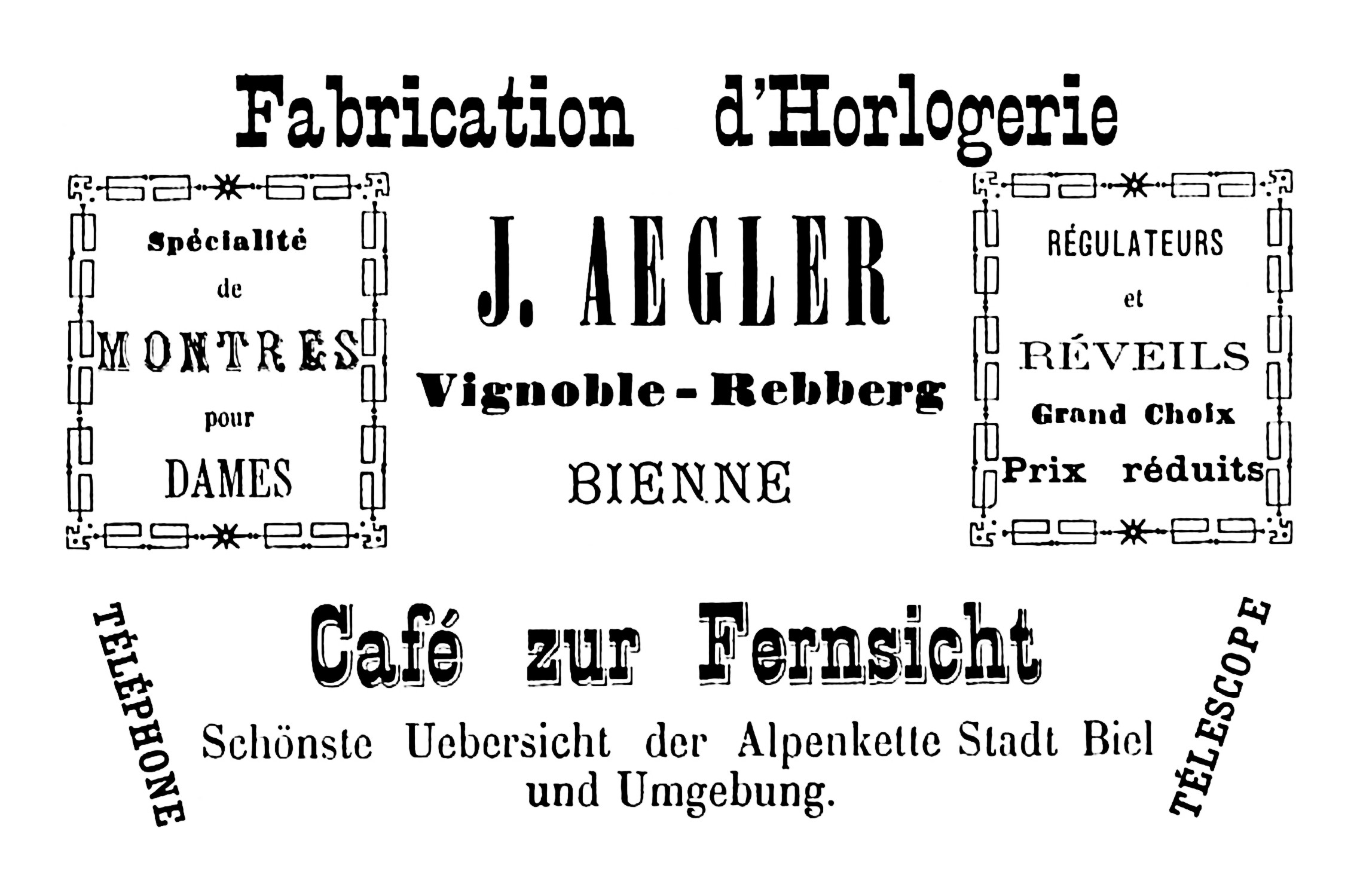
Aegler advertisement 1886: Click image to enlarge
The advertisement from 1886 reproduced here shows two lesser-known aspects of Aegler's production. In addition to saying that the company specialises in watches for ladies, it also mentions that they have a big choice of régulateurs (regulator clocks) and réveils (alarm clocks). Perhaps the ‘reduced prices’ suggests that they are getting out of that line of work. These clocks are unknown; if you know of one, please get in touch.
The second less well known aspect of the advert is the Café zur Fernsicht (Cafe with a View), with its ‘Most beautiful overview of the Alpine chain, city of Biel and surroundings.’
From 1881, Jean and Anna Maria Aegler rented from Johann Jakob Schmid a house in a vineyard set high above the city. The house contained an apartment, a watch workshop formerly used by the Bienne watchmaking school and, from New Year's Eve 1885, the Zur Fernsicht café. This was run by Anna Maria, who was described as a barmaid and landlady. In 1904, as the watchmaking business required more space, an apartment building with a department store and the Café Fernsicht was built at No. 81 Höheweg by Corti frères for Anna Maria Aegler-Ramser.
Death of Jean Aegler
Jean Aegler died on 2 August 1891 in Bienne at the young age of only 41 years. In Switzerland, privately owned companies had to be named after the person or persons in charge, so as soon as one person or partner died or left the company, a name change had to follow. In this case, Jean's widow Anna Maria took over and the name of the company was changed Veuve Jean Aegler, (widow of Jean Aegler), in German Witwe Jean Aegler, often abbreviated to Vve Jean Aegler or or Wwe. This device maintained continuity of the Jean Aegler name whilst complying with Swiss company law.
Back to the top of the page.
Aegler Factory
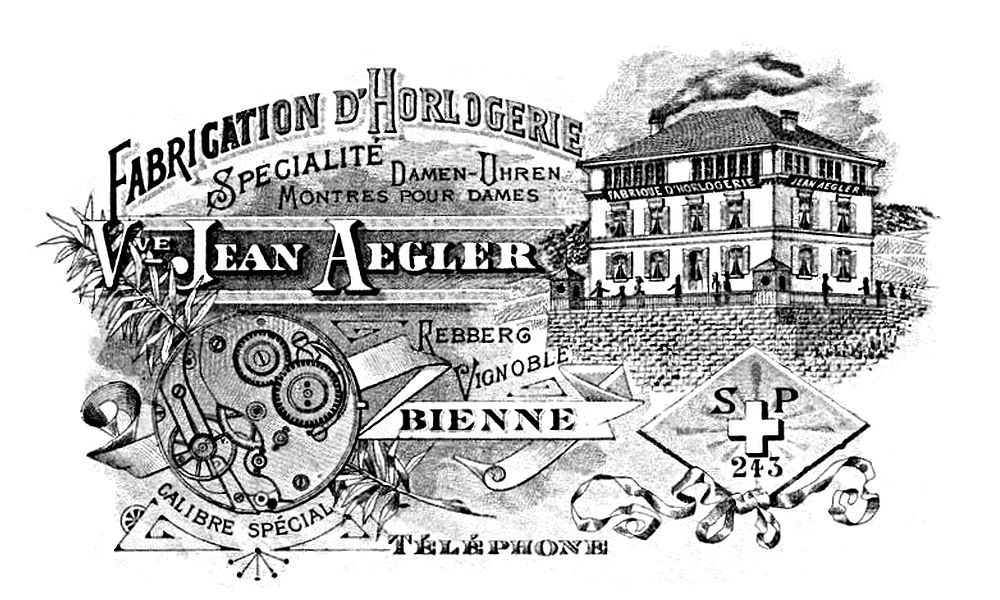
Aegler First Factory 1881: Click image to enlarge
Image courtesy of James Dowling
The advertising image here of the first Aegler factory shows in the top right corner a picture of a three storey building with the legend ‘Fabrique d'Horlogerie’ (Watchmaking Factory) along the front and ‘Jean Aegler’ at the side in white text on a black background beneath the top floor windows.
The image shows the first factory block from 1881, although the image was obviously made after Jean Aegler died in 1891 and his widow had taken over running the company, because the central bar says ‘Vve. Jean Aegler (Widow of Jean Aegler).
The address is ‘Rebberg Vignoble, Bienne’, a bilingual address typical of Biel/Bienne, where German and French speakers lived side-by-side. ‘Rebberg’ (German for vine-covered hillside) was the local name of the district, and ‘Vignoble’ its French equivalent. To French-speaking and international buyers, the combination clarified the location, rather than appearing tautological.
A couple things in the image are worth noting. It says that the company specialises in Damen-Uhren or Montres Pour Dames; German and French terms for ladies' watches. These were small pocket watches or fob watches, worn pinned to the outside of clothing on a fob or chatelaine.
The movements of such watches are the perfect size to make men's wristwatches, something that became important later in Aegler's history when Hans Wilsdorf, the founder of Rolex, began placing large orders with Aegler for wristwatches.
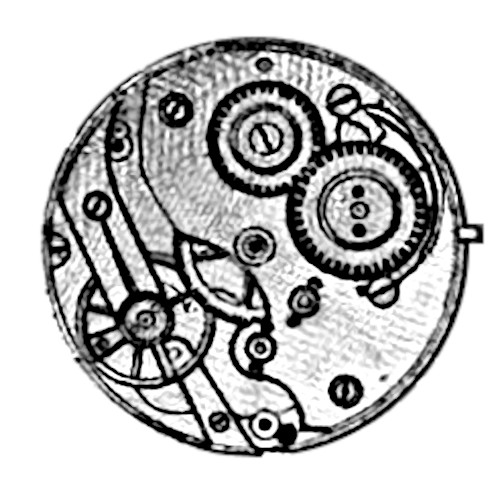
Aegler Calibre Special:
Click image to enlarge
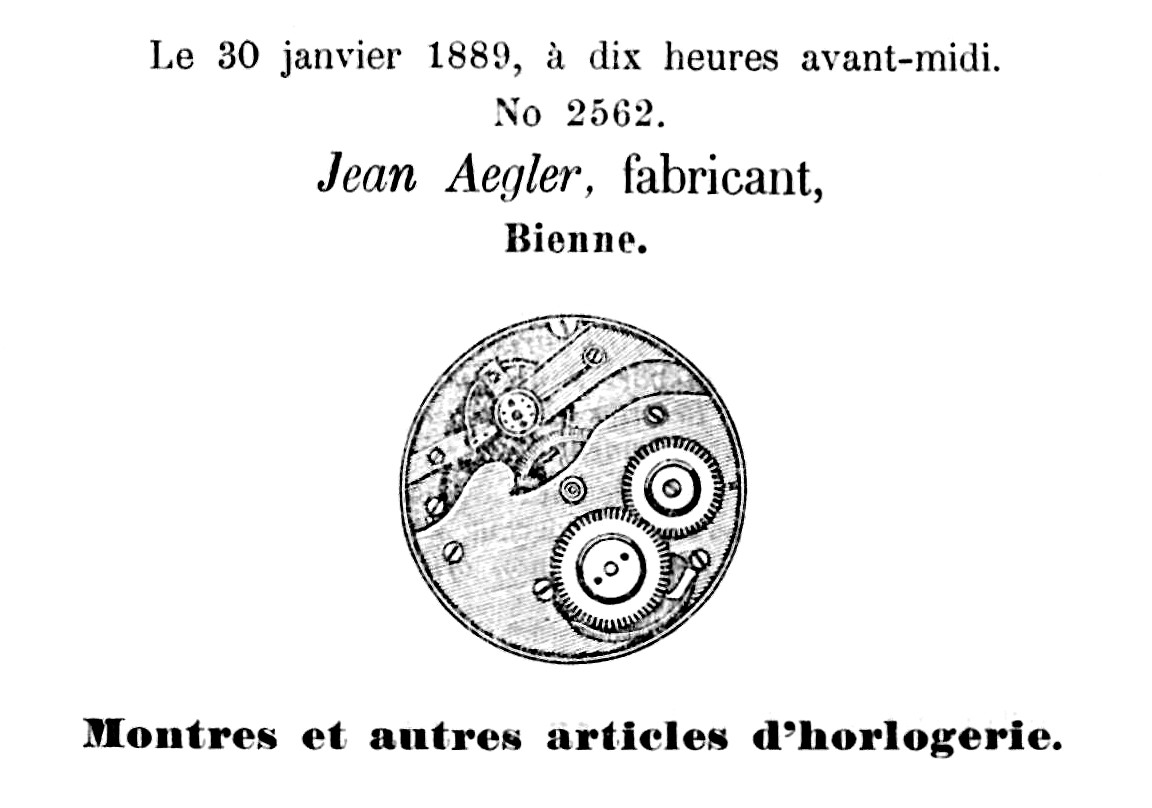
Aegler trademark No 2562 registered 30 January 1889:
Click image to enlarge
Wilsdorf said that Aegler specialised in lever escapement movements, which has led some to assume that Aegler didn't make movements with cylinder escapements. However, the Calibre Special shown in the image, shown more clearly in the separate image extracted from the advert, clearly has a cylinder escapement – the cock beneath the balance is for the escape wheel which, in a cylinder escapement, has to be planted next to the balance because there is no intermediate lever. The train bearings are jewelled, with the jewels set in chatons.
There is evidence that Aegler specialised in small cylinder escapement movements, and did not make lever escapement movements before 1903, when the word ‘Rebberg’ was registered as a trademark and two designs of lever escapement movement were registered as ‘modèles déposé’ or registered designs.
The ‘Calibre Special’ was registered as a trademark by Aegler on 30 January 1889, with the registration number 2562.
Another thing of note in the advertising image of the factory is the diamond or lozenge shaped shape at bottom right with the Swiss Federal cross at the centre. Above the centre bar of the cross, on either side of the vertical member, are the letters S and P. Below the cross is the number 243.

Aegler Calibre Special SP 243: Click image to enlarge
Thanks to Piers for this image
SP means Schweizerisches Patent (Swiss Patent), and the number is a reference to Swiss patent No. 243, granted to Aegler in 1888 for a keyless stem winding and setting mechanism. In French, reference to a patent would be to a ‘Brevet’, but patents were federal, not cantonal, and the official registration language was generally German. The German word Patent was widely used, even in French-language trade catalogues and technical journals.
The Calibre Special movement shown in the advert clearly has a cylinder escapement movement and keyless winding, the crown and ratchet wheels are visible in the Swiss fashion.
An Aegler Calibre Special movement stamped with the patent reference SP  243 can be seen in the image here kindly supplied by Piers of the movement of a watch in his possession. This is clearly the same as the Calibre Special illustrated in the Aegler advertisement, the shape of the barrel bridge which also holds the bearings for the centre, third and fourth wheels, is identical.
The drawing in the advert is so accurate that it was most likely taken directly from a finished movement. The only differences between the drawing and Piers' movement are that the movement in the drawing does not have dial feet securing screws, which are crewed into the bottom plate and are visible between the cocks and top plate in the photo, and the jewels for the third and fourth wheels in the drawing are set in chatons, rather than simply pressed in.
Back to the top of the page.
Aegler Patent No. 243
On 15 November 1888, very soon after the first Swiss Federal Law on Patents for Inventions of 29 June 1888 was adopted by the Federal Council at its meeting on 12 October 1888, Jean Aegler was granted Swiss patent No. 243 for a Mécanisme de mise à l'heure par la couronne; a mechanism for setting the hands to the correct time using the crown.
This mechanism, or keyless work, so called because it enables the watch to be wound and set without using a key, was a variation on the sliding sleeve keyless work invented by Adrien Philippe in 1845. In common with many patents taken out on stem winding and setting mechanisms based on Philippe's invention, Aegler's patent concerned the arrangement of levers that moved the sliding pinion between the winding and setting positions.

Figure from Aegler patent 243 of 1888

Transfer of Patents to New Partnership
In the figure from the patent you can see the Philippe winding and setting pinions clearly, the crown or winding pinion is labelled C, the sliding pinion B. Pulling upwards on the stem causes lever F to press down on lever A, which is engaged in the slot around the sliding pinion. Lever A rotates around its securing screw as shown by the dotted lines and the sliding pinion is pressed downwards into the hand setting position. When the stem is pushed down, the spring a pushes the lever A back, which returns the sliding pinion to the winding position.
When Jean Aegler died 1891 his widow Anna Maria took over the business, which was renamed in French Veuve Jean Aegler (widow of Jean Aegler), often abbreviated to Vve. Jean Aegler. In German it was Witwe Jean Aegler, Witwe meaning widow in German, often abbreviated to Wwe.
An additional patent No. 243/104, an extension to No. 243, was granted to Madame Veuve Jean Aegler in December 1891. This patent, with the same title as the original 243, was for an improvement to the mechanism of levers that moved the sliding pinion between the winding and setting positions. The modification was for savonnette (hunter) watches where the front lid was opened when setting the time. After setting the time, when the case is closed, a spring pressed by the edge of the case pushes the yoke lever, which moves the sliding pinion. The movement of this lever has the effect of raising the sliding pinion, which then engages with the crown pinion and ceases to act on the hands. Thus, each time the case is closed, the mechanism is automatically positioned for winding and not for setting the time, without having to push back the crown.
By 1902 the business, under the direction of Hermann and Hans Aegler, the sons of Jean and Anna Maria, was manufacturing small ébauches with lever escapements. The business gained a reputation for the mechanised manufacture at reasonable prices of good quality lever movements on the gauged and interchangeable system of mass production.
Back to the top of the page.
Aegler Manufactures Ébauches

Aegler Advert from 1890
A press release by Rolex announcing a new Rolex factory in Bienne in 2012 said that the Aegler factory began to produce its own ébauches between 1890 and 1895. However, it seems likely that Aegler was making complete movements from some time before then.
The Aegler advert from 1890 reproduced here says that the ‘fabrique d'horlogerie’ (watch factory) Jean Aegler of Rebberg, Bienne, specialises in stem wound watches (remontoirs au pendant) and has a new system of setting the time, the most advanced that exists (le plus perfectionné qui existe). This setting mechanism is the subject of Swiss patent 243 referenced at the bottom of the advert: "Brevet pris on Suisse sous No. 243" – Swiss patent is taken under No. 243.
The stem wind mechanism referred to was the subject of Swiss patent No. 243 already discussed, which is referenced at the bottom of the advert. This patent was granted to Jean Aegler in November 1888, so it seems likely that the Aegler factory was making complete ébauches by at least 1888 or 1889.
From the trademark registered by Jean Aegler in 1885, which is unequivocally the trademark of a manufacturer of ‘montres’ or watches, not of parts of watches or associated items, it appears that Aegler actually started to make complete movements, indeed most likely complete watches, some time between the acquisition of the new factory in 1881 and 1885.
Back to the top of the page.
Rebberg Déposé

Rebberg Calibres Registration 1903
Click image to enlarge

Rebberg Trademark Registration 1903
Click image to enlarge
The word Rebberg, the German word for vineyard or wine growing district of Bienne where the Aegler factory was located, was registered as a trademark by the company Witwe Jean Aegler on 21 January 1903. It was given the number 15427 in the Swiss register of trademarks.
The official notice of this registration reproduced here shows that in the German language the Aegler company was a Fabrikantin (manufacturer) of uhren and uhrenbestandteile, watches and watch components, and in French étuis, which means cases. Traditionally in Switzerland, watch cases were called boxes or boîtes, but around 1900 the term cases or étuis began to supersede the older term. This appears to have coincided with the introduction of wristwatches.
A term that is often seen on Aegler movements is Rebberg Déposé. In Swiss/French, déposé means to file, lodge or deposit. In this context it refers to either a registered trademark (marque déposée) or a registered design (modèle déposé).
The second official record shown here records that on 25 January 1903, the company Witwe Jean Aegler registered two designs of calibres for pocket watches (Taschenuhren), Lépine and savonnette versions Nr 1 and Nr 2 respectively. This registration was given the number 9284 in the Swiss register of designs. Gottfried Furrer was the vertreter or representative who handled the registration process.
The term Rebberg Déposé is seen on Aegler movements, which refers to the two registered designs, which in consequence are usually referred to as Aegler Rebberg calibres.
Aegler Lever Movements
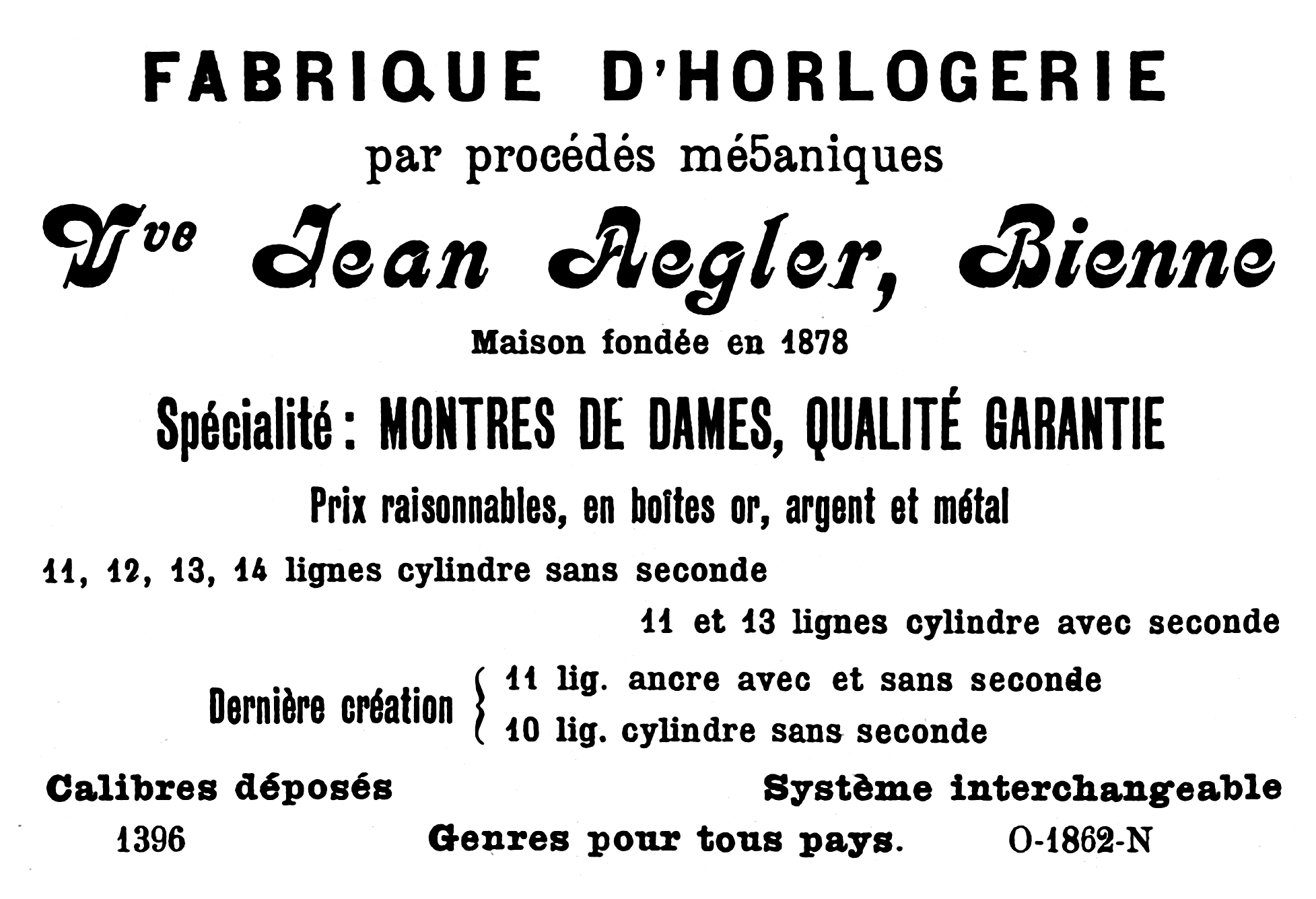
Aegler advert June 1904 new lever calibres
Click image to enlarge
The Rebberg calibres registered in 1903 are lever escapement movements. The top bearing for the escape wheel is planted in the central bridge alongside the bearings for the centre, third and fourth wheels. This can be compared to the Calibre Special cylinder escapement movement, where the top bearing for the escape wheel is beneath the balance. In the drawings of the Rebberg calibres, the cock for the upper bearing of the lever staff is visible beneath the escape wheel.
The Rebberg calibres registered in 1903 appear to be the first lever escapement movements made by Aegler. The Aegler advert from June 1904 contains some very interesting information, so it is worth going over the wording in detail.
WATCHMAKING FACTORY
by mechanical processes
Vve. Jean Aegler, Bienne
Founded in 1878
Speciality: LADIES' WATCHES, QUALITY GUARANTEED
Reasonable prices, in gold, silver, and metal cases
11, 12, 13, 14 ligne cylinder without seconds
11 and 13 ligne cylinder with seconds
Latest creation: { 11 ligne lever with and without seconds
{ 10 ligne cylinder without seconds
Registered calibres. Interchangeable system.
Styles for all countries.
The most interesting statement concerns the company's ‘latest creations’. The 10-ligne (~22.6 mm) cylinder movement is 2.2 mm smaller than the smallest 11-ligne (~24.8) movement made previously. However, the inclusion of 11-ligne lever calibres as the company's latest creations implies that before 1903, when the Rebberg lever escapement calibres were registered, Aegler made only cylinder escapement movements.
No mention of Aegler making lever escapement movements before 1903 has been found in any contemporary advertisement or record.
In the Rolex Jubilee Vade Mecum, Wilsdorf writes,
In 1902, during my stay in La Chaux-de-Fonds, I heard that Hermann Aegler of Bienne had started the regular and mechanised manufacture of ébauches (or rough movements) for a small lever escapement movement.
Taking all these factors into account, it appears that before 1902, Aegler made only cylinder escapement movements. Wilsdorf's evidence shows that Aegler started to manufacture small lever escapement movements in 1902. Designs of Lépine and savonnette lever escapement movements, and the trademark Rebberg, were registered by Aegler in January 1903. An advertisement by Aegler in 1904 describes 11-ligne lever escapement movements as the company's ‘latest creations’.
By 1913,
Renewal of Rebberg Calibres registration

Aegler Calibres registered August 1918: Click image to enlarge
A Swiss modèle déposé or registered design had a term of five years, after which it could be renewed or it would be automatically struck off the list. The registration of modèle déposé 9284 was renewed for the first time in 1905. In July 1906, the registration was transferred to the newly reconstituted company Les Fils de Jean Aegler Fabrique Rebberg. The registration was renewed for a second time in 1908 and for a third time in 1913. Only three renewals or extensions were allowed by Swiss law, so modèle déposé 9284 was struck off the list of protected designs in February 1918.
The striking off of modèle déposé 9284 in February 1918 prompted Aegler to register two virtually identical calibres in August of the same year. These are shown in the figure from the registration reproduced here. Rather strangely, the train bridges and balance cock are shown blank, without the bearing holes for the train wheels and balance.
Aegler became a Société Anonyme (S. A.), a French term for a public limited company or Aktiengesellschaft (AG), in 1913, and here the trading name is given as Aegler S. A. Rolex Watch Co., showing how important Rolex had become as a customer, although Gruen was an equally important customer and Aegler was also supplying many other établisseurs with movements. In the engravings, the name ROLEX can be made out on the ratchet wheels of the two calibres.
Back to the top of the page.
Aegler Xi Trademark

Aegler S.A. Trademark Xi and Ξ October 1900

Aegler Trademark Xi Ξ 1913
The letters Xi within an oval, and separately what appears at first glance to be three lines within an oval, were registered as trademarks in October 1900 by the company Vve. Jean Aegler.
The mark that appears to be simply three horizontal lines is actually the Greek uppercase letter Ξ, which is the 14th letter of the Greek alphabet. This is written in Roman letters as “Xi”. It represents the /ks/ sound and is pronounced [ksi]. It is distinct from the Greek letter Χ (chi), which gave its form to the Latin letter X.
In the photograph of a trademark stamped in a case dated 1913, the mark is a combination of the two separate marks within an oval.
The registration details show that the marks Xi and Ξ trademarks could be used on “Montres, boîtes, mouvements et emballages de montres”, or watches, cases, movements and packaging of watches. In fact, the Xi and Ξ trademarks are most often seen today on watch cases, which strongly suggests that Aegler made cases as well as watch movements. Aegler were also granted a number of patents for designs of watch cases, which further reinforces the idea that they made cases.
If it hadn't been for the domination of Aegler by their principal customers Rolex and Gruen, latterly of course Rolex who acquired Aegler in 2004, perhaps the symbol Ξ would be as well known today as is the Ω of another, quite well known, Swiss watch manufacturer.
Back to the top of the page.
Watch Cases
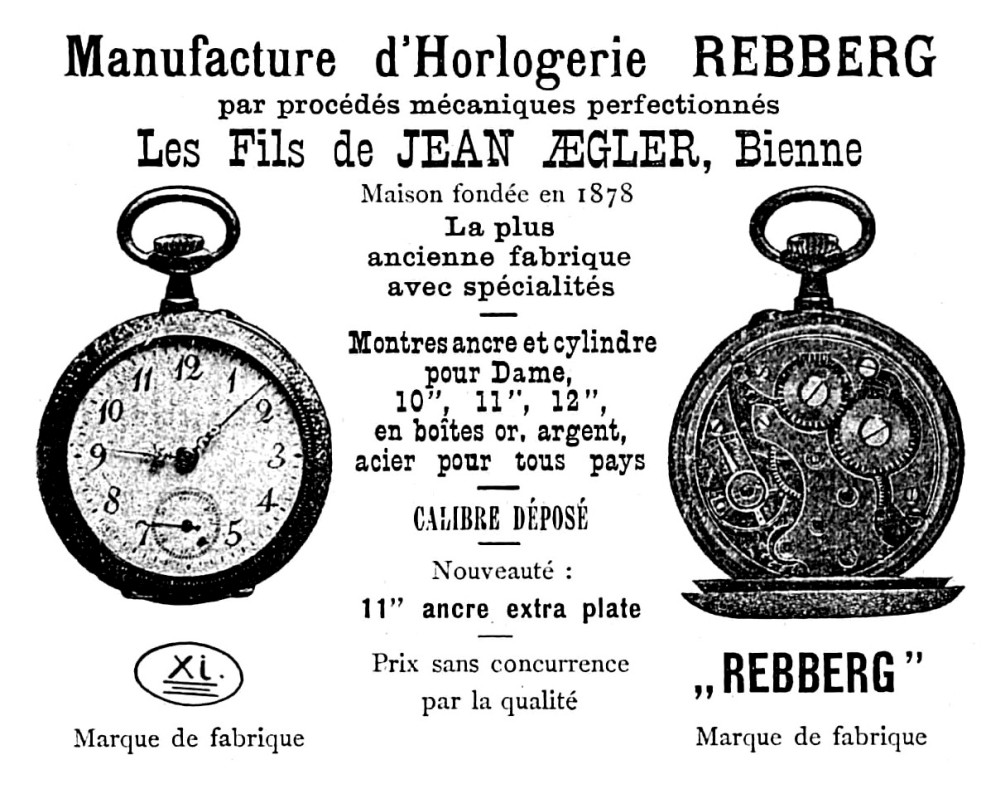
1908 Aegler Advertisement showing complete watches: Click image to enlarge
Aegler made watch cases as well as movements and sold complete watches.
The advertisement from 1908 reproduced here says that the company makes watches for ladies with lever and cylinder escapement movements in 10‴ (10 lignes), 11 ligne and 12 ligne sizes, in cases of gold, silver and steel for all countries. A new product is an extra thin 11 ligne lever escapement movement.
There is no entry for Aegler in the lists of Swiss Poinçons de Maître, suggesting that they ceased making watch case before the mid-1920s when that system came into effect.
Aegler were granted many patents, including, in the years before circa 1920, a number of Swiss patents for watch cases. The list of watch case patents that follow here may not be complete.
Patent CH 23382
In April 1902 Swiss patent No. 23382 was granted to Witwe Jean Aegler for a "Taschenuhrgehause", a pocket watch case.
The case design extends the bezel and back over the middle part of the case, also called the case band, so that the bezel and back meet in a single joint and the middle part of the case is umschließen und nach außen unsichtbar machen – enclosed and invisible to the outside. This would permit the substantial but unseen middle part of the case to be made of base metal while the bezel and case back were made from thin sheets of precious metal, keeping down the cost.
Patent CH 54712
On 17 February 1911, the company Les Fils de Jean Aegler, Fabrique Rebberg, was granted Swiss patent number 54712 for a Taschenuhrgehänse or pocket watch case. The principal feature of this watch case is that it is oval or elliptical in shape.
Patent CH 71362
On 16 May 1916, Aegler S. A. Rolex Watch Co was granted Swiss patent number 71362 for three designs of ‘capsule’ watch cases for enhanced dust and water resistance.
The principal object of these designs was to eliminate the front bezel and therefore the joint between the bezel and the middle part of the case. This means that the movement must be inserted from the back of the case, and three designs are shown with threaded carrier rings, like the threaded carrier ring of a Borgel screw case, and screw backs.
Back to the top of the page.
Serial Numbers
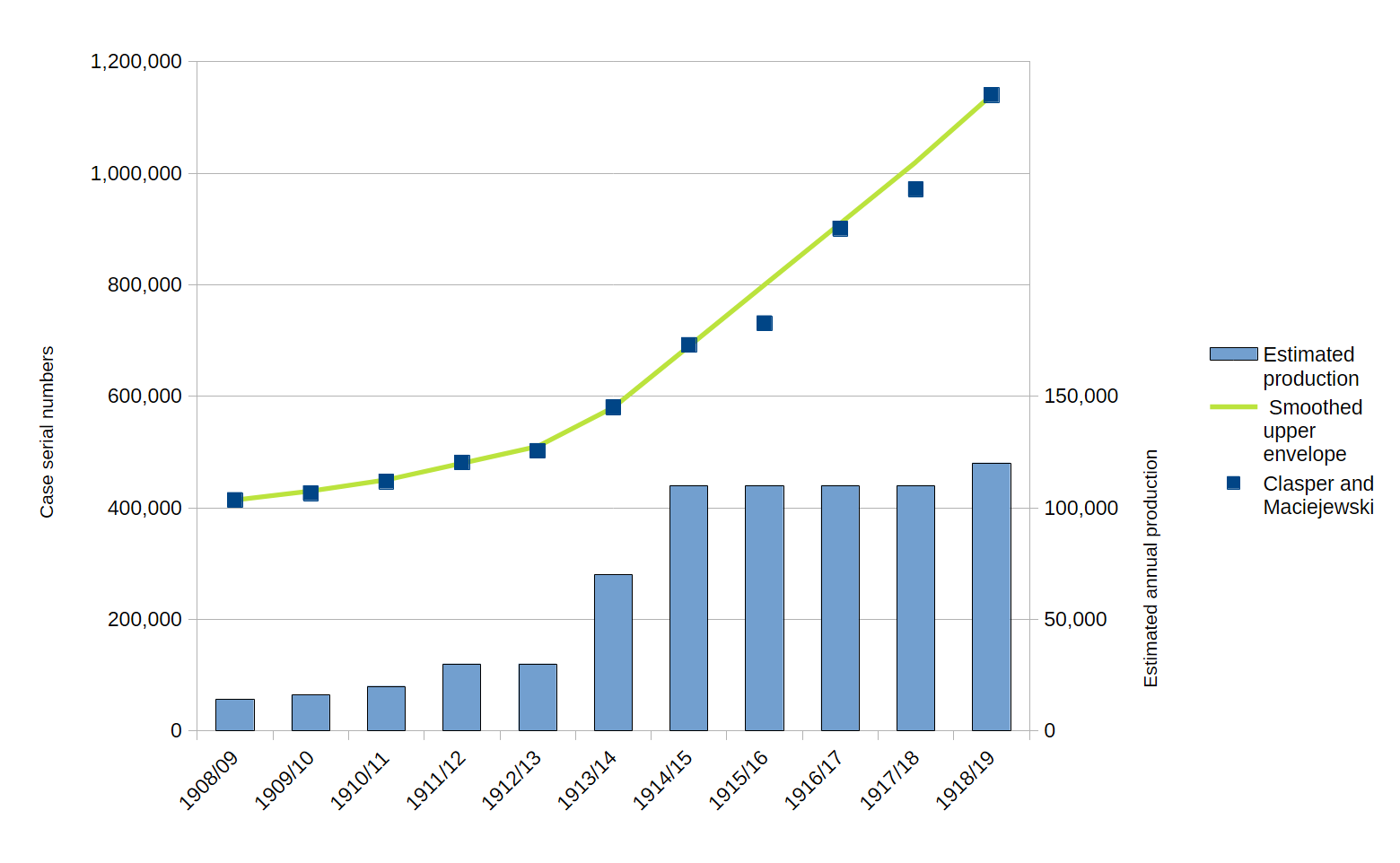
Aegler case serial numbers
Click image to enlarge
Unlike most Swiss watch manufacturers, Aegler didn't stamp its movements with serial numbers. However, it did stamp cases with serial numbers.
Analysis by Clasper and Maciejewski reported in the Horological Journal in February 2025 shows that Aegler applied serial numbers in sequence to its watch cases, both those manufactured in-house, shown by Aegler’s ‘Xi’ trademark, and those bought from external suppliers.
Data was reported as the highest number seen in hallmarked watch cases for each London Assay Office hallmarking year from 1908 to 1919. The hallmarking year was not the same as the calendar year, it ran from 29 May of one year to 28 May the following year.
The chart here shows the highest serial observed in each hallmarking year as a blue square.
It would have been very lucky if the highest number observed was actually the last case hallmarked in each hallmarking year, but naturally it almost certainly wasn't. The highest number in any year cannot be lower than the highest number observed, but it could be higher. This effect is particularly evident for the years 1915/16 and 1917/18, where the blue squares fall noticeably below the trend of the other date.
The line in green is a smoothed upper envelope that attempts to overcome this problem by fitting a curve to the upper edge of the data, smoothing it over the points where the numbers are obviously below the trend.
The light blue columns show the estimated annual production rate derived from the green curve. This shows a steady increase in production in the years from 1909 to 1913, then a noticeable increase in 1913/14. This hallmarking year ended in May 1914 and Britain did not enter the war until the first week of August, so the reason for this is not clear. However, production during the war years was significantly higher than in the pre-war years, at around 110,000 per annum. This reflects the huge increase in demand for wristwatches during the First World War. This number appears to have remained fairly constant throughout the war, suggesting that Aegler was running flat-out.
Back to the top of the page.
Les fils de Jean Aegler, fabrique Rebberg
On 7 July 1906, it was recorded that the company Wwe. Jean Aegler (widow of Jean Aegler) in Biel was dissolved. The assets and liabilities, including the trademarks and patents of Veuve Jean Aegler, were transferred to a new company, a "nom-collectif" or partnership ‘Les fils de Jean Aegler, Fabrique Rebberg’ (The sons of Jean Aegler, makers of Rebberg).
The company Les fils de Jean Aegler, fabrique Rebberg, was founded on 1 May 1906 by Hermann and Hans Aegler. Hans appears to have been a sleeping partner, the only person authorized to represent the company was Hermann Aegler. Hans Aegler died in 1918 and the business was continued by Hermann Aegler alone.
Watches are seen with the legend ‘Rebberg Watch Co.’ stamped on the movement. Although Rebberg was a registered trademark of Aegler, there was not a separate company with this name. Les fils de Jean Aegler, fabrique Rebberg, was rendered into English as The Sons of John Aegler, Rebberg Watch Co.
Back to the top of the page.
Aegler and Rolex
In the Rolex Jubilee Vade Mecum, Hans Wilsdorf says that in 1905 he London placed a large order for wristwatches with Aegler. The first line of wristwatches that he placed on the market were silver watches with leather straps for men's and ladies' wear, and their success was immediate so that the range had to be widened, in particular to watches with gold cases.
In view of the prevailing fashion of 1905, when only military men wore wristwatches, the success must have been with the ladies' models. James Dowling notes that the majority of Rolex wristwatches with hallmarks prior to the start of the First World War are gold and in ladies' sizes, whereas those with hallmarks after 1915 are mostly silver and men's 13 ligne size.
This is implicitly confirmed by Wilsdorf himself, who says that an expanding metal bracelet was launched in 1906 and our little gold watch became increasingly popular throughout the empire. A little gold watch on an expanding metal bracelet is not the sort of thing that an Edwardian gentleman would be seen dead wearing. The bracelet was called the Britannic, patented and manufactured by the London jewellers Edwin Harrop.
When Wilsdorf coined the name Rolex in 1908 he decided that he wanted to have only this name on the watches supplied to Wilsdorf & Davis by Aegler. Aegler felt that as the maker their name should be on the watches, but in the end Wilsdorf got his wish.
Aegler Fabrique de montres Rebberg, Final & Rolex

Aegler: manufacturers of Rebberg, Final and Rolex watches
In November 1912, the registered name of the Aegler company was changed, as shown by the announcement reproduced here published in 1912, from ‘Les fils de Jean Aegler, Fabrique Rebberg’ to ‘Les fils de Jean Aegler, Fabrique de montres Rebberg, Final & Rolex’ (The sons of Jean Aegler, manufacturers of Rebberg, Final and Rolex watches). Like Rebberg, Final was an Aegler trademark.
The notice also makes it clear that, in addition to supplying other manufacturers with movements, Aegler also sold watches under their own Rebberg brand. Aegler Rebberg branded watches are marked ‘Rebberg Watch Co.’
Back to the top of the page.
In 1913 Aegler registered Rolex as a trademark for the manufacture of watches and watch parts. From this point on the history of Wilsdorf & Davis, Aegler and Rolex becomes virtually impossible to untangle from information publicly available. However, it is clear that Aegler and Rolex remained separate companies, and that Aegler continued to supply watches to companies other than Rolex into the 1930s.
At a General Assembly on 2 July 1921, the joint-stock company under the name of Aegler S. A. fabrique de montres Rolex (Aegler S. A., Rolex Watch Co.) (Aegler S. A. Uhrenfabrik Rolex), with registered office in Biel, appointed the following Board of Directors: Hans Wilsdorf, President; Hermann Aegler, vice-president; Emil Béha, secretary.
On 26 December 1940, The Board of Directors of Aegler re-appointed the management as follows: Hermann Aegler as President; Hans Wilsdorf as Vice President and Emil Borer as Secretary.
Ownership of Rolex
Wilsdorf & Davis owned the name Rolex, which Hans Wilsdorf was very proud of. He wanted it to appear only on the best watches supplied to him, the ones made by Aegler. Accordingly he kept pressing Aegler to increase the use of the name Rolex, and as Wilsdorf & Davis were one of Aegler's largest customers they went along with this, describing themselves in adverts as both "Manufacture d'Horlogerie Rebberg" and "Rolex Watch Co.".
The name Rolex was used by liberally by both Aegler and Wilsdorf & Davis in ways that can be very confusing. The single word "Rolex" was used as a brand name on the best watches produced by Aegler for Wilsdorf & Davis (although some of these were only 7 jewel). Conversely, the name Rolex Watch Co. on a watch does not mean that it is a Rolex watch, only that it was a product sold by the Rolex Watch Company.
Is this all a semantic exercise in splitting hairs? Maybe. But today some people advertise watches marked Rolex Watch Co. as if they are Rolex watches, which can trap the unwary into paying too much for a watch that more seasoned collectors do not regard as a Rolex watch, so it is good to be aware of the arguments. And caveat emptor.
Back to the top of the page.
Incorporation of Aegler S.A.

Aegler S.A. registration 1913
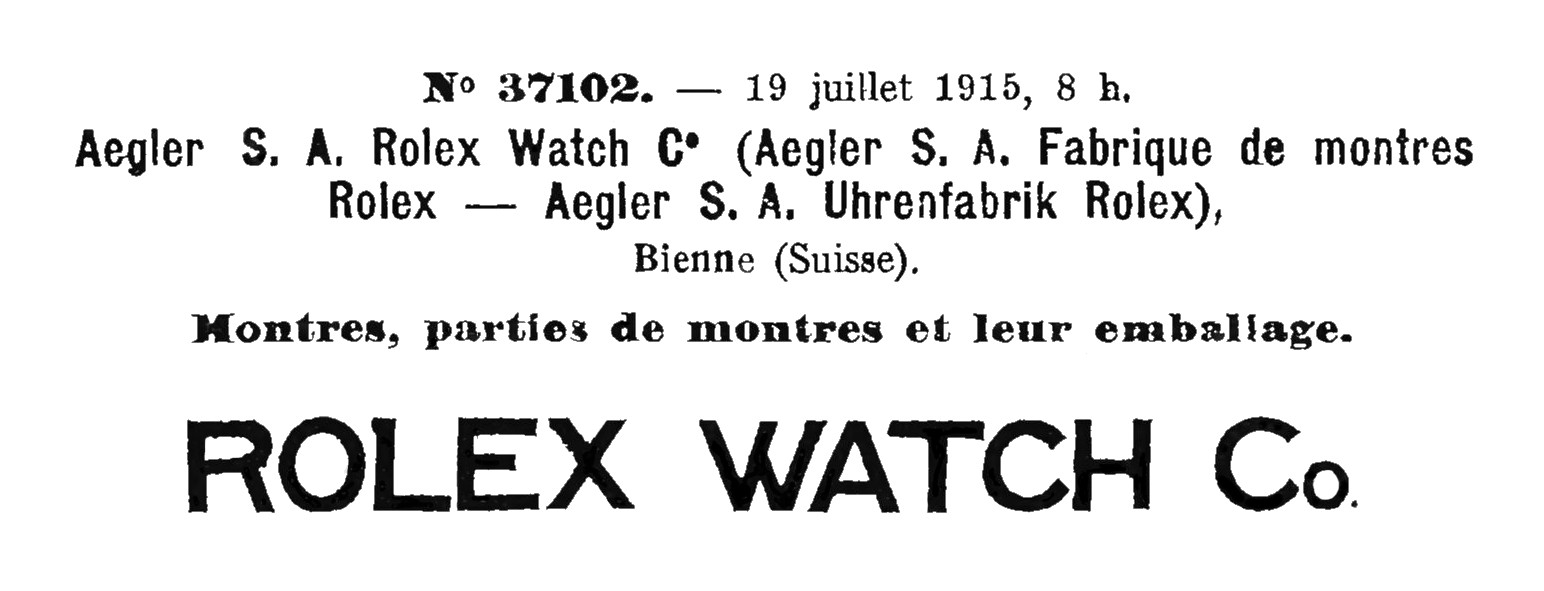
Aegler trademark Rolex Watch Co 1915: Click image to enlarge
The first notice reproduced here shows that a new, limited, company was registered on 26 September 1913, "Aegler S.A.". Notice that the composition of the company changes from a "nom collectif", a partnership, to an S.A. or "Société Anonyme", a joint-stock or limited company, a company with shareholders whose liability is limited to the amount they have invested.
The notice states that the new company Aegler S.A. was formed for the purpose of the acquisition and continuation of the previous partnership Les fils de Jean Aegler, Fabrique Rebberg and the compamies which preceded it, Jean Aegler and Witwe Jean Aegler. The address Chemin du Haut is the French version of the German Höheweg, both meaning high road.
In Swiss/French the word for shares in a company is "actions" so a société par actions is a joint stock company with shareholders who appoint a board of directors to run the company. Note that shares in a such a company do not have to be offered to the public, they can be held privately by the people who founded the company or sold at their discretion to raise capital. A joint stock company is a legal entity and its finances are separate from the personal finances of the shareholders, unlike a nom-collectif or partnership, where the partners are jointly and severally liable for any debts incurred by the partnership. Limited liability and joint stock companies are formed when the business is getting bigger and if unseen problems arose the consequences could be catastrophic for the individual partners, so the formation in 1913 of Aegler S.A. was a sign that the business was booming.
At a general meeting on 6 July 1915, Aegler S. A. revised its articles of association and changed the company name to ‘Aegler S.A. Rolex Watch Co.’ (Aegler S.A. Fabrique de montres Rolex, Aegler S.A. Rolex Watch Factory). For some reason that is not at all clear, the company registered the trademark ‘Rolex Watch Co.’ on 19 July 1915.
Back to the top of the page.
Aegler and Gruen
Another large customer of Aegler was the US firm Gruen. In recognition of this, on 30 September 1925 the Aegler company name was changed to ‘Aegler, Société Anonyme, Fabrique des Montres Rolex & Gruen Guild A. (Aegler Aktiengesellschaft Fabrik der Rolex & Gruen Guild A. Uhren) (Aegler Limited Manufacture of Rolex & Gruen Guild A. Watches).’
At an Extraordinary General Meeting on 4 December 1926, Fred G. Gruen and Geo J. Gruen, were elected to the Board of Directors of Aegler.
Both Gruen and Rolex showed pictures of the Aegler factory in their advertising, each with their own name added to the picture of the building, implying that it was a Gruen or Rolex owned factory depending on which version of the advert that you saw.
In April 1910, Aegler registered the trademark ‘Precision’ for watches and parts of watches. Gruen used the name Precision for watches, and in the 1920s built a factory called the Gruen Precision Factory in Bienne. The factory was sold in 1977, becoming part of Aegler S.A.
When Rolex and Gruen were both shareholders in Aegler, the two companies sold Aegler watches only in their respective territories. Rolex had Europe, Asia and the British Empire, whilst the Gruen brothers sold Aegler watches in the US only.
Aegler held a general meeting on 14 August 1936 and revised its articles of association. The company name was changed from Aegler, Société Anonyme, Fabrique des Montres Rolex & Gruen Guild A. to Manufacture des Montres Rolex, Aegler Société Anonyme (Manufacture of Rolex Watches, Aegler Limited). The share capital, previously CHF 1,000,000, was reduced to CHF 500,000 by writing down each share from CHF 1,000 to CHF 500, divided into 1,000 registered shares of CHF 500 each. Fred. G. Gruen and Georg J. Gruen resigned from the Board of Directors. Emil Borer, from Grindel (Solothurn), Technical Director, based in Biel, was elected to the Board of Directors, continuing to hold joint signing authority as an authorized signatory. The change of name was registered on 22 December 1936.
Back to the top of the page.
Aegler and Dimier Brothers
Dimier Brothers & Co was a large company importing Swiss watches into Britain in the nineteenth and early twentieth centuries, and also exporting to Switzerland leather straps made in England for wristwatches. The company had offices in London and, under the name Dimier Fréres & Co, in la Chaux-de-Fonds. They had no manufacturing capability, they were purely an import / export company. Watches and watch movements imported by Dimier Brothers often carry the trademark DF&C within an oval.
Watches made by Aegler are seen with Dimier Fréres & Co trademarks with silver cases carrying the Aegler Xi trademark and the Swiss three bears hallmark, which shows that they were made for export to Britain before 1907. This shows that Dimier Brothers & Co were importing Aegler watches before Wilsdorf and Davis, and there is evidence to show that this continued after the foundation of Wilsdorf and Davis and Rolex.
Dimier Brothers played an important role at the beginning of the twentieth century in the introduction of the first men's wristwatches. They registered in Britain and Switzerland a design of curved fixed wire lugs to attach a leather strap to a watch case. They required Swiss watch manufacturers to pay a fee to use this design, which was shown by the Swiss registered design number 9846 being stamped in the back of the watch case as "Déposé No. 9846". You can read more about this at Déposé No. 9846.

Aegler Rebberg Movement. Click image to enlarge.

Case with Aegler's Xi Trademark. Click image to enlarge.

Weir & Sons Demi-Savonnette. Click image to enlarge.
The images here show the movement and inside case back of a half-hunter (demi-savonnette) wristwatch retailed by Weir & Sons of Dublin & Belfast. Founded in 1869 by Thomas Weir, today Weir & Sons is a retailer on Grafton Street in Belfast.
The case has London Assay Office Import Hallmarks for sterling silver (⋅925). The date letter is the "q" of the hallmarking year from June 1911 to May 1912 - London date letter punches were changed when new wardens were elected at the end of May so were used over two calendar years.
The sponsor's mark DB in cameo in the case and the DF&C trademark on the movement are both for Dimier Brothers & Co. Dimier Brothers & Co. were a large Anglo-Swiss company importing Swiss watches into Britain from the mid-nineteenth century. The company was important in the early history of the wristwatch and exported to Switzerland leather watchstraps made in England for wristwatches. In Switzerland the company had offices in La Chaux-de-Fonds under the name Dimier Fréres & Co., hence the DF&C on the movement.
The watch movement is a Aegler Rebberg and the case has Aegler's Xi trademark.
The crown is on the left side of the case as worn, which is seen in some early wristwatches before the placement on the right hand side of the case became universal. It doesn't signify that the wearer was left handed. It is actually a much more sensible place to put the crown, because it is much less likely to get knocked, which can result in the stem breaking and the crown being lost. It is not inconvenient as many think, because a watch should never been wound or set whilst being worn.
Back to the top of the page.
Rolex Gets Close to Aegler
Wilsdorf opened an office in Bienne in 1916 to be near to Aegler, which was becoming increasingly important to his business. This increased further in importance when high import tariffs were imposed by the British government during the First World War (1914-1918). Previously all watches sold by Wilsdorf & Davis had been sent to London for inspection before being sent on to retailers both within Britain and the rest of the world. The high import tariffs meant that this added extra cost to watches that were destined for markets outside Britain so the Bienne office took over the duty of inspecting these watches and dispatching them direct to their destination.
This was the start of a move headquarters of Wilsdorf & Davis and Rolex from London to Switzerland. If it hadn't been for the First World War and British import duties, Rolex might still be a British company.
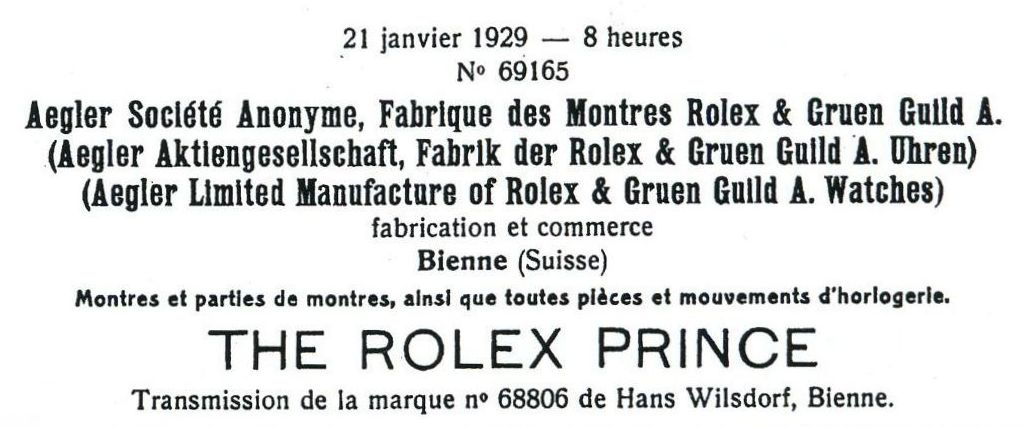
Aegler SA 1929, Manufacture of Rolex & Gruen Watches.
In 1919 a new company was incorporated in Geneva by Wilsdorf & Davis as Montres Rolex SA. Its manufactory was listed as "Manufacture des Montres Rolex, Aegler S.A." but the two companies, Aegler S.A. Bienne and Montres Rolex S.A. Geneva, were legally separate entities. Aegler also had other customers, the largest of which was the US firm Gruen. The notice here from 1929 shows that Aegler Ltd. was the manufacturer of Rolex and Gruen Guild watches.
Over the next few years this remained the situation. Aegler supplied Rolex branded watches to Montres Rolex S.A. who organised their distribution to approved outlets, and advertising and marketing. Aegler also supplied watches to Gruen, who sold them in the USA, and to others. Montres Rolex S.A. and Gruen were Aegler's biggest customers and they had a mutually beneficial arrangement where Gruen would only sell watches in the USA and Montres Rolex sold watches to the rest of the world. As the USA was the wealthiest consumer market in the world at the time this was not so unbalanced as it sounds.

Aegler Factory 1920: Click image to enlarge
The image here shows a drawing of the Aegler factory in 1920. If you compare it to the drawing of the first factory, you can see that is now the smallest block at the right hand end and carries the date 1881. All three parts of the factory are dated, the oldest factory carries the date 1881. The block in the centre is dated 1896 - 1912, the block on the left of that is dated 1914.
The three blocks of the factory are at numbers 80-82 Höheweg. The original 1881 building was modified by adding watch workshops in the roof space in 1896 by Magri frères for the widow J. Aegler. Extensions to the factory 1897, 1898, 1907, 1911, 1912 and 1914 by Magri frères, Jules Aebi, Römer & Fehlbaum and Corti frères for the widow and her two sons Hermann and Hans Aegler. In 1914 the factory had around 200 employees. The complex of hipped roof buildings with regular windows is characterized by the redesigns carried out by Römer & Fehlbaum in 1912 and 1914.
On the roof of the main blocks in the image are two banners. The first says "Aegler S.A.", the second "Montre Rolex". These banners probably never existed in reality but were drawn in on the advertisement image. When the same image was reproduced in adverts in America, the "Montre Rolex" was altered to "Montre Gruen".
Montres Rolex and Gruen did not take all the watches that Aegler could make, so Aegler also continued to supply watches to other companies. At the same time, Wilsdorf was interested in making watches that could be sold at lower price points than the top line Rolex branded watches, so he bought in movements and watches from other manufacturers such as Fontainemelon that were used in watches carrying names such as Marconi, Unicorn and Tudor.

Borer: Modern Watch Repairing: Click image to enlarge
During the First World War Emile Borer, nephew and ultimately successor to Hermann Aegler, joined the Aegler factory personnel as an engineer. On 18 December 1926 Emil Borer and Eduard Baumgartner were appointed the executive with joint power of representation. Unlike Wilsdorf, who freely admitted he was no watchmaker, Borer was a watchmaker to his finger tips. Borer became responsible for developing new technology and developed an automatic winding system that was patented by Aegler in 1931.
A book about watch servicing and repairing by Borer was published in English as Modern Watch Repairing. The first edition was published in 1931, the revised second edition shown here in 1937. It's a very good book for its time. Emile Borer was appointed as a director of Aegler in 1931 and subsequently became Chief Technical Director, and then in 1944 General Manager of Aegler S.A.
Business between Rolex and Aegler had flourished until by 1920 Rolex was Aegler’s largest customer. The post war slump that culminated in the Wall Street Crash of 1929 and the ensuing Great Depression hit Montres Rolex's business hard, and Hermann Aegler invested in the survival of his largest customer by acquiring 6,960 shares of Montres Rolex S.A. and was appointed to the board. It is said that he was given these shares, but there must have been some sort of quid-pro-quo. As business recovered both Rolex and Gruen became large shareholders in Aegler.
The Aegler company adopted the trading name "Aegler, S.A., Fabrique des Montres Rolex & Gruen Guild A". Gruen and Montres Rolex adverts of the period show pictures of the Aegler factory with either Rolex or Gruen on the factory roof, implying that it was a Gruen or Rolex owned factory. As the Gruen adverts were for US display and Montres Rolex adverts for display outside the US this dichotomy was not obvious to consumers. Over the years various names were used to identify the Aegler factory more and more closely with Rolex, but these were just trading names. The legal entity that owned the factory was Aegler S.A., which was owned by the Aegler and Borer families.
In the 1930s Gruen and Montres Rolex S.A. sold their shares in Aegler S.A. back to the company, and Aegler S.A. sold its shares in Montres Rolex S.A. to Wilsdorf. In 1936 Gruen ceased purchasing watches from Aegler and Montres Rolex S.A. Geneva agreed to take up the entire production of the Aegler S.A. factory in Bienne. In September 1936 the company changed its corporate name, dropping the reference to Gruen and styling itself ‘Manufacture des Montres Rolex, Aegler Societe Anonyme’, although it was now wholly owned again by the Aegler family.
In 1969 Harry Borer, son of Emile Borer, took over management of Aegler S.A. and oversaw the expansion of the company, with eventually seven new production buildings being built in the Champs-de-Boujean industrial area of Bienne.
Rolex Buys Aegler

Bloomberg © 2016: Acquisition of Aegler by Rolex in 2004
The arrangement of Aegler SA making watches for Rolex to sell continued until 31 December 2004. The Borer family decided that they wanted to sell the Aegler company, and it was bought by Rolex.
The two companies remained separate legal entities until 2004 when Harry Borer sold Aegler S.A. to Montres Rolex S.A. and the Rolex Watch Company finally owned the factory which made Rolex watches. The company overview by Bloomberg reproduced here tells the story in a few words. As the Bloomberg report shows, the manufacturing facility in Bienne is still a separate company called Manufacture des Montres Rolex SA, a wholly owned subsidiary of Rolex SA.
The company that is now called ‘Manufacture des Montres Rolex S.A.’ is stated to have been incorporated in 1913. This is the company that was incorporated in 1913 as Aegler SA, irrespective of what trading names or styles the company adopted at various times, until it was taken over by Rolex and formally renamed.
Back to the top of the page.
Trials Results
In 1910, an 11 ligne Rebberg watch with a lever escapement, compensation balance and Breguet overcoil balance spring was awarded a first class certificate at the Bienne Watch Rating Office. This is described in the Rolex Jubilee Vade Mecum as ‘the first Rolex wrist-watch chronometer’.

Aegler advert from 1910 mentioning first class bulletin d'observatoire for 11 ligne Rebberg watch with lever escapement
The Aegler advert here from March 1910 celebrates this feat, but doesn't mention Wilsdorf or Rolex. This is often reported to be the first time a wristwatch had obtained a chronometer certificate, but the advert doesn't mention a wristwatch, which would seem to be a curious omission and missed advertising opportunity. In fact, it says that a montre (watch) obtained the bulletin d'observatoire, not a montre bracelet (wristwatch). It is quite possible that this was a ladies' fob watch. However, it was a notable achievement for such a small movement.
Bienne Watch Rating Office
Before 1904, the towns of Biel/Bienne, La Chaux-de-Fonds, Le Locle, and St-Imier each had an official office that examined watches' accuracy and issued certificates if the results met the requirements of regulations that varied from one town to another. In 1903, La Chaux-de-Fonds initiated discussions with the watchmaking commissions of Biel/Bienne, Le Locle, and St-Imier to unify the regulations of the Swiss watchmaking offices. An agreement was reached a year later. At that point, the regulations were standardised.
The offices were called ‘bureaux d'observation des montres’, because they observed watches, but this could be confused with astronomical observatories that also tested watches, such as the Neuchâtel observatory. If the standards had been equally rigorous, that might not have caused a problem, but the performance required to be awarded a certificate at the bureaux d'observation des montres were lower than the more rigorous observatory tests.
Watches could be entered at a bureau d'observation for two classes of test, First Class, which involved tests for 15 days in positions at ambient temperature, and in heat and cold, or Second Class, which involved 10 days of tests. There were also First and Second Class tests for complicated watches and small watches less than 30 mm across the movement plate. The requirements for these tests allowed 25% greater variation in the results than the tests for larger watches.
Below are the details of the results from March 1910 of the 11-ligne Rebberg movement entered by Les fils de Jean Aegler that was tested at the Bienne bureau d'observation. This was the company's first time participating in the competition. The watch received a First Class certificate, which was quite rare for watches of this size.
| Performance of 11-ligne Rebberg watch | Allowed seconds | Aegler Watch seconds |
|---|---|---|
| Average daily rate at ambient temperature | 10.0 | +1.30 |
| Average variation in daily rates | 4.0 | ±1.42 |
| Difference from flat to hanging | 10.0 | +7.30 |
| Variation per degree Celsius | 0.5 | -0.21 |
If a watch passed the first class test within half of the allowed variations, the certificate was endorsed «très satisfaisant». The Aegler watch just missed this due to the difference in rate between the horizontal (flat) and vertical (hanging) rates being too great. In 1909, a watch with an 11-ligne movement entered by Paul Ditisheim for the trail at the bureau d'observation in La Chaux-de-Fonds received a first class certificate endorsed «très satisfaisant».
Aegler advertised this success, saying that an 11-ligne Rebberg watch had received a First Class observatory bulletin. This was stretching things. The Bienne establishment was officially called a bureau d'observation des montres; it was not an astronomical observatory. Observatory tests were stricter. For example, the duration of a first class observatory test was usually around 45 days, rather than the 15 days of a bureau d'observation first class test.
Unlike other bureaux d'observation, the Bienne Watch Rating Office does not appear to have calculated the resumption of rate after the thermal tests.
In 1912 the Revue internationale de l’horlogerie recorded that the former ‘bureaux d’observation des montres’ were officially renamed ‘bureaux officiels de contrôle de la marche des montres’, precisely to remove the word ‘observation’, which was causing confusion with the true chronometer observatory certificates issued at Neuchâtel. The French word contrôle is difficult to translate directly into English, it has connotations of observation and inspection. However, in this context, rating is the most appropriate translation, because they were concerned with establishing watches' rates under different conditions, so they became official watch rating offices.
In January 1913, the newspaper L'impartial recorded that the Bienne Watch Rating Office examined 740 watches during the year 1912. Of these, 637 watches received a first class certificate, 266 of which were endorsed ‘very satisfactory’. The most prolific entrant was Brandt & frère, S. A., Bienne, which received 281 first class certificates and 227 first class certificates endorsed ‘very satisfactory’. Aegler entered three watches that received first class certificates, one of which was endorsed very satisfactory.
In January 1913, the Bienne Watch Rating Office issued three performance certificates for 11-ligne Aegler watches, one of which was rated ‘very satisfactory.’ In addition, a first class performance certificate was issued to an Aegler watch with a 9-ligne movement. This was the first 9-ligne watch to receive a performance certificate. The watch was regulated by Mr. Luthi-Hirt in Bienne.
| Performance of 9-ligne Rebberg watch | Allowed seconds | Aegler Watch seconds |
|---|---|---|
| Average daily rate | 10.0 | +0.20 |
| Average variation in daily rates | 4.0 | +1.68 |
| Difference from flat to hanging | 10.0 | -2.50 |
| Variation per degree Celsius | 0.5 | +0.50 |
| Resumption of rate after thermal test | 5.0 | -1.50 |
Kew Trials
On 3 January 1913, the Kew Observatory received three 11-ligne bracelet watches sent by Wilsdorf and Davis for the Rolex Watch Co., Bienne and London. The first of these, with serial number 492260, was entered for the Class A trial, but did not pass. The second and third watches, with serial numbers 492258 and 492285, were entered for Class B. The mainspring of 492285 failed on 4 January, the second day of the trial. Number 492258 completed the trial but did not pass.
On 18 January 1913, the Kew Observatory received a 9-ligne ligne bracelet watch sent by Wilsdorf and Davis for the Rolex Watch Co., Bienne and London. The watch was regulated by Mr. Luthi-Hirt in Bienne. This watch, with serial number 460926, was entered for the Class B trial, and was tried between 21 January and 20 February, the 31 days duration of the Class B trial. It passed the trial and was awarded a Class B certificate on 22 February, the first Kew certificate awarded to a 9-ligne watch.
On 6 February 1913, Wilsdorf and Davis resubmitted one of the three 11 ligne watches that had not passed trial in January. This was serial number 492260, which had previously been entered for a Class A trial. This time it was entered for the Class B trial. It was tried between 7 February and 9 March, and passed. In March 1913, the Kew Observatory issued its first performance certificate to an 11-ligne watch. The certificate was endorsed ‘Especially Good’.
Neuchâtel Observatory
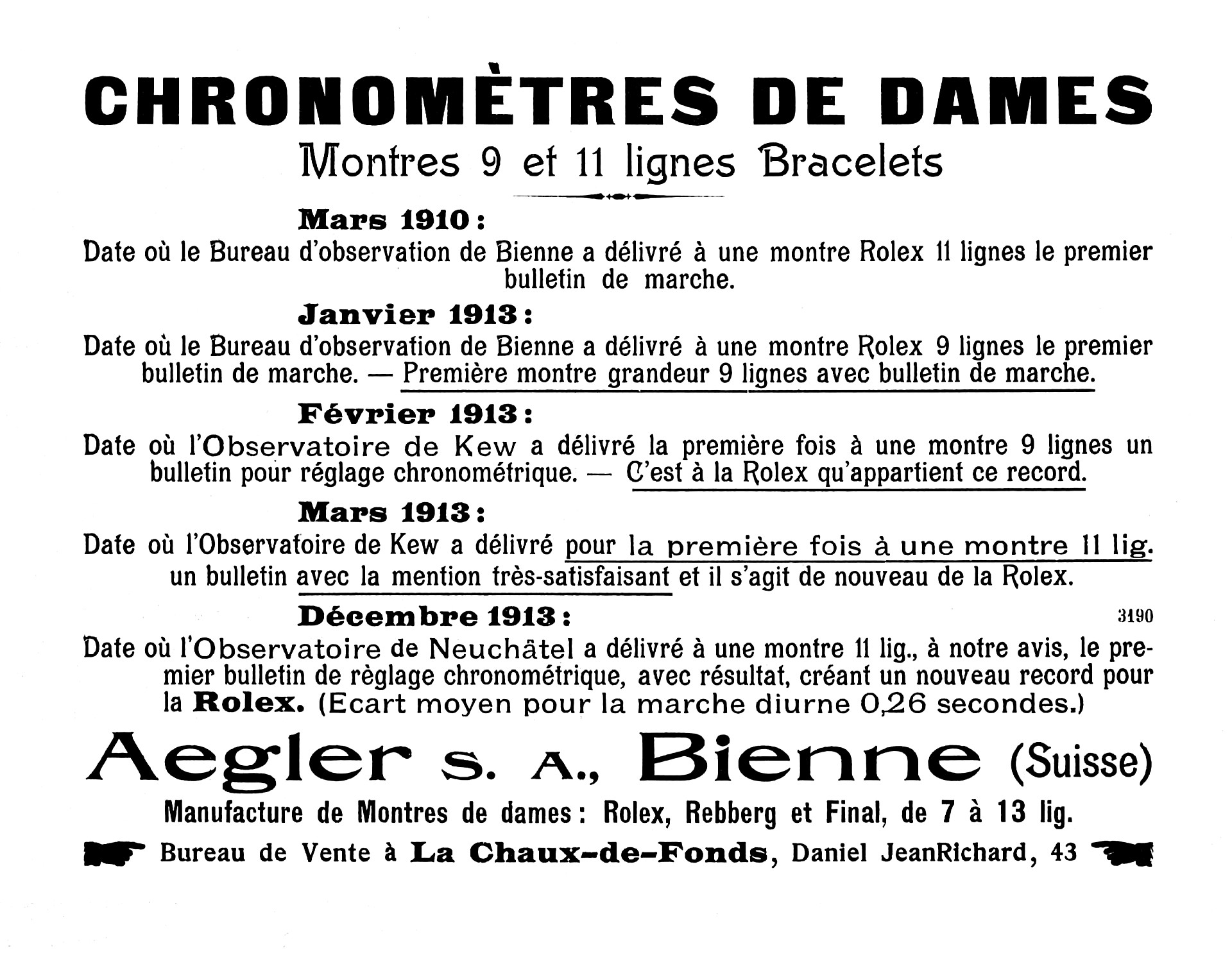
Aegler Advert February 1914
Click image to enlarge
In December 1913, the Neuchâtel Observatory issued the first observatory certificate to an 11-ligne watch, creating a new record for Rolex. The average deviation of daily rate was 0.26 seconds.
Aegler celebrated the trial successes from March 1910 to December 1913 in the advert reproduced here from February 1914. Interestingly, all the watches are now described as Rolex watches, which wasn't the case in previous adverts. The watches entered for the Kew trials in February and March 1913 had been submitted by Wilsdorf and Davis for the Rolex Watch Co., Bienne and London
Rolex Wristwatch Kew A Certificate
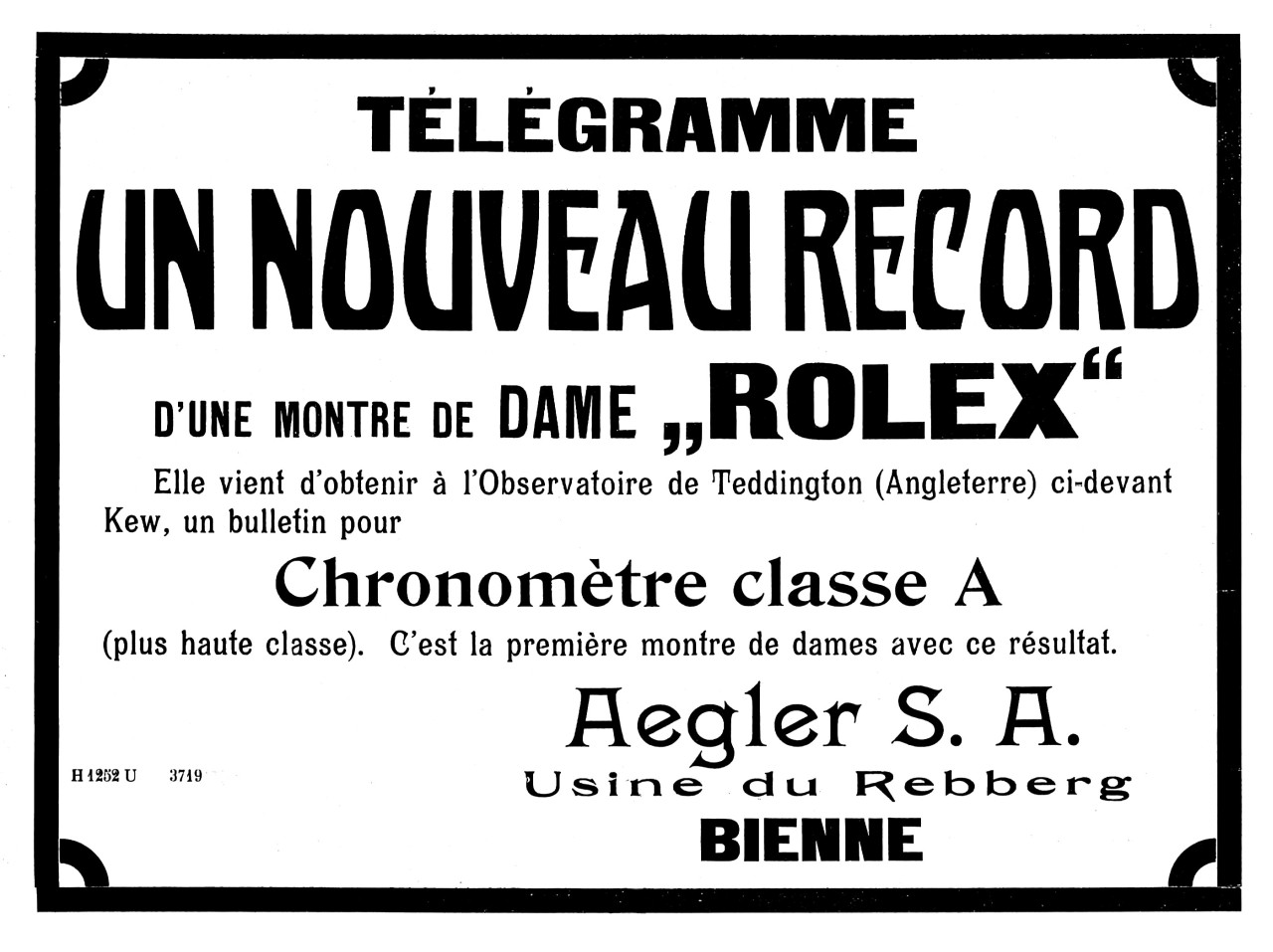
Aegler advert 1914 Kew A: Click image to enlarge
Wilsdorf and Davis for the Rolex Watch Co., Bienne and London, submitted to the National Physical Laboratory at Teddington two watches for the Kew Class A trial in early 1914, serial numbers 492257 and 492282. Both are described in the Kew register as keyless open face bracelet watches with 11 ligne movements. Neither watch passed.
The watch with serial number 492282 was resubmitted on 29 May and tried between 1 June and 15 July. This time it passed with 77.3 marks, just short of the 80 marks required to be endorsed ‘especially good’, and was awarded a Class A certificate. This was the first time that a Kew A certificate had been awarded to a wristwatch and it was a remarkable performance for such a small watch.
In the Vade Mecum it is said that the tests were carried out at Kew observatory, where watches had been tested since 1884. In November 1912 the watch and chronometer rating department moved from Kew to the National Physical Laboratory at Teddington, which is where the certificate was actually issued, although it was still called a Kew A certificate.
The marks awarded were
| Variation of daily rate: | 25.9 | out of a possible 0 to 40 |
| Change of rate with change of position: | 34.1 | out of a possible 0 to 40 |
| Temperature compensation: | 17.3 | out of a possible 0 to 20 |
| Total marks awarded: | 77.3 | out of a possible 0 to 100 |
A Class A certificate would be awarded to a watch that achieved the minimum performance requirements and was awarded zero marks in each category. The Rolex watch achieved 77.3 marks out of 100, an excellent result that was only 2.7 marks short of the 80 marks required for the certificate to be endorsed “Especially good”. However, to put this result in context, the watch that scored the highest number of marks in the trial was entered by Paul Ditisheim and achieved 94.0 marks, and the lowest scoring of the top 50 watches reported in the Horological Journal was entered by Vacheron & Constantin, scoring 85.7 marks.
The result was triumphantly announced in the Swiss trade press by Aegler. The advert here was published on 18 July, only a few days after the Class A certificate was awarded. It is headed "Telegram", showing how the news was quickly communicated to Switzerland.
The full text reads;
A NEW RECORD FOR A ROLEX LADY'S WATCH
It has just been awarded a certificate for Class A Chronometer (highest class) at the Teddington Observatory (England), formerly Kew. It is the first ladies' watch to achieve this standard.
Aegler S.A. Rebberg Factory BIENNE
Wilsdorf said that this was a red letter day in the development of the firm, a day that he would never forget. The ability of a wristwatch to maintain accurate time keeping could no longer be doubted.
Wilsdorf made chronometer-level performance central to Rolex’s strategy, and asked Aegler to submit representatives of all Rolex calibres for observatory testing. Initially, this may have been only a single movement of each calibre, simply to demonstrate that the calibre could pass the test, but independent testing and certification of Rolex calibres increased in importance as time went on, and became an central part of Rolex's strategy. Aegler subsequently submitted Rolex movements for observatory trials in large numbers. Although only a small proportion of the total production of Rolex watches were actually tested, these served to demonstrate that the standard was being achieved and maintained.
The Rolex Jubilee Vade Mecum erroneously states that the watch had undergone the same trials as ‘any large marine chronometer’, confusing the Kew watch trials performed at Teddington with the trials of marine chronometers and deck watches performed at Greenwich.
In June 1925, a Class A certificate was awarded to a small oval Rolex wristwatch with a movement measuring 9¾ lines by 5¾ lines (22 x 13 mm). The National Physical Laboratory report said ‘This is the smallest piece to have received a Class A certificate from the Laboratory in recent years’, but it must have been the smallest watch ever to have received a Class A certificate to that date.
In 1927, a Class A certificate was awarded to a Rolex wristwatch with a movement measuring 10¾ lignes by 6¾ lignes (24 x 15 mm). The watch achieved a very creditable 86.5 marks and the certificate was therefoe endorsed ‘especially good’.
Aegler Rebberg Movements

Aegler Rebberg Movement marked “Rolex 15 Jewels” on ratchet wheel: Click to enlarge.

Aegler Rebberg Movement Marked W&D: Click to enlarge.
Aegler manufactured movements in its ébauche factory in the Rebberg district of Bienne, and consequently Rebberg was a registered as a trade mark by Aegler. Early Aegler movements used in Rolex watches are often referred to as “Rebberg” movements because of this, even if they are not stamped with the Rebberg name. If they are stamped Rebberg, it is often on the bottom plate under the dial so not normally visible.
Aegler supplied Rebberg movements to Wilsdorf & Davis, and also to a lot of other companies. In fact it is most likely that Aegler supplied complete, cased, watches. Companies in London that Aegler supplied, such as the fledgling Wilsdorf & Davis, were simple importation business operations with an office in London but no factory capability, either in Switzerland or in England to put movements into cases and test the finished watches. All the silver cases that are seen with Rebberg movements, and gold cases until 1915, were made in Switzerland, so it is clear that the movements would have been cased and the finished watches tested at the Aegler factory. You can read about the other companies that Aegler supplied on my page about Aegler and see movements with their brand names at Rebberg Movements.
The two images here show savonnette versions of these Rebberg movements with their characteristic single central bridge holding the pivots of all the train wheels; centre, third, fourth and escape wheel. The movement with the perlage decoration to the plates is 13 ligne, the one with the plain plates is slightly smaller and shows a slight variation in the shape of the central bridge, but is still unmistakably an Aegler Rebberg. They are both stem wound and set lever escapement movements with 15 jewel bearings. Savonnette movements were used in savonnette (hunter) pocket watches, and in Lépine (open face) wristwatches because they have the fourth wheel at 90 degrees from the stem. This allows the crown to be at three o'clock and the small seconds indication at six o'clock on the dial.
Wilsdorf also imported Rolex watches with lower grade 7 jewel versions of the Rebberg movement. The 15 jewel versions were better finished and had “Rolex 15 Jewels” on the ratchet wheel, the 7 jewel versions just had the word Rolex and were less highly finished. There were also a small number of Prima grade movements with 18 jewels.
The smaller movement with the plain bridge is from a watch with a Borgel screw case with London Assay Office import hallmarks for sterling silver dated 1910 to 1911. Although it appears to have been made after Wilsdorf came up with the name Rolex, this watch doesn't carry the name Rolex. Both the case and the movement carry the W&D mark of Wilsdorf and Davis. On the case this is not unusual, a silver or gold case had to be punched with a sponsor's mark before it would be accepted for assay and hallmarking. But to find the same WD mark stamped on the movement is quite unusual.
The larger movement with the perlage decoration on the bridge dates from circa 1918 carries the single name “Rolex” so this is from a Rolex watch, not just a watch that was sold by the Rolex Watch Company. But notice that the Rolex brand name is engraved on the ratchet wheel. This is an easy component to change, just a single screw holds it in place. This was most likely an idea of Aegler's to reduce the amount of stock they needed to hold. They could hold ratchet wheels engraved with Rolex or any other name, and then when an order came in they could simply take unbranded movements and change the ratchet wheels to one with the name given on the order. This was a more cash efficient system than tying up lots of movements with names engraved on their bridges which then could only be sold to that customer.
Wilsdorf would have wanted the Rolex name engraved on the bridge of movement from the outset, but in the early days, before the 1920s, he was only one of many customers Aegler had and they could afford to refuse him. This is most likely the source of the story that Aegler at first refused to put the Rolex name onto their movements. They didn't want to engrave it onto the bridges because that stock could then only be sold to Rolex. But they put lots of different names on ratchet wheels, which could be easily exchanged, so it wasn't that they didn't want another company's name appearing on their movements at all, just not on the bridge where it was difficult to change or remove.
When Rolex became more important to Aegler as a customer they had to listen to him more seriously and the Rolex name got engraved on the bridge. The earliest watch that I have seen with Rolex engraved on the central bridge of the Aegler Rebberg movement had Glasgow Assay Office import hallmarks in the case back with the date letter "d" for the year 1926 to 1927.
If you have any comments or questions, please don't hesitate to get in touch via my Contact Me page.
Copyright © David Boettcher 2005 - 2026 all rights reserved. This page updated April 2025.
Back to the top of the page.