Blog: Watch Industry Secrets
Copyright © David Boettcher 2005 - 2026 all rights reserved.First published: 5 June 2025, last updated 25 March 2026.
I make additions and corrections to this web site frequently but, because they are buried somewhere on one of the pages, the changes are not very noticeable. I decided to create this blog to highlight new material.
Note that these articles also get updated, especially soon after they are posted when additional information may be added. Check the “last updated” date to see when the article was last updated.
The section below is from the page about Watch Cases.
As always, if you have any comments or questions, please don't hesitate to get in touch via my Contact Me page.
Secrets

1883: Louis Juillerat, maker of secrets: Click image to enlarge

1906: Ecabert-Ziegler, manufacture of American secrets: Click image to enlarge
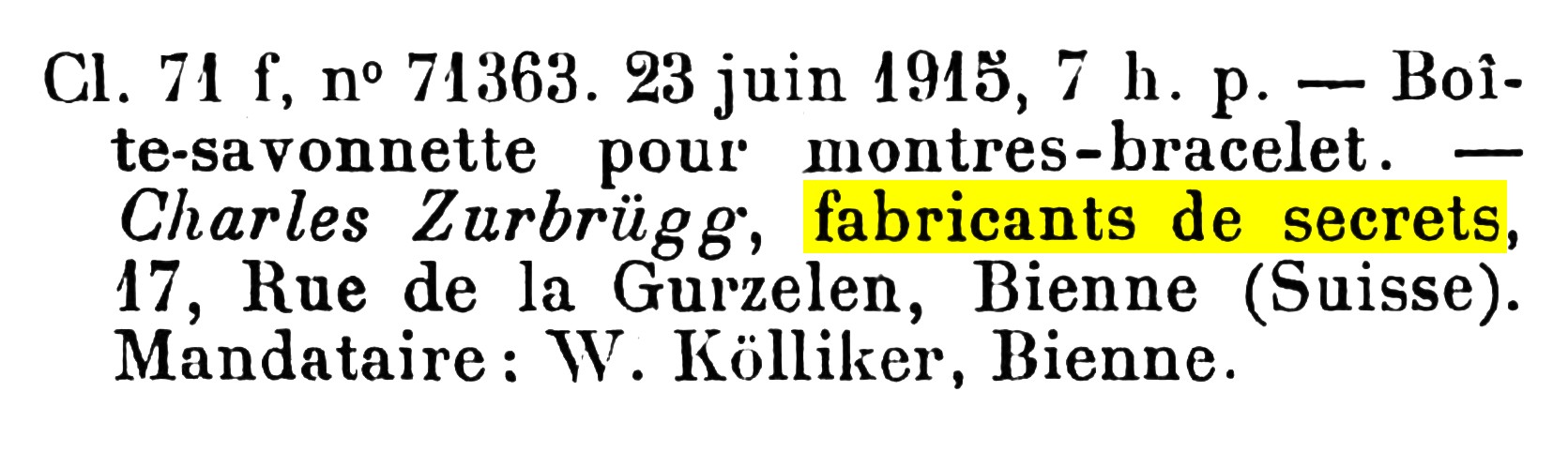
1915: Zurbrügg, ‘fabricants de secrets’: Click image to enlarge
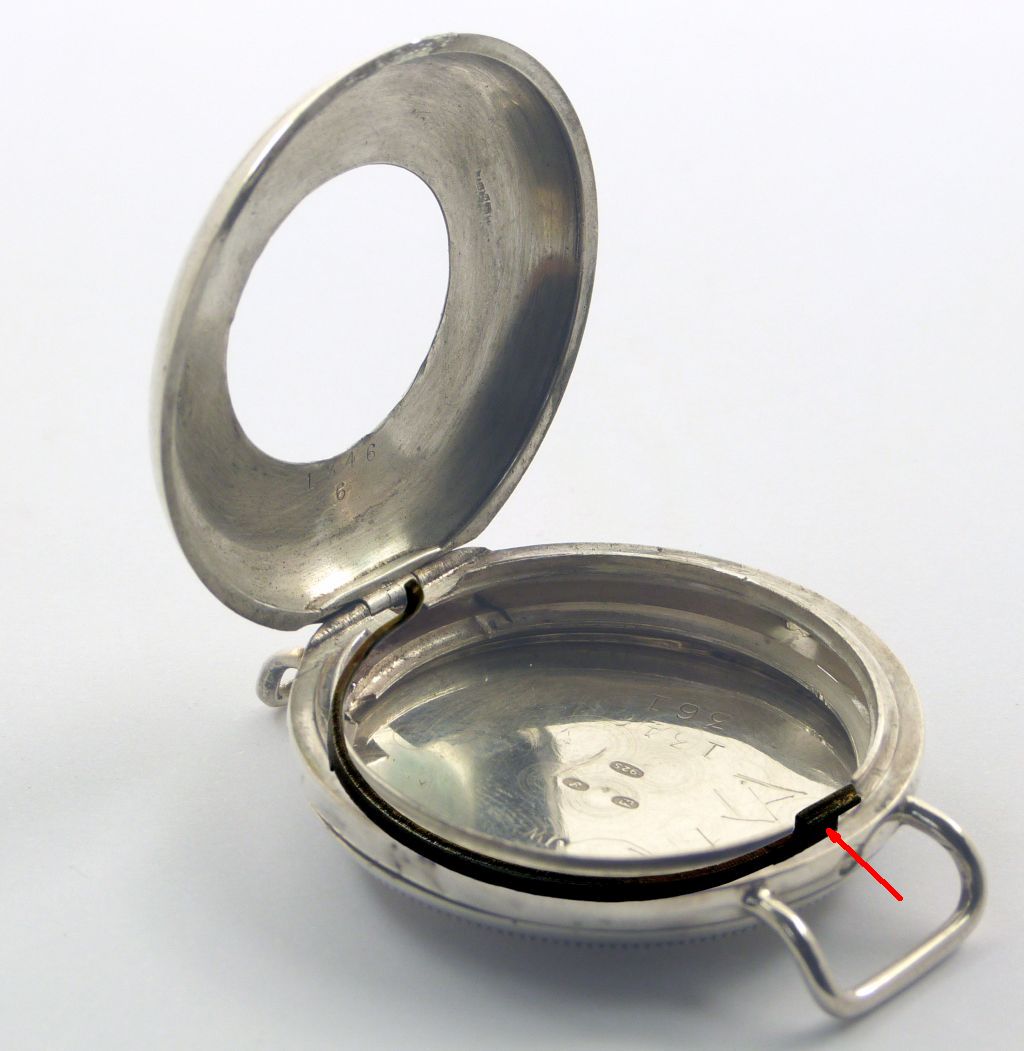
Zurbrügg half-hunter wristwatch case: Click image to enlarge
Pocket watch cases, and some wristwatch cases, have springs concealed inside the case for convenience. For example,
- Key-wound watches have a spring that opens the back of the case when a button on the pendant is pressed, so the wearer can apply the key to the arbor of the mainspring barrel and wind the spring.
- Hunter watches have a spring that opens the front lid of the case when a button on the pendant is pressed so that the time can be read.
French and Swiss watch case makers called these springs ‘secrets’, and makers of these springs called themselves, rather mysteriously to English ears, ‘faiseur de secrets’ or ‘fabricants de secrets’ (‘maker of secrets’ or ‘manufacturers of secrets’).
The springs are hidden within the case band and not visible on casual inspection or to the wearer of the watch, so it is not surprising that they are called ‘secret’, but it is surprising that the word is used on it own.
In French, springs are ‘ressorts’, so it would seem logical to call hidden springs ‘ressorts secret’, but they weren't; they were simply called ‘secrets’. Watchmaking has its own vocabulary with some funny word usage, but this must be the most unusual and obscure.
The first notice reproduced here dated 1883 about the ownership of the company called Louis Juillerat in Le Locle shows that the nature of the business was ‘maker of secrets’.
The advertisement dated 1906 by Ecabert-Ziegler of Les Bois shows that they were a manufacturer of ‘American secrets’ for silver watch cases.
The notice dated 1915 is about Swiss patent 71363, which was granted to Charles Zurbrügg on 23 June 1915 for a "Boîte-savonnette pour montres-bracelet" or hunter case for wristwatches.
The type of secret usually used in Switzerland was made in two parts. This was explained by Chevallier and Dubois in 1890 in their article ‘L'emboîtage de la montre - Du secret et de son fonctionnement’.
In hunter-case pieces, casing is more complicated, in that there is a secret to be set in motion. The closing springs consist of two parts held to the case band by screws; these are the head and the lever. The first, when pushed, causes the back or cover to detach, while the second places the back at right angles.
So, standard secrets have two separate parts; the head which forms the catch, and the lever that opens the lid. An alternative form called an ‘American secret’ has the head and the lever formed as a single piece.
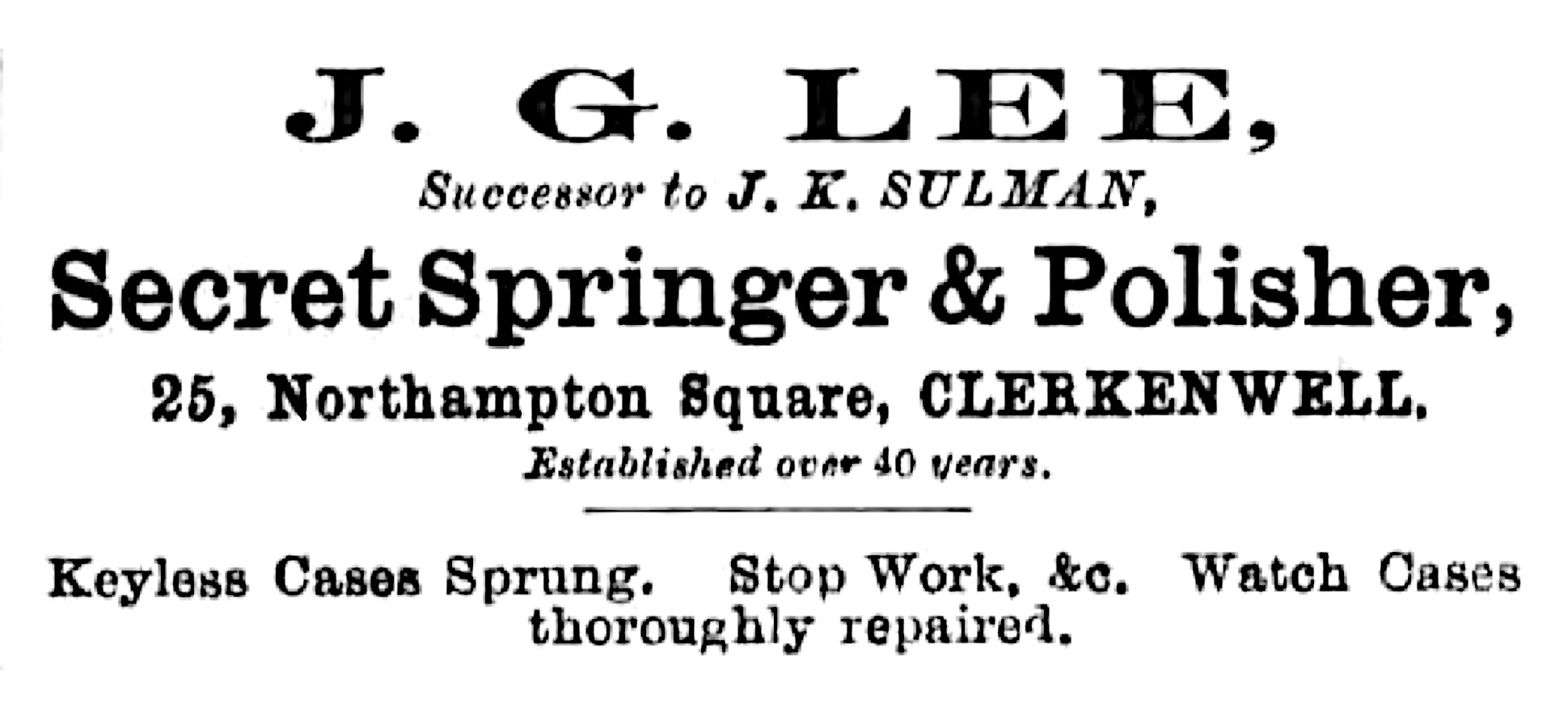
1899: J G Lee, Secret Springer: Click image to enlarge
On 25 November 1912, IWC was granted Swiss patent CH 62178 for a ‘Gehäusefeder für Uhren’ or case spring for watches. The spring is an improvement on the usual one piece lever spring, in that the spring and the part that is screwed to the case are separate items. This allows the spring part to be more easily replaced if it breaks.
The composite image shows a Zurbrügg half-hunter wristwatch case with the steel secret spring superimposed to show its location inside the case.
The spring has a catch for the lid at one end and a lever at the other end that forces the lid open when the catch is released. This makes it an ‘American secret’. The red arrow indicates where a shaft attached to a small release button passes through the hole in the case between the sides of the strap lug and operates the end of the spring with the lid catch.
This term passed into the English watch trade. Tradesmen who fitted springs to watch cases were known as ‘secret springers’, such as J G Lee, who advertised as a Secret Springer over many years.
If you have any comments or questions, please don't hesitate to get in touch via my Contact Me page.
Copyright © David Boettcher 2005 - 2026 all rights reserved. This page updated March 2026.
Back to the top of the page.