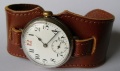
Newsome & Yeomans, Newsome & Co. and Samuel Yeomans
Copyright © David Boettcher 2005 - 2026 all rights reserved.Newsome & Yeomans, Newsome & Co. and Samuel Yeomans are regarded as amongst the leading English watchmaking companies of the late nineteenth century, but there is frustratingly little written about them in contemporary material.
Their reputation is based on the high quality of the watches they produced and their results in the watch trials at Kew rather than them making large quantities of watches, although they did make use of machinery and the gauge principle to increase production and reduce manufacturing costs.
In common with most English watch manufacturers, Newsome and Yeomans usually didn't sign their watches but instead applied the retailer's name. This makes their watches difficult to detect. However, in gold or silver cases, a sponsor's mark entered at an assay office by one of the company's principals can reveal the identity of the manufacturer.
Newsome & Yeomans
Newsome & Yeomans of Spon Street, Coventry, advertised in the Watchmaker, Jeweller and Silversmith in the 1870s as "Wholesale Watch Manufacturers ... Silver English Lever Watches of every description; also gold lever watches, three-quarter and full plate; Three-quarter Plate Keyless Centre Seconds Stop Watches in Gold and Silver. The Performance of every Watch guaranteed for a number of Years."
On 29 Aug 1874 Samuel Yeomans entered his details and an "SY" cameo punch at the Chester Assay Office as a Watchcase & Watch Manufacturer.
In December 1875 the Watchmaker, Jeweller and Silversmith reported that Newsome & Yeomans had opened a new factory in Coventry. The address is not stated but it must be Spon Street, Coventry, because Newsome and Yeomans adverts continued to give this address until 1878, and Yeomans continued on Spon Street after the partnership had ended.
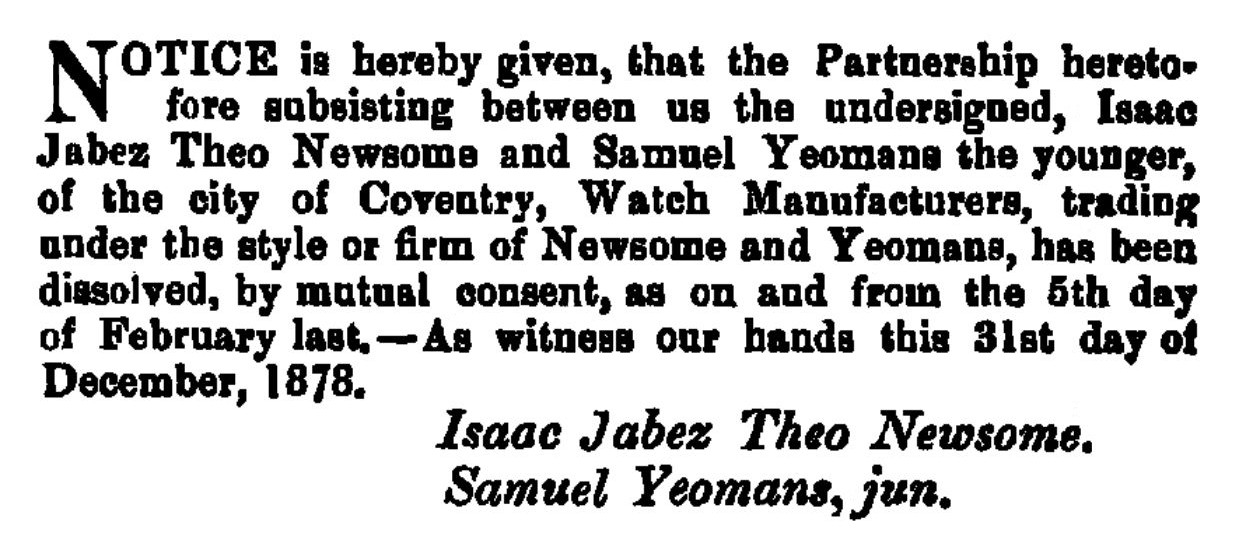

Newsome and Yeomans Partnership Dissolved February 1878
The main workshop on the first floor, where it was well supplied with daylight, was 120 feet in length and accommodated over fifty workmen. On the ground floor was another workshop about forty five feet in length, along with a heated cloakroom, and a tea room. The report said that "Altogether the factory is certainly one of the most complete, although not the largest, which we have inspected."
The report said that "Their watches are all made by the aid of machinery to gauges, a system having many decided advantages, the chief of which is, that in the event of any wheel or pinion being broken or lost, it may easily be replaced without sending the entire watch. One special branch of their extensive business is the manufacture of the higher class gold ¾ plate, centre seconds, keyless, watches." The remark that spare parts could be sent out is somewhat puzzling because, in common with most English watchmakers, Newsome rarely put their name on the watches they made. The visible name, usually the only name, was almost always that of the retailer. In which case, how a watch repairer would know to contact Newsome to ask for parts is something of a mystery.
Newsome and Yeomans dissolved their partnership on 5 February 1878 and went their separate ways as Newsome & Co. and S. Yeomans, as evidenced by the adjacent adverts reproduced here from June 1878.
Samuel Yeomans remained in Spon Street, Newsome moved to 14, Butts, Coventry.
Newsome & Co.

On 7 February 1878 Jabez Newsome entered his details and a "JN" cameo punch at the Chester Assay Office as a Watchcase & Watch Manufacturer. This was only two days after the dissolution of the partnership of Newsome and Yeomans on 5 February 1878.
The address quoted by Ridgway and Priestley for the 1878 cameo punch mark is 14 & 15, Butts, Coventry, but this is an error. The earliest adverts by Newsome & Co. such as the one reproduced here were for 14 Butts, only later was 15 included.
Newsome and Co. advertised from the address 14 & 15, Butts, Coventry, in the Watchmaker, Jeweller & Silversmith in the 1880s as watch and chronometer makers. This is puzzling as English streets normally have even numbers on one side of the road and odd numbers on the other side. Today number 15 Butts Coventry is occupied by Chicko's Café & Restaurant, flanked by The Mint Restaurant at number 13 and Istanbul Restaurant at number 17. However, information kindly provided by Robert Witts at the Coventry Archives and Culture Coventry is that a 1905 trade directory indicates that postal addresses at that time were numbered consecutively, so 14 and 15 were next to each other, and on the opposite, North, side of the road to the current number 15. A 1905 OS map shows the watch factory between York Street and Thomas Street (which no longer exists), opposite to today's number 15 and where the West side of the multi storey car park of the Ramada Hotel is today. According to the 1905 trade directory, the right side of the Butts (including Newsomes) runs from number 1 to 70, and the left hand side runs from number 71 to about 100. This was before extensive slum clearance and redevelopment took place from the 1930s onwards and the current, more usual, numbering scheme was adopted.
In March 1891 the death of Mr. I. J. T. Newsome was announced. The business was carried on as usual by the surviving partners, I. K. and S. T. Newsome, presumably sons. The first must be Jabez Kerby Newsome of 14 and 15 The Butts, Watch Manufacturer, who in 1896 was granted a patent for "Improvements in the Means and Method of Securing Bows to Keyless Watches." The letter "J" is a relatively recent addition to the alphabet and was often rendered as an "I" at the time. The second was Samuel Theo Newsome (1868-1930) died on 4 January 1930 aged 61.

Newsome & Co. Advert 1894. Click image to enlarge.
By 1894 Newsome and Co. had a London office at 94 Hatton Garden, EC, and were advertising as Wholesale Watch Manufacturers. All kinds of English Lever Watches in Stock. Sole Makers of Patent Safety Wheel for Going Barrels. Keyless Work a Spécialité with or without the Kew Certificate in “A,” “B,” or “C” class... Illustrated catalogue on application.
The “Keyless Work a Spécialité ...” is particularly nice sophistication, as is the statement “Appro parcels sent out at 1 Minute's Notice”; these are parcels of goods sent out for approval and subsequent payment or return. How the orders for such rapid parcels were communicated is not clear, since no telegraph or telephone details are given.
The firm's London agent was listed in 1897 as J. M. Joseph. The London office subsequently moved to 70 Hatton Garden, and Joseph was succeeded by Charles Louis Ebeling.
Patents used in Newsome watches
On 3 March 1886, Albert John Morcom of St. Austell, Cornwall, was granted British patent 3005 for a “Safety Mechanism for preventing damage to the movements of Watches and Clocks on the breaking of the mainspring” to guard against damage caused by breakage of the mainspring in movements with goings barrels. This invention was taken up by Newsome & Co, who called it the “patent safety wheel” and advertised that they were the sole manufacturers.
The safety mechanism consists of two separate wheels on one axis, placed between the barrel wheel and the centre pinion. Between the two wheels of the safety wheel are a click and ratchet. The barrel wheel teeth are cut on the middle of the barrel, which has the additional benefit of distributing friction equally on both ends of the barrel arbor. The upper wheel of the safety mechanism engages with the barrel wheel and the lower wheel engages with the centre pinion, as the barrel would normally. When the mainspring is driving the train of wheels, the click and ratchet enables the upper wheel to drive the lower wheel. Should the action of the barrel be reversed, as it is when the mainspring breaks, the top wheel reverses on the ratchet, preventing any further damage from taking place.
In 1890 a new type of chronograph was manufactured by Newsome and Co. for registering one-sixtieth part of a second. The inventor was Mr. Robert Turner of 53 Princess Street, Bury, who was granted a patent for this invention in 1889. The escape-wheel arbor of an ordinary chronograph train of 18,000 vph was fitted with an additional wheel of forty eight teeth, which engage with a pinion of eight leaves that carried a hand on a small auxiliary dial divided into 60ths seconds. The result being that the small hand makes a complete revolution each second. The rest of the train was as normal and there was also a centre-seconds hand on the large dial.
Back to the top of the page.
Samuel Yeomans
Samuel Yeomans learned his trade at the bench, and began business in partnership with I. J. T. Newsome. In 1889, he was a founder member of the Coventry Watch Movement Manufacturing Company and remained Chairman until shortly before his death. He was President of the Coventry Watch Trade Protection Association. He died in 1901.
Back to the top of the page.
Sponsor's Marks
I. J. T. N: Isaac Jabez Theo Newsome, Newsome & Company.

IJTN: Newsome and Company, London 1886 / 1887 Hallmarks

IJTN: Newsome and Company, Chester 1888 / 1889 Hallmarks.
The two sets of hallmarks shown here both have the same sponsor's mark, the initials I.J.T.N in cameo within a rectangular surround.
Punches with this mark were first entered at the Chester Assay Office on 7 November 1884, and at the London Assay Office on 21 November 1884 and 22 April 1886 by Isaac Jabez Theo Newsome with the address 14/15 The Butts, Coventry, giving his occupation as watchmaker and watchcase maker.
Another punch with the came initials in cameo but with a diamond shaped surround was also entered at the Chester Assay Office on 7 November 1884.
Reading from the top and then left to right the marks are:
- The lion passant or walking lion, the standard mark for sterling silver.
- The town marks of (1) the Chester Assay Office, an upright sword between three wheat sheaves, and (2) the leopard's head of the London Assay Office.
- The Chester hallmark has assayer's mark or date letter "E" for the year 1888 to 1889. The London hallmarks has the date letter "L" for the year 1886 to 1887. Remember that hallmark date letters span two calendar years, for brevity only the first year is shown in most references.
- The sponsor's mark I.J.T.N in cameo within a rectangular surround. NB: Philip Priestley has the London punch as being entered by Newsome & Yeomans but this is incorrect. All the I.J.T.N punches were entered by Newsome after Newsome and Yeomans had parted company in 1878.
Notice how the three assay office hallmarks are arranged in a regular triangle formation, whereas the sponsor's mark can be at a random angle. This is because the sponsor's mark was struck with a single punch before the case was sent to the assay office, but the three assay office marks were made by a "press punch". This is one punch that carries all three marks which was applied to the case and driven home by a fly press. This method of marking was used to speed up the process of marking the large numbers of gold and silver watch cases submitted for hallmarking. If the assay office hallmarks are not punched in a regular triangle pattern, this can indicate a fake hallmark in a watch case.
Samuel Yeomans
Samuel Yeomans entered a sponsor's mark “S.Y” in cameo within a rectangular surround with cut corners at the Chester Assay Office on 29 August 1874.
Samuel Yeomans entered a sponsor's mark “S.Y” incuse with no surround at the Chester Assay Office on 16 April 1880. Watchcase & Watch Manufacturer. Tow further punches with the same description were entered on 30 May 1884 and 16 April 1886.
Samuel Yeomans entered a sponsor's mark “S.Y” in cameo within a rectangular surround with cut corners at the Birmingham Assay Office on 19 June 1890.
If you have any comments or questions, please don't hesitate to get in touch via my Contact Me page.
Copyright © David Boettcher 2005 - 2026 all rights reserved. This page updated December 2024.
Back to the top of the page.