
Blog: Glucydur Balances
Copyright © David Boettcher 2005 - 2026 all rights reserved.First published: 24 June 2024, last updated 12 February 2026.
I make additions and corrections to this web site frequently but, because they are buried somewhere on one of the pages, the changes are not very noticeable. I decided to create this blog to highlight new material.
Glucydur is used for watch balances. Sometimes Glucydur is said to be a material with low thermal expansion. This is wrong; Gluydur actually has a high rate of thermal expansion, simmilar to brass. A Google search for Glucydur balance and low expansion will return plenty of results, because some people think that a low expansion balance is necessary for temperature compensation. This is also wrong; the high rate of thermal expansion of Glucydur is used as part of an oscillating system that is not affected by changes of temperature.
The article in this blog is from a series explaining how temperature compensation is achieved in modern watches without bimetallic compensation balances. This is achieved by using an unusual property of nickel steel alloys to make balance springs that, unlike steel springs, get stiffer as their temperature increases.
The breakthrough occurred in 1897, with the invention by Paul Perret and Dr Guillaume of the first nickel steel compensating balance springs. The development of nickel steel balance springs began with these first Paul Perret balance springs, leading to Elinvar, and ultimately to Nivarox in the 1930s.
Six articles in this series are currently planned;
- The Discovery of Invar,
- Paul Perret Balance Springs,
- Dr Guillaume Spirals,
- Elinvar balance springs,
- Variable Rate Balances and
- Nivarox balance springs.
The highlighted links will jump straight to the ones that have been published.
The articles are from the page about Temperature Compensation by Nickel Steels.
The article below is part of the page about Temperature Compensation.
As always, if you have any comments or questions, please don't hesitate to get in touch via my Contact Me page. I would be interested to get your feedback on this article, about how it reads and if there are any mistakes!
Glucydur Balances
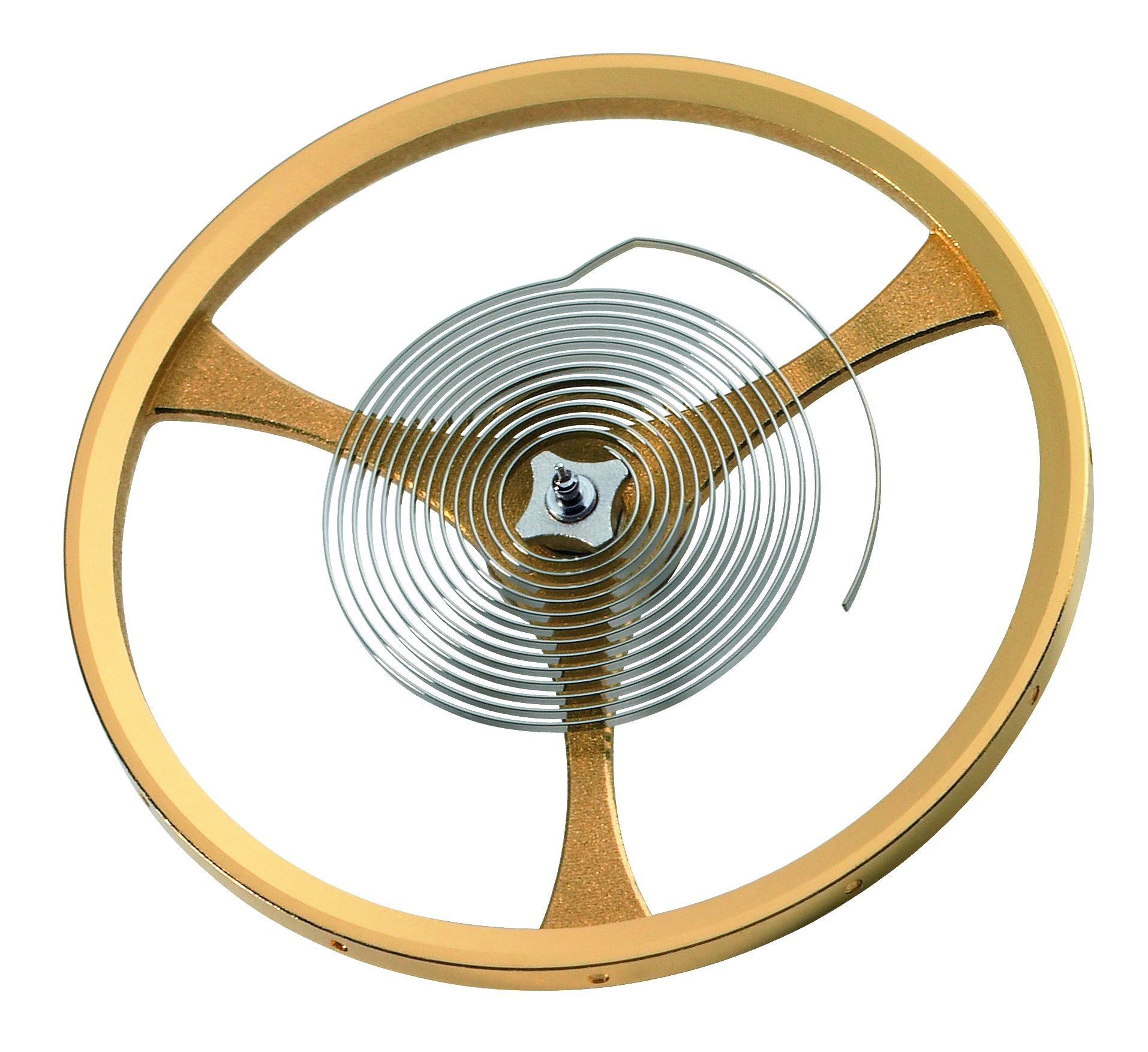
Glucydur Balance with Nivarox balance spring
Click image to enlarge
Glucydur an alloy of copper and beryllium used for watch balances. The name Glucydur is derived from glucinium, an old name for beryllium, and dur for durable.
The same alloy is also called beryllium copper, beryllium bronze and CuBe or Cu-Be, from the chemical symbols of its constituent elements, Cu for copper and Be for beryllium.
Beryllium copper was invented in the 1920s by Georg Masing and Otto Dahl, two German metallurgists working in the research laboratories of Siemens & Halske AG, a German telecommunication company with a well funded R&D laboratory. They investigated the effects of adding small amounts of various elements to copper and found that beryllium, even in minor quantities, substantially improved the mechanical properties of copper. Beryllium copper can be heat treated to have a strength and hardness similar to alloy steels while retaining the excellent electrical conductivity of copper and was therefore useful for telephone exchange switching components. Several patents over the use of beryllium as an alloying component were granted to Siemens & Halske AG.
Beryllium copper alloys, including Glucydur, are precipitation hardening alloys that develop their high strength and hardness through heat treatment.
Precipitation hardening requires an alloying element that is insoluble in the principal element at normal temperature, but fully soluble at high temperature. The first such combination to be discovered was copper in aluminium, resulting in the alloy Duralumin. This developed its properties at normal temperature over time and, because of this, the process was called age hardening. Precipitation hardening is a superset of age hardening, where additional heating is required to achieve the hardening.
In precipitation hardening, there are two different heat treatment regimes that result in different properties. For beryllium copper alloys, including Glucydur, these are,
Solution Annealing: In this treatment, the beryllium copper alloy is heated to a temperature of around 800°C to dissolve the beryllium into the copper matrix, creating a homogeneous solution. The alloy is then rapidly cooled, usually by quenching in water or oil, to retain the beryllium in a supersaturated solid solution. This locks the beryllium atoms in place within the copper matrix. In this state, the alloy is as soft as copper and can be formed and worked easily.
Precipitation Hardening: The alloy is reheated to a lower temperature, typically between 315°C and 400°C and held at this temperature for several hours, allowing beryllium to precipitate out of solution and form clusters dispersed finely throughout the copper matrix. These clusters of beryllium hinder the movement of dislocations, which increases the alloy's strength and hardness. After this heat treatment, the alloy has a strength and hardness similar to alloy steels.
The change in properties of beryllium copper with heat treatment has great benefits. In the solution annealed state, it is easy to form and shape, although caution is needed because beryllium is hazardous to health. After being formed into the final shape, the items are precipitation heat treated to give them high strength and hardness. For watch balances, the fact that beryllium copper is non-magnetic is also an advantage.
Thermal Expansion
The law of mixtures says that the rate of thermal expansion of an alloy will be in proportion to the rates of thermal expansions of its constituent parts. Since Glucydur is 98% copper and 2% beryllium, its rate of thermal expansion should be close to that of copper, which it is. Swatch Group stated that the coefficient of thermal expansion of Glucydur is 17×10-6 per degree Celsius.
The coefficient of thermal expansion of steel is about 10.4×10⁻⁶ per degree Celsius, and brass is about 18.6×10⁻⁶ per degree Celsius. So it can be seen that Glucydur has a rate of thermal expansion 63% greater than steel and nearly as large as that of brass. This is certainly not a small rate of thermal expansion.
Thermal expansion of a balance causes a losing rate, because it increases the moment of inertia of the balance. A watch fitted with a Glucydur balance will lose due to expansion of the balance about 1½ seconds per day per degree Celsius, or about 45 seconds per day over a temperature range of 30 degrees.
The Contrôle Officiel Suisse des Chronomètres (COSC) test allows a variation of up to +/- 0.6 seconds per day per degree Celsius in the variation of the rate as a function of temperature for Category 1, or +/- 0.7 seconds for category 2. This rate is obtained by subtracting the rate at 8°C from that at 38°C and dividing by 30, the difference between the two temperatures.
If there was no thermal variation in rate caused by the balance spring, the difference of 45 seconds in rate between 8°C and 38°C caused by expansion of a Glucydur balance would disqualify a watch from receiving a COSC certificate.
If you have any comments or questions, please don't hesitate to get in touch via my Contact Me page.
Copyright © David Boettcher 2005 - 2026 all rights reserved. This page updated February 2026.
Back to the top of the page.