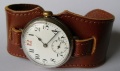
Temperature Compensation by Nickel Steels
Copyright © David Boettcher 2005 - 2026 all rights reserved.In the late nineteenth century, the discovery by Dr Charles Édouard Guillaume of the anomalous thermal expansion characteristics of nickel steel alloys resulted in new ways to compensate clocks and watches for the effects of temperature.
Guillaume's first discovery was Invar, an alloy with about 36% nickel that has very low thermal expansion, about 1 part in one million per degree Celsius. This is 10 times lower than the rate of thermal expansion of steel, and it was immediately realised that it would be useful for pendulum rods.
The announcement of the discovery of Invar prompted Paul Perret to ask for a sample, which he made into a watch balance spring and discovered something even more unexpected about Invar than its very low thermal expansion. This discovery resulted in balance springs that required very little compensation. The results of Perret's discovery are still used in mechanical watches today.
Back to the top of the page.
The Discovery of Invar

Armour plates tested at Annapolis, MD, in 1890
Image from Scientific American, 1898. Click image to enlarge
Nickel is a metallic element with the symbol Ni and atomic number 28. Slightly yellow in colour, resembling very pale brass, it is corrosion resistant due to the formation of a thin, protective nickel oxide layer on its surface.
Nickel alloys well with steel. In ancient times, nickel steel was obtained from meteorites and used to make items such as the dagger found in Tutankhamun’s tomb. However, because nickel is difficult to extract from ore, its applications remained limited until the development of efficient extraction methods in the 19th century.
As technological advancements made it possible to extract and refine nickel, the use of nickel in steel alloying gained prominence. Pioneering research by Michael Faraday in the 1820s demonstrated that even small additions of nickel improved steel’s toughness. By the 1880s, nickel steel was replacing traditional steel as a material for battleship armour.
Tests conducted by the US Navy at Annapolis in 1890 demonstrated the superiority of nickel steel over both traditional steel and compound armour plates. The trial compared three plates: a steel plate and a nickel steel plate, both manufactured by Schneider & Co., Le Creusot, and a compound plate made by Cammell & Co., Sheffield. The plates were approximately 10½ inches thick.
Four shots were fired into the corners of each plate from 28 feet using a 6-inch breech-loading rifled naval gun. The projectiles were Holtzer 6-inch armour-piercing shells weighing 100 lbs, propelled by 44½ lbs of brown prismatic powder manufactured by DuPont, with a striking velocity of 2,075 feet per second. A fifth shot was then fired into the centre of each plate by an 8-inch breech-loading rifled naval gun using Firth armour-piercing shells weighing 210 lbs, with an 85 lb powder charge and a striking velocity of 1,850 feet per second. It must have been great fun!
The figure from the Scientific American Coast Defense Supplement of 1898 shows the final result. The compound plate was perforated by all projectiles, and its steel face was destroyed. Both Schneider plates kept out all projectiles. The steel plate showed slightly greater resistance to penetration, but it cracked severely under the 8-inch shell, whereas the nickel steel plate remained uncracked. This demonstrated the superior toughness of nickel steel, leading the Board to conclude that the nickel steel plate was the best.
Another French company, the Société de Commentry, Fourchambault et Decazeville, also played an important role in the development of nickel steel. Formed in 1853 through the merger of several companies involved in steel production, it included the steelworks at Imphy, located in the Nièvre department of the Bourgogne-Franche-Comté region of central-eastern France. The Imphy works, with origins dating back to the 17th century, emerged in the late 19th century as a centre of innovation in metallurgy, particularly in nickel steel alloys.
At the time of the US Navy test in 1890, Schneider & Co. of Le Creusot was France’s principal producer of armour-grade nickel steel. In the years that followed, the Imphy steelworks, which was part of the Schneider group, became increasingly important in the production of specialised nickel steels. By the late 1890s it was supplying high-quality nickel steel to the French Navy and exporting to other countries, including the United States and Japan.
Dr C. E. Guillaume
Charles Édouard Guillaume was born on 15 February 1861 in Fleurier, Switzerland, in the heartland of the Swiss watchmaking industry. His grandfather, Charles Frédéric Alexandre Guillaume, had left Switzerland to establish a watch business in London. His three sons joined the business but one, Édouard, returned to Fleurier and had a son, Charles Édouard. He, Charles Édouard, studied physics at the Polytechnikum in Zurich (the precursor of the Eidgenossische Technischc Hochschule). At the age of 22, Charles Édouard joined the Bureau International des Poids et Mesures, at Sèvres, a suburb of Paris.
The Bureau international des Poids et Mesures (BIPM), or International Bureau of Weights and Measures, was established by the Metre Convention in 1875 and began operations around 1881. Its principal task was to standardise international measurements and to distribution to signatory countries of the Metric convention standards of length and weight. From the very outset, it had a problem, the cost of the platinum-iridium alloy used for length standards, chosen because it has low thermal expansion, was prohibitively high.
Guillaume was given the task of finding a cheaper alloy with low thermal expansion that would be suitable for length standards. There were no instruments that could measure dimensions of materials at different temperatures to determine their coefficients of thermal expansion with sufficient accuracy, so one of his first tasks was to design an accurate dilatometer.
Guillaume presented the results of his studies in 1892. He had examined pure nickel, a nickel-iron alloy and three types of bronze. The nickel-iron alloy he eliminated because it rusted quickly in the presence of water. The pure nickel seemed the most promising, but lengths of four metres were required and no manufacturer could produce bars of pure nickel longer than about two metres.
Nickel Steels
In 1895, the bureau received a request to calibrate a metre length standard belonging to the Technical Branch of the French Artillery. Extensive research in the 1880s to find improved alloys for armour had resulted in a steel alloy with 22% nickel and 3% chromium, from which this standard had been made.
During the calibration, the standard did not behave well. Guillaume measured its coefficient of thermal expansion and found that it was about 18 parts per million (ppm), that is 18 × 10⁻⁶, per degree Celsius. This is greater than bronze and much higher than expected from the rule of mixtures. An alloy of 75% steel and 22% nickel with a small amount of chromium would be expected to have a thermal expansion about three-quarters of the way between steel at 11 to 13 × 10⁻⁶ per degree Celsius and nickel at 12.5 × 10⁻⁶ per °C. It was determined that the material was not suitable for a length standard, and no further work was done.
In 1896, a bar of an iron alloy with 30% nickel was supplied to the Bureau by the Société de Commentry-Fourchambault for the possible construction of precision weights. Much to his surprise, Guillaume found that its thermal expansion coefficient was only about one-third of that of the earlier alloy, lower than platinum and much lower than expected.
Guillaume realised that the unexpected rates of thermal expansion of the two alloys showed a previously unknown phenomenon was taking place at an atomic lever that required significant further study, a reaction that would ultimately make his name world famous and lead to a Nobel Prize. When the thought initially occurred to him, he told his wife that he would spend the next ten years studying the effect. In fact, it was to occupy him for the next thirty years.
Guillaume found that both nickel steels had been made by the Commentry-Fourchambault steelworks at Imphy. He contacted the Company and spoke to its Managing Director, Henri Fayol, who was not only willing but eager to help, saying “What do you need to continue? I'm with you all the way.” This was the start of a long collaboration, during which more than six hundred alloys were been provided free of charge to the International Bureau.

Nickel steels linear alpha and non-linear beta thermal expansion coefficients:
Click image to enlarge
Guillaume initially asked for seventeen different alloys of iron and nickel covering the range from pure iron to 44% nickel. He measured the expansion coefficients of these, which gave the results plotted on the graph here. The horizontal x axis shows increasing nickel content from zero at the left to 100% at the right. The verical y axis shows the expansion coefficient in parts per million per °C.
The upper graph in the figure labelled α (alpha) shows the linear coefficients of thermal expansion. The expansion coefficient of steel at normal temperatures is marked on the left y axis as point A. The expansion coefficient of nickel is marked on the right y axis as point B. If the rule of mixtures was followed, the expansion coefficient of an alloy at would be expected to lie between these points, e.g. the expansion coefficient of an alloy of 50% nickel and 50% steel would be expected to be exactly at the mid-point between points A and B. The dotted line joining A and B shows this rule.
However, instead of following the rule of mixtures, Guillaume found that the expansion coefficients of the alloys takes a “wild path”. From the left hand axis, as the nickel content increases from zero to about 28%, the expansion coefficient increases until it reaches the line drawn from C to B near 24%. Point C on the left y axis is the expansion coefficient of iron at high temperatures. The curve then falls sharply until at about 36% nickel it reaches a low point of about 0.9 ppm per degree. This was a quite astonishing result, a metal alloy with such a low coefficient of thermal expansion was previously unknown and unexpected.
Shortly after the discovery was announced, in the Swiss Journal of horology Professor Marc Thury pointed out that the alloy with very low expansion would be useful for pendulum rods, requiring only minimal compensation for the effect of changes in temperature. He proposed the name ‘Invar’ for this alloy, derived from invariable dimensions. The name immediately caught on and made Guillaume famous outside of the small world of professional metrology.
Guillaume continued to study the nickel steel alloys. He discovered that an alloy containing 44 to 48% nickel has the same thermal expansion as glass. Wires made from this alloy could be substituted for the expensive platinum that was previously used to form the lead wires for incandescent lamps, hence the name “platinite” was given to this alloy.
The careful and rigorous studies of the properties of nickel steel alloys and investigations into the causes of their unusual properties led to Guillaume being awarded the Nobel Prize for Physics in 1920.
Non-linear Effects
Thermal expansion doesn't follow a direct, linear, relationship to temperature changes. As atoms are given more energy and heat up, they vibrate more, which causes the bonds between them to lengthen. This is what causes thermal expansion. Longer bonds cause weaker interactions between atoms, and the rate of bond weakening isn’t linearly proportional to temperature; it increases at higher temperatures. This non-linear behaviour means that the rate of expansion of most metals accelerates as the temperature rises.
Using his very accurate dilatometer, Guillaume was able to measure the departure from linearity of the thermal expansion of the nickel steel alloys, which is shown by the curve in the lower graph of the figure labelled β (beta). An interesting feature of this curve is that it crosses the zero axis at exactly the same point at which the curve in the upper graph is at a minimum, the Invar point. The zero line has been highlighted in red to show this clearly.
To the right of the Invar point on the lower graph, between the nickel contents of 36% and about 50%, the curve is below the zero line. This is a range of nickel steel alloys that have negative non-linear expansion, meaning that their rate of thermal expansion decreases with increasing temperature.
This is an extremely rare property; no other metal alloys with such a strong negative non-linear effect are known.
What is Invar
Invar is the name of a nickel steel alloy containing 36% nickel and having the unusual property of extremely low thermal expansion. The name Invar was suggested by Professor Marc Thury because of the alloy's almost invariable dimensions.
Other nickel steel alloys have more normal rates of thermal expansion and should not be referred to as Invar.
Invar in Watches
Invar has never been used in watches, despite what is sometimes claimed. The name Invar was never registered as a trademark by Guillaume or Thury and was therefore open to anyone to copy. This led to the name Invar being used by some companies that were not connected with Guillaume for purely marketing purposes. Nickel steel components in watches were sometimes called Invar even though they were a different alloy. One of these was the term “Invar balance” used for balances invented by Guillaume that used a different nickel steel alloy called Anibal. Guillaume remarked that “Invar balance” was “a decidedly erroneous name, Invar not entering into the composition of the balance.”
Invar balance: “a decidedly erroneous name, Invar not entering into the composition of the balance.”
Back to the top of the page.
Paul Perret Balance Springs

Paul Perret nickel steel balance spring and monometallic balance in a watch made by H. Williamson of Coventry circa 1910: Click image to enlarge
A watch’s rate is determined by the frequency of oscillation of its balance, which is principally determined by the rotational inertia of the balance and the stiffness of the balance spring. The effects of changes in temperature on the balance and spring were a problem for early watchmakers working with steel balance springs. As temperature rises, thermal expansion of the balance increases its rotational inertia, slowing the watch. The balance spring also expands. Increases in the length and height of the spring nullify each other, but the increase in thickness makes it stiffer which would cause a gain. But the most significant effect is that the spring’s modulus of elasticity reduces, lessening its stiffness, which also slows the rate.
A watch with a steel balance spring and plain brass balance loses about 11 seconds per day for each degree Celsius temperature rise. The magnitudes of the effects of temperature are quite different. Expansion of the balance and spring oppose and almost cancel each other; it is the reduction in the elastic modulus of the balance spring that is most significant.
John Harrison's invention of the bimetallic strip enabled the effects of temperature to be compensated. This ultimately resulting in the invention of the compensation balance. Compensation balances were expensive to make and adjust and delicate to handle, but remained the only way to compensate for changes in stiffness of a balance spring as a result of changes of temperature until the late nineteenth century.
In the 1890s, Dr Charles Édouard Guillaume worked at the International Bureau of Weights and Measures in Sevres, a suburb of Paris. A length standard made of nickel steel sent to the bureau by the artillery section of the French army for calibration was found to have a rate of thermal expansion significantly different from that predicted by the rule of mixtures from its proportions of iron and nickel, which attracted Guillaume’s attention. Other samples of nickel steel subsequently sent to the bureau were also found to have unexpected thermal expansion rates. Following these observations, Guillaume made a systematic study of the rates of thermal expansions of a wide range of nickel steel alloys with the assistance of the Société de Commentry-Fourchambault & Decazeville, the steelworks at Imphy in Burgundy that made the nickel steel alloys. One result of this investigation was the discovery of Invar, a nickel steel alloy with 36% nickel and a very low thermal expansion rate.
After presenting his findings to the French Academy of Science in the spring of 1897, Guillaume received a letter from Paul Perret, a watch springer and timer in La Chaux-de-Fonds, requesting a sample of Invar. Guillaume, having a spare piece of Invar wire, obliged. Two weeks later, Perret wrote again, requesting samples of all the other nickel steel alloys that Guillaume had studied. However, this time, Guillaume refused. A few days later, Perret arrived unexpectedly at Guillaume’s office in Sevres. Guillaume recounted their meeting:
Paul Perret said, ‘With the Invar specimen you sent me, I made balance springs and found results that astonished me.’
I said – I know.
Paul Perret (no doubt surprised by this reply) asked – How do you know?
I said – If you had not found extraordinary results, you would not be here in Sèvres.
Paul Perret replied – That’s true!
It’s not difficult to imagine an outbreak of mutual smiles or laughter.
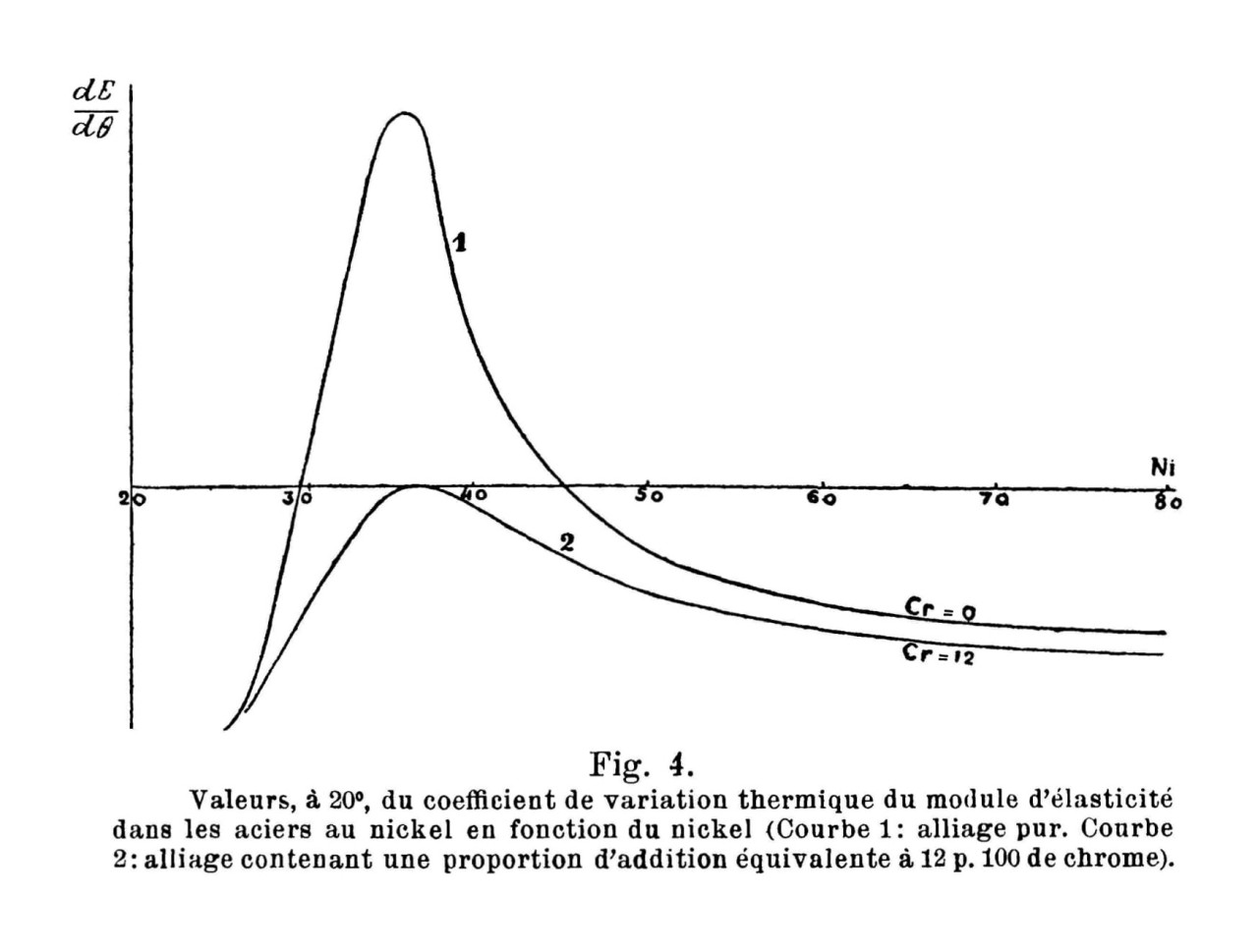
Figure 1 Thermoelastic variations of nickel steels: Click image to enlarge
Paul Perret had discovered that a watch fitted with a balance spring made from Invar gained significantly when its temperature increased, precisely the opposite of a watch with a steel balance spring.
A watch with a steel balance spring and plain brass balance loses about 11 seconds per day for each degree Celsius increase in temperature. The watch that Perret fitted with an Invar balance spring gained 18 seconds per day for each degree Celsius. This was so astonishing that Perret told Guillaume he thought he might have gone mad!
This discovery revealed that Invar has a positive thermoelastic effect, which means that its modulus of elasticity increases as it is heated. This is extremely unusual. Since the discovery of Invar, positive thermoelastic effects have been observed in a few materials, but the effect is uncommon; almost every metal alloy becomes less stiff when heated. A cantilever beam made of steel with a weight suspended from its free end bends further when heated, lowering the weight. A similar beam made of Invar straightens when heated, raising the weight.
Knowing that a watch with a steel balance spring loses about 11 seconds per day per degree and having discovered that a watch with an Invar spring gains about 18 seconds per day per degree, Perret reasoned that somewhere between steel and Invar, there should be a nickel steel alloy that would cause no variation in rate with temperature changes.
He explained this to Guillaume, and they agreed to collaborate. At the time, the best way to determine the thermoelastic effect of an alloy was to make it into a balance spring, fit this to a watch and record the rate at different temperatures, from which the thermoelastic coefficient of the spring material can be calculated. Perret and Guillaume worked together in the summer of 1897 to measure the thermoelastic effects of different nickel steel alloys in this way.
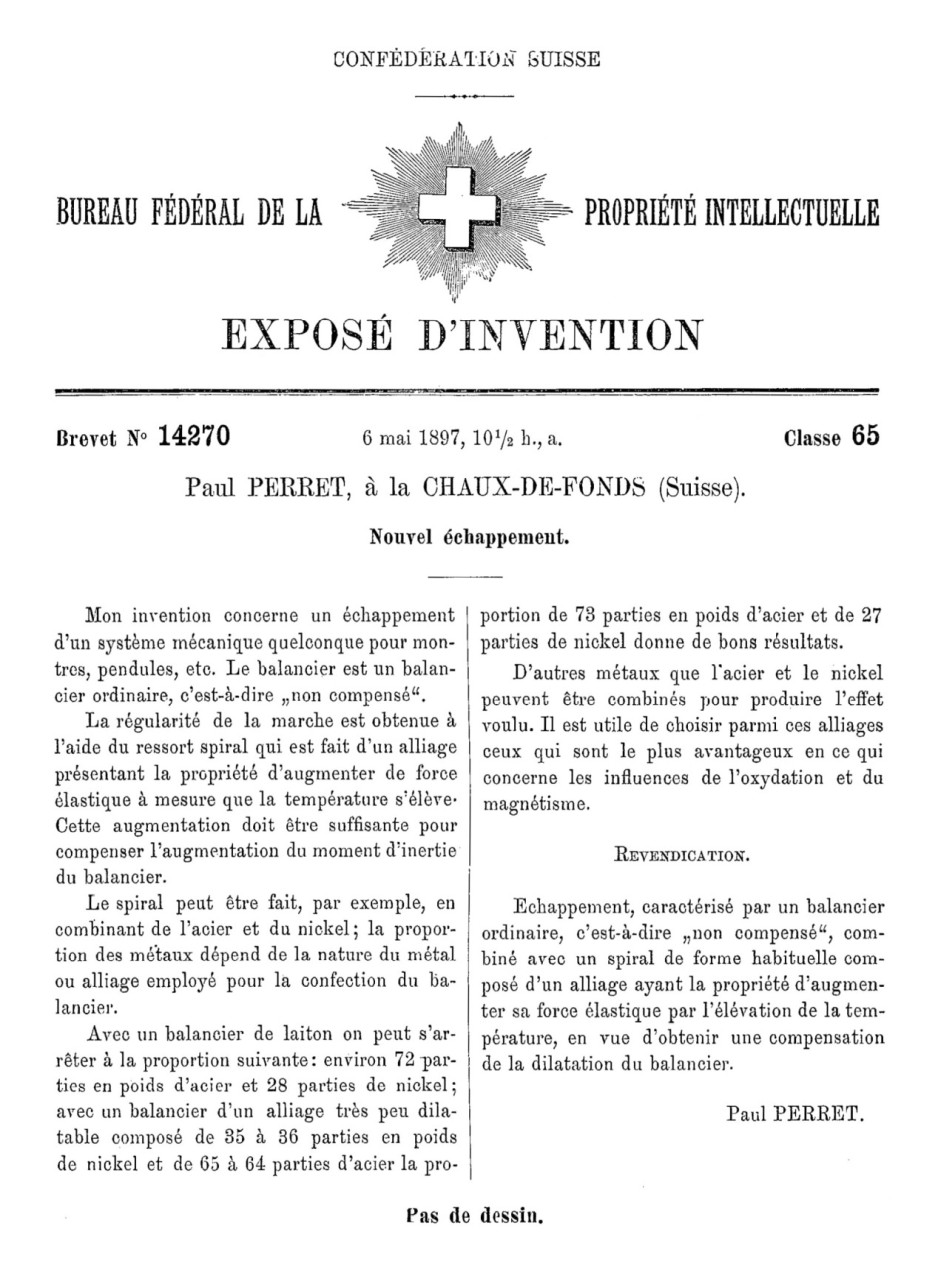
Figure 2 Paul Perret patent CH14270 for nickel steel balance springs: Click image to enlarge
The results are plotted as curve 1 in the figure reproduced here. This shows the thermoelastic coefficients on the y-axis plotted against increasing nickel concentrations on the x-axis. Curve 1 peaks in the positive region at around 36% nickel, corresponding to Invar, which caused the result that astonished Perret. It crosses the zero x-axis between 27% and 28% nickel and between 43% and 44% nickel. At these two points, the thermoelastic coefficient is zero and the elastic modulus of the alloy does not vary with temperature changes, another very unusual property.
On 6 May 1897, Perret applied for a Swiss patent on his idea, which was granted Swiss patent number 14270 on 15 January 1898, Figure 2. It only remained to put the idea into practice.
Guillaume subsequently recorded that on 20 August 1897, in Perret’s workshop in La Chaux-de-Fonds, he witnessed a watch with a plain, that is not compensated, balance and a nickel steel balance spring that ran at the same rate at temperatures of zero and 30 degrees Celsius. An uncompensated watch with a steel balance spring would run 330 seconds, or five and a half minutes, slower, so this was a significant breakthrough.
Invariable Elasticity?
It should be noted that the balance spring of the watch witnessed by Guillaume in Perret’s workshop did not have invariable elasticity; that is, it did not have an invariable modulus of elasticity.
The elasticity of a material is quantified by its modulus of elasticity or Young's modulus. This is defined as the ratio of stress to strain within the elastic region. Unfortunately, this definition means that a greater modulus of elasticity means that more stress must be applied to create a certain amount of strain, that is, a material with a greater modulus of elasticity is stiffer and less elastic than one with a lower modulus, which is in the opposite sense to what is meant by elastic.
A more elastic material is easier to stretch than one that is less elastic, and therefore has a lower modulus of elasticity. It would have been better and more logical if the modulus of elasticity was defined more normally as the ratio of the dependent variable strain to the independent variable stress, but it isn't and we are stuck with it.
It is sometimes thought that combining a balance spring of invariable elasticity, that is one having an invariable modulus of elasticity, and a balance with low thermal expansion would form an oscillator unaffected by changes in temperature, but that is not the case. It doesn't work because the stiffness of a spring is not determined solely by the modulus of elasticity of the material.
The modulus of elasticity of a material is a property that is independent of dimensions. A specific spring's stiffness depends on its elastic modulus and dimensions. A thicker spring is stiffer than a thinner one, even if their elastic moduli are exactly the same.
The stiffness of a flat spring such as a balance spring is proportional to the cube of its thickness, a factor that arises from the geometry of the spring's cross-section. This makes the spring's stiffness highly sensitive to changes in its thickness.
There are no materials with invariable elasticity and zero thermal expansion. This is why a material with invariable elasticity does not make a spring of invariable stiffness; thermal expansion due to increasing temperature makes the spring thicker, and therefore stiffer, even if its modulus of elasticity does not alter.
Guillaume summarised the problem and its solution very succinctly:
‘In practice, what one should look for is not an alloy whose thermoelastic coefficient is strictly zero, but an alloy such that the thermal expansion of the balance and the spring, and the thermoelastic variations of the latter, give a zero sum.’
This idea can be expressed algebraically, starting from the basic equation for the period of semi-oscillation of a balance from its moment of inertia \(I\) and the spring constant \(S\).
\[ T = \pi \sqrt{\frac{I}{S}} \]To make a balance spring oscillator whose frequency of oscillation is not affected by changes in temperature, the period must remain constant. When the thermal expansion of the balance and spring, and the variations in the elastic modulus of the spring, are included in the model, it is found that the materials of the balance and spring have to fulfil the following relationship,
\[ 2 \, \alpha_{\, balance} - 3 \, \alpha_{\, spring} - \gamma_{\, spring} = 0 \]where \( \alpha_{\, balance} \) is the thermal expansion of the balance, \( \alpha_{\, spring} \) is the thermal expansion of the spring and \( \gamma_{\, spring} \) is the thermoelasticity of the spring.
Creation of a temperature independent oscillator is then simply a matter of finding materials for the balance and spring that fulfil this condition.
Perret’s patent described two possible embodiments of the idea. The first features a balance spring made from an alloy of 28% nickel and 72% steel with a brass balance. The second uses a balance spring of 27% nickel and 73% steel with a balance made of an alloy of 35% to 36% nickel with very low expansion, that is an Invar balance.
In both cases, the balances are monometallic, made of a single metal, and uncut, not compensation balances. The only active thing they do is expand and contract with changes in temperature. The balance spring's combination of thermoelasticity and thermal expansion causes it to become sufficiently stiffer with increasing temperature to compensate for the balance's thermal expansion. To achieve this, the two nickel steel alloys Perret defined fall on either side of the point of zero thermoelastic effect between 27% and 28% nickel.
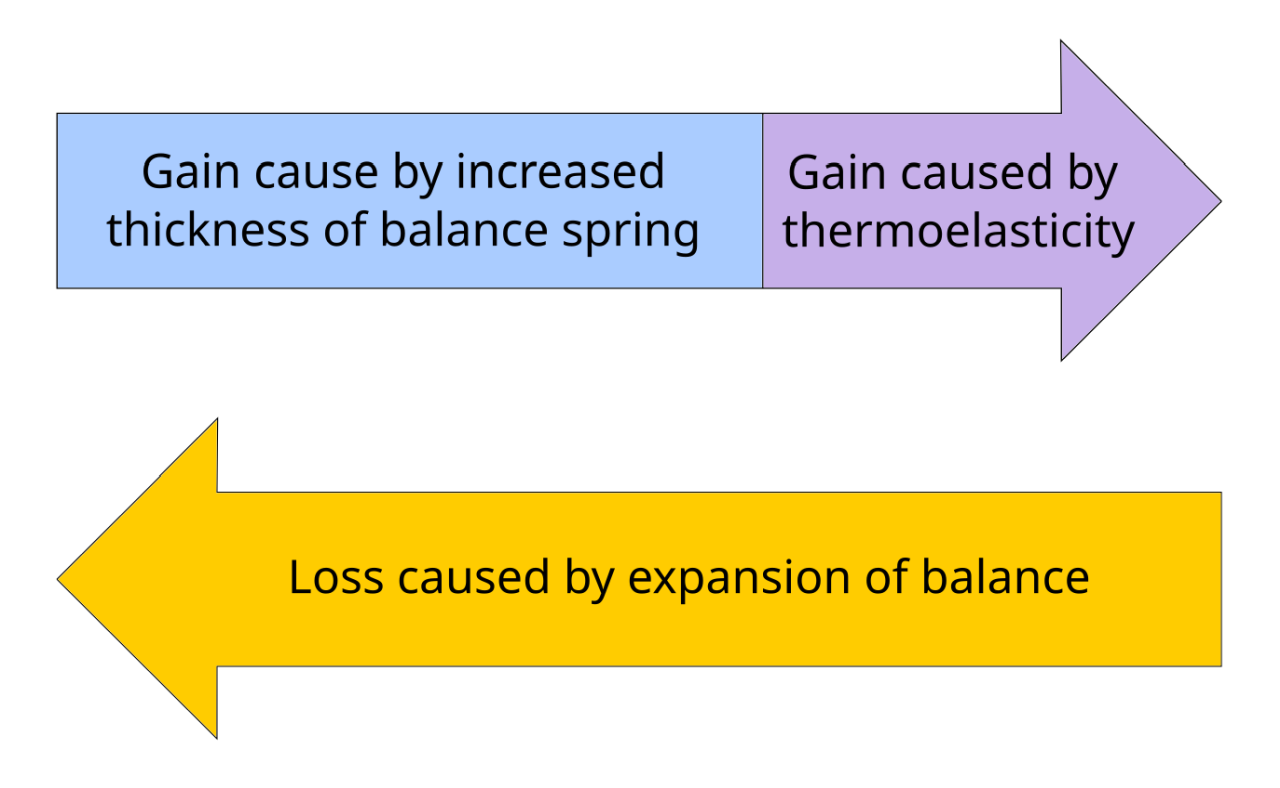
Figure 3 Thermoelastic and Thermal Expansion Effects: Click image to enlarge
The alloy with 28% nickel is in the region where the thermoelastic effect is positive. This effect, along with thermal expansion, increases the spring's stiffness to compensate for the expansion of a brass balance.
The thermal expansion of an Invar balance would be much less than that of a brass balance; thermal expansion of the spring causes a greater increase in stiffness than is necessary to compensate for this, which would result in a residual gain. The alloy with 27% nickel is in the region with a negative thermoelastic effect, reducing the modulus of elasticity to compensate for the excess increase in stiffness.
However, Perret dismissed the idea of making balances from Invar, saying that Invar presented no advantage over brass, because the nickel steel alloy for the spring could as easily be formulated to work with a brass balance as an Invar balance, and Invar has the disadvantage of being magnetic and difficult to work with. As a consequence, apart from a few experimental trials early on, Invar balances have never been used in watches.
Figure 3 shows the effects of thermal expansion and thermoelastic changes following a temperature increase of 30 degrees Celsius on the rate of a watch fitted with a 28% nickel steel balance spring and brass balance. Expansion of the balance causes a loss of 48 seconds per day, but the gains caused by the increase in stiffness of the balance spring, 29 seconds due to its thermal expansion and 19 seconds due to thermoelastic effect, compensate for this, resulting in an overall zero rate.
In 1897, Paul Perret was granted a British patent for this invention under international convention, which meant that Swiss patents were recognised in Britain and did not undergo a separate examination. This patent can be seen by clicking this link: British patent No 24,142. The invention is said to consist mainly of a balance spring made of “an alloy possessing the property of increasing its elastic force in proportion as the temperature rises”. The term “elastic force” is a poor and misleading description of what actually happens. The elastic force of the spring, the restoring torque or couple, is constantly varying at any temperature as the balance swings from one extreme of its rotation to the other, being a maximum at the extremes and zero at the neutral point. It is the stiffness of the balance spring that must increase to compensate for the increased moment of inertia of the balance and maintain a constant frequency of oscillation.

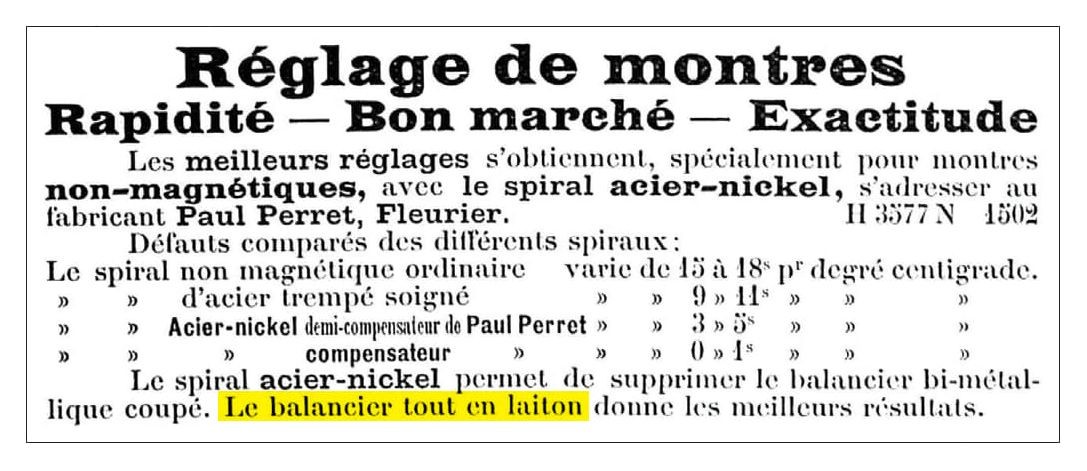
Figure 4 Advert for Paul Perret balance springs: Click image to enlarge
The first nickel steel balance springs were sold under the name of Paul Perret. Figure 4 is an advert for Paul Perret nickel steel balance springs from 1901. The statement at the bottom says that nickel steel balance springs make cut bimetallic balances, that is, compensation balances, unnecessary and that a balance made entirely of brass (‘tout en laiton’) gives the best results.
Paul Perret balance springs were relatively soft and had high internal friction. They also had a significant secondary error because their thermoelastic coefficients were not constant over a range of temperatures, making them unsuitable for the highest-quality watches. They were used to provide temperature compensation for millions of cheaper watches, which did not justify the cost of a compensation balance.
The quality of the alloy was improved significantly within a few years. One manufacturer of better-quality watches that was an early adopter of nickel steel balance springs was Tavannes. Many Tavannes watches from the First World War have monometallic balances and nickel steel balance springs.
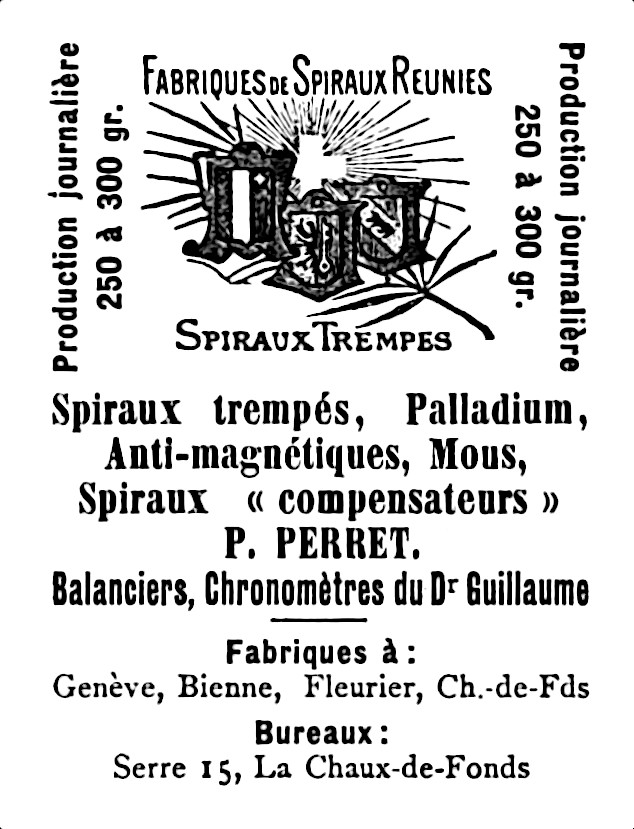
Fabriques de Spiraux Reunies advert, 1908:
Click image to enlarge
Manufacture of Paul Perret balance springs was taken over after Perret’s death by the Fabriques de Spiraux Reunies (United Balance Spring Manufacturers). An advert published by this company in 1908 is reproduced here, including “Spiraux « compensateur » P. Perret”. The combined daily output (production journalière) of 250 to 300 gross, where a gross is 144 units, that is 36,000 to 43,200 balance springs, about 10 million per annum, is impressive.
Many watches fitted with nickel steel balance springs have not survived, because of accidental damage to the balance spring during servicing due to the delicate nature of the spring. Lifting the balance away from the movement suspended from the balance spring, which many watchmakers do, is enough to distort a nickel steel balance spring. Even Elinvar springs can be damaged by this treatment.
An English company that used Paul Perret balance springs was H. Williamson of Coventry. Figure 5 shows one of their adverts from 1910 stating that patent Paul Perret nickel steel balance springs were used in their Coventry Astral watches. Figure 6 shows the balance and spring of a Coventry Astral watch from around that time.
The balance is monometallic, made from Maillechort, also called nickel silver, German silver or Argentan. Despite the word silver in some names, it does not contain any silver and the word refers to its appearance. It is a an alloy of copper, nickel and zinc.
Maillechort can be formulated to have a similar rate of thermal expansion to brass and is therefore suitable to be used as a balance with Paul Perret temperature compensation balance springs. It is harder than brass and doesn't tarnish, which is why Maillechort balances superseded brass. In Switzerland, nickel silver balances were frequently called simply nickel balances.
Figure 6 Paul Perret balance spring circa 1910: Click image to enlarge
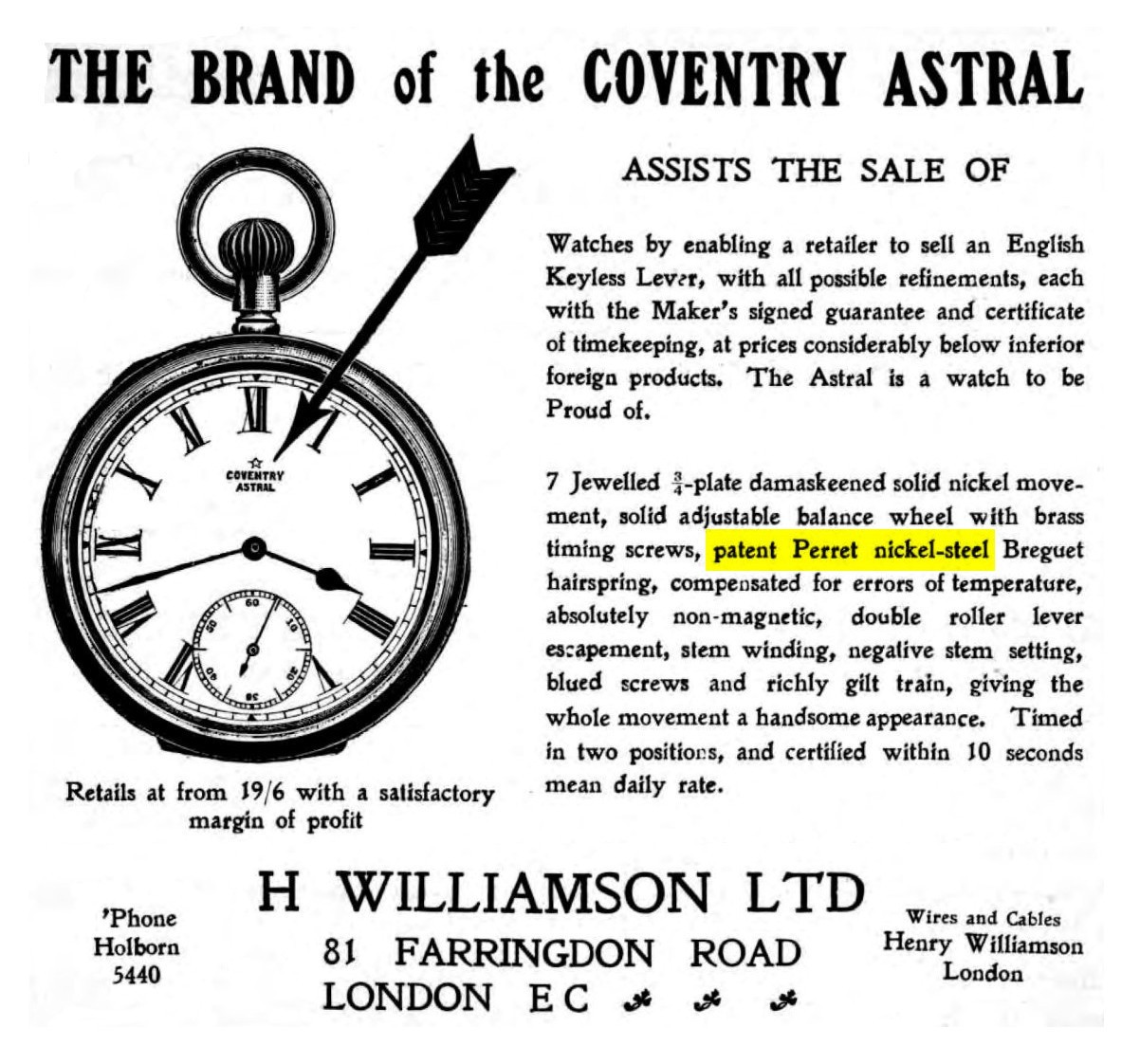
Figure 5 H Williamson advert 1910: Click image to enlarge
Back to the top of the page.
Dr Guillaume Balance Springs

Figure 1 Dr Guillaume balance spring in my grandfather's Rolex watch movement: Click image to enlarge
The first nickel steel balance springs sold under the name of Paul Perret were a revolution in temperature compensation. For the first time, errors in timekeeping caused by changes of temperature were compensated by the properties of the materials of the balance and spring, with no need for an expensive and delicate compensation balance.
However, the nickel steel alloy of the first Paul Perret springs had a relatively low elastic limit or yield strength, the point at which it stops behaving elastically and starts to permanently deform. This made the springs delicate, they could easily be deformed during handling when being initially fitted to the watch or during servicing. The alloy also had high internal friction, which caused damping of the balance oscillations.
After Paul Perret died in 1904, the rights to his balance spring patents were acquired by the Société des Fabriques de Spiraux Réunies, a company that had been formed in on 17 December 1895 by the merger of the five main Swiss balance spring manufacturers: Georges Sandoz, Charles Dufaux and Guye & Cie in Geneva, Baehni & Cie in Bienne and J. Huguenin-Girard in La Chaux-de-Fonds. The board was composed of the directors of these companies: Georges Sandoz, Charles Dufaux, Philippe-Auguste Guye and Jules Huguenin.
To improve the properties of the material used for nickel steel balance springs, experiments were made with adding alloying elements. For Guillaume and Pierre Chevenard, the metallurgist at the Imphy steelworks, the challenge was to increase its yield strength without affecting its thermoelastic characteristics, which gave balance springs their thermal compensation properties.
In line with the usual practice at the time, only small amounts of alloying elements were used. In the 1880s, it was found that adding 3% nickel to steel produced an alloy that was exceptionally strong and tough, beating all others at a famous trial in 1890 at the US Naval Ordnance Proving Ground in Annapolis, Maryland. This led to the widespread use of nickel steel armour for battleships, in artillery pieces such as the French 75mm field gun, and to Guillaume's discovery of Invar.
Adding small amounts of alloying elements has little effect on the modulus of elasticity of a material, but can significantly increase its yield strength. This manifests itself as an increase in hardness. This traditional method of alloying is called solution hardening, because the alloying elements are soluble in the main element at all temperatures. It works by atoms of the alloying elements taking up substitutional or interstitial positions within the crystal lattice, introducing local strains that impede the movement of dislocations. Copper alloyed with tin results in bronze, which is much harder than copper and gave rise the bronze age. Silver alloyed with 7½% of copper results in sterling silver, long used for coins because of its durability compared to pure silver.
On 17 June 1912 and 1 July 1912 respectively, Dr Guillaume and Société des Fabriques de Spiraux Réunies were granted two Swiss patent, 54715 and 54876, both of which have the same priority date of 20 February 1911. The priority date is the date that the application was submitted which, if the patent is approved or “granted”, is the date from which the invention is protected under patent law.
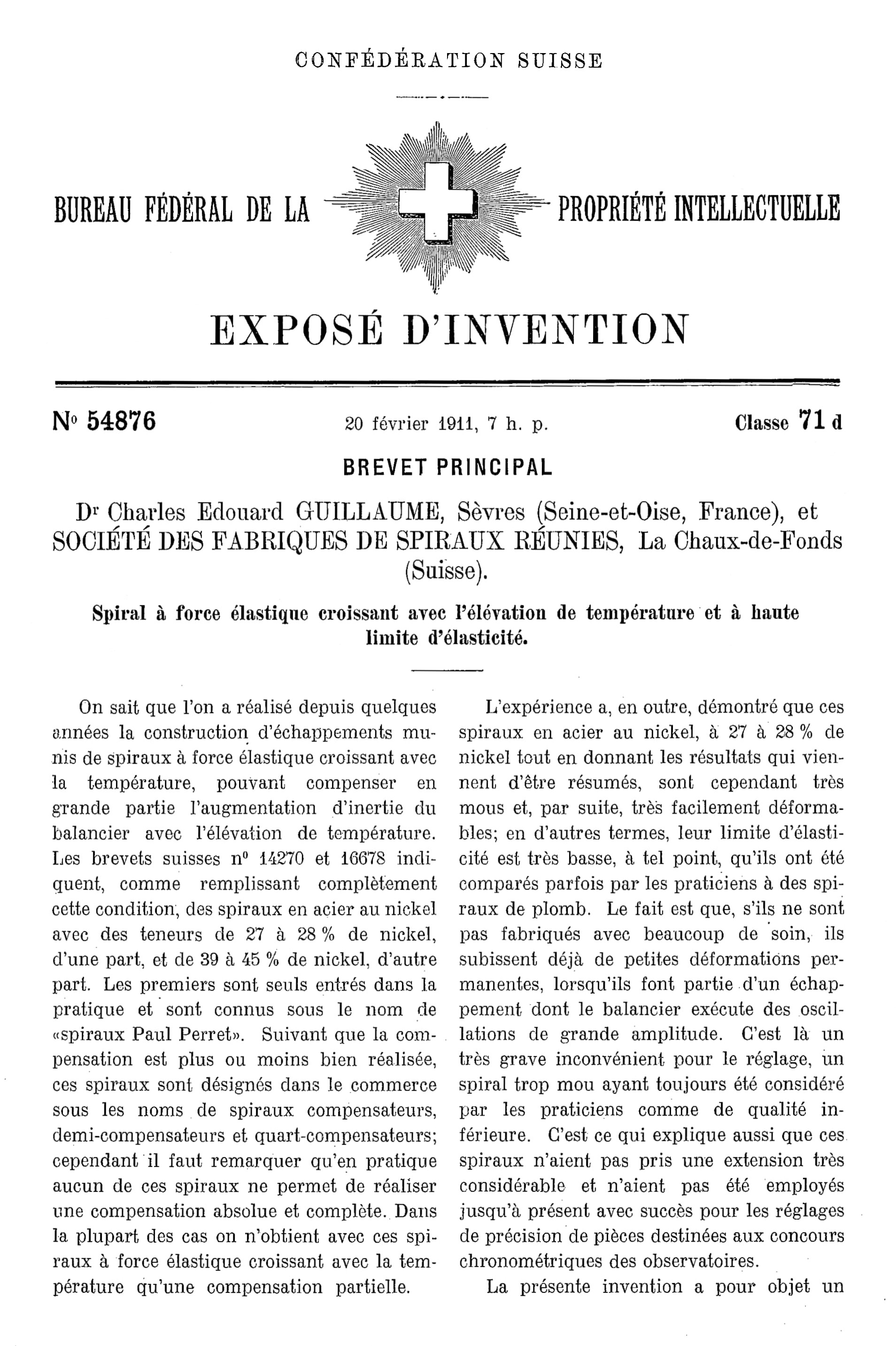
Figure 2 Swiss Patent 54876: Click image to enlarge
Patent 54715 is for an “Alliage à force élastique croissant avec la température et à haute limite d'élasticité”, or Alloy with elastic force increasing with temperature and high elastic limit. This was a patent for a nickel steel alloy with the property of its modulus of elasticity increasing with temperature, the same thermoelastic characteristic as the alloy of Paul Perret balance springs, but with a higher elastic limit.
Patent 54876 is for a “Spiral à force élastique croissant avec l'élévation de température et à haute limite d'élasticité”, or balance spring with elastic force increasing with increasing temperature and high elastic limit. This is essentially the same material as patent 54715, but with specific application to balance springs.
The statement that the “elastic force” of the spring increases with temperature is a poor expression. The “elastic force” of a balance spring, if it is taken to mean the restoring torque or couple that the spring exerts on the balance, depends on the angle of rotation of the balance. It varies as the balance swings, from zero at the neutral position to a maximum at the limits of the balance excursion. To compensate for thermal expansion of a balance monometallic balance, it is the stiffness of the balance spring that must increase as the temperature increases so that at any given angle of rotation of the balance, the restoring force is greater at a higher temperature to compensate for the increased moment of inertia of the balance due to its thermal expansion.
The increasing stiffness of the balance spring with increasing temperature is partially a result of a positive thermoelastic coefficient, meaning that its modulus of elasticity increases as the temperature rises, making it stiffer and less elastic. The increase in the modulus of elasticity and thermal expansion of the spring, particularly its thickness, produces an increase in the spring's stiffness that compensates for thermal expansion of the balance.
The new material was a nickel steel alloy containing 27-30.5% nickel, but with the addition of at least four of the elements carbon, chromium, manganese, molybdenum, silicon, tantalum, titanium, tungsten and vanadium. The proportion of each of these additional elements was between 0.2 and 4%, and their total amount in the alloy amounted to between 3.5% and 10%. The patent does not specify the exact amounts of the alloying elements; the objective was to secure protection of the invention without giving precise details that competitors could copy.
Balance springs made from this material were said to have an elastic limit comparable to that of hardened and tempered carbon steel springs, but that was rather an exaggeration. However, they are harder than the earlier simple binary nickel steel alloy of Paul Perret balance springs.
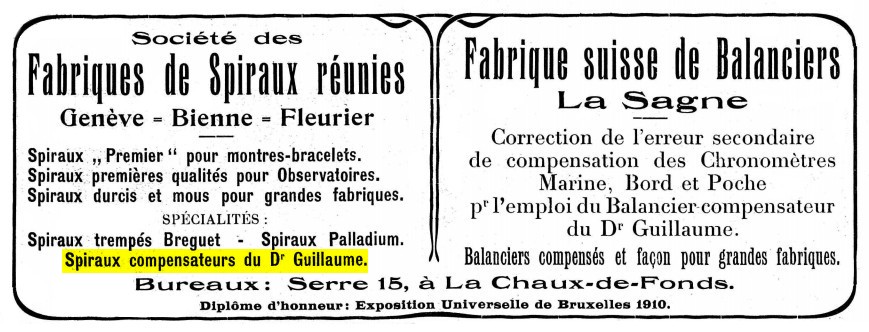
Figure 3 Advert for Dr Guillaume balance springs - Spiraux compensators du Dr Guillaume: Click image to enlarge
Balance springs made from the new alloy superseded Paul Perret springs and were called “spiraux Guillaume” (Guillaume spirals, or Guillaume balance springs). Figure 2 shows in the left half an advert by Fabriques de Spiraux Reunies from 1914 which lists ‘Spiraux compensators du Dr Guillaume’ (compensation balance springs of Dr Guillaume).
Within the same advert in the right half is a notice by Fabrique Suisse de Balanciers of La Sagne about correction of secondary errors (middle temperature error) in marine chronometers, deck (‘bord’) watches, and pocket watches by use of Dr Guillaume compensation balances.
My grandfather's wristwatch was made around 1918 and, as can be seen in Figure 1, it has a nickel steel balance spring. Given the date of manufacture, this must be a “Dr Guillaume spiral”. At first glance, the balance looks like a bimetallic compensation balance, which is puzzling.
Nickel steel balance springs needed no temperature compensation so, at the time this watch was made, were usually fitted with monometallic balances of brass or Maillechort. However, the balance of my grandfather's watch is clearly bimetallic, with steel arms and inner rim and brass outer rim. This looks like a compensation balance and there are cuts in the rims in the places where a compensation balance would usually be cut through. However, the these cuts do not go all the way through the rim, which means that sections of the rim cannot curl inwards or outwards in response to changes in temperature. This is therefore not a compensation balance, even though it looks like one.
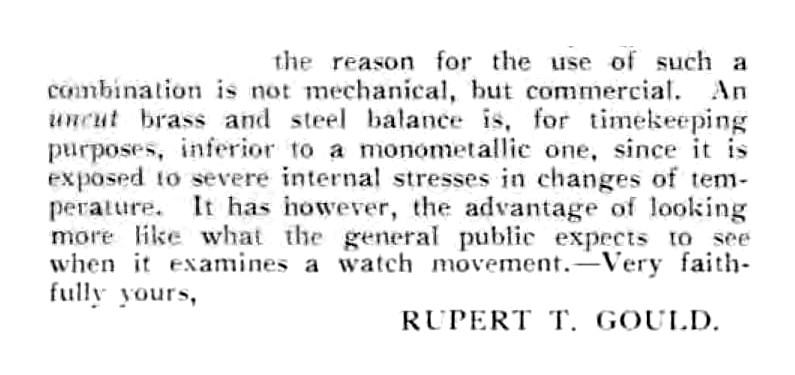
Figure 4 Horological Journal August 1924: Click image to enlarge
A nickel steel compensation spring not only makes a compensation balance unnecessary; fitting one would produce the undesired effect of the watch running faster as the temperature increased. This explains why the rims of this balance are not cut through, which prevents it from functioning as a compensation balance. So why was a bimetallic balance fitted at all?
The explanation was given by Rupert Gould in a letter to the Horological Journal as shown in Figure 4. It was because people expected to see a compensation balance in a high quality watch, so a balance was fitted that looked like a compensation balance but didn't behave like one.
The advertisement shown in Figure 3 includes “Balanciers compensés et façon ...” It appears that balanciers façon compensés was the term used for uncut bimetallic balances that looked like compensation balances.
Back to the top of the page.
Elinvar Balance Springs
Elinvar was a breakthrough in nickel steels alloys for balance springs, the first that could challenge carbon steel in observatory trials. The most surprising thing about Elinvar is that it doesn't have invariable elasticity, despite its name being derived from “elasticity invariable”.
If Elinvar really did have invariable elasticity, it would not be a suitable material for balance springs. This article explains why this is, and why Dr Guillaume gave Elinvar its misleading name.
As the importance of nickel steel alloys to the Imphy steelworks increased, Henri Fayol, the managing director of the company, recruited talented engineers to improve its technical capabilities. The most outstanding was Pierre Chevenard (1888–1960) who had graduated from the École Nationale Supérieure des Mines de Saint-Étienne in 1911. Chevenard set up a laboratory at Imphy for metallurgy, and he equipped it with precision instruments to measure the properties of alloys using small samples. In this way, a large number of alloys could be studied without making large castings.
In 1912, Chevenard experimented with adding significant proportions of manganese to nickel steel alloys in the Invar range to improve their casting properties. He discovered that nickel steel would accept much greater amounts of manganese, copper and chromium as alloying elements than had been thought possible. This also had interesting effects on the thermoelastic characteristics of nickel steel alloys.

Figure 1 : Thermoelastic variations of nickel steels alloys with zero and 12% chromium: Click image to enlarge
A nickel steel alloy with 10 to 12% chromium and small amounts of nickel, tungsten, carbon, manganese and silicon as solid solution hardening elements as before, was found to have better thermoelastic characteristics than the nickel steel alloy for which Dr Guillaume and the Société des Fabriques de Spiraux Réunies had been granted a patent in 1911, as well as greater hardness and lower internal friction than the simple nickel steel alloys used for Paul Perret balance springs.
The thermoelastic characteristics of nickel steel alloys with 12% chromium are shown as curve 2 in Figure 1. In contrast to curve 1, which cuts the zero line sharply at two points, curve two has a much flatter peak around the zero line. This is useful when making alloys with low thermoelastic effects, because they are less sensitive to the exact ratios of nickel to steel. As well as being less sensitive to chemical composition, this alloy also has a thermoelastic coefficient that varies less with temperature, meaning that its rate of change of stiffness over the temperature range of concern for watches is lower.
It is well known that Guillaume coined the name ‘Elinvar’ for this alloy from ‘invariable elasticity’. However, Elinvar is a misleading name, and the intersection of curve 2 with the zero x-axis is not representative of Elinvar, which has a much lower thermoelastic coefficient than steel, but it is not zero as the curve suggests.
It is also important to know that the stiffness of a spring is a property defined by Hooke's Law and depends not only on the modulus of elasticity of the spring's material but also on its shape, its geometry and dimensions.
Although Elinvar-type alloys can have a range of moduli of elasticity, the Elinvar of balance springs does not have invariable elasticity. It has a positive thermoelastic coefficient, which means that its elastic modulus increases with temperature, just like the nickel steel allop used for Paul Perret and Guillaume balance springs. Elinvar also expands when heated, increasing its stiffness. Dr Guillaume stated that the rate of thermal expansion of Elinvar is 8×10⁻⁶ or 8 parts per million per degree Celsius, which is about three-quarters that of steel and slightly less than half that of brass.
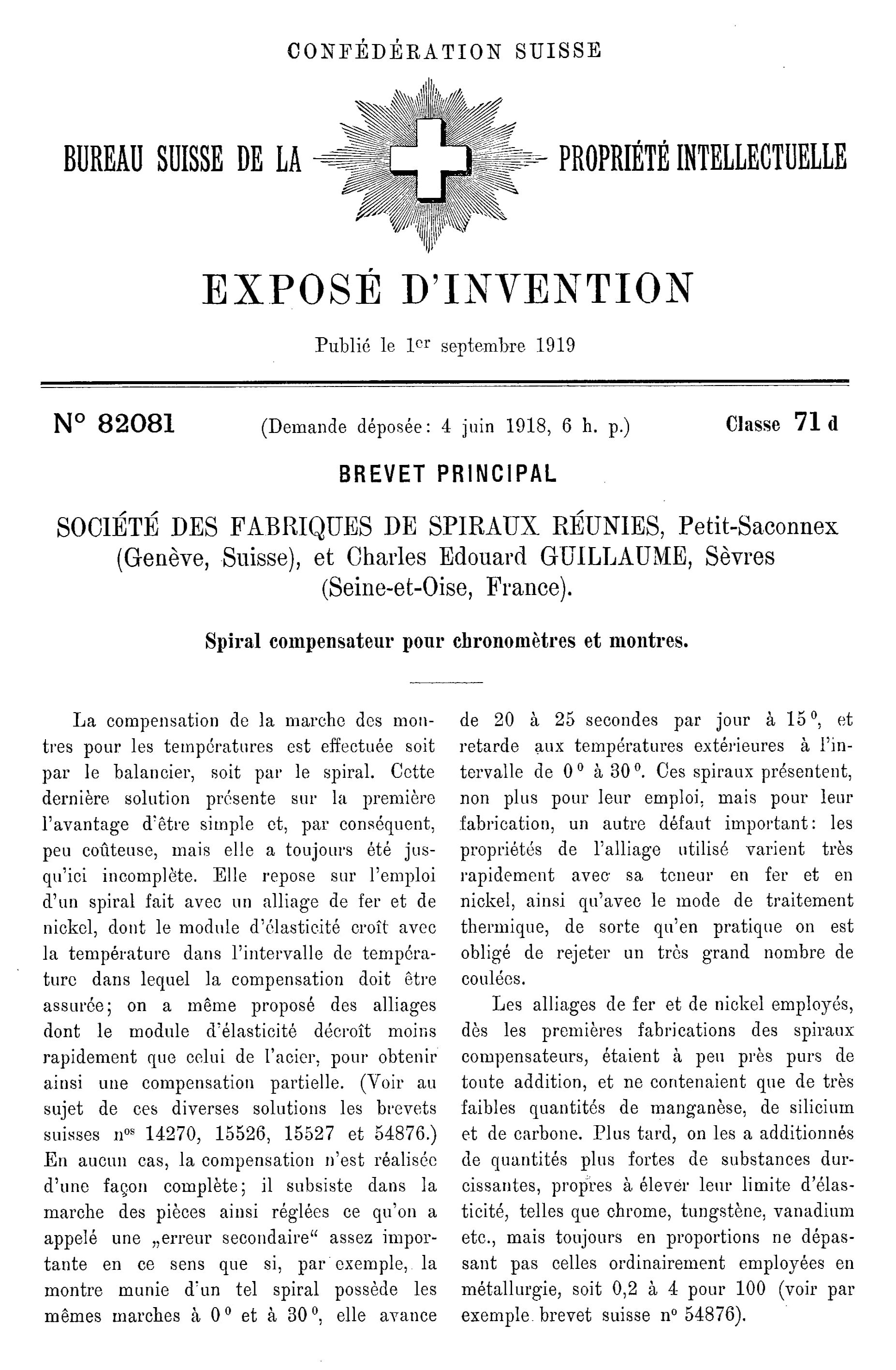
Figure 2 : Elinvar patent CH 82081, priority date 4 June 1918: Click image to enlarge
Even if Elinar did have invariable elasticity as a material, it would not make a balance spring that had invariable elasticity. The elasticity of a spring depends on the elastic modulus of its material and its physical dimensions. A thicker spring is stiffer than a thinner one. Elinvar expands as it is heated, which increases the dimensions of a spring and makes it stiffer.
In fact, Elinvar has positive thermoelasticity, which means that its modulus of elasticity increases and, as a material, it gets stiffer as its temperature increases.
When an Elinvar spring is heated, the two effects of an increase in its modulus of elasticity and thermal expansion cause the spring to get stiffer and exert a greater restoring force for a given angle that it is wound.
As with Paul Perret balance springs and Dr Guillaume spirals, Elinvar balance springs are used with monometallic, uncut, balances that expand when heated. The increase in stiffness of the balance spring compensates for the increase in the moment of inertia of the balance.
Elinvar springs are usually used with balances made of Maillechort, also called nickel silver, an alloy of copper with zinc and nickel that is non-magnetic, oxidation-resistant and harder than brass, although having the same thermal expansion rate.
The Elinvar alloy was discovered in 1913, but the Imphy steelworks could not produce it commercially before the First World War broke out in 1914. After that, the French army needed all the nickel steel produced by Imphy. Consequently, Elinvar balance springs were not manufactured until after the war.
The Société Des Fabriques De Spiraux Réunies and Dr Guillaume applied for a Swiss patent on 4 June 1918, which was granted number 82081 on 1 September 1919, Spiral compensateur pour chronomètres et montres, Figure 2.
A Misleading Name
The name Elinvar often leads to an erroneous assumption. Knowing that it is derived from élasticité invariable or invariable elasticity, it is assumed that a balance spring made from it will not change in stiffness with temperature changes. But this is wrong. In choosing the name Elinvar, Guillaume meant only to imply that the modulus of elasticity was invariable, not that a spring made from it would have invariable stiffness; he knew perfectly well that Elinvar expands when it is heated, which causes a spring made from it to increase in stiffness.
Guillaume was a scientist, a metrologist, and not a professional horologist, which may have influenced his thinking. For many applications, Elinvar can be regarded as having a modulus of elasticity that does not alter significantly with temperature changes, and after the fame he had gained from his earlier discovery being named Invar, another similar, catchy name would have been very tempting, even if it was not strictly accurate. But watches are very sensitive to changes in the stiffness of their balance springs, and Elinvar cannot have invariable elasticity when it is used for a watch balance spring, just as Invar cannot be taken as having zero thermal expansion when it is used as a pendulum rod.
Guillaume knew that nickel steel balance springs could not be made with invariable elasticity. Swiss patent 54876 of 1911 begins, ‘It is known that for several years, escapements have been constructed with balance springs whose elastic force increases with temperature, which largely compensate for the increase in the inertia of the balance with the temperature rise.' It is, therefore, strange that in some articles, Guillaume stated that Elinvar has invariable elasticity. However, in a paper about Elinvar presented to the French Academy of Sciences in July 1920, he added the following explanatory remark,
It should be noted, in fact, that the indication … of a zero value of the thermoelastic coefficient was intended, above all, to simplify the presentation. What we must look for in reality is an alloy endowed with a thermoelastic coefficient with very low linear variation and of a value such that its action, associated with the sum of the effects of expansion, acting in the opposite direction, of the balance spring and balance, leads to the perfect equalisation of the rate of chronometers throughout the temperature range of their use. [emphasis added]
So that’s it. Guillaume’s description of Elinvar as having a zero thermoelastic coefficient and the derivation of its name from invariable elasticity was intended to simplify things. Instead, it has caused more than a century of confusion.
In addiiton to the confusion caused by Guillaume's description and name for Elinvar, it must be remembered that a spring's stiffness depends on its elastic modulus and dimensions. Even if Elinvar did have invariable elasticity, it would not make a spring of invariable stiffness; thermal expansion would make the spring stiffer even if its modulus of elasticity did not alter.
Watches with monometallic balances do not achieve temperature compensation by using a balance spring with invariable elasticity and a balance with a low thermal expansion. Instead, they use a balance spring which increases in stiffness as its temperature increases, due to a combination of thermal expansion and thermoelastic variation, to compensate for the increasing inertia of the balance due to thermal expansion.
Ditisheim No. 44811
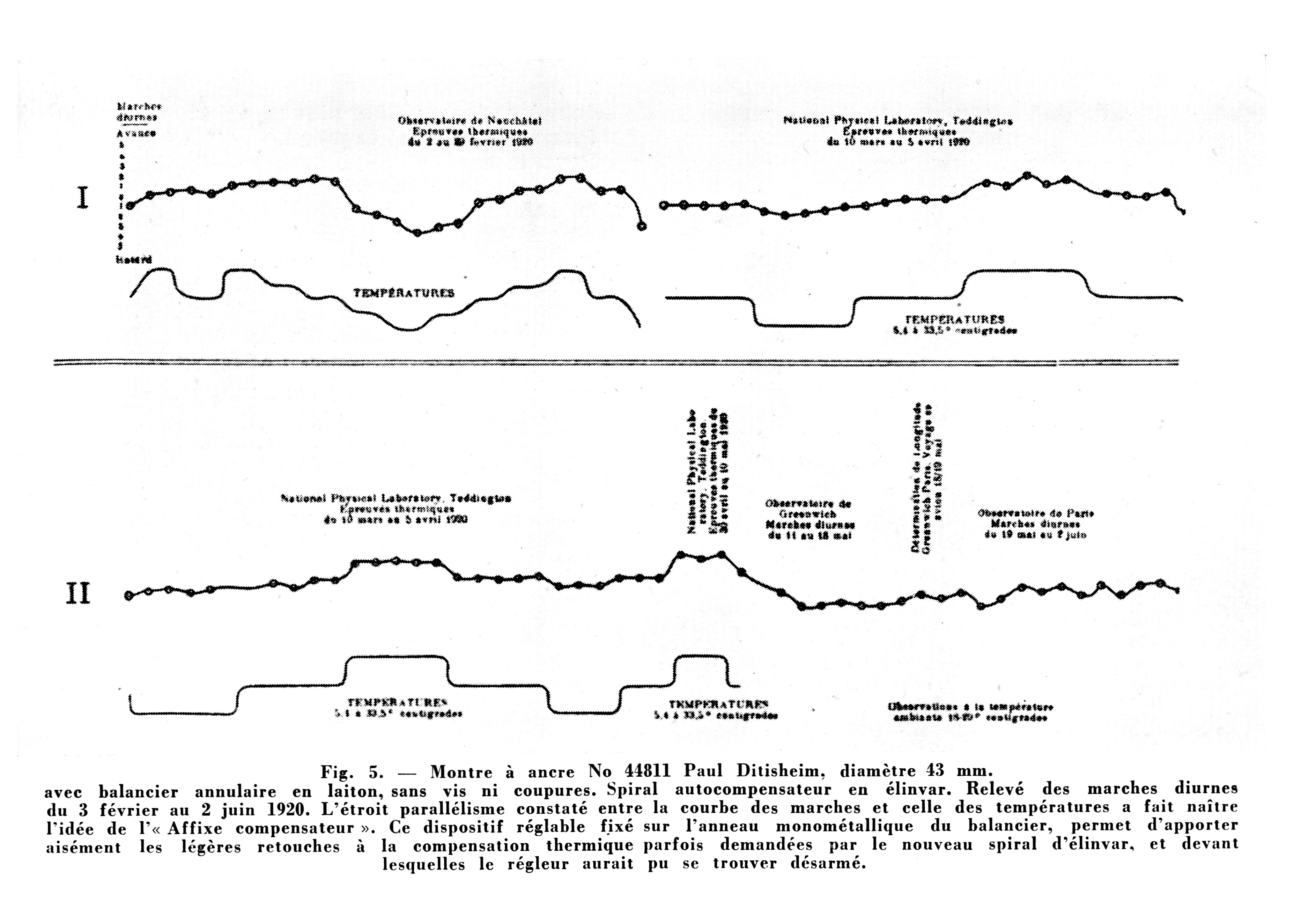
Figure 3 : Rate of Ditisheim 44811 at different temperatures: Click image to enlarge
The earlier nickel steel Paul Perret and Dr Guillaume balance springs did not perform well enough to be competitive in observatory trials, but Elinvar had a more linear thermoelastic response to changes in temperature. In 1920, Dr Guillaume gave one of the first Elinvar balance springs to Paul Ditisheim, who fitted it to a watch with his serial number 44811.
No. 44881 was a Ditisheim pocket watch, 43mm diameter with a lever escapement. The Elinvar balance spring was paired with a monometallic uncut balance made of brass that had no temperature compensation effect.
The watch was tested at different temperatures at the National Physical Laboratory (NPL), Teddington, from 16 March to 10 May 1920. The Kew/NPL records state “Special test for temperatures only – Copy of daily rates throughout given. 5 days ran at 67, 42, 67, 92, 67, 42, 67, 92, 67”. That is nine periods of five days, a total of 45 days. From 16 March to 10 May is a period of 55 days, which allowed one day between tests at different temperatures for the watch to acclimatise to the new temperature. The figures are temperatures in Fahrenheit.
The results of tests at the Observatory of Neuchatel in February 1920, and at the NPL and Greenwich Observatory are shown in figure 3. The tests at Neuchatel and the NPL at different temperatures are shown in the top part of the figure. In the lower part of the figure, the test at the NPL are shown to have been followed by period at Greenwich Observatory when the daily rate was recorded at room temperature. After this, the watch was taken to Paris by Ditisheim, along with 12 other watches with standard temperature compensation, in an experiment to measure the difference in longitude between the Greenwich and Paris observatories. The rate of the watch was then observed at the Paris Observatory between 19 May and 2 June.
The tests showed that the watch ran slightly faster at higher temperatures. The increasing stiffness of the Elinvar spring as the temperature increased was overcompensating for the expansion of the brass balance.
Guillaume suggested that this could be resolved by making a balance from brass with a higher zinc content, which would have a greater rate of thermal expansion. But Paul Ditisheim had a different solution, which will be discussed in the next article in this series.
Unfortunately, the current location of Ditisheim watch No. 44881, a very important watch in the history of precision horology, is not known.
Back to the top of the page.
Variable Expansion Rate Balances
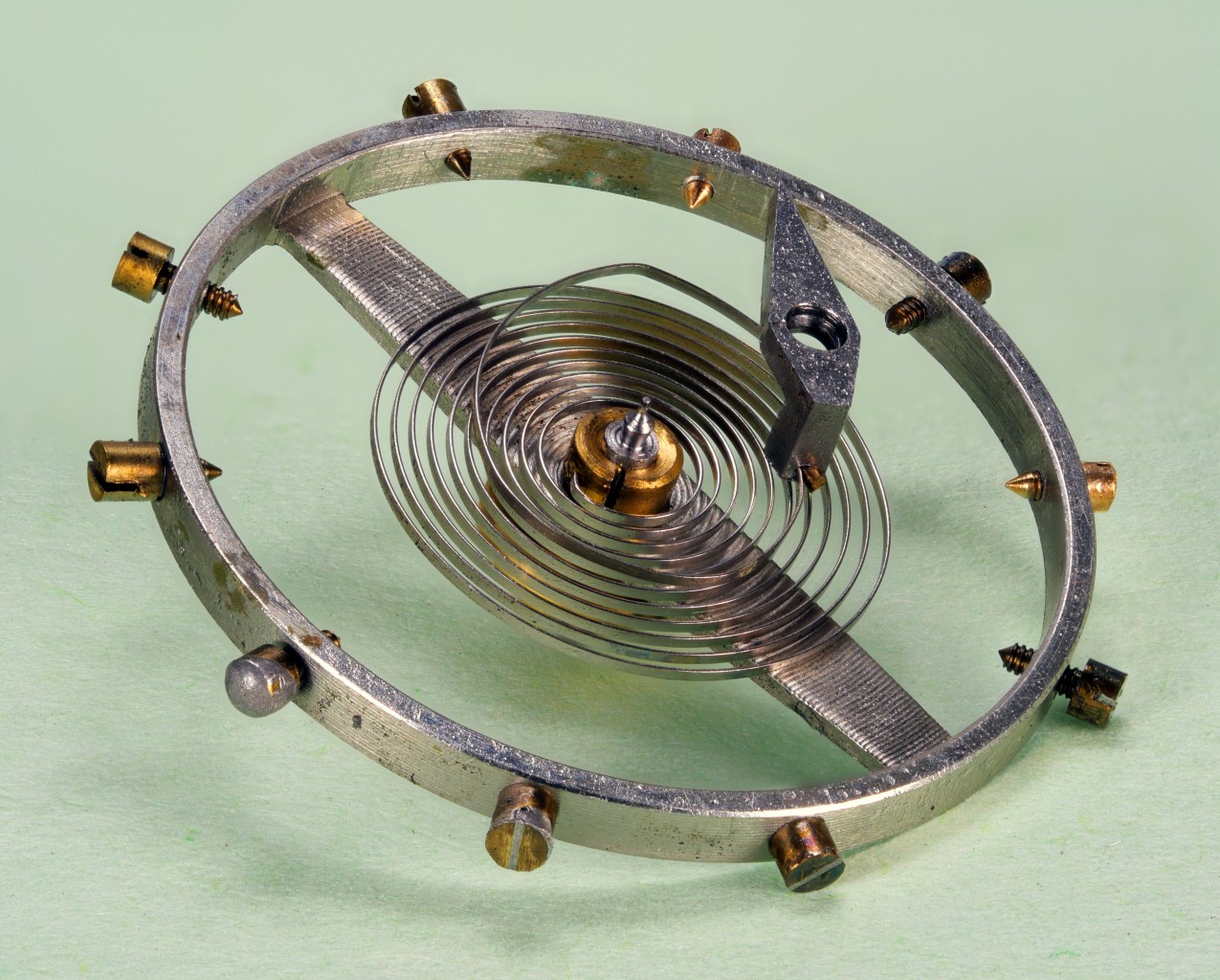
Nickel steel spring and monometallic balance from circa 1910: Click image to enlarge
Balances with variable rates of thermal expansion were invented to overcome the problem of variations in the thermal expansion and thermoelastic properties of nickel steel balance springs and monometallic balances.
Balances with variable rates of thermal expansion had existed since Pierre Le Roy (or Leroy) invented the compensation balance in 1765. Le Roy's first compensation balance used mercury thermometers to alter its radius of gyration in response to changes in temperature. This was soon superseded by the brass and steel compensation balance with cut bimetallic rims. These balances were needed to compensate for the large loss of rate of 11 seconds per day per degree Celsius, or 330 seconds per day over a range of 30 degrees Celsius, caused by the thermoelastic variations of steel balance springs.
Traditional compensation balances were difficult, and therefore expansive, to true and adjust to give the correct rate of compensation. Because they had to compensate for the large losses in rate caused by steel springs, their cut rims had to be made thin, in order to provide sufficient movement inwards and outwards. This made the rim sections weak and flexible, vulnerable to damage during handling and affected by centrifugal force during operation, which was particularly significant in box chronometers with their large diameter balances.
Nickel steel balance springs had much smaller thermoelastic variations than steel balance springs. They were used with plain balances with uncut rims. The rims were made of a single metal and hence the balances are called monometallic, to distinguish them from compensation balances with bimetallic rims. The photo here shows a nickel steel balance spring and monometallic balance made in around 1910.
The nickel steel alloy was formulated so that the increase in stiffness of balance springs made from it compensated for the expansion of the balance. When the match between thermal variations of spring and balance was perfect, their was no variation in rate as the temperature varied. But achieving the perfect alloy was impossible in practice, and most nickel steel springs caused small variations of a few seconds per day with changes in temperature.
The first person to consider this problem was Paul Perret, the inventor of the nickel steel balance spring, who in 1897 invented an ovalising balance to allow the effective rate of expansion of the balance to be varied to match the thermoelastic characteristics of individual nickel steel balance springs. However, the earliest nickel steel balance springs also had a significant error at the middle temperature and Perret's invention was not used. Elinvar balance springs had a much more linear thermoelastic characteristics, which meant that the idea of a balance which allowed small adjustments to its thermal expansion was revived by Paul Ditisheim.
A traditional compensation balance was designed to compensate for the large loss of rate with increasing temperature caused by a steel balance spring. The variable expansion rate balances conceived by Perret and used by Ditisheim did not have to compensate for a large loss of rate; they were used to adjust the balance to much smaller gains or losses in rate caused by nickel steel balance springs. This allowed them to be more rigid and easier to construct, avoiding many of the problems that made traditional compensation so problematic and expensive.
The Source of the Problem
The first nickel steel alloys for watch balance springs were created in 1897 for Paul Perret and Dr Guillaume by the steelworks at Imphy. The Imphy steelworks primarily made large melts of nickel steel for armour plate, so making small batches of nickel steel for balance springs was challenging, and achieving very precise alloying was difficult given the technology of the era.
The alloying process at Imphy used open crucibles for melting and mixing alloys. This was not capable of producing alloys of precise and completely homogeneous composition. Flux materials were added to provide protection from atmospheric oxidation, to absorb impurities and provide thermal insulation for the melt. These introduced impurities and, at the end of the melt, were raked-off as slag, carrying away some of the alloying elements. Natural thermal convection currents in the crucible would provide some mixing, but would be insufficient for homogenisation of precision alloys and manual stirring was likely employed, probably using carbon or clay-graphite rods. This would also introduce contamination, and it was insufficient to ensure complete mixing, meaning it was not possible to perfectly mix the alloying elements.
These deficiencies in mixing resulted in variations in the resulting nickel steel alloys that caused balance springs made from them to have inconsistent thermal expansion and thermoelastic properties. The alloys were tested and those with properties closest to those required were selected and the balance returned to be reformulated by remelting and alloying. However, it was difficult to produce alloys with exactly the changing rate of stiffness with increasing temperature to exactly compensate for the thermal expansion of a balance.
Dr Guillaume explained the problem succinctly:
It has been found that the elastic properties sought (elasticity increasing with the temperature and high elastic limit) depend to a certain extent on the impurities which usually accompany the several elements constituting the alloy used, even when these alloys are made from the most pure products obtainable by metallurgy; this dependence is such that two alloys prepared from elements in the same apparent proportions from materials technically pure but of different origin have not exactly the same elastic properties. Even when using the same materials the alloys obtained have not always strictly the same composition and the same elastic properties ; this arises from the fact that during the fusion of the alloy certain elements may be more or less oxidised in the crucible and thus pass into the slag; the alloy has not then strictly the composition represented by the proportions of the products used for preparing it. One cannot therefore prescribe strict and absolute proportions and it can only be said that when employing for making the alloys the pure materials obtainable in commerce within the aforesaid limits there is obtained a metal possessing to a more or less perfect degree the desired properties, namely elasticity increasing with rise of temperature and high elastic limit. The proportions to be adopted in making the alloy for the spring vary moreover to a certain extent with the nature of the metals used in the construction of the balance to which the spring is to be applied.
Because of this, from the very start Paul Perret realised that a means of altering the rate of thermal expansion of the balance would allow the balance to be tuned or adjusted to the characteristics of the balance spring it was paired with.
The adjustment required was only small, plus or minus a few seconds in twenty four hours over a temperature interval of thirty degrees compared with the loss of five and a half minutes caused by a carbon steel spring. Perret conceived of a balance with a rim having a greater rate of thermal expansion than the arms so that the rim would become increasingly oval as the temperature varied away from the normal. The rate of change of the radius of gyration could be altered by moving screws around the rim. Perret documented this idea in a letter to Guillaume in 1897.
However, the performance of the first nickel steel balance springs did not warrant such fine adjustment. The variation in their thermoelastic response to changes in temperature was non-linear, causing a secondary error at the middle temperature of twenty to thirty seconds per day. Because of this they were not suitable for the highest grade watches. Perret's invention of an ovalising balance was not used.
Elinvar was a breakthrough, to the extent that it is often thought to be the first nickel steel alloy used for compensation springs. However, the aspect that differentiated Elinvar most from the nickel steel alloys that had gone before was its virtually linear thermoelastic response to changes in temperature. This eliminated the secondary error at the central temperature of the earlier alloys. With a linear increase in stiffness as the temperature increased, Elinvar was able to rival carbon steel as a balance spring material.
Rate of Ditisheim 44811 at different temperatures: Click image to enlarge
In 1920, Dr Guillaume gave one of the first Elinvar balance springs to Paul Ditisheim, who fitted it to a watch with his serial number 44811. The balance was brass, uncut and without screws. This watch was subjected to special temperature tests at the observatories at Neuchatel and Paris, at the National Physical Laboratory in Teddington and at Greenwich.
The results of these tests are summarised in the figure reproduced here. The captions says:
Fig. 5. — Anchor watch No. 44811 Paul Ditisheim, diameter 43 mm with annular brass balance, without screws or cuts. Self-compensating balance spring in élinvar. Record of daily rates from February 3 to June 2, 1920. The close parallelism observed between the curve of the rates and that of the temperatures gave rise to the idea of the “Compensating Affix.” This adjustable device fixed to the monometallic ring of the balance makes it easy to make the slight adjustments to the thermal compensation sometimes required by the new élinvar balance spring, and before which the adjuster could have found himself helpless.
The performance of the watch was excellent, although it exhibited a small increase in rate with increasing temperature because the compensation provided by the balance spring was greater than required to compensate for the increase in the moment of inertia of the balance due to its thermal expansion. The results of the tests at the NPL have not been located and may be lost, but from the graph it appears that the rate amounted to an increase of no more than four seconds per day for a temperature increase from 42 to 92 degrees Fahrenheit, that is 0.08 seconds per day per degree Fahrenheit.
To pass the Kew Class A test, the mean change of rate with change of temperature had to be less than one third of a second per day per degree Fahrenheit. Zero variation would gain 20 marks. Ditisheim's watch number 44811 was not entered for a Class A trial, but with a variation of 0.08 seconds per day per degree Fahrenheit it passed the minimum requirement and would have been awarded 15.2 marks out of 20 for temperature compensation.
This watch by Ditisheim deserves to be better known. It was the first watch with a temperature compensating nickel steel balance spring subjected to observatory tests, and the results showed that nickel steel balance springs could, with a little more development, be a serious assault on the dominance of the carbon steel balance spring in precision observatory trials. Ditisheim watch number 44811 was therefore a pioneer in modern temperature compensation. However, very few people have heard of the watch, and its current whereabouts are unknown.
Although the temperature compensation of the watch was very good, good enough to pass the Kew Class A test, it was not good enough for Ditisheim, who was used to scoring 95 marks in Kew A trials. Ditisheim entered twelve other watches with conventional temperature compensation for Class A certificates at the same time as number 44811 was being tested. The highest scoring of these received 96.9 marks, and the twelve averaged 94.9 marks. Ditisheim subsequently took these twelve watches on a flight to Paris to determine the difference in longitude between Greenwich and Paris.
If number 44811 had been fitted with a steel balance spring and a compensation balance, the temperature compensation could have been adjusted by moving screws along the bimetallic rim sections. But with an Elinvar spring and a plain, uncut, monometallic balance, moving screws around the rim would be pointless because all parts of the rim expanded at the same rate.
Guillaume suggested that monometallic balances could be made from a selection of brasses with differing amounts of zinc, and therefore different expansion rates, and a balance selected to match the thermal characteristics of each Elinvar spring. He remarked that between Invar and brass was a wide range of rates of thermal expansion that could be used. However, this required fitting a balance and spring to a watch and measuring its rates under varying temperatures, and then changing the balance and repeating the test. Selecting balances to match springs this way was not a practical proposition because of the time and effort required.
With a flash of genius, Ditisheim realised that instead of trying to select a balance with exactly the right thermal characteristics for an Elinvar spring, the rate of thermal expansion of a brass balance could be made adjustable so that it could be matched to the characteristics of the spring.
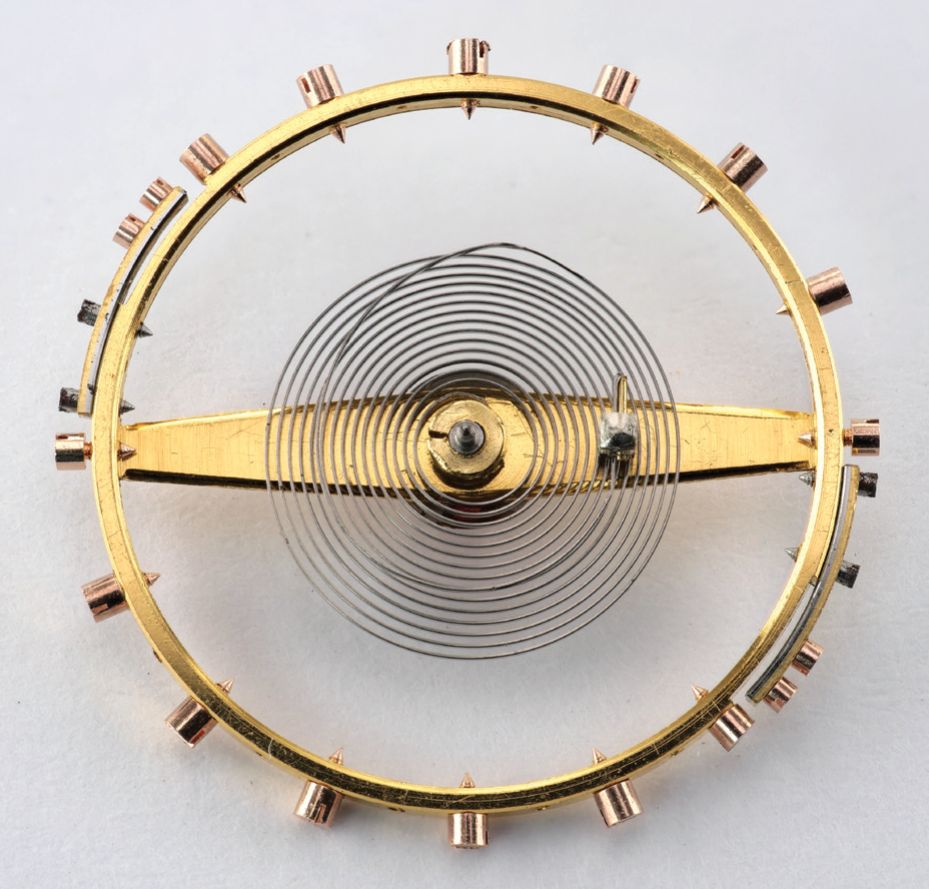
Monometallic brass balance with Affixes: Click image to enlarge

Adjusting effect of Affixes: Click image to enlarge
To provide the necessary adjustment, Ditisheim fitted plain brass balances with small bimetallic "affixes" on their rims. By moving screws along these affixes, or using heavier or lighter screws, the rate of thermal expansion of the radius of gyration of the balance could be fine tuned to match the compensation provided by an Elinvar balance spring.
The photo here shows an Affix balance from a Ditisheim watch. Although the temperature compensation of an Elinvar spring fitted to a plain brass balance was already good enough for to pass the Kew “A” trial, and therefore good enough for everyday wear, Ditisheim was a perfectionist and fitted his watches with Affix balances.
It is the rate of thermal expansion of the radius of gyration of a balance, which in simple terms can be thought of as the radius of the rim, that determines how many seconds of loss per day per degree Celsius it causes. A watch with a brass balance and carbon steel balance spring will lose 11 seconds per day for a rise in temperature of one degree Celsius. Of this loss, 1.6 seconds are caused by the thermal expansion of the balance, which for a rise in temperature of 30 degrees Celsius is a loss of 48 seconds per day.
The bimetallic Affixes that Ditisheim fixed to the rim of a balance allowed its rate of thermal expansion to be adjusted. By fitting Affixes that curled outwards as the temperature increased, the effective rate of thermal expansion of the balance was increased. Reversing the bimetallic strips so that they curled inwards as the temperature increased reduced the rate of expansion. By this means, the rate of thermal expansion of a balance could be adjusted to match the characteristics of an individual Elinvar balance spring.
The diagram here shows this effect. A brass balance causes a loss with increasing temperature, shown as the solid line sloping downwards in the lower part of the figure. An Elinvar balance spring increases in stiffness as the temperature rises, causing a gain. The gain caused by a perfect balance spring is shown by the dotted line in the top of the figure, but because the manufacturing variations already discussed, this was rarely obtained. The range of gains caused by Grade 1 Elinvar balance springs is shown by the shaded grey area in the top of the figure. Without any way of adjusting the gain caused by the spring or the loss caused by the balance, the temperature compensation would be imperfect and the watch would either lose or gain, depending on the characteristics of the Elinvar spring it was fitted with.
The shaded grey area around the line of the loss caused by the brass balance shows the range of adjustments to its rate that were made possible by fitting bimetallic Affixes to its rim. With careful adjustment, these allowed the rate of loss caused by the balance to be altered to match the gain caused by an individual Elinvar balance spring.
This surprised Guillaume, who had thought that the limit of what was possible had already been achieved. Ditisheim was granted two Swiss patents for this invention. The application for the first was submitted on 31 August 1920, followed by an application for an additional or supplementary patent submitted on 25 August 1921. The patents subsequently granted were CH 91169, published 17 October 1921, and CH 98234, published 1 March 1923.
Although the combination of a carbon steel balance spring with a bimetallic compensation balance had dominated the results of observatory trials, Ditisheim pointed out the advantages of an Elinvar balance spring used with a monometallic balance with compensating affixes.
- The uncompensated residue of an Elinvar balance spring and monometallic balance is less than one hundredth of the error of a steel spring that a compensating balance must correct, and the problems an adjuster must combat are reduced in a similar proportion.
- Equilibrium (i.e. poise) at any temperature is almost entirely ensured by the monometallic portion of the balance and easily achieved.
- Centrifugal force has no effect on the monometallic balance, and its effect on the short Affixes is completely negligible.
Ditisheim later used balances with small sections of brass embedded in their steel rims. This necessitated the rims being cut in a manner analogous to a traditional compensation balance. The advantage of this type of balance was most likely that it was cheaper to manufacture than an Affix balance, but cutting the rim reintroduced flexibility like a traditional cut compensation balance. However, in a watch size balance, scale effects mean that this was probably negligible.
Ovalising Balances

Sketch by Paul Perret for his ovalising balance in a letter to Guillaume dated September 1897: Click image to enlarge
The ovalising balance was invented by Paul Perret, who documented his idea in a letter to Guillaume in 1897. Perret’s idea was a balance with a rim having a greater rate of thermal expansion than the arms, so that the rim would become increasingly oval as the temperature changed. The rate of change of the radius of gyration could be altered by moving screws around the rim.
In his letter to Guillaume, Perret sent the sketch reproduced here, saying “Here is the balance I designed: it consists of an arm to which the rim is screwed. If the arm is made of a metal that is not very expandable and the rim is very expandable, the rim will deform as indicated by the dotted line; if you place a mass at A, you will have little effect, while at B, you will have more.”
This type of balance was described by Paul Ditisheim in the Horological Journal in December 1925, who attributed its invention to Charles Volet.
Charles Volet was Swiss. Born in 1895 at Vevey in the canton of Vaud, he received a degree in physics and mathematics from the University of Lausanne. In 1917, he joined the International Bureau of Weights and Measures. He worked closely with Charles-Édouard Guillaume in his research on nickel-steels, steels with a high percentage of chromium and carbon, including Elinvar, and studied the metrological properties of different brasses (copper-zinc and copper-zinc-nickel alloys), which were used to make balances for use with nickel steel balance springs such as Elinvar.
In an article published in the May and June 1920 issues of the Journal suisse d'Horlogerie et de Bijouterie, Volet described and analysed mathematically several new balances for chronometers, including ovalising balances, which he called balanciers différentiels non coupés (uncut differential balances). The figure from the article reproduced here shows, at the top, a balance for a box or marine chronometer, and a watch balance at the bottom. In his analysis, Volet assumed that the arms would be made of Invar and the rims of brass.
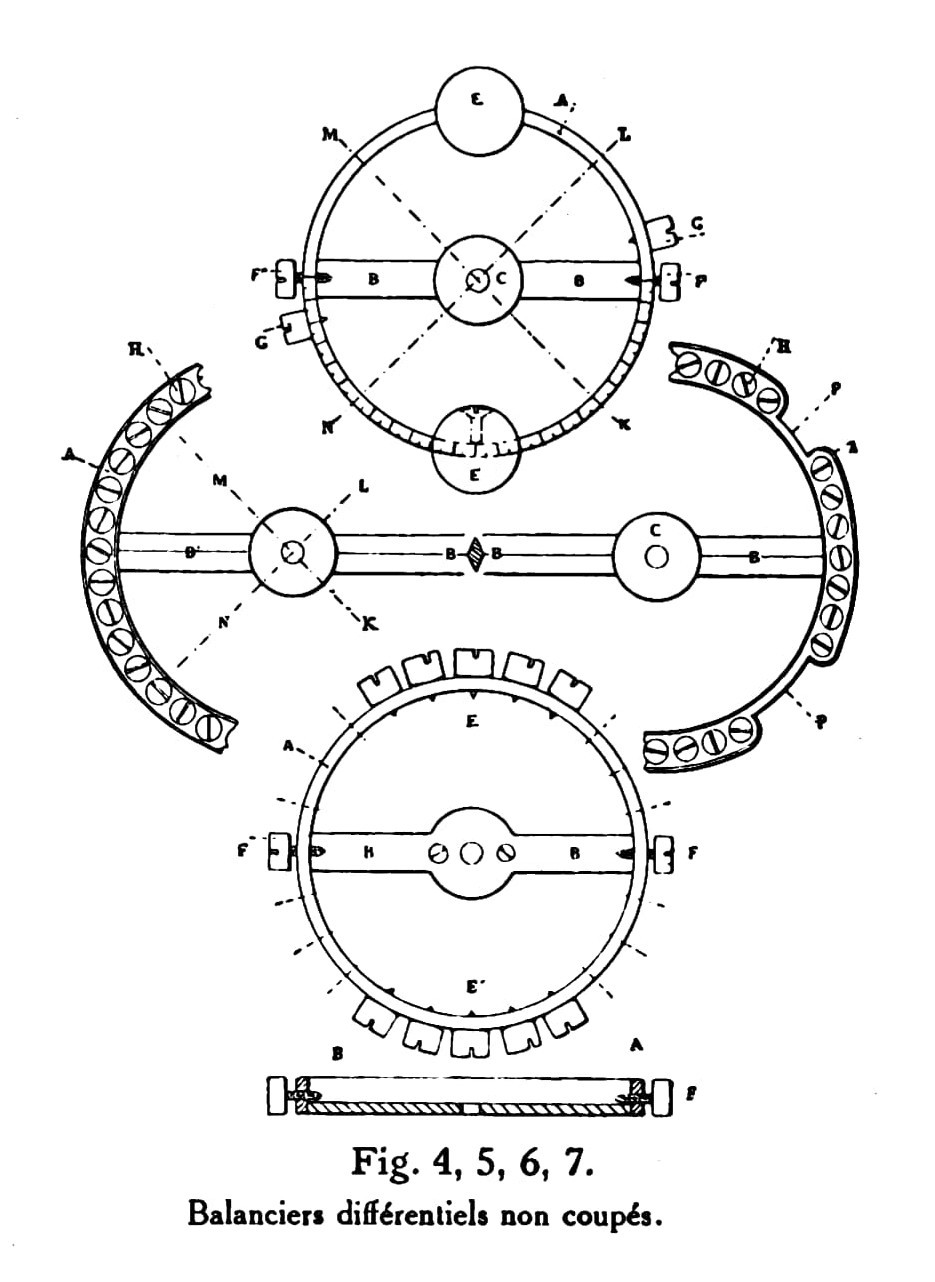
Volet’s figure of uncut differential (ovalising) balances: Click image to enlarge
In his article, Volet did not claim to have invented these balances himself, but remarked;
Le deuxième type de balancier différentiel que nous nous proposons de décrire, construit comme le précédent avec la collaboration des Ateliers Paul Ditisheim, se distingue en ce que la serge n'est pas sectionnée ... Sous l'influence d'une variation de la température, la serge s'ovalise très légèrement, ses différents points s'éloignent ou se rapprochent donc de l'axe de rotation dans des proportions inégales.
[The second type of differential balance that we propose to describe, built like the previous one in collaboration with the Paul Ditisheim Workshops, is distinguished by the fact that the rim is not sectioned ... Under the influence of a temperature variation, the rim becomes very slightly oval, and its various points therefore move away from or towards the axis of rotation in unequal proportions.]
From this it seems clear that Ditisheim got to know about the ovalising balance when Volet asked him to make one, presumably to experimentally verify the concept, and assumed that it was an invention of Volet’s. However, it seems most likely that, rather than inventing the ovalising balance completely independently, Volet learned of Paul Perret’s invention from Guillaume.
Swiss patent number 99077 for various designs of compensating balances, including the ovalising balance, was granted to Ditisheim and Volet on 16 May 1923, with a priority date of 4 February 1922.
The ovalising balance that has been described in so many books as Volet’s invention was, in fact, invented in 1897 by Paul Perret.
Two further instances of ovalising balances are interesting.
Straumann
Reinhard Straumann searched for a material with thermal anisotropy, i.e. with different rates of thermal expansion in different directions. After extensive studies and metallurgical experiments he found this property in a zinc cadmium alloy. Zinc crystals have a coefficient of expansion along the longitudinal axis that is about 5 times greater than that at right angles. For the measurements of the effect, Straumann developed a highly sensitivity “microdilatometer” or micro-expansion meter.
The zinc cadmium alloy was rolled into sheets, which caused the crystals to arrange longitudinally in the direction of rolling, and consequently the sheet to have a greater coefficient of expansion along the line of rolling than at right angles to it. Balances were cut from the sheet with the arms in the direction of rolling. Increasing temperature caused the arms to lengthen more than the rim expanded, so the rim became oval.
It appears that Straumann's anisotropic zinc alloy ovalising balance didn't go into production, there are no known examples of such a balance.
Hamilton
During the Second World War, the American Hamilton watch company produced their Model 21 marine chronometer. The US Naval Bureau of Ships specification for the contract called for the design to be closely based on a chronometer made by Ulysse Nardin, including a fusee, a steel balance spring and a cut bimetallic brass-and-steel compensation balance. Hamilton had no experience of making marine box chronometers and declined to accept the contract unless they could use their own “Elinvar Extra” balance spring material and an uncut balance.
The Bureau of Ships had little option but to accept Hamilton's conditions, which turned out to be the right decision. Hamilton used an ovalising balance with arms made of Invar and a rim of stainless steel, which has a similar rate of thermal expansion to brass. The use of a balance with an uncut rim allowed both the diameter and the amplitude of the balance to be increased, which contributed to the exceptional timekeeping of the Model 21 Marine Chronometer.
In the late 1920s, Paul Chamberlain visited Paul Ditisheim in Paris. He was so impressed with Ditisheim’s work that he convinced the president of the Hamilton Watch Company and his son to visit Ditisheim in Paris. This resulted in a consultancy agreement between Hamilton and Ditisheim, with Hamilton subsequently acquiring the American rights to the use of Elinvar. Under the consultancy agreement, Ditisheim would no doubt have told Hamilton about Paul Perret's ovalising balance (although he would have called it Volet’s invention). William Ogle Bennett, the chief physicist for the Hamilton Watch Company from 1932 to 1946, was granted a US patent for an ovalising balance in 1944, which he assigned to Hamilton.
Although the same invention sometimes occurs to completely unconnected people, there is a thread running through the story of the ovalising balance that forms a connection. Here's the story as I see it. In 1897, when Paul Perret invented the temperature compensating nickel steel balance spring, he realised that a little adjustment would be required, although far less than provided by a compensation balance, so he invented the ovalising balance. He communicated this invention to Dr Guillaume in September 1897. Around 1920, Charles Volet was working as an assistant to Dr Guillaume at the BIPM on the properties of Elinvar balance springs and monometallic balances. In the course of this work, Guillaume told Volet about Perret's ovalising balance. Volet modelled Perret's ovalising balance mathematically, and asked Paul Ditisheim to have one made to verify his theory. Ditisheim assumed that Volet had invented the ovalising balance. When he was contracted to Hamilton as a consultant, he told them, or at least Bennett, about the ovalising balance. When Hamilton were working on the design of the Model 21 Marine Chronometer, Bennett suggested that an ovalising balance be used, and since the invention had never previously been patented, he secured a US patent on the idea in 1944, 47 years and an ocean away on a different continent from its original inventor.
Back to the top of the page.
Nivarox Balance Springs
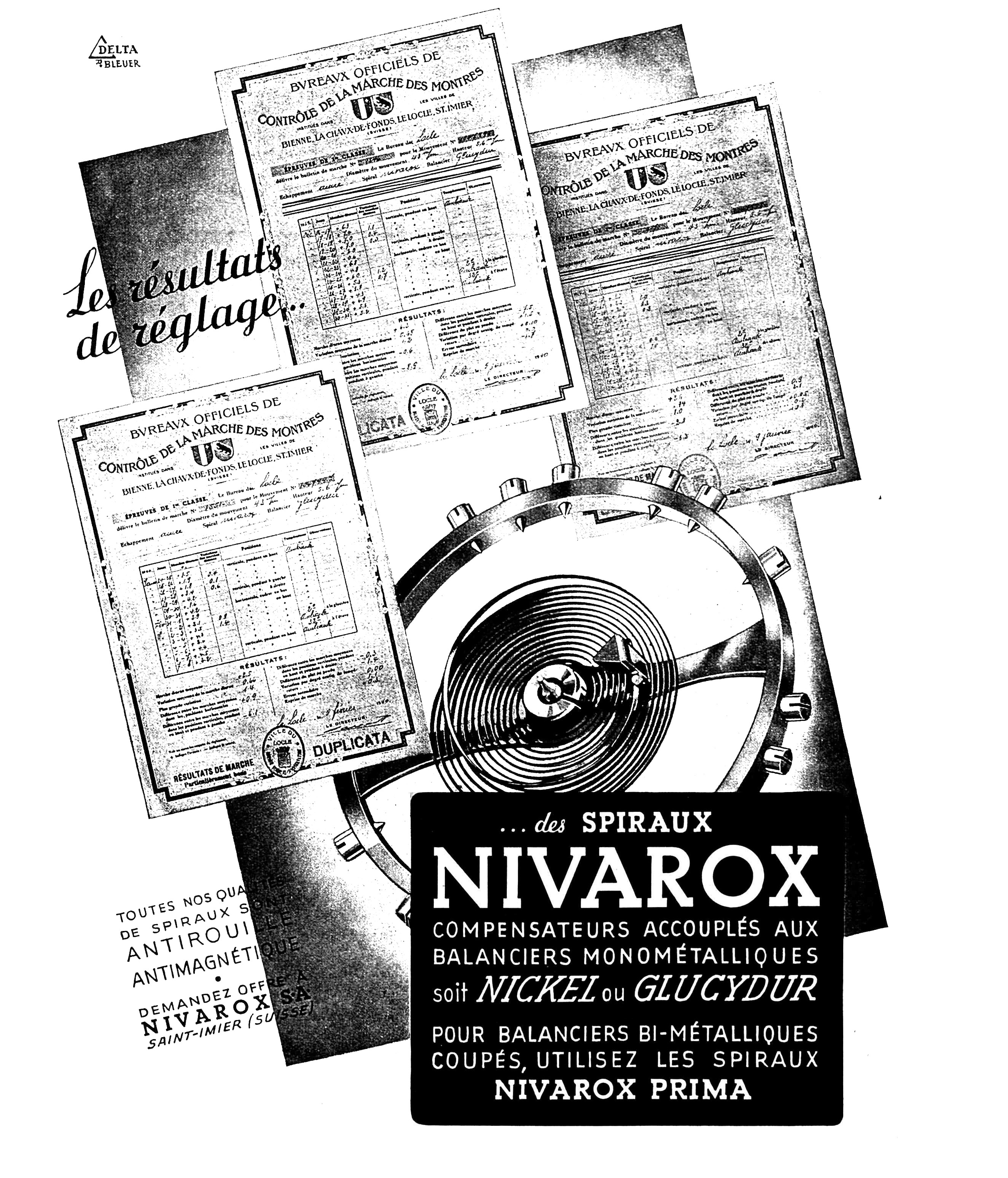
Nivarox advert from 1940: Click image to enlarge
In the 1920s, Elinvar balance springs were a hot topic in watchmaking. They seemed to offer the promise of simple temperature compensation without the cost of compensation balances or the problems of the earlier Paul Perret and Dr Guillaume nickel steel springs, which were softer and had higher internal friction than the best hardened steel balance springs.
Despite the best efforts of materials specialist Pierre Chevenard and outstanding watchmaker Paul Ditisheim, watches with Elinvar balance springs weren't taking top places in observatory trials. Although Elinvar was harder and had lower internal friction that earlier nickel steel balance springs, it was still not as good as hardened steel.
Reinhard Straumann struggled to overcome the problems of Elinvar balance springs. He invented balances that used the anisotropic thermal expansion of zinc alloys to give them variable thermal expansion rates that could be matched to the characteristics of individual Elinvar balance springs, but he came to the conclusion that Elinvar simply wasn't good enough, and he decided to do something about it.
The final result was Nivarox, which swept away carbon steel to become the most successful balance spring material ever produced. Introduced in the 1930s, Nivarox is still used today, nearly on hundred years later, in many of the finest watches.
The advertisement from 1940 reproduced here shows observatory certificates awarded to watches fitted with Nivarox balance springs, which it states are used with monometallic balances made of nickel or Glucydur. For compensation balances, a grade of Nivarox called Nivarox Prima was available, but this soon disappeared along with the use of compensation balances, which were expensive and made obsolete by Nivarox.
Reinhard Straumann
Straumann was born in 1892 in Bennwil, a municipality in the district of Waldenburg in the canton of Basel in Switzerland. After elementary school, he completed an apprenticeship in watch technology and precision mechanics at the École d’horlogerie in Le Locle, and from 1914 to 1916 he studied mechanical engineering at the École Supérieure d’Aéronautique in Lausanne.
In 1916, Straumann joined the Waldenburg watch manufacturing company Revue Thommen as a designer, and subsequently became technical director.
Straumann was unhappy with Elinvar balance springs due to several fundamental deficiencies: although Elinvar is harder and has a higher elastic limit than the previous Paul Perret and Guillaume nickel steel alloys, its elastic limit is lower than hardened steel, making it relatively soft, it has high internal friction causing damping of oscillations of the balance and reduced amplitude and it is susceptible to magnetic fields.
Straumann visited Dr Guillaume on two occasions, trying to persuade him to that a better material than Elinvar was required, but Guillaume was not responsive to the idea.
Beryllium
Straumann kept up to date with technical developments in materials. In the late 1920s, he read about the work of George Masing and Otto Dahl at Siemens & Halske, a German telecommunication company with a well funded R&D laboratory. They had investigated the effects of alloying metals with beryllium. One outcome was beryllium bronze, which could be precipitation heat treated to have a strength and hardness similar to alloy steels, and was used for telephone exchange switching components which had to withstand repeated switching over many thousands of cycles.
Several patents over the use of beryllium as an alloying component had been granted to Siemens & Halske. Straumann contacted the company proposing the investigation of beryllium as an alloying material for balance springs and, fortunately, Dr Illig, the head of the technical development department, understood the significant potential of the request. He issued a licence to Straumann allowing him to create alloys covered by Siemens & Halske patents.
Straumann’s own laboratory facilities at that time were not equipped to carry out systematic metallurgical experiments, and the material would have to be processed from 500kg cast billets into watch balance springs, so he sought Swiss companies to participate in the work. None was interested.
Fortunately, the head of Heraeus Vacuumschmelze in Hanau, Germany, Dr Wilhelm Rohn, was more willing and with his deputy Dr. Hessenbruch, together with Carl Haas of the spring making company Carl Haas in Schramberg, Germany, formed a working group with Straumann.
The technology of Heraeus Vacuumschmelze was essential to the project because beryllium has a high affinity for oxygen, which affects the ability to melt and alloy it in conventional furnaces. In 1913, Dr. Wilhelm Rohn, developed a process for melting metals in a vacuum. In 1918, the process for vacuum melting and tempering of metals and alloys was granted a patent. Making the alloy that Straumann wanted to create required the elements be melted and mixed in a vacuum, something that the steelworks at Imphy couldn't do.
Straumann and Heraeus Vacuumschmelze took Elinvar as a starting point and added around 2% of beryllium to the mix. However, this was found to have an adverse effect on the thermoelastic response of the material. It was necessary to add other alloying elements such as tungsten, molybdenum and chromium to maintain the thermoelastic characteristics required for making balance springs.
After many trials, the work was eventually successful and an application for a patent submitted in April 1931. The patent describes an iron-nickel alloy with beryllium and other elements that is heat treated after making wire and forming into spiral shapes to fix the shape and develop high hardness through precipitation hardening. The addition of additional alloying elements such as tungsten and molybdenum allowed the value of the thermoelastic coefficient to be adjusted so that it was linear between 50° and +50°C, eliminating secondary error.
The name Nivarox was chosen by Straumann as a derivative of the German “nicht variable, nicht oxidierend” (non-variable, non-oxidising). The non-variable part refers to the thermoelastic response of Nivarox. However, the thermoelastic characteristic of Nivarox can be varied over quite a wide range from negative to positive. Nivarox was not a single alloy, it was the name given to a family of precipitation hardening nickel steel chrome beryllium alloys; Straumann gave an example of valves for internal combustion engines. The thermoelastic characteristics were varied with different alloying elements and heat treatments to suit specific application. For balance springs, the thermoelastic characteristic of Nivarox is made positive so the modulus of elasticity increases with temperature.
| Nominal composition | Ni | Cr | Ti | Be | Fe |
| Nivarox CT | 37% | 8% | 1% | 0.8% | Balance |
The nominal composition of Nivarox used for balance springs is given in the table here. The precise composition of Nivarox alloys, and details of their heat treatments, are trade secrets known only to Vacuumschmelze, Carl Haas and Nivarox FAR S.A.
Precipitation Hardening
The key to the success of Nivarox is precipitation hardening, an extremely useful property in an alloy. Precipitation hardening was discovered in 1906 by Alfred Wilm, a German metallurgist, who was granted a patent for it in 1909. Wilm found that when 4% of copper was added to aluminium and the quenched, the alloy would increase in hardness over several days at room temperature. The name is a contraction of Dürener and aluminium because the alloy was originally made at Dürener Metallwerke at Düren, Germany.
The key to precipitation hardening is that an alloying element is used which is fully soluble in the main element at high temperature, but insoluble at low temperature. The elements are mixed or annealed at high temperature and quenched, which fixes the high temperature crystal structure with the alloying element evenly dispersed in solid solution. At this point, the alloying element has little effect on the material hardness because it is finely dispersed.
Hardening takes place when the alloying element precipitates from the solid solution and gathers in clusters. The clusters impede the movement of dislocations. In some alloys, this takes place at normal temperature, making the material harder over time. This is what Wilm discovered in Duralumin.
In other precipitation hardening alloys, the alloying element remains in solid solution at room temperature and the material can be formed or machined easily. The parts are then heated to a temperature where precipitation of the alloying element occurs and their hardness increases. Unlike other heat treatments, the material has to be held at high temperature for a lengthy period for the hardening element to precipitate and form clusters. Because of the length of time required, this is also referred to as age hardening.
Nivarox balance springs take advantage of precipitation hardening with beryllium as the precipitation-hardening element.
The small size of beryllium atoms allows them to fit into interstitial sites or substitute for other atoms in the crystal lattice, contributing to solid-solution strengthening. Beryllium also has a very high modulus of elasticity (~287 GPa), so even small amounts increase the alloy’s stiffness. However, the principal benefit of beryllium is that, during controlled heat treatment, it forms very fine intermetallic compounds with iron and nickel which precipitate out of solid solution and act as barriers to dislocation movement. This greatly increases the alloy’s hardness and yield strength without significantly compromising ductility.
Annealed and quenched Nivarox can be drawn and rolled into the fine section wire required for a balance spring and then heat treated to develop its full hardness, which is similar to hardened and tempered high carbon steel. Nivarox also has low internal friction similar to hardened steel. Straumann showed that the oscillations of a balance with a Nivarox spring decayed at a rate similar to a balance fitted with a hardened steel spring.
Straumann announced the new material in the Journal Suisse d'Horlogerie in November 1932. He listed its properties as:
- The thermoelastic coefficient of Nivarox can be modified at will. It can be prepared for a monometallic balance made of Maillechort (nickel silver), for the anisotropic "Straumann" balance, or any other type of balances including cut bimetallic balances.
- It has a low secondary error, the deviation of rate at the middle temperature from that at high and low temperatures.
- It has a lower sensitivity to magnetic fields than other materials used for balance springs and residual effects after exposure to a strong magnetic field are lower.
- Its hardness and elastic limit are like hardened steel, making it resistant to deformation and allowing its use for very small springs.
- It has low internal friction so that damping of the balance oscillations is small and watches with Niarox balance springs have amplitudes as large as those with hardened steel springs.
- It does not rust. Because it can be made with the same thermoelastic coefficient as hardened steel balance springs, it can be used as an alternative to steel that doesn't rust and has reduced secondary error.
The Nivarox advert from 1940 reproduced at the head of this section mentions Nivarox balance springs formulated to be used with bimetallic compensation balances, “balanciers bi-metalliques coupés”. These were called Nivarox Prima.
Nivarox was the solution to all the problems with Elinvar that Straumann had identified, and more. It soon swept Elinvar and all other balance spring materials away and became the only material used for the balance springs of high quality Swiss watches for most of the rest of twentieth century.
Monometallic Balances
The first nickel steel Paul Perret balance springs were formulated for use with monometallic brass balances, which had the advantage of being easy to machine and non-magnetic. These were superseded by nickel and Maillechort, nickel silver, balances, which were also non-magnetic and harder then brass.
From his contacts with Siemens & Halske, Straumann knew that adding a small amount, about 2½%, of beryllium to copper created an alloy that was hard, non-magnetic and did not rust or corrode. He realised that this would be an excellent material to use for balances. He called this alloy Berrydur-Cu. Today it is better known as beryllium bronze or Glucydur, after glucinimum, an old name for beryllium.
The Nivarox advert from 1940 reproduced at the head of this section mentions Nivarox balance springs formulated to be used with monometallic balances of nickel or Glucydur.
Temperature Effects
It is sometimes said that the modulus of elasticity of Nivarox doesn't vary with changes in temperature, or that the stiffness of balance springs made from Nivarox doesn't vary with temperature, and even that Nivarox has very low thermal expansion. In conjunction with these statements is usually the idea that Nivarox balance springs are used with balances that have very low thermal expansion.
None of these statements are true.
A material with a modulus of elasticity that doesn't change with temperature cannot be used to make a spring whose stiffness doesn't change with temperature unless it also has no thermal expansion. But like all metals, Nivarox has significant thermal expansion, which makes a spring stiffer as its temperature increases.
The thermoelastic response of Nivarox to changes in temperature can be made to be positive, zero or negative, depending on the intended application. For balance springs, the thermoelastic response of Nivarox is made positive so its modulus of elasticity increases as its temperature rises.
Both of these effects; thermal expansion and positive thermoelasticity, mean that a Nivarox balance spring gets stiffer as its temperature increases. For this reason, Nivarox springs are used with balances that have significant thermal expansion.
When temperature increases, the increase in stiffness of the Nivarox spring due to its thermal expansion and increased modulus of elasticity compensates for the increased rotational inertia of the balance due to its expansion.
Nivarox balance springs are usually used with beryllium bronze balances. Beryllium bronze used for balances has a coefficient of thermal expansion of 17 × 10-6/°C, and Nivarox has a coefficient of thermal expansion of 7.5 × 10⁻⁶/°C. These figures were provided to me by Swatch Group who do not reveal the thermoelastic coefficient of Nivarox, saying only that it is in the range +/- 25 × 10-6/°C. However, plugging the figures for thermal expansion into the following equation
\[ 2 \, \alpha_{\, balance} - 3 \, \alpha_{\, spring} - \gamma_{\, spring} = 0 \]where \( \alpha_{\, balance} \) is the thermal expansion of the balance, \( \alpha_{\, spring} \) is the thermal expansion of the spring and \( \gamma_{\, spring} \) is the thermoelasticity of the spring, reveals that the thermoelastic coefficient of Nivarox is 11.5 × 10⁻⁶/°C.
| Effect of 30°C increase in temperature | Daily rate (sec) |
|---|---|
| Beryllium bronze balance expansion | -44.1 |
| Nivarox spring thermal expansion | +29.2 |
| Nivarox spring thermoelasticity | +14.9 |
| Overall effect on rate | 0.0 |
Thermal expansion of the balance causes a loss, which is compensated by thermal expansion of the spring and an increase in its modulus of elasticity.
The table lists the individual effects for a temperature increase of 30° Celsius. About two-thirds of the loss of rate caused by thermal expansion of the balance is offset by the increase in stiffness of the balance spring from its thermal expansion, and one third by the increase in its modulus of elasticity.
Thermal expansion of the balance spring is often either neglected or misunderstood. When it was first noticed, in the eighteenth century, that watches lost rate as the temperature increased, it was thought that this was mainly due to the balance spring becoming longer as it expanded. However, the frequency of a spring balance oscillator is proportional to the height (breadth) of the spring and inversely proportional to its length. As both of these change in the same proportion with increases in temperature, the increasing length has no effect. The significant factor is that the frequency is also inversely proportional to the square root of the cube of the spring's thickness. This means that even a small change in the thickness of the spring has a large effect on rate, as can be seen from the results here.
If a Nivarox balance spring is 0.03 millimetres thick, or 0.0012 inches, an increase in temperature of 30°C will cause it to increase in thickness by 0.00000675 millimetre or 0.00000027 inches. Standard workshop micrometers measure to one hundredth of a millimetre or a thousandth of an inch, and Vernier versions can give readings of a thousandth of a millimetre or one ten thousandth of an inch. The change in thickness of a balance spring is much less than these micrometers can measure, which shows why it is impossible to calculate the rate of a watch accurately from measurements of the parts.
Richard Lange and Nivarox
Richard Lange was granted a patent for a metal alloy for watch springs containing beryllium. Because of this, it is sometimes said that Lange was “the father of Nivarox.” This is not correct. Lange’s patent describes simple alloying (solution hardening), which achieves some increase in hardness, but not the breakthrough that Straumann achieved. The patent meant that Straumann had to pay a license fee to Lange, but Lange had no part in the creation of Nivarox.
Back to the top of the page.
Glucydur Balances
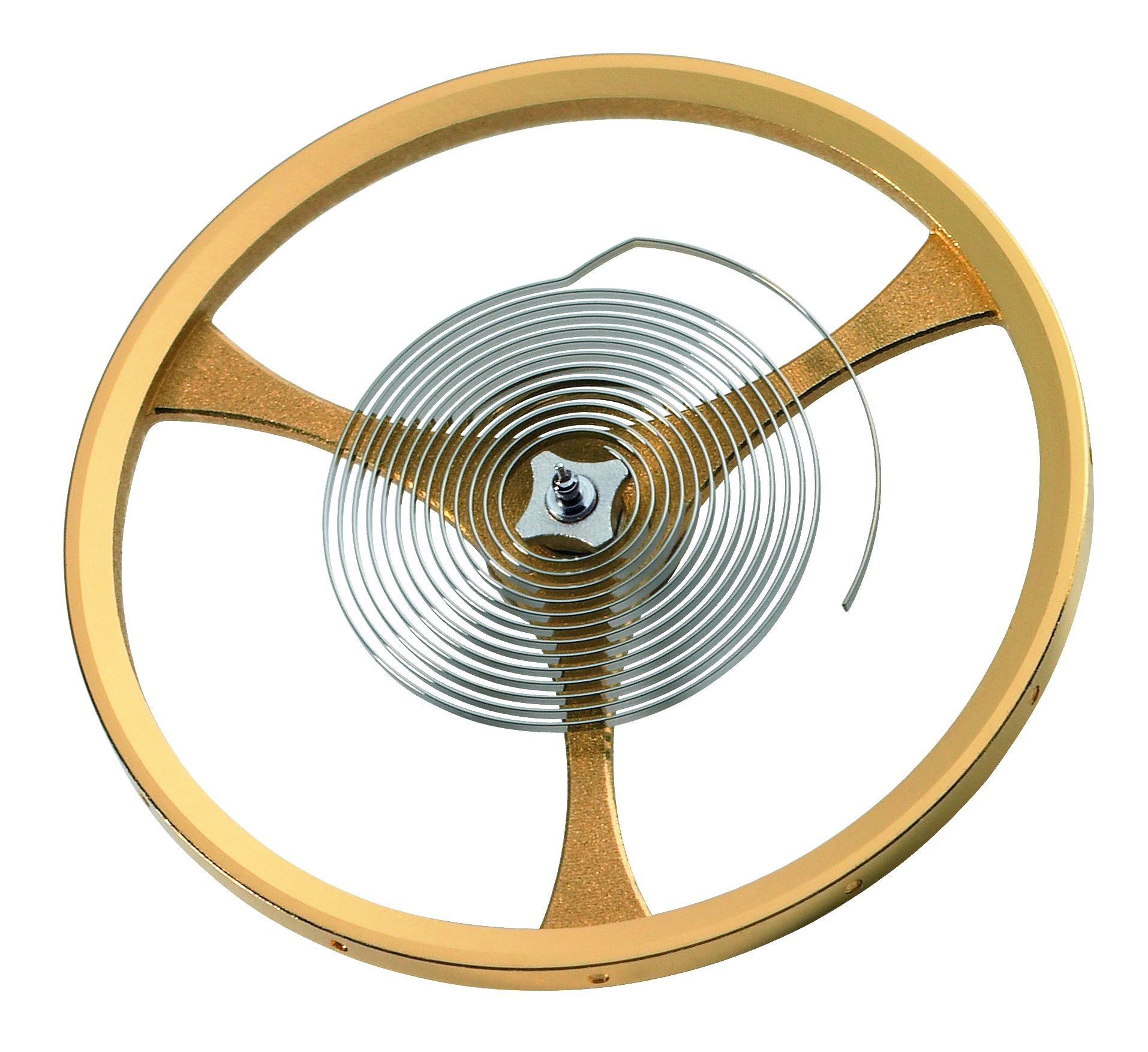
Glucydur Balance with Nivarox balance spring
Click image to enlarge
Glucydur an alloy of copper and beryllium used for watch balances. The name Glucydur is derived from glucinium, an old name for beryllium, and dur for durable.
The same alloy is also called beryllium copper, beryllium bronze and CuBe or Cu-Be, from the chemical symbols of its constituent elements, Cu for copper and Be for beryllium.
Beryllium copper was invented in the 1920s by Georg Masing and Otto Dahl, two German metallurgists working in the research laboratories of Siemens & Halske AG, a German telecommunication company with a well funded R&D laboratory. They investigated the effects of adding small amounts of various elements to copper and found that beryllium, even in minor quantities, substantially improved the mechanical properties of copper. Beryllium copper can be heat treated to have a strength and hardness similar to alloy steels while retaining the excellent electrical conductivity of copper and was therefore useful for telephone exchange switching components. Several patents over the use of beryllium as an alloying component were granted to Siemens & Halske AG.
Beryllium copper alloys, including Glucydur, are precipitation hardening alloys that develop their high strength and hardness through heat treatment.
Precipitation hardening requires an alloying element that is insoluble in the principal element at normal temperature, but fully soluble at high temperature. The first such combination to be discovered was copper in aluminium, resulting in the alloy Duralumin. This developed its properties at normal temperature over time and, because of this, the process was called age hardening. Precipitation hardening is a superset of age hardening, where additional heating is required to achieve the hardening.
In precipitation hardening, there are two different heat treatment regimes that result in different properties. For beryllium copper alloys, including Glucydur, these are,
Solution Annealing: In this treatment, the beryllium copper alloy is heated to a temperature of around 800°C to dissolve the beryllium into the copper matrix, creating a homogeneous solution. The alloy is then rapidly cooled, usually by quenching in water or oil, to retain the beryllium in a supersaturated solid solution. This locks the beryllium atoms in place within the copper matrix. In this state, the alloy is as soft as copper and can be formed and worked easily.
Precipitation Hardening: The alloy is reheated to a lower temperature, typically between 315°C and 400°C and held at this temperature for several hours, allowing beryllium to precipitate out of solution and form clusters dispersed finely throughout the copper matrix. These clusters of beryllium hinder the movement of dislocations, which increases the alloy's strength and hardness. After this heat treatment, the alloy has a strength and hardness similar to alloy steels.
The change in properties of beryllium copper with heat treatment has great benefits. In the solution annealed state, it is easy to form and shape, although caution is needed because beryllium is hazardous to health. After being formed into the final shape, the items are precipitation heat treated to give them high strength and hardness. For watch balances, the fact that beryllium copper is non-magnetic is also an advantage.
Thermal Expansion
The law of mixtures says that the rate of thermal expansion of an alloy will be in proportion to the rates of thermal expansions of its constituent parts. Since Glucydur is 98% copper and 2% beryllium, its rate of thermal expansion should be close to that of copper, which it is. Swatch Group stated that the coefficient of thermal expansion of Glucydur is 17×10-6 per degree Celsius.
The coefficient of thermal expansion of steel is about 10.4×10⁻⁶ per degree Celsius, and brass is about 18.6×10⁻⁶ per degree Celsius. So it can be seen that Glucydur has a rate of thermal expansion 63% greater than steel and nearly as large as that of brass. This is certainly not a small rate of thermal expansion.
Thermal expansion of a balance causes a losing rate, because it increases the moment of inertia of the balance. A watch fitted with a Glucydur balance will lose due to expansion of the balance about 1½ seconds per day per degree Celsius, or about 45 seconds per day over a temperature range of 30 degrees.
The Contrôle Officiel Suisse des Chronomètres (COSC) test allows a variation of up to +/- 0.6 seconds per day per degree Celsius in the variation of the rate as a function of temperature for Category 1, or +/- 0.7 seconds for category 2. This rate is obtained by subtracting the rate at 8°C from that at 38°C and dividing by 30, the difference between the two temperatures.
If there was no thermal variation in rate caused by the balance spring, the difference of 45 seconds in rate between 8°C and 38°C caused by expansion of a Glucydur balance would disqualify a watch from receiving a COSC certificate.
Back to the top of the page.
Monometallic Balances
A monometallic balance is a balance made from a single metal. These existed from the beginning of watchmaking, but provided no compensation for the loss of rate at increasing temperatures caused by a steel balance spring. To overcome this problem, bimetallic brass and steel compensation balances were invented. Compensation balances were expensive to make and adjust, so were used in better quality watches. Monometallic balances continued to be used in the cheapest watches.
This all changed in 1897, when Paul Perret invented nickel steel balance springs which could themselves compensate for changes caused by variations in temperature, and therefore did not require a compensation balance.
Advert for Paul Perret balance springs:
Click image to enlarge
Brass Balances
After testing different materials, including Invar, Paul Perret found that brass was the most suitable material for use with his autocompensating balance springs. Perret found that Invar is difficult to machine and, in its machined state, had an unattractive appearance. Brass is easy to machine to produce a fine finish, and had the benefit of already being widely used to make balances. The nickel steel alloy used for Paul Perret balance springs was formulated to work with balances made of brass.
The advert for Paul Perret balance springs reproduced here says that a balance made entirely of brass (‘tout en laiton’) gives the best results.
Nickel Silver Balances
An English company that used Paul Perret balance springs was H. Williamson of Coventry. An advert from 1910 stating that patent Paul Perret nickel steel balance springs are used in their Coventry Astral watches. The photo shows the balance and spring of a Coventry Astral watch from around that time.
The balance is monometallic, made from nickel silver, which is also called Maillechort, German silver or Argentan. Despite the word silver in some names, it does not contain any silver, and the word refers to its appearance only. It is a an alloy of copper, nickel and zinc. Maillechort can be formulated to have a similar rate of thermal expansion to brass and is therefore suitable to be used as a balance with Paul Perret temperature compensation balance springs.
Nickel silver is harder than brass and doesn't tarnish, which is why nickel silver balances superseded brass. In the Swiss watch industry, nickel silver or Maillechort balances were often referred to simply as nickel balances.
Figure 6 Paul Perret balance spring:
Click image to enlarge
Figure 5 H Williamson advert 1910:
Click image to enlarge
Beryllium Copper Balances
Beryllium copper was invented in the 1920s by Georg Masing and Otto Dahl, two German metallurgists working in the research laboratories of Siemens & Halske AG, a German telecommunication company with a well funded R&D laboratory. They investigated the effects of adding small amounts of various elements to copper and found that beryllium, even in minor quantities, substantially improved the mechanical properties of copper. Beryllium copper can be heat treated to have a strength and hardness similar to alloy steels while retaining the excellent electrical conductivity of copper and was therefore useful for telephone exchange switching components. Several patents over the use of beryllium as an alloying component were granted to Siemens & Halske AG.
In 1934, the Swiss company Fabriques de Balanciers Réunies introduced balances made of 2% beryllium copper under the name Glucydur. These were considerably harder than nickel silver balances, which was an advantage when replacing balance staffs, and non-magnetic.
A Common Thread
The basic equation for the period of semi-oscillation of a spring balance shows how it depends on the rotational (moment of) inertia of the balance \(I\) and the balance spring constant \(S\), which defines the restoring force or torque the spring produces in response to the balance being rotated from its rest position.
\[ T = \pi \sqrt{\frac{I}{S}} \]To prevent variations in rate with changes in temperature, the ratio of \(I\) to \(S\) must be kept constant.
For the purposes of timekeeping, the significant characteristic of a monometallic balance used with an autocompensating balance spring is the rate of thermal expansion of the balance. It would be possible to create a balance that didn't expand as the temperature increased, by using Invar. But apart from a few experiments in the early days of autocompensation by the balance spring, Invar balances have never been used in watchmaking. In fact, the materials used for monometallic balances, brass, nickel steel and beryllium copper, have quite high rates of thermal expansion, so that \(I\) changes significantly with variations in temperature.
Since the moment of inertia \(I\) of monometallic balances increases significantly as the temperature rises, due to thermal expansion, the spring constant \(S\) must also increase, to keep the ratio of \(I\) to \(S\) constant, which means the spring stiffness must increase.
The force exerted by the spring depends on its stiffness and the angle though which the balance turns. The spring's stiffness depends on its length, cross sectional shape and modulus of elasticity. All spring materials expand when heated, which increases the spring's stiffness. This partly compensates for the increase in the inertia of the balance. The material of the spring is formulated such that its modulus of elasticity increases as the temperature rises, which provides the other part of the compensation for the increase in inertia of the balance.
Guillaume summarised the principle of autocompensation, temperature compensation by the materials of the balance and spring alone, very succinctly:
‘In practice, what one should look for is not an alloy whose thermoelastic coefficient is strictly zero, but an alloy such that the thermal expansion of the balance and the spring, and the thermoelastic variations of the latter, give a zero sum.’
The first autocompensating balance springs, which were called Paul Perret balance springs, were made from a simple nickel steel alloy. In around 1910, small amounts of additional alloying elements were added to make them harder. These were called Dr Guillaume balance springs. In 1913, it was discovered that adding 12% chromium made the thermoelastic response to changes in temperature more linear. Balance springs made from this alloy were introduced in 1920 under the name Elinvar. Elinvar was superseded in 1932 by Nivarox, which included beryllium as a precipitation hardening element.
All of these balance springs followed the same principle of increasing in stiffness with rising temperature. Each succeeding generation was formulated to work with the same monometallic balances as the preceding generation. Elinvar springs were formulated to work with balances made of brass or nickel steel, and Nivarox springs were formulated to work with nickel steel or beryllium copper balances.
This means that brass, nickel silver and Glucydur balances have the same, or very similar, coefficients of thermal expansion, so that each succeeding generation of balances was a drop in replacement for the preceding one without needing to reformulate the balance spring material, or keep two different materials available during the transition period.
Examples of Pairings
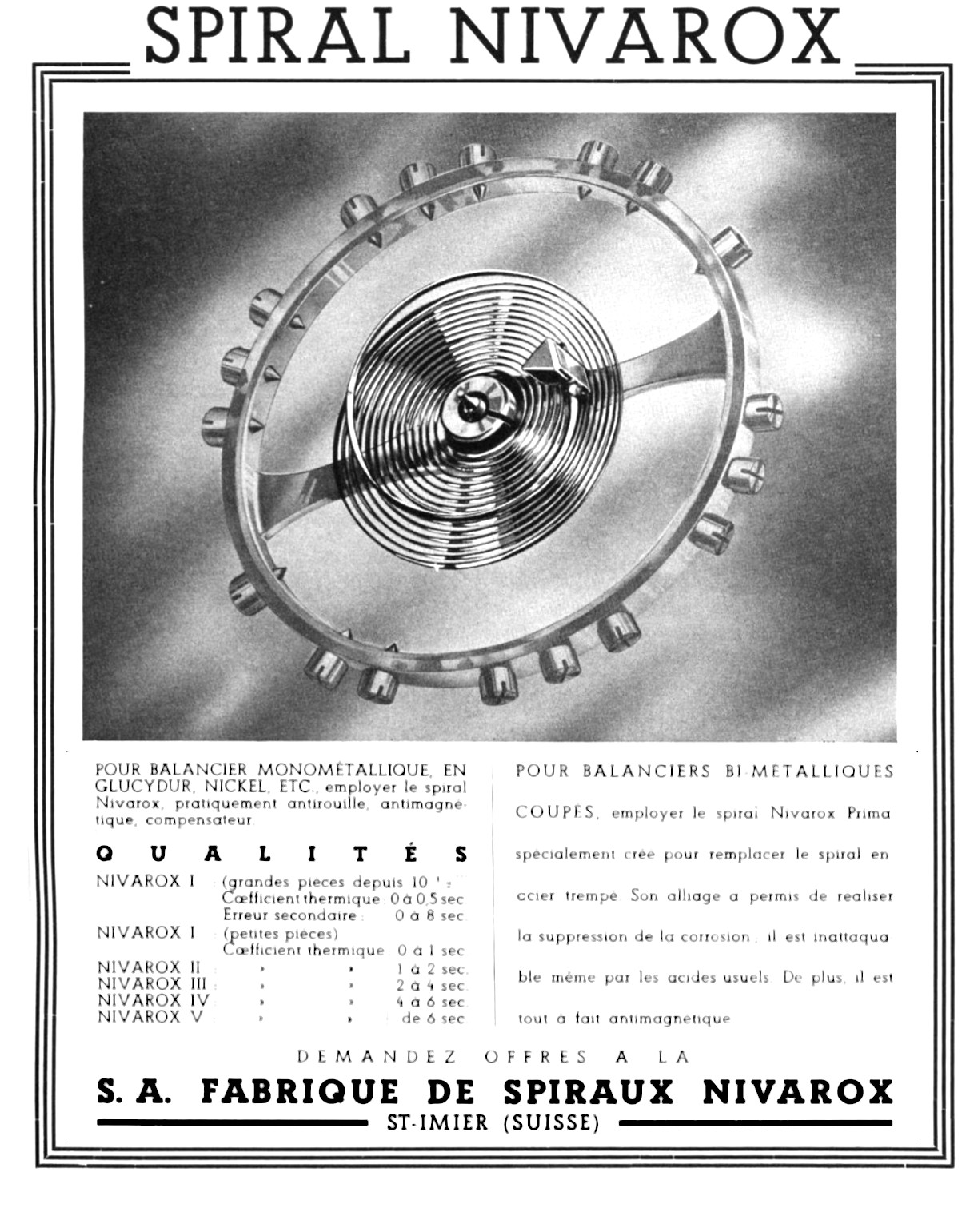
Advert for Nivarox balance springs:
Click image to enlarge
Because some pairings, such as Nivarox with Glucydur balances, became dominant, it is sometimes thought that they are the only ones that work. However, this is not correct. The advertisement reproduced here was published in 1939 and clearly states the Nivarox balance springs can be used with monometallic balances of Glucydur, nickel, etc. In the Swiss watchmaking industry, nickel silver, especially when used for balances, was called simply nickel. The etc. refers to brass. A grade of Nivarox called Nivarox Prima was made with the same thermoelastic characteristics as steel so that it could be used with bimetallic balances, with the advantages that it does not rust and is far less susceptible to magnetic fields than steel.
- The advert by Paul Perret shows that his balance springs were formulated to work with brass balances.
- The Coventry Astral watch advert and photo show that Paul Perret balance springs work with nickel silver balances.
- The first watch with an Elinvar balance spring tested at Kew, Paul Ditisheim's number 44811, was fitted with a brass balance.
- The thermal coefficient of Elinvar was determined for each casting using a brass balance.
- When Nivarox was introduced, there were no Glucydur balances, so Nivarox balance springs were paired with nickel silver balances, the same as Elinvar.
Back to the top of the page.
The Guillaume ‘Integral’ Balance

Figure 1: Middle Temperature Error:
Click image to enlarge

Figure 2: Guillaume Integral Balance:
Click image to enlarge
The accuracy of box (marine) chronometers with steel balance springs and bimetallic compensation balances was limited by middle temperature error. Many auxiliary compensation devices were invented to counter middle temperature error, but they were delicate and difficult to adjust.
Middle temperature error arises because the modulus of elasticity of a steel balance spring does not decrease in direct proportion, or linearly, with increasing temperature, but instead follows a downward curve. A brass and steel compensation balance eliminates most of this effect by reducing its own effective diameter as the temperature increases. However, the compensation provided by a brass and steel compensation balance varies linearly, which means that it can only exactly compensate for the non-linear changes in the modulus of elasticity of a steel spring at either one middle temperature, or at two points equally distributed about the middle temperature.
To get the best overall rate, watch and chronometer makers chose the second of these, making the rate correct at two temperatures either side of the middle temperature. The chronometer or watch would then gain at temperatures between these two points, this gain being called the middle temperature error, and lose at temperatures outside.
In Figure 1, the green line labelled ‘Spring’ represents the decrease in rate caused by the reduction in stiffness of a steel balance spring with increasing temperature. The straight blue line labelled ‘Balance’ represents the increase in rate due to the inward movement of the compensation masses in response to increases in temperature. The masses are moved inwards with increasing temperature to reduce the moment of inertia of the balance to compensate for the reducing stiffness of the balance spring.
It is evident that the straight blue line of the compensation balance does not exactly mirror the green curve of the balance spring. The net effect on rate is given by the difference between the two, resulting in the curved red ‘Error’ line.
One spring evening in 1899, Dr Guillaume realised that the properties of nickel steel could be exploited to overcome middle temperature error. The steel inner layer of a bimetallic compensation balance was replaced by a nickel steel alloy called Anibal, which had the unusual property of causing the rate of compensation to increase as the temperature rose, matching the increasing loss of stiffness of the balance spring.
In Figure 2, the dark blue upward curving line shows the effect of this on the change in rate caused by the balance. The blue line of the rate due to the balance has an upwards curve that matches and mirrors the downwards curve of the green spring line, eliminating the middle temperature error and producing a flat rate over the temperature range.
To understand how Dr Guillaume created the integral balance it is useful to understand his view of how middle temperature error arises. Guillaume noted that middle temperature error, which he called ‘secondary error’ or ‘Dent’s error’, is significantly reduced when a palladium alloy balance spring is used instead of a steel one. This shows that the middle temperature error is caused by a physical characteristic of the steel balance spring.
Palladium alloy balance springs require slightly more overall temperature compensation than steel springs. This is because their modulus of elasticity change more than that of steel for a change in temperature. The reduced middle temperature error with a palladium alloy balance spring is therefore not due to a smaller change in its modulus of elasticity with temperature. The middle temperature error is reduced because the modulus of elasticity in palladium alloys varies more linearly across the temperature range than that of steel.
Compensation Balances
An ordinary compensation balance has a rim made of a layer of brass on the outside and steel on the inside, and the rim is cut in two places close to the arms.
Brass has a higher rate of thermal expansion than steel, in the ratio of about 18 to 11. As the temperature increases, the greater thermal expansion of brass than steel causes the bimetallic rim sections to curl inwards towards the axis of the balance, reducing its moment of inertia, which compensates for a decrease in stiffness of the balance spring.
The compensation provided by a brass and steel compensation balance varies linearly with temperature due to a curious coincidence in the rates of thermal expansion of brass and steel. When a piece of metal is heated or cooled by \(\pm \theta\) degrees, its length at the new temperature can be calculated using the expression,
\[ L_\theta = L_0 ( 1 + \alpha \theta + \beta \theta^2 ) \]where \(L_0\) is the length at the initial temperature, \(\theta\) is the change in temperature and \(L_\theta\) is the length at the new temperature.
Inside the brackets, the \(\alpha\) and \(\beta\) symbols are the coefficients of thermal expansion. Frequently, only the first term with \(\alpha\) is used, but when greater accuracy is required, the second term with \(\beta\) is added. If only the first term is used, the result is that the calculated length changes in direct proportion to changes in temperature. When plotted on a graph of length versus temperature, the change in length forms a straight line, so this is referred to as linear expansion.
When the second term with \(\beta\) is added, this introduces a curve or non-linearity into the graph of change in length with temperature, because it is calculated using the square of the change in temperature. This is referred to as non-linear expansion. Ususally, the non-linear effect is small, so the plot looks like a straight line, which is why the non-linear effect is usually ignored. However, in precision horology, the non-linear effect is noticeable.
The \(\alpha\) coefficient is called the linear coefficient of thermal expansion. The \(\beta\) coefficient is called the non-linear coefficient, or the quadratic coefficient, because it involves the square of the temperature change.
Brass and steel, like most metals, have a small positive non-linear curvature in their rate of thermal expansion. This means that their rate of expansion increases as the temperature increases and their \(\beta\) non-linear or quadratic coefficient has a positive value. It is not a large effect, but it exists and can be measured.
Brass has a linear coefficient of thermal expansion of about \(18 \times 10^{-6}\)/°C whereas that of steel is about \(11 \times 10^{-6}\)/°C. The curious coincidence that causes the compensation provided by a brass and steel compensation balance to be linear is that, unlike their linear coefficients of thermal expansion, the non-linear coefficients of thermal expansion of brass and steel are virtually the same, \( 5.5 \times 10^{-9} \)/°C for brass and \(5.2 \times 10^{-9}\)/°C for steel.
Because the rates of non-linear expansion of brass and steel are virtually the same, it is effectively only the significant difference between their linear rates of thermal expansion that causes the rims to bend, so they move in or out in direct proportion to changes in temperature.
Anibal
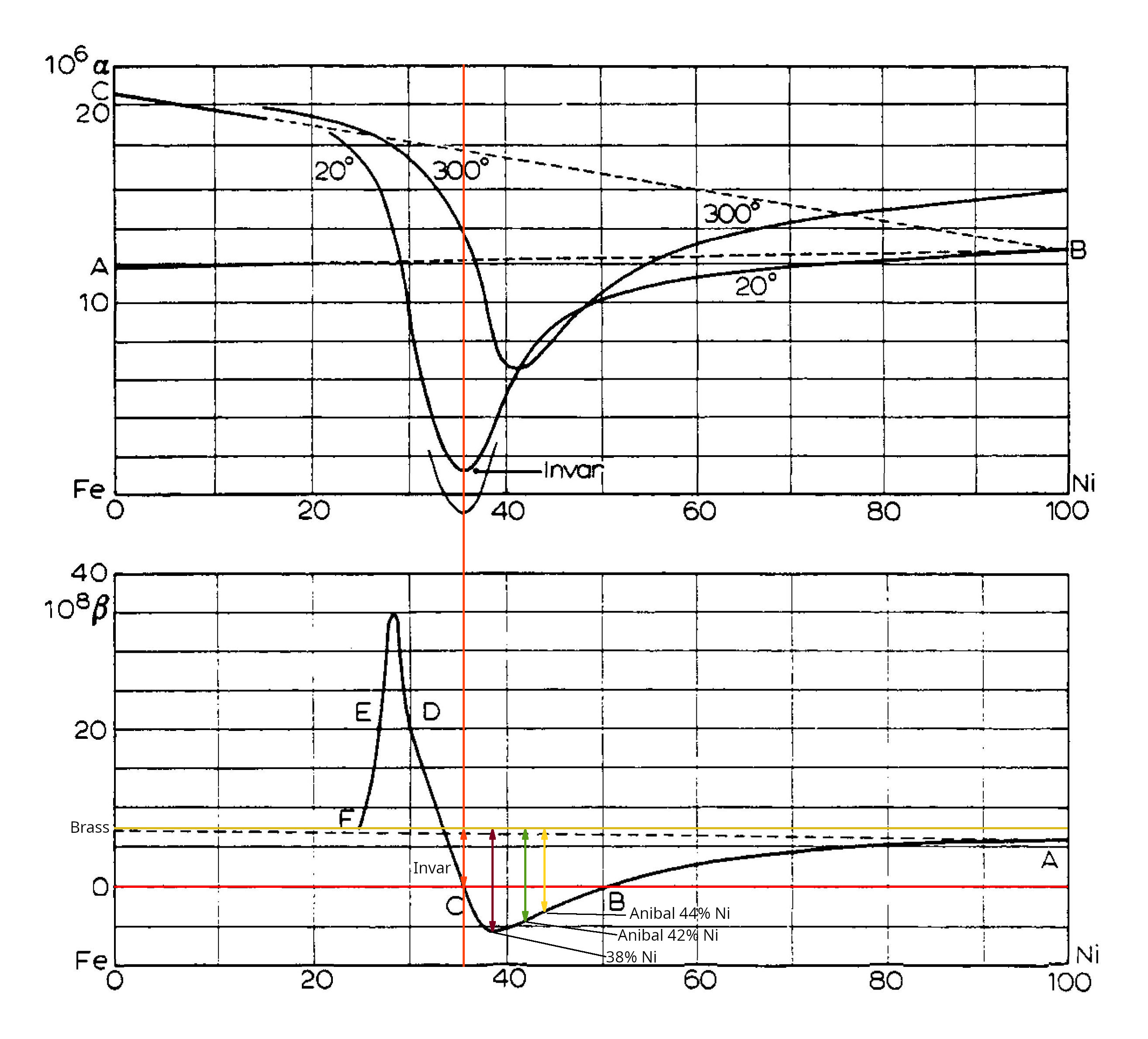
Nickel Steels alpha and beta coefficients: Click image to enlarge
Some nickel steel alloys have the unusual property that their rate of thermal expansion decreases at higher temperatures. This is characterised by a negative coefficient for the non-linear quadratic term in the thermal expansion equation.
The graph here shows the \(\alpha\) and \(\beta\) coefficients for the nickel steels. The alloy with the lowest \(\alpha\) coefficient occurs at 36% nickel and exhibits almost no change in length as its temperature is increased, for which reason it is named Invar. The lowest point of the continuous curve is at \(0.8 \times 10^{-6}\)/°C, but a short section of curve below that indicates that the coefficient can be reduced further by heat treatment and become negative, so that the material actually contracts with increases in temperature.
The red vertical line through Invar crosses the curve of the \(\beta\) coefficients at the point labelled C, exactly at zero; the zero line is highlighted in red. Between points C and B, the \(\beta\) coefficients are below zero, that is they are negative. This is very unusual, the vast majority of metals have positive \(\beta\) coefficients and expand at an increasing rate as the temperature increases.
Note that the scale of the \(\beta\) coefficients in the lower graph is different from that of the \(\alpha\) coefficients in the upper graph. The scale of the \(\alpha\) coefficients has \(10^6\) next to the \(\alpha\) at the top of the y axis. This means that the figures on the y axis have been multiplied by \(10^6\), so that the figure 20 on this scale represents \(20 \times 10^{-6}\)/°C. The y axis of the \(\beta\) coefficients has \(10^8\) next to the \(\beta\), so the 20 on this scale is actually \(20 \times 10^{-8}\)/°C. Engineers like to use powers of three, so would write this as \(2.0 \times 10^{-9}\)/°C.
The non-linear or quadratic coefficient of thermal expansion of brass is shown on the figure as the brass-coloured line at \(5.5 \times 10^{-9}\)/°C The non-linear coefficient of thermal expansion of steel lies immediately below it, where the dotted line crosses the y axis at pure iron (Fe) and 0% nickel. The non-linear rate of expansion of brass is slightly greater than that of steel, which does increase the rate of compensation of an ordinary compensation balance as the temperature increases, but the effect is small and not significant.
One evening in the spring of 1899, the idea occurred to Guillaume that if the inner steel lamina of a compensation balance was replaced by something that had a rate of non-linear thermal expansion lower than that of steel, the difference between the non-linear expansion of the brass and steel would be greater. The rate of compensation would increase as the temperature increased to more closely match the rate of decrease in the modulus of elasticity of a steel spring, and the middle temperature error would be reduced.
An obvious candidate was Invar, which has a non-linear coefficient of thermal expansion of zero, shown where the vertical red line crosses the zero axis in the lower plot. If Invar was used instead of steel, the non-linear expansion of the brass would make the rate of change of the compensation non-linear. This would reduce the middle temperature error by about 1 second in 24 hours, not enough to eliminate the full error of around 2½ seconds. This is the reason that Invar is not used in compensation balances; it would only partially correct the middle temperature error.
The degree of non-linearity in the compensation is determined by the difference between the non-linear coefficients of the two parts of the bimetallic rims, the outer brass layer which has a non-linear coefficient of \(+5.5 \times 10^{-9}\)/°C. The non-linear coefficient of Invar is zero, which in itself is unusually low, but Guillaume realised that the difference between the non-linear expansion of the brass and the inner layer would be further increased by using one of the nickel-steels that has a negative non-linear coefficient, one of the alloys between the points C and B on the graph. Referring to the graph, it is easy to see how much further away from the non-linear coefficient of thermal expansion of brass the alloys between points C and B become.
Guillaume realised that by exploiting this non-linear effect, he could alter the compensation to mirror the change in stiffness of the balance spring. Guillaume calculated that the non-linear expansion of an alloy with 44% nickel would virtually eliminate the middle temperature error. He called this alloy Anibal, from ‘acier nickel pour balanciers’ (nickel-steel for balances).
The first compensation balances with Anibal instead of steel were made by James Vaucher, a balance manufacturer in Travers. When fitted to a Nardin chronometer, the middle temperature error was reduced by about 90%. Guillaume then undertook further experimental work in conjunction with the Société des Fabriques de Spiraux Réunies to reduce the error still further. As a result of this, the nickel content of Anibal was reduced from 44% to 42%. The invention of the balance had cost Guillaume only a few calculations, but the experiments were quite expensive and consequently the results were kept secret until revealed in the early 1920s.
Looking at the plot of the \(\alpha\) and \(\beta\) coefficients for the nickel steels, the lowest point on the curve of the \(\beta\) coefficients is at around 38% nickel. Using this alloy instead of Anibal would produce too much non-linear compensation. It would cause a new middle temperature error in the opposite direction to the previous one.

Compensation Balance Non-linear Effects: Click image to enlarge
The difference between the linear coefficients of the two metals in the bimetallic rims of a compensation balance causes the rims to move in a way directly related to a change in temperature. The different metals being discussed here that could be used with brass to form a compensation balance have different linear coefficients of thermal expansion, which cause would cause different amounts of movement for a given temperature change. However, this is not important to the analysis of the non-linear effects because the compensations screws or masses can be moved along the rim to make the change in moment of inertia the same.
It is the difference between the non-linear coefficients that reduces middle temperature error, by making the compensation follow a similar curve to the changes in the modulus of elasticity of a steel spring. The effect is very small in comparison to the linear effects. The middle temperature error of a steel balance spring with a brass and steel compensation balance is about 2½ seconds per day in the middle of a 30° temperature range, whereas the change in rate due to an uncompensated steel spring over the same temperature range would be 330 seconds per day. In order to see the non-linear effects on a graph, the linear effects have to be stripped out.
The plot here called Compensation Balance Non-linear Effects shows the effects of only the non-linear coefficients of the different combinations in a bimetallic strip of brass with steel, Invar, Anibal with 44% nickel and 42% nickel, and nickel-steel with 38% nickel. One thing that is very noticeable is how flat the curve of brass with steel is almost completely flat and it is easy to see that it doesn't compensate in any way for the non-linear reduction in the modulus of elasticity of the spring. The combination of brass and Anibal with 42% nickel gives the best compensation for the non-linear changes in the stiffness of the balance spring.
The rate of thermal expansion of Anibal is smaller than than that of steel, so the difference between the linear expansion of brass and Anibal is greater than that between brass and steel. A bimetallic strip made from brass and Anibal deflects more for a given change of temperature than one made from brass and steel. In addition, to compensating for the decreasing stiffness of the balance spring as the temperature increases, a compensation balance must compensate for its own thermal expansion. In an ordinary compensation balance, the arms are steel, whereas in a Guillaume balance, they are made of Anibal. Since Anibal has a lower rate of thermal expansion than steel, the balance expands less, requiring less compensation and hence less movement of the masses.

Guillaume integral balance for a box chronometer
The Guillaume Integral balance was designed to be used with steel balance springs, the same as were used with ordinary compensation balances. This meant that in both types of balance, the compensation masses had to move essentially the same distances, although the masses in the Guillaume balance moved with the non-linearity needed to eliminate secondary error. Because the deflection of the bimetallic sections of the Guillaume balance was greater for the same temperature change, a shorter length of rim produced the necessary movement of the masses. Essentially the compensation masses of the Guillaume balance could be placed closer to the root of the strip where it is attached to the arm.
To produce the necessary movement of the compensation masses, an ordinary brass and steel compensation balance had to have long thin bimetallic rim sections. Kullberg had shown in 1887 that these were affected by outward flexing of the rims due to centrifugal force as the balance oscillated. One of the balances he submitted to the Royal Observatory for testing was an ordinary compensation balance which had rims of thickness 0.038 inches (less than 1 millimetre) thick. The length of the acting laminae, the bimetallic strips, was given as 135° and the compensation masses were positioned 98° from the bar. With such long thin bimetallic sections it is hardly surprising that the ordinary compensation balance would be significantly affected by outward flexing of the rims.
The Guillaume compensation balance produced the required movement of the masses with much shorter bimetallic sections, which were also less susceptible to outward flexing of the rims.
In addition to compensating for the reducing stiffness of a steel balance spring with increasing temperature, a compensation balance must also compensate for the radial expansion of its own arms. Anibal has a lower expansion rate than steel, which reduces the expansion of the arms, further reducing the distance that the masses on the rims need to move in or out in response to changes in temperature.
Identifying Guillaume Balances
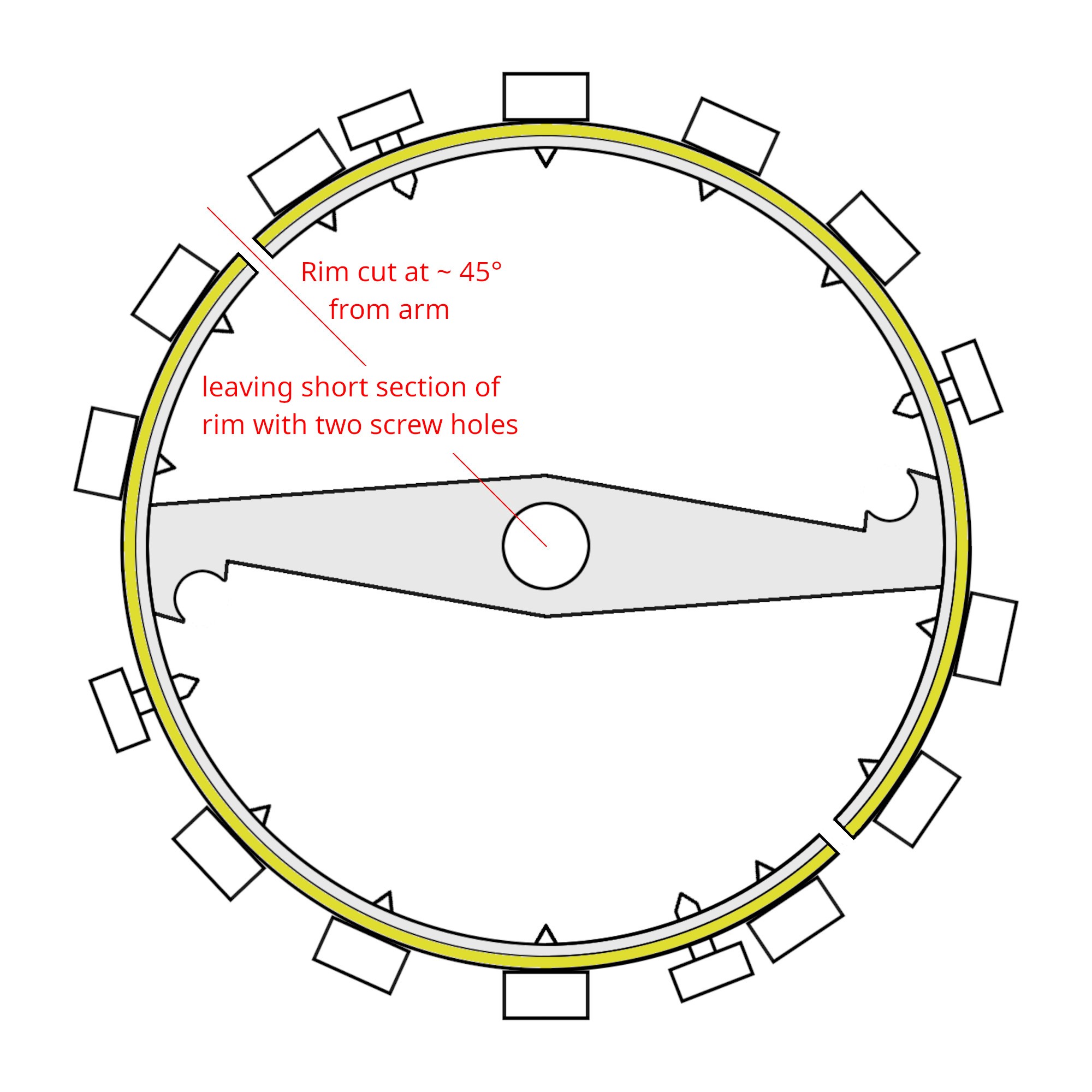
Drawing of a Guillaume watch balance:
Click image to enlarge
The extra movement of the rim sections allowed the rim of balances for box (marine) chronometers to be cut at 90° to the bar to make four short bimetallic sections, and four smaller compensation masses used. The distance these had to be moved in and out to provide the compensation was essentially the same as in the ordinary compensation balance, but instead of being positioned 100° to 120° along the rim sections, the extra movement of the rims allowed the to be at about 45°.
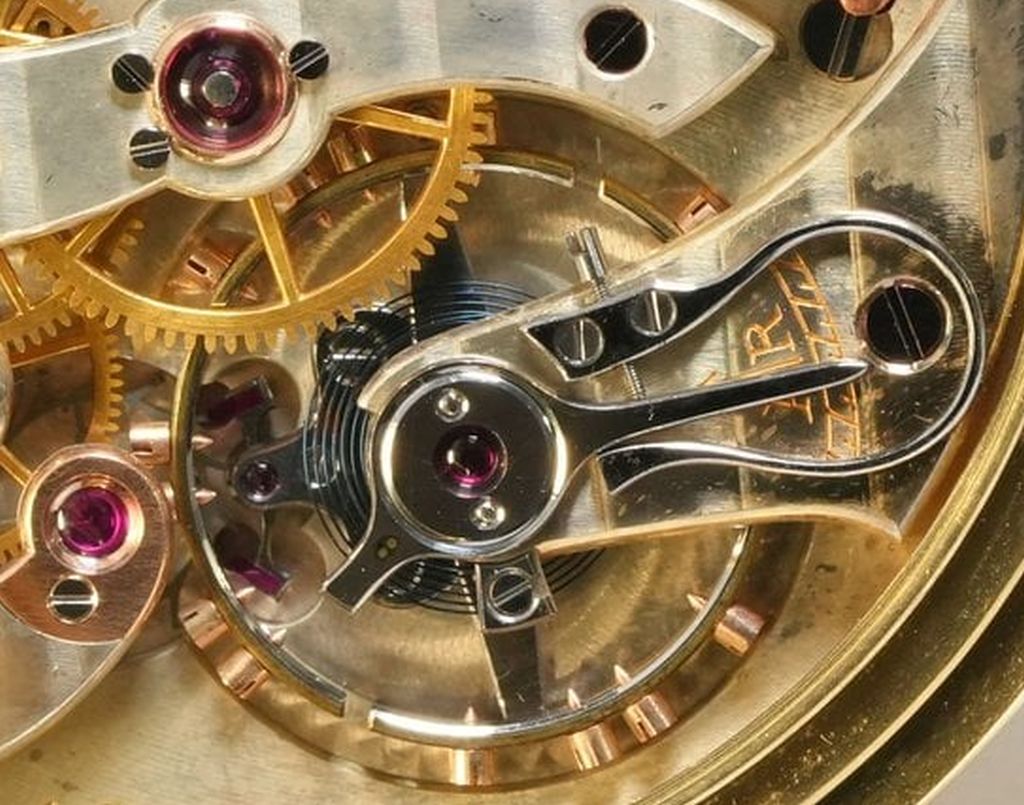
Guillaume watch balance:
Click image to enlarge
The drawing of a Guillaume compensation balance shown in the section above can be compared to the drawing of an ordinary marine chronometer compensation balance in the section about the Compensation Balance.
Guillaume balances for watches are different from those for larger box chronometers. The photo here shows a Guillaume balance in a pocket watch.
The balance is identified by the short sections of bimetallic rim next to the arms with holes for two screws. Ordinary compensation balances do not have these; the rim is cut closer to the arms.
Making Guillaume Balances
Anibal was alloyed and cast at the Imphy steelworks and supplied to balance manufacturers in Switzerland. Discs of Anibal were made from the raw material. A ring of brass was placed on the disc, with a fluz between the two. They were then heated in a furnace until the brass melted and fused onto the outer circumference of the Anibal disc.
After fusing the brass ring to the Anibal disc, the brass was in a relatively soft state, so after cleaning up it was compressed by hammering. This was a skilled task and could not be completely consistent, so later the brass was compressed by rolling between three ball races.
The outer surface of the disc was then machined to the final dimensions and the inner part cut away to form the inner Anibal rim and the arms.
Performance of Guillaume Balances
After the introduction in 1877 by Charles-Auguste Paillard of a palladium alloy suitable for balance springs, many leading English chronometer makers, after some initial resistance, adopted palladium alloy balance springs. Palladium alloy has two advantages over steel: it does not rust, and its modulus of elasticity varies more linearly with temperature. This more linear variation in the modulus of elasticity significantly reduced the middle temperature error when used with ordinary compensation balances. Britten observed that ‘The fifth chronometer on the 1883 Greenwich trial was fitted with a palladium spring and an ordinary compensation balance without auxiliary. No chronometer maker would expect such a result with a steel spring.’
The Guillaume balance was invented in 1899 and was not available commercially in time for the Neuchâtel chronometer competition in 1901. However, in the following year, 13 pocket chronometers fitted with Guillaume balances were entered. The report of the competition in the Journal suisse d’horlogerie states that these showed a variation of ±0.044 seconds per degree, a proportionality deviation of ±0.35 seconds, and a return to normal operation after thermal testing of ±0.50 seconds.
The following table summarises the results from the same competition for 21 box (marine) chronometers fitted with Guillaume balances and steel balance springs against 9 box chronometers with palladium alloy balance springs and ordinary compensation balances, and 144 chronometers with steel balance springs and ordinary compensation balances.
| Variation per 1°C ± s | Proportionality deviation ± s | Resumption of rate after thermal test ± s | Given by | |
|---|---|---|---|---|
| Guillaume balance, steel balance spring | 0.040 | 0.33 | 0.42 | 21 chronometers |
| Palladium alloy spring, ordinary compensation balance | 0.041 | 1.46 | 1.35 | 9 chronometers |
| Ordinary compensation balance, steel spring | 0.071 | 1.63 | 0.94 | 144 chronometers |
In this table:
- Variation per 1°C is the average rate variation with temperature.
- Proportionality deviation is the middle temperature error — the departure from perfectly linear compensation across the temperature range.
- Resumption of rate after thermal test measures how well timekeeping returned to normal after temperature changes.
Although the variation per degree was almost identical for palladium springs and Guillaume balances, the proportionality deviation (middle temperature error) and recovery after temperature changes were significantly better in chronometers fitted with Guillaume balances and steel springs. These results explain why continental chronometer makers quickly adopted the Guillaume balance while abandoning palladium springs, despite their earlier promise.
These results show that a steel balance spring combined with a Guillaume balance produces superior timekeeping. Although palladium alloy springs used with traditional compensation balances reduced the middle temperature error compared to steel springs, the Guillaume balance compensated the non-linear elasticity of steel springs more effectively. Steel springs had lower internal friction than palladium alloy ones, were less prone to sagging under their own weight, were easier to form accurately, and were well supported by established manufacturing techniques. The combination of a steel spring and Guillaume balance delivered better temperature compensation, better recovery after temperature changes, and superior long-term stability compared with palladium springs used with ordinary compensation balances.
The English agent for Guillaume balances, which were often incorrectly called “Invar balances”, charged 45 shillings (£2 5s) for a Guillaume balance for a marine chronometer. On top of the resistance of the English watch industry to continental inventions, this was a very high price, and few English chronometers used Guillaume balances.
Back to the top of the page.
B. W. Raymond Invar Balances
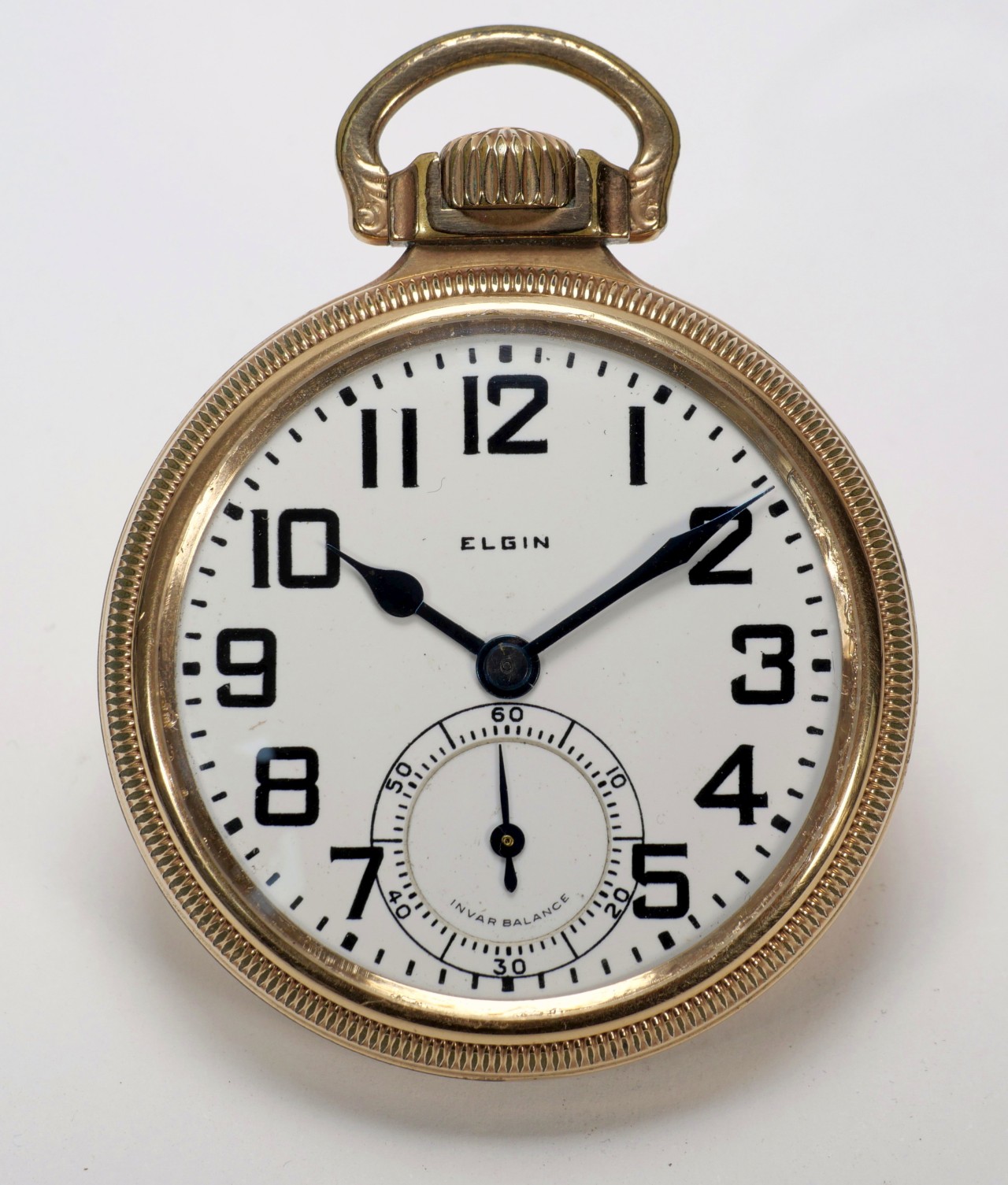
Elgin B W Raymond, “Invar” balance: Click image to enlarge
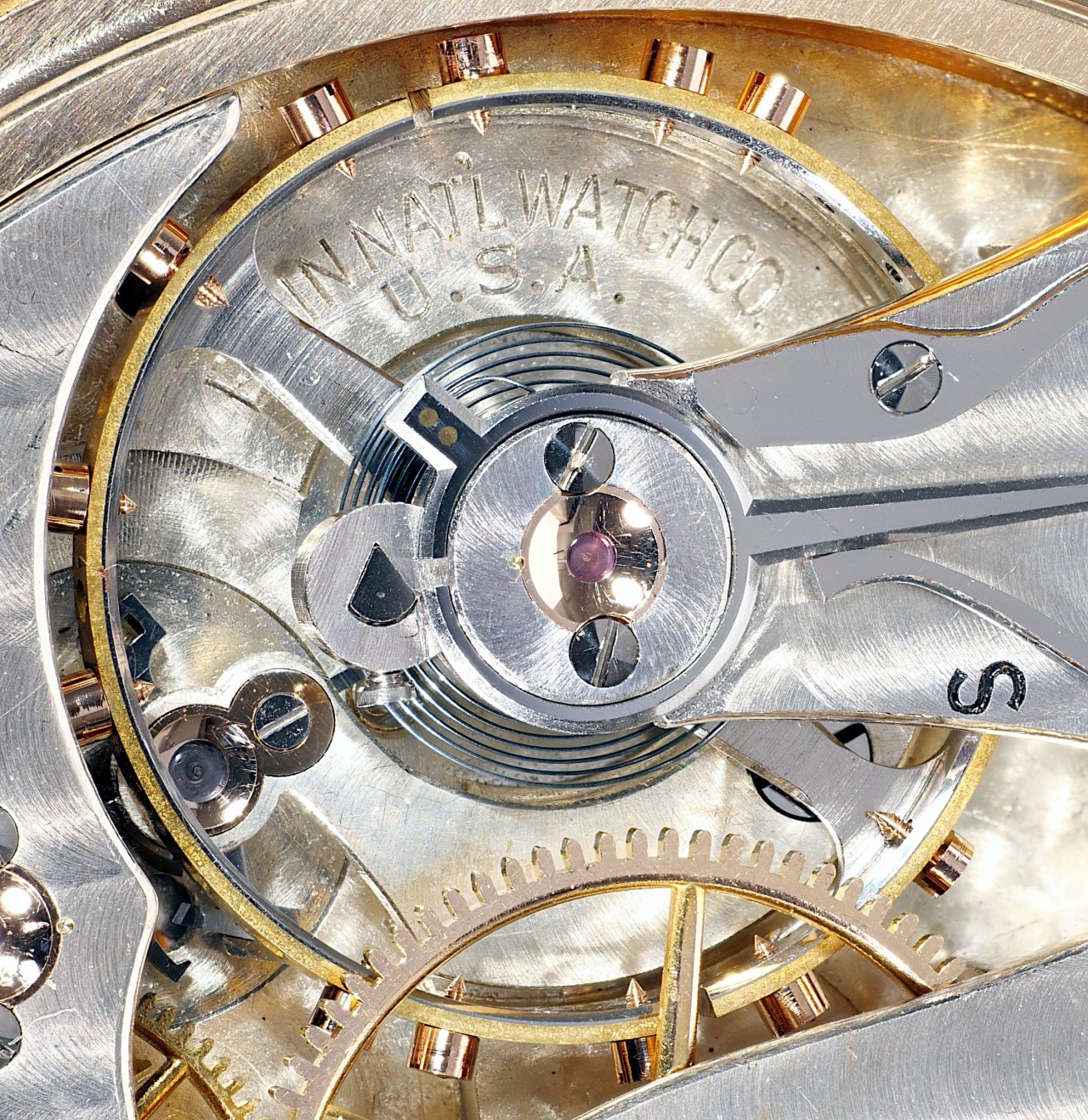
Guillaume balance: Click image to enlarge
A statement that sounds self contradictory or paradoxical is that “Invar balances contain no Invar”. But it's true, and here is the explanation.
Watches like the one shown in the photos here were introduced by the Elgin National Watch Company of Elgin, Illinois, in 1923 under the name “B. W. Raymond”. Benjamin W. Raymond was the Elgin National Watch Company’s first president. These watches were aimed at railway workers and have the features expected in a Railroad Grade watch, with a clear and easy to read dial and lever setting to avoid accidentally changing the time.
The movement is very high quality. It is a 16-size Elgin model 15 with 21 jewels, a fine adjustment Ball type regulator and a special type of compensation balance. The photo of the face of the watch shows within the seconds track that Elgin called this an “Invar Balance”.
The second photo is a close up of the balance. It has a cut bimetallic rim with brass on the outside and a silvery coloured metal on the inside. This metal is a nickel-steel alloy, but it is not Invar. Invar is strictly the name used for the nickel steel alloy with the lowest rate of thermal expansion, which has around 36% nickel.
The nickel steel alloy used in this balance has a different ratio of nickel to steel, around 42%, and a coefficient of thermal expansion of about \(7 \times 10^{-6}\), much greater than Invar. It is therefore not Invar.
Unlike brass and steel compensation balances, the rims of which are cut close to the arms, the rims of this balance are cut at an angle of about 30° to the arms. This creates a long and a short section on either side of each arm. Each of these sections carries gold screws for poising the balance and adjusting the temperature compensation. In this balance, the shorter sections have two holes and carry one screw. These short sections are the sign that the balance is not an ordinary brass and steel compensation balance.
The so-called Invar balance is actually a Guillaume Integral balance, with a nickel steel alloy called Anibal as its inner layer and brass for the outer layer.
Explanation
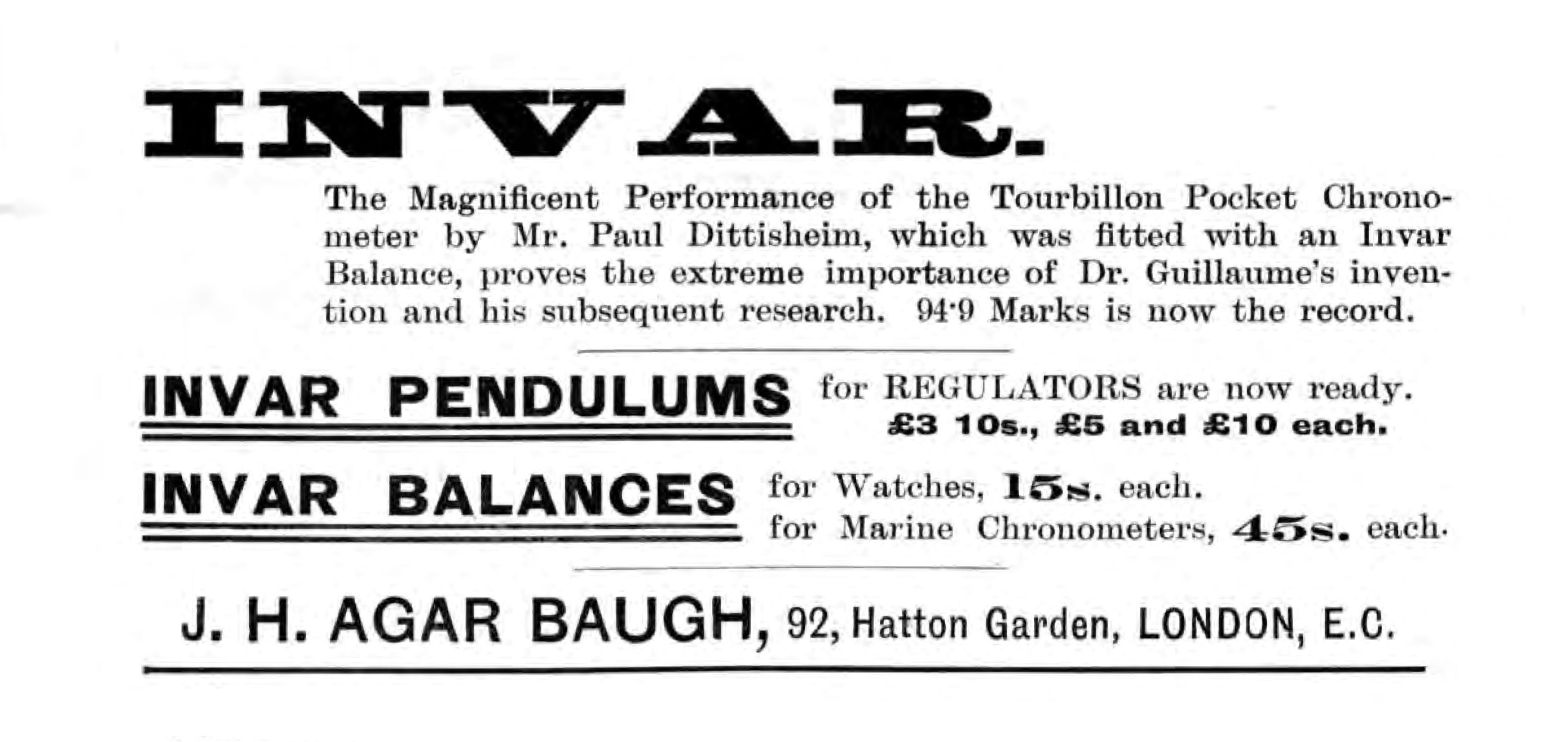
Advert from 1903 with the erroneous name ‘Invar balances’:
Click image to enlarge
Invar is a nickel-steel alloy with very low, near zero, thermal expansion, meaning that it hardly expands or contracts with changes in temperature. Invar was discovered in 1896 by Dr Charles Guillaume of the International Bureau of Weights and Measures, the BIPM, in Sèvres. It has a nickel content of nominally 36% by weight and a coefficient of thermal expansion of around \(0.8 \times 10^{-6}\) per degree Celsius, which can be further reduced by heat treatment. The name Invar was suggested by Professor Marc Thury because of its lack of thermal expansion and almost invariable dimensions. All other nickel-steel alloys have greater thermal expansion than Invar.
The use of a nickel-steel alloy in compensation balances stems from the problem of the middle temperature error and was the result of the research at the end of the nineteenth century into nickel-steel alloys by Dr Guillaume. In 1899, Guillaume realised that one of alloys he had been studying could be used to resolve the problem of middle temperature error.
Guillaume identified a nickel steel alloy with 44% nickel that has a lower rate of thermal expansion than steel, and the unusual characteristic that its rate of expansion decreases as the temperature increases. Guillaume called this alloy ‘Anibal’, derived from acier nickel pour balanciers, or nickel steel for balances.
The decreasing rate of thermal expansion of Anibal was the key to creating a balance that eliminated the middle temperature error. It meant that the difference between the expansion of the brass outer layer of the balance and the Anibal inner layer increased as the temperature increased, causing a greater movement of the bimetallic rims. This was in the opposite direction to the increasing loss of stiffness of a steel balance spring, thus matching the compensation to the characteristics of the spring.
Various names were used for brass and Anibal compensation balances. In 1912, Guillaume was moved to write a letter to the Journal Suisse d’Horlogerie about this. He said
The balance that I described for the first time in this journal is quite generally, in French-speaking countries, designated by the name of its author [that is a balancier Guillaume or Guillaume balance]. In Hamburg, it is called Nickelstahlunruhe, an incomplete denomination, since nickel steel constitutes only a part of it, while in Kew, it is called an Invar balance, a decidedly erroneous name, Invar not entering into the composition of the balance. Ch.-Éd. Guillaume, Sèvres, 29 août 1912.
After this, it became more common to refer to the balances as ‘Guillaume balances’, although some in England continued to refer to them as Invar balances. This was most likely simply due to a lack of familiarity with them. English chronometer makers used palladium alloy balance springs which had a lower middle temperature error than steel springs and were corrosion resistant, so better for marine chronometers, and English watchmakers were not disposed to using highly priced foreign balances, whatever their name.
This is the answer to the apparently paradoxical assertion that Invar balances contain no Invar. The balances in Elgin B. W. Raymond watches marked ‘Invar Balance’ are actually Guillaume balances, with the inner layer of the rim made of Anibal.
It is not known why Elgin called them Invar balances, but it might have been after the earlier use at Kew and by some in the English trade, including the British importer of Invar and Guillaume balances, or possibly because the name Invar was well known and associated with precision metrology and timekeeping. Whether Elgin made them in-house or bought them from Switzerland is not known, but their appearance is identical to Guillaume balances made in Switzerland by .
If you have any comments or questions, please don't hesitate to get in touch via my Contact Me page.
Copyright © David Boettcher 2005 - 2026 all rights reserved. This page updated April 2026.
Back to the top of the page.