Blog: Nivarox Balance Springs
Copyright © David Boettcher 2005 - 2026 all rights reserved.First published: 20 January 2025, last updated 04 May 2025.
I make additions and corrections to this web site frequently but, because they are buried somewhere on one of the pages, the changes are not very noticeable. I decided to create this blog to highlight new material.
Note that these articles also get updated, especially soon after they are posted when additional information may be added. Check the “last updated” date to see when the article was last updated.
The article in this blog is from a series explaining how temperature compensation is achieved in modern watches without bimetallic compensation balances. This is achieved by using an unusual property of nickel steel alloys to make balance springs that, unlike steel springs, get stiffer as their temperature increases.
The breakthrough occurred in 1897, with the invention by Paul Perret and Dr Guillaume of the first nickel steel compensating balance springs. The development of nickel steel balance springs began with these first Paul Perret balance springs, leading to Elinvar, and ultimately to Nivarox in the 1930s.
Six articles in this series are currently planned;
- The Discovery of Invar,
- Paul Perret Balance Springs,
- Dr Guillaume Spirals,
- Elinvar balance springs,
- Variable Rate Balances and
- Nivarox balance springs.
The highlighted links will jump straight to the ones that have been published.
The articles are from the page about Temperature Compensation by Nickel Steels.
As always, if you have any comments or questions, please don't hesitate to get in touch via my Contact Me page.
Nivarox Balance Springs
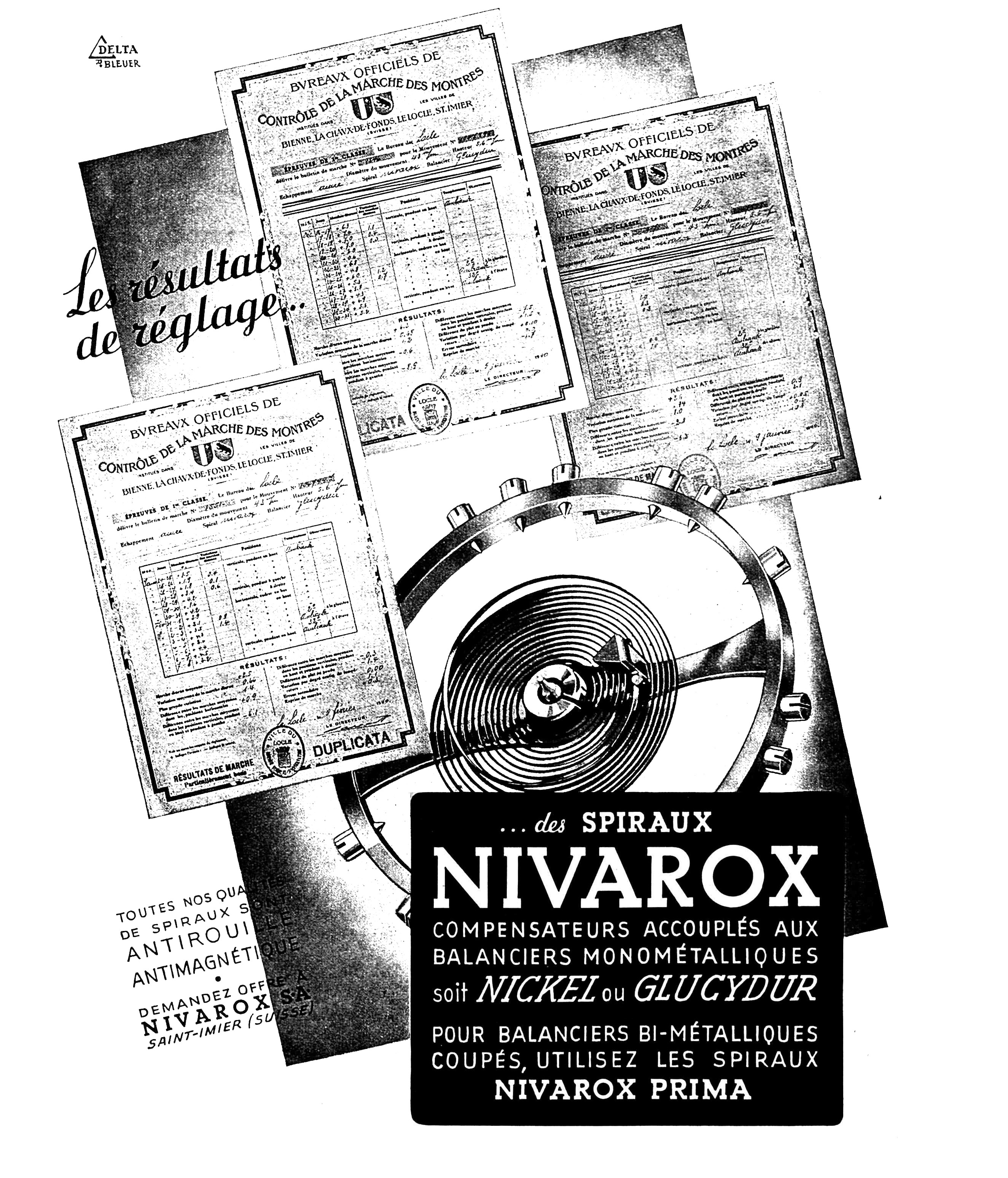
Nivarox advert from 1940: Click image to enlarge
In the 1920s, Elinvar balance springs were a hot topic in watchmaking. They seemed to offer the promise of simple temperature compensation without the cost of compensation balances or the problems of the earlier Paul Perret and Dr Guillaume nickel steel springs, which were softer and had higher internal friction than the best hardened steel balance springs.
Despite the best efforts of materials specialist Pierre Chevenard and outstanding watchmaker Paul Ditisheim, watches with Elinvar balance springs weren't taking top places in observatory trials. Although Elinvar was harder and had lower internal friction that earlier nickel steel balance springs, it was still not as good as hardened steel.
Reinhard Straumann struggled to overcome the problems of Elinvar balance springs. He invented balances that used the anisotropic thermal expansion of zinc alloys to give them variable thermal expansion rates that could be matched to the characteristics of individual Elinvar balance springs, but he came to the conclusion that Elinvar simply wasn't good enough, and he decided to do something about it.
The final result was Nivarox, which swept away carbon steel to become the most successful balance spring material ever produced. Introduced in the 1930s, Nivarox is still used today, nearly on hundred years later, in many of the finest watches.
The advertisement from 1940 reproduced here shows observatory certificates awarded to watches fitted with Nivarox balance springs, which it states are used with monometallic balances made of nickel or Glucydur. For compensation balances, a grade of Nivarox called Nivarox Prima was available, but this soon disappeared along with the use of compensation balances, which were expensive and made obsolete by Nivarox.
Reinhard Straumann
Straumann was born in 1892 in Bennwil, a municipality in the district of Waldenburg in the canton of Basel in Switzerland. After elementary school, he completed an apprenticeship in watch technology and precision mechanics at the École d’horlogerie in Le Locle, and from 1914 to 1916 he studied mechanical engineering at the École Supérieure d’Aéronautique in Lausanne.
In 1916, Straumann joined the Waldenburg watch manufacturing company Revue Thommen as a designer, and subsequently became technical director.
Straumann was unhappy with Elinvar balance springs due to several fundamental deficiencies: although Elinvar is harder and has a higher elastic limit than the previous Paul Perret and Guillaume nickel steel alloys, its elastic limit is lower than hardened steel, making it relatively soft, it has high internal friction causing damping of oscillations of the balance and reduced amplitude and it is susceptible to magnetic fields.
Straumann visited Dr Guillaume on two occasions, trying to persuade him to that a better material than Elinvar was required, but Guillaume was not responsive to the idea.
Beryllium
Straumann kept up to date with technical developments in materials. In the late 1920s, he read about the work of George Masing and Otto Dahl at Siemens & Halske, a German telecommunication company with a well funded R&D laboratory. They had investigated the effects of alloying metals with beryllium. One outcome was beryllium bronze, which could be precipitation heat treated to have a strength and hardness similar to alloy steels, and was used for telephone exchange switching components which had to withstand repeated switching over many thousands of cycles.
Several patents over the use of beryllium as an alloying component had been granted to Siemens & Halske. Straumann contacted the company proposing the investigation of beryllium as an alloying material for balance springs and, fortunately, Dr Illig, the head of the technical development department, understood the significant potential of the request. He issued a licence to Straumann allowing him to create alloys covered by Siemens & Halske patents.
Straumann’s own laboratory facilities at that time were not equipped to carry out systematic metallurgical experiments, and the material would have to be processed from 500kg cast billets into watch balance springs, so he sought Swiss companies to participate in the work. None was interested.
Fortunately, the head of Heraeus Vacuumschmelze in Hanau, Germany, Dr Wilhelm Rohn, was more willing and with his deputy Dr. Hessenbruch, together with Carl Haas of the spring making company Carl Haas in Schramberg, Germany, formed a working group with Straumann.
The technology of Heraeus Vacuumschmelze was essential to the project because beryllium has a high affinity for oxygen, which affects the ability to melt and alloy it in conventional furnaces. In 1913, Dr. Wilhelm Rohn, developed a process for melting metals in a vacuum. In 1918, the process for vacuum melting and tempering of metals and alloys was granted a patent. Making the alloy that Straumann wanted to create required the elements be melted and mixed in a vacuum, something that the steelworks at Imphy couldn't do.
Straumann and Heraeus Vacuumschmelze took Elinvar as a starting point and added around 2% of beryllium to the mix. However, this was found to have an adverse effect on the thermoelastic response of the material. It was necessary to add other alloying elements such as tungsten, molybdenum and chromium to maintain the thermoelastic characteristics required for making balance springs.
After many trials, the work was eventually successful and an application for a patent submitted in April 1931. The patent describes an iron-nickel alloy with beryllium and other elements that is heat treated after making wire and forming into spiral shapes to fix the shape and develop high hardness through precipitation hardening. The addition of additional alloying elements such as tungsten and molybdenum allowed the value of the thermoelastic coefficient to be adjusted so that it was linear between 50° and +50°C, eliminating secondary error.
The name Nivarox was chosen by Straumann as a derivative of the German “nicht variable, nicht oxidierend” (non-variable, non-oxidising). The non-variable part refers to the thermoelastic response of Nivarox. However, the thermoelastic characteristic of Nivarox can be varied over quite a wide range from negative to positive. Nivarox was not a single alloy, it was the name given to a family of precipitation hardening nickel steel chrome beryllium alloys; Straumann gave an example of valves for internal combustion engines. The thermoelastic characteristics were varied with different alloying elements and heat treatments to suit specific application. For balance springs, the thermoelastic characteristic of Nivarox is made positive so the modulus of elasticity increases with temperature.
| Nominal composition | Ni | Cr | Ti | Be | Fe |
| Nivarox CT | 37% | 8% | 1% | 0.8% | Balance |
The nominal composition of Nivarox used for balance springs is given in the table here. The precise composition of Nivarox alloys, and details of their heat treatments, are trade secrets known only to Vacuumschmelze, Carl Haas and Nivarox FAR S.A.
Precipitation Hardening
The key to the success of Nivarox is precipitation hardening, an extremely useful property in an alloy. Precipitation hardening was discovered in 1906 by Alfred Wilm, a German metallurgist, who was granted a patent for it in 1909. Wilm found that when 4% of copper was added to aluminium and the quenched, the alloy would increase in hardness over several days at room temperature. The name is a contraction of Dürener and aluminium because the alloy was originally made at Dürener Metallwerke at Düren, Germany.
The key to precipitation hardening is that an alloying element is used which is fully soluble in the main element at high temperature, but insoluble at low temperature. The elements are mixed or annealed at high temperature and quenched, which fixes the high temperature crystal structure with the alloying element evenly dispersed in solid solution. At this point, the alloying element has little effect on the material hardness because it is finely dispersed.
Hardening takes place when the alloying element precipitates from the solid solution and gathers in clusters. The clusters impede the movement of dislocations. In some alloys, this takes place at normal temperature, making the material harder over time. This is what Wilm discovered in Duralumin.
In other precipitation hardening alloys, the alloying element remains in solid solution at room temperature and the material can be formed or machined easily. The parts are then heated to a temperature where precipitation of the alloying element occurs and their hardness increases. Unlike other heat treatments, the material has to be held at high temperature for a lengthy period for the hardening element to precipitate and form clusters. Because of the length of time required, this is also referred to as age hardening.
Nivarox balance springs take advantage of precipitation hardening with beryllium as the precipitation-hardening element.
The small size of beryllium atoms allows them to fit into interstitial sites or substitute for other atoms in the crystal lattice, contributing to solid-solution strengthening. Beryllium also has a very high modulus of elasticity (~287 GPa), so even small amounts increase the alloy’s stiffness. However, the principal benefit of beryllium is that, during controlled heat treatment, it forms very fine intermetallic compounds with iron and nickel which precipitate out of solid solution and act as barriers to dislocation movement. This greatly increases the alloy’s hardness and yield strength without significantly compromising ductility.
Annealed and quenched Nivarox can be drawn and rolled into the fine section wire required for a balance spring and then heat treated to develop its full hardness, which is similar to hardened and tempered high carbon steel. Nivarox also has low internal friction similar to hardened steel. Straumann showed that the oscillations of a balance with a Nivarox spring decayed at a rate similar to a balance fitted with a hardened steel spring.
Straumann announced the new material in the Journal Suisse d'Horlogerie in November 1932. He listed its properties as:
- The thermoelastic coefficient of Nivarox can be modified at will. It can be prepared for a monometallic balance made of Maillechort (nickel silver), for the anisotropic "Straumann" balance, or any other type of balances including cut bimetallic balances.
- It has a low secondary error, the deviation of rate at the middle temperature from that at high and low temperatures.
- It has a lower sensitivity to magnetic fields than other materials used for balance springs and residual effects after exposure to a strong magnetic field are lower.
- Its hardness and elastic limit are like hardened steel, making it resistant to deformation and allowing its use for very small springs.
- It has low internal friction so that damping of the balance oscillations is small and watches with Niarox balance springs have amplitudes as large as those with hardened steel springs.
- It does not rust. Because it can be made with the same thermoelastic coefficient as hardened steel balance springs, it can be used as an alternative to steel that doesn't rust and has reduced secondary error.
The Nivarox advert from 1940 reproduced at the head of this section mentions Nivarox balance springs formulated to be used with bimetallic compensation balances, “balanciers bi-metalliques coupés”. These were called Nivarox Prima.
Nivarox was the solution to all the problems with Elinvar that Straumann had identified, and more. It soon swept Elinvar and all other balance spring materials away and became the only material used for the balance springs of high quality Swiss watches for most of the rest of twentieth century.
Monometallic Balances
The first nickel steel Paul Perret balance springs were formulated for use with monometallic brass balances, which had the advantage of being easy to machine and non-magnetic. These were superseded by nickel and Maillechort, nickel silver, balances, which were also non-magnetic and harder then brass.
From his contacts with Siemens & Halske, Straumann knew that adding a small amount, about 2½%, of beryllium to copper created an alloy that was hard, non-magnetic and did not rust or corrode. He realised that this would be an excellent material to use for balances. He called this alloy Berrydur-Cu. Today it is better known as beryllium bronze or Glucydur, after glucinimum, an old name for beryllium.
The Nivarox advert from 1940 reproduced at the head of this section mentions Nivarox balance springs formulated to be used with monometallic balances of nickel or Glucydur.
Temperature Effects
It is sometimes said that the modulus of elasticity of Nivarox doesn't vary with changes in temperature, or that the stiffness of balance springs made from Nivarox doesn't vary with temperature, and even that Nivarox has very low thermal expansion. In conjunction with these statements is usually the idea that Nivarox balance springs are used with balances that have very low thermal expansion.
None of these statements are true.
A material with a modulus of elasticity that doesn't change with temperature cannot be used to make a spring whose stiffness doesn't change with temperature unless it also has no thermal expansion. But like all metals, Nivarox has significant thermal expansion, which makes a spring stiffer as its temperature increases.
The thermoelastic response of Nivarox to changes in temperature can be made to be positive, zero or negative, depending on the intended application. For balance springs, the thermoelastic response of Nivarox is made positive so its modulus of elasticity increases as its temperature rises.
Both of these effects; thermal expansion and positive thermoelasticity, mean that a Nivarox balance spring gets stiffer as its temperature increases. For this reason, Nivarox springs are used with balances that have significant thermal expansion.
When temperature increases, the increase in stiffness of the Nivarox spring due to its thermal expansion and increased modulus of elasticity compensates for the increased rotational inertia of the balance due to its expansion.
Nivarox balance springs are usually used with beryllium bronze balances. Beryllium bronze used for balances has a coefficient of thermal expansion of 17 × 10-6/°C, and Nivarox has a coefficient of thermal expansion of 7.5 × 10⁻⁶/°C. These figures were provided to me by Swatch Group who do not reveal the thermoelastic coefficient of Nivarox, saying only that it is in the range +/- 25 × 10-6/°C. However, plugging the figures for thermal expansion into the following equation
\[ 2 \, \alpha_{\, balance} - 3 \, \alpha_{\, spring} - \gamma_{\, spring} = 0 \]where \( \alpha_{\, balance} \) is the thermal expansion of the balance, \( \alpha_{\, spring} \) is the thermal expansion of the spring and \( \gamma_{\, spring} \) is the thermoelasticity of the spring, reveals that the thermoelastic coefficient of Nivarox is 11.5 × 10⁻⁶/°C.
| Effect of 30°C increase in temperature | Daily rate (sec) |
|---|---|
| Beryllium bronze balance expansion | -44.1 |
| Nivarox spring thermal expansion | +29.2 |
| Nivarox spring thermoelasticity | +14.9 |
| Overall effect on rate | 0.0 |
Thermal expansion of the balance causes a loss, which is compensated by thermal expansion of the spring and an increase in its modulus of elasticity.
The table lists the individual effects for a temperature increase of 30° Celsius. About two-thirds of the loss of rate caused by thermal expansion of the balance is offset by the increase in stiffness of the balance spring from its thermal expansion, and one third by the increase in its modulus of elasticity.
Thermal expansion of the balance spring is often either neglected or misunderstood. When it was first noticed, in the eighteenth century, that watches lost rate as the temperature increased, it was thought that this was mainly due to the balance spring becoming longer as it expanded. However, the frequency of a spring balance oscillator is proportional to the height (breadth) of the spring and inversely proportional to its length. As both of these change in the same proportion with increases in temperature, the increasing length has no effect. The significant factor is that the frequency is also inversely proportional to the square root of the cube of the spring's thickness. This means that even a small change in the thickness of the spring has a large effect on rate, as can be seen from the results here.
If a Nivarox balance spring is 0.03 millimetres thick, or 0.0012 inches, an increase in temperature of 30°C will cause it to increase in thickness by 0.00000675 millimetre or 0.00000027 inches. Standard workshop micrometers measure to one hundredth of a millimetre or a thousandth of an inch, and Vernier versions can give readings of a thousandth of a millimetre or one ten thousandth of an inch. The change in thickness of a balance spring is much less than these micrometers can measure, which shows why it is impossible to calculate the rate of a watch accurately from measurements of the parts.
Richard Lange and Nivarox
Richard Lange was granted a patent for a metal alloy for watch springs containing beryllium. Because of this, it is sometimes said that Lange was “the father of Nivarox.” This is not correct. Lange’s patent describes simple alloying (solution hardening), which achieves some increase in hardness, but not the breakthrough that Straumann achieved. The patent meant that Straumann had to pay a license fee to Lange, but Lange had no part in the creation of Nivarox.
If you have any comments or questions, please don't hesitate to get in touch via my Contact Me page.
Copyright © David Boettcher 2005 - 2026 all rights reserved. This page updated May 2025.
Back to the top of the page.