Blog: Variable Thermal Expansion Rate Balances
Copyright © David Boettcher 2005 - 2026 all rights reserved.First published: 21 May 2025, last updated 16 June 2026.
Balances with variable rates of thermal expansion were invented to overcome the problem of variations in the thermal expansion and thermoelastic properties of nickel steel balance springs. The first was an ovalising balance invented by Paul Perret in 1897.
I make additions and corrections to this web site frequently but, because they are buried somewhere on one of the pages, the changes are not very noticeable. I decided to create this blog to highlight new material.
Note that these articles also get updated, especially soon after they are posted when additional information may be added. Check the “last updated” date to see when the article was last updated.
The article in this blog is from a series explaining how temperature compensation is achieved in modern watches without bimetallic compensation balances. This is achieved by using an unusual property of nickel steel alloys to make balance springs that, unlike steel springs, get stiffer as their temperature increases.
The breakthrough occurred in 1897, with the invention by Paul Perret and Dr Guillaume of the first nickel steel compensating balance springs. The development of nickel steel balance springs began with these first Paul Perret balance springs, leading to Elinvar, and ultimately to Nivarox in the 1930s.
Six articles in this series are currently planned;
- The Discovery of Invar,
- Paul Perret Balance Springs,
- Dr Guillaume Spirals,
- Elinvar balance springs,
- Variable Rate Balances and
- Nivarox balance springs.
The highlighted links will jump straight to the ones that have been published.
The articles are from the page about Temperature Compensation by Nickel Steels.
As always, if you have any comments or questions, please don't hesitate to get in touch via my Contact Me page.
Variable Expansion Rate Balances
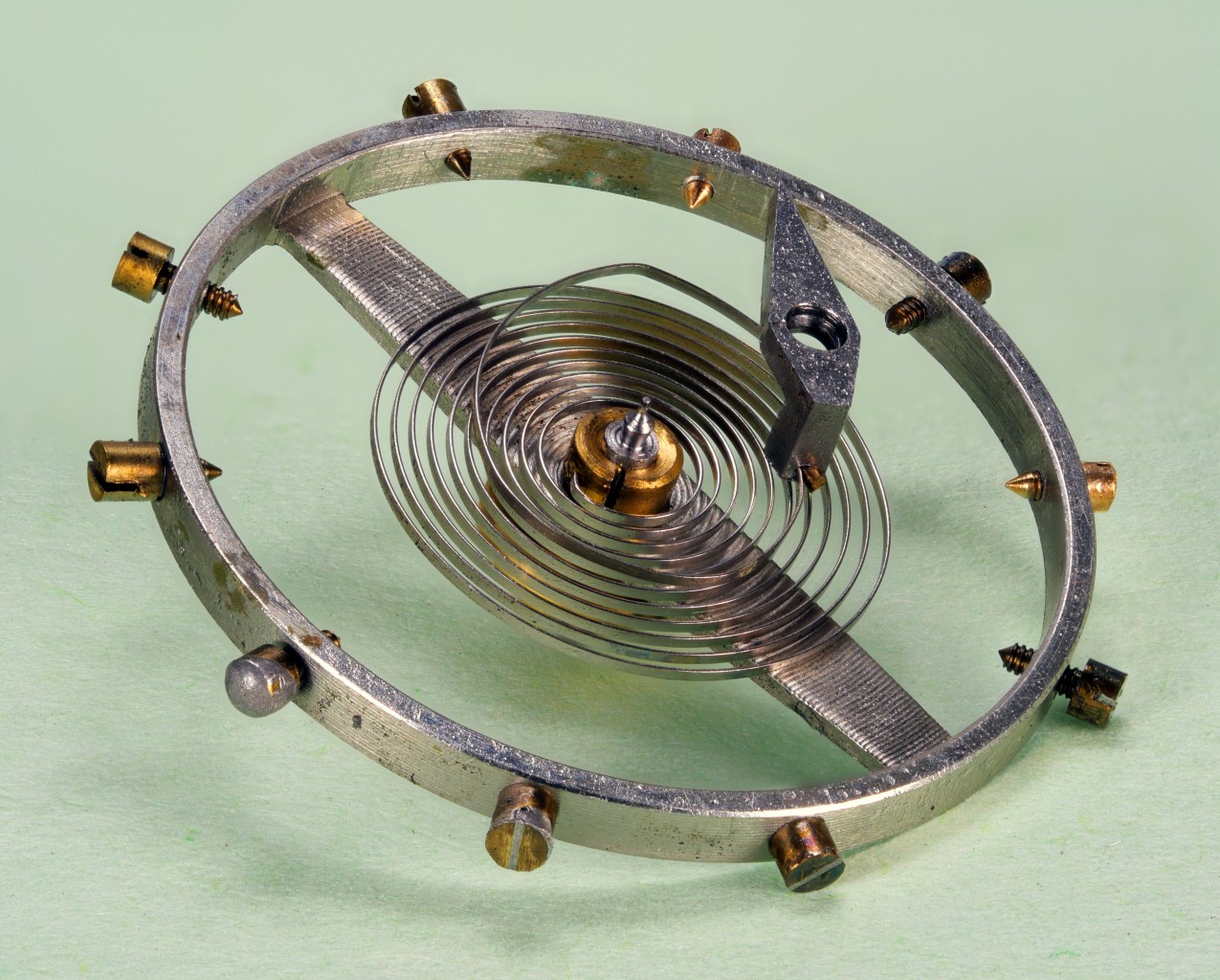
Nickel steel spring and monometallic balance from circa 1910: Click image to enlarge
Balances with variable rates of thermal expansion were invented to overcome the problem of variations in the thermal expansion and thermoelastic properties of nickel steel balance springs and monometallic balances.
Balances with variable rates of thermal expansion had existed since Pierre Le Roy (or Leroy) invented the compensation balance in 1765. Le Roy's first compensation balance used mercury thermometers to alter its radius of gyration in response to changes in temperature. This was soon superseded by the brass and steel compensation balance with cut bimetallic rims. These balances were needed to compensate for the large loss of rate of 11 seconds per day per degree Celsius, or 330 seconds per day over a range of 30 degrees Celsius, caused by the thermoelastic variations of steel balance springs.
Traditional compensation balances were difficult, and therefore expansive, to true and adjust to give the correct rate of compensation. Because they had to compensate for the large losses in rate caused by steel springs, their cut rims had to be made thin, in order to provide sufficient movement inwards and outwards. This made the rim sections weak and flexible, vulnerable to damage during handling and affected by centrifugal force during operation, which was particularly significant in box chronometers with their large diameter balances.
Nickel steel balance springs had much smaller thermoelastic variations than steel balance springs. They were used with plain balances with uncut rims. The rims were made of a single metal and hence the balances are called monometallic, to distinguish them from compensation balances with bimetallic rims. The photo here shows a nickel steel balance spring and monometallic balance made in around 1910.
The nickel steel alloy was formulated so that the increase in stiffness of balance springs made from it compensated for the expansion of the balance. When the match between thermal variations of spring and balance was perfect, their was no variation in rate as the temperature varied. But achieving the perfect alloy was impossible in practice, and most nickel steel springs caused small variations of a few seconds per day with changes in temperature.
The first person to consider this problem was Paul Perret, the inventor of the nickel steel balance spring, who in 1897 invented an ovalising balance to allow the effective rate of expansion of the balance to be varied to match the thermoelastic characteristics of individual nickel steel balance springs. However, the earliest nickel steel balance springs also had a significant error at the middle temperature and Perret's invention was not used. Elinvar balance springs had a much more linear thermoelastic characteristics, which meant that the idea of a balance which allowed small adjustments to its thermal expansion was revived by Paul Ditisheim.
A traditional compensation balance was designed to compensate for the large loss of rate with increasing temperature caused by a steel balance spring. The variable expansion rate balances conceived by Perret and used by Ditisheim did not have to compensate for a large loss of rate; they were used to adjust the balance to much smaller gains or losses in rate caused by nickel steel balance springs. This allowed them to be more rigid and easier to construct, avoiding many of the problems that made traditional compensation so problematic and expensive.
The Source of the Problem
The first nickel steel alloys for watch balance springs were created in 1897 for Paul Perret and Dr Guillaume by the steelworks at Imphy. The Imphy steelworks primarily made large melts of nickel steel for armour plate, so making small batches of nickel steel for balance springs was challenging, and achieving very precise alloying was difficult given the technology of the era.
The alloying process at Imphy used open crucibles for melting and mixing alloys. This was not capable of producing alloys of precise and completely homogeneous composition. Flux materials were added to provide protection from atmospheric oxidation, to absorb impurities and provide thermal insulation for the melt. These introduced impurities and, at the end of the melt, were raked-off as slag, carrying away some of the alloying elements. Natural thermal convection currents in the crucible would provide some mixing, but would be insufficient for homogenisation of precision alloys and manual stirring was likely employed, probably using carbon or clay-graphite rods. This would also introduce contamination, and it was insufficient to ensure complete mixing, meaning it was not possible to perfectly mix the alloying elements.
These deficiencies in mixing resulted in variations in the resulting nickel steel alloys that caused balance springs made from them to have inconsistent thermal expansion and thermoelastic properties. The alloys were tested and those with properties closest to those required were selected and the balance returned to be reformulated by remelting and alloying. However, it was difficult to produce alloys with exactly the changing rate of stiffness with increasing temperature to exactly compensate for the thermal expansion of a balance.
Dr Guillaume explained the problem succinctly:
It has been found that the elastic properties sought (elasticity increasing with the temperature and high elastic limit) depend to a certain extent on the impurities which usually accompany the several elements constituting the alloy used, even when these alloys are made from the most pure products obtainable by metallurgy; this dependence is such that two alloys prepared from elements in the same apparent proportions from materials technically pure but of different origin have not exactly the same elastic properties. Even when using the same materials the alloys obtained have not always strictly the same composition and the same elastic properties ; this arises from the fact that during the fusion of the alloy certain elements may be more or less oxidised in the crucible and thus pass into the slag; the alloy has not then strictly the composition represented by the proportions of the products used for preparing it. One cannot therefore prescribe strict and absolute proportions and it can only be said that when employing for making the alloys the pure materials obtainable in commerce within the aforesaid limits there is obtained a metal possessing to a more or less perfect degree the desired properties, namely elasticity increasing with rise of temperature and high elastic limit. The proportions to be adopted in making the alloy for the spring vary moreover to a certain extent with the nature of the metals used in the construction of the balance to which the spring is to be applied.
Because of this, from the very start Paul Perret realised that a means of altering the rate of thermal expansion of the balance would allow the balance to be tuned or adjusted to the characteristics of the balance spring it was paired with.
The adjustment required was only small, plus or minus a few seconds in twenty four hours over a temperature interval of thirty degrees compared with the loss of five and a half minutes caused by a carbon steel spring. Perret conceived of a balance with a rim having a greater rate of thermal expansion than the arms so that the rim would become increasingly oval as the temperature varied away from the normal. The rate of change of the radius of gyration could be altered by moving screws around the rim. Perret documented this idea in a letter to Guillaume in 1897.
However, the performance of the first nickel steel balance springs did not warrant such fine adjustment. The variation in their thermoelastic response to changes in temperature was non-linear, causing a secondary error at the middle temperature of twenty to thirty seconds per day. Because of this they were not suitable for the highest grade watches. Perret's invention of an ovalising balance was not used.
Elinvar was a breakthrough, to the extent that it is often thought to be the first nickel steel alloy used for compensation springs. However, the aspect that differentiated Elinvar most from the nickel steel alloys that had gone before was its virtually linear thermoelastic response to changes in temperature. This eliminated the secondary error at the central temperature of the earlier alloys. With a linear increase in stiffness as the temperature increased, Elinvar was able to rival carbon steel as a balance spring material.
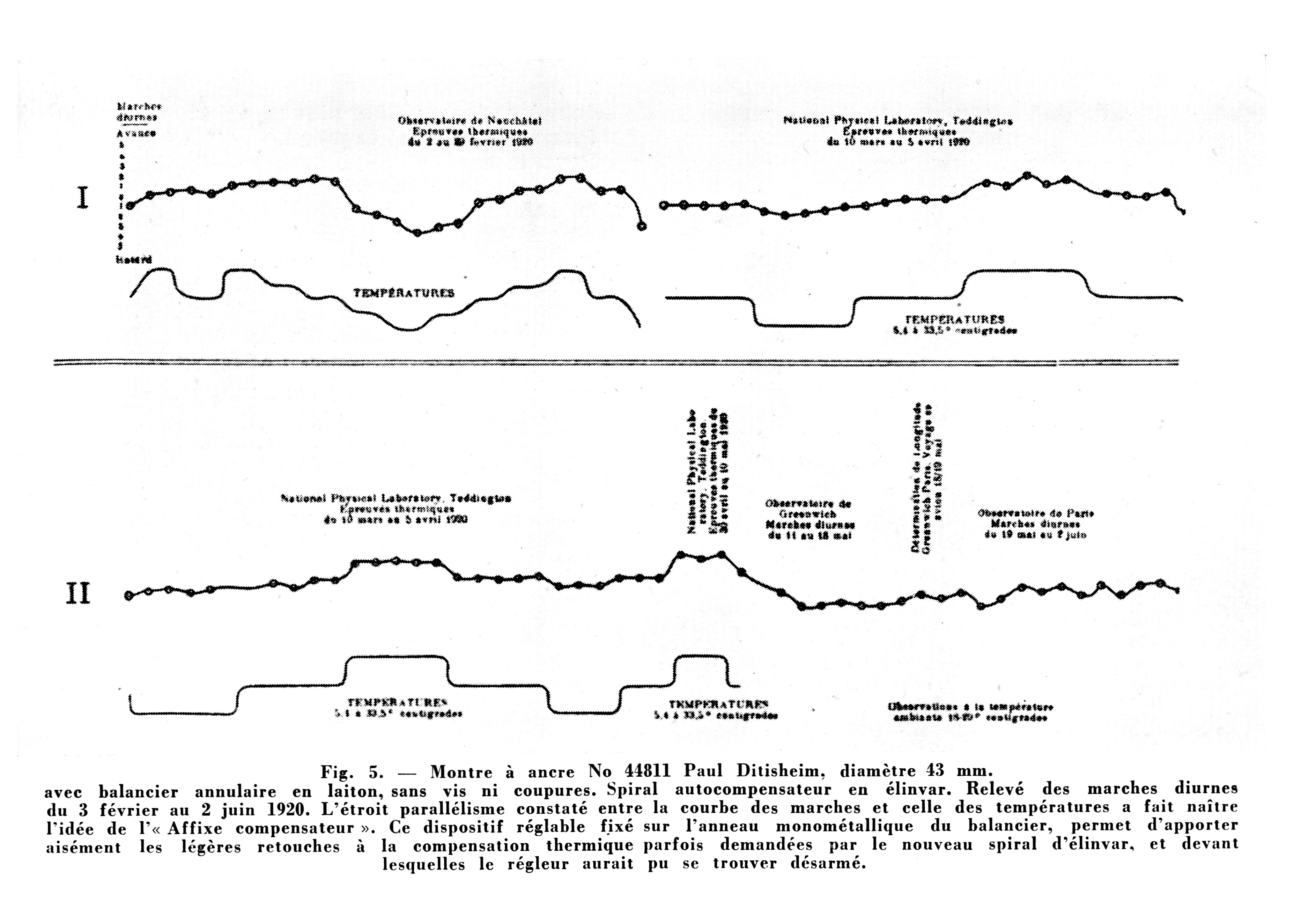
Rate of Ditisheim 44811 at different temperatures: Click image to enlarge
In 1920, Dr Guillaume gave one of the first Elinvar balance springs to Paul Ditisheim, who fitted it to a watch with his serial number 44811. The balance was brass, uncut and without screws. This watch was subjected to special temperature tests at the observatories at Neuchatel and Paris, at the National Physical Laboratory in Teddington and at Greenwich.
The results of these tests are summarised in the figure reproduced here. The captions says:
Fig. 5. — Anchor watch No. 44811 Paul Ditisheim, diameter 43 mm with annular brass balance, without screws or cuts. Self-compensating balance spring in élinvar. Record of daily rates from February 3 to June 2, 1920. The close parallelism observed between the curve of the rates and that of the temperatures gave rise to the idea of the “Compensating Affix.” This adjustable device fixed to the monometallic ring of the balance makes it easy to make the slight adjustments to the thermal compensation sometimes required by the new élinvar balance spring, and before which the adjuster could have found himself helpless.
The performance of the watch was excellent, although it exhibited a small increase in rate with increasing temperature because the compensation provided by the balance spring was greater than required to compensate for the increase in the moment of inertia of the balance due to its thermal expansion. The results of the tests at the NPL have not been located and may be lost, but from the graph it appears that the rate amounted to an increase of no more than four seconds per day for a temperature increase from 42 to 92 degrees Fahrenheit, that is 0.08 seconds per day per degree Fahrenheit.
To pass the Kew Class A test, the mean change of rate with change of temperature had to be less than one third of a second per day per degree Fahrenheit. Zero variation would gain 20 marks. Ditisheim's watch number 44811 was not entered for a Class A trial, but with a variation of 0.08 seconds per day per degree Fahrenheit it passed the minimum requirement and would have been awarded 15.2 marks out of 20 for temperature compensation.
This watch by Ditisheim deserves to be better known. It was the first watch with a temperature compensating nickel steel balance spring subjected to observatory tests, and the results showed that nickel steel balance springs could, with a little more development, be a serious assault on the dominance of the carbon steel balance spring in precision observatory trials. Ditisheim watch number 44811 was therefore a pioneer in modern temperature compensation. However, very few people have heard of the watch, and its current whereabouts are unknown.
Although the temperature compensation of the watch was very good, good enough to pass the Kew Class A test, it was not good enough for Ditisheim, who was used to scoring 95 marks in Kew A trials. Ditisheim entered twelve other watches with conventional temperature compensation for Class A certificates at the same time as number 44811 was being tested. The highest scoring of these received 96.9 marks, and the twelve averaged 94.9 marks. Ditisheim subsequently took these twelve watches on a flight to Paris to determine the difference in longitude between Greenwich and Paris.
If number 44811 had been fitted with a steel balance spring and a compensation balance, the temperature compensation could have been adjusted by moving screws along the bimetallic rim sections. But with an Elinvar spring and a plain, uncut, monometallic balance, moving screws around the rim would be pointless because all parts of the rim expanded at the same rate.
Guillaume suggested that monometallic balances could be made from a selection of brasses with differing amounts of zinc, and therefore different expansion rates, and a balance selected to match the thermal characteristics of each Elinvar spring. He remarked that between Invar and brass was a wide range of rates of thermal expansion that could be used. However, this required fitting a balance and spring to a watch and measuring its rates under varying temperatures, and then changing the balance and repeating the test. Selecting balances to match springs this way was not a practical proposition because of the time and effort required.
With a flash of genius, Ditisheim realised that instead of trying to select a balance with exactly the right thermal characteristics for an Elinvar spring, the rate of thermal expansion of a brass balance could be made adjustable so that it could be matched to the characteristics of the spring.
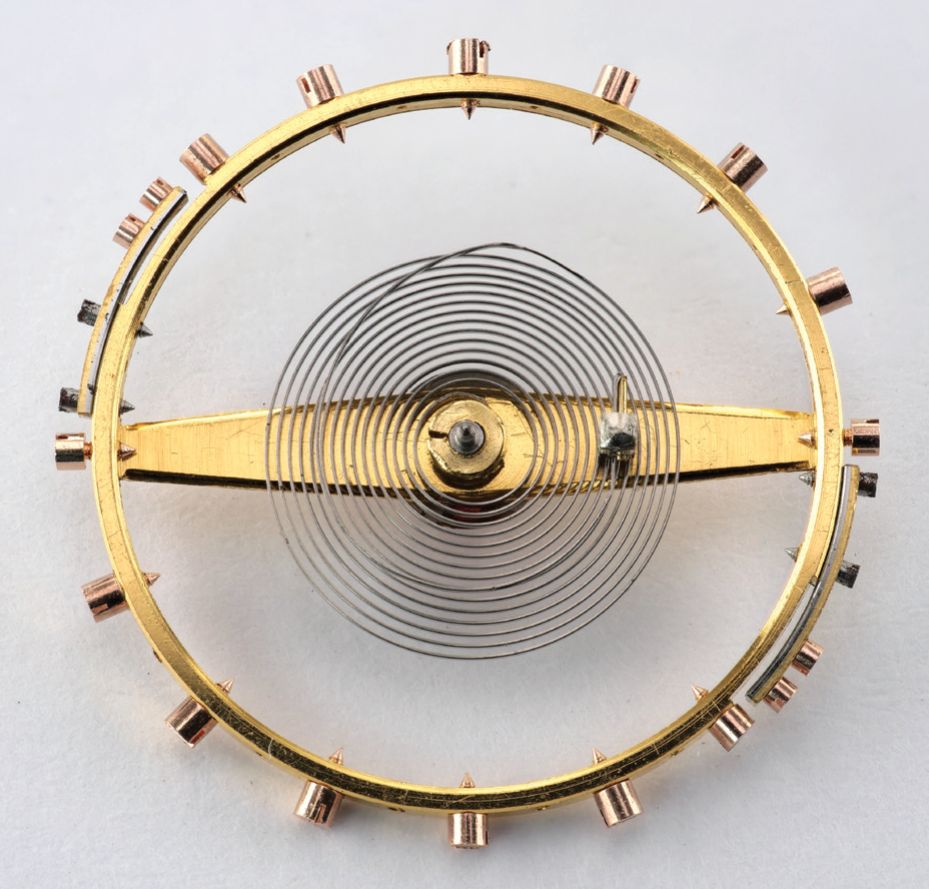
Monometallic brass balance with Affixes: Click image to enlarge

Adjusting effect of Affixes: Click image to enlarge
To provide the necessary adjustment, Ditisheim fitted plain brass balances with small bimetallic "affixes" on their rims. By moving screws along these affixes, or using heavier or lighter screws, the rate of thermal expansion of the radius of gyration of the balance could be fine tuned to match the compensation provided by an Elinvar balance spring.
The photo here shows an Affix balance from a Ditisheim watch. Although the temperature compensation of an Elinvar spring fitted to a plain brass balance was already good enough for to pass the Kew “A” trial, and therefore good enough for everyday wear, Ditisheim was a perfectionist and fitted his watches with Affix balances.
It is the rate of thermal expansion of the radius of gyration of a balance, which in simple terms can be thought of as the radius of the rim, that determines how many seconds of loss per day per degree Celsius it causes. A watch with a brass balance and carbon steel balance spring will lose 11 seconds per day for a rise in temperature of one degree Celsius. Of this loss, 1.6 seconds are caused by the thermal expansion of the balance, which for a rise in temperature of 30 degrees Celsius is a loss of 48 seconds per day.
The bimetallic Affixes that Ditisheim fixed to the rim of a balance allowed its rate of thermal expansion to be adjusted. By fitting Affixes that curled outwards as the temperature increased, the effective rate of thermal expansion of the balance was increased. Reversing the bimetallic strips so that they curled inwards as the temperature increased reduced the rate of expansion. By this means, the rate of thermal expansion of a balance could be adjusted to match the characteristics of an individual Elinvar balance spring.
The diagram here shows this effect. A brass balance causes a loss with increasing temperature, shown as the solid line sloping downwards in the lower part of the figure. An Elinvar balance spring increases in stiffness as the temperature rises, causing a gain. The gain caused by a perfect balance spring is shown by the dotted line in the top of the figure, but because the manufacturing variations already discussed, this was rarely obtained. The range of gains caused by Grade 1 Elinvar balance springs is shown by the shaded grey area in the top of the figure. Without any way of adjusting the gain caused by the spring or the loss caused by the balance, the temperature compensation would be imperfect and the watch would either lose or gain, depending on the characteristics of the Elinvar spring it was fitted with.
The shaded grey area around the line of the loss caused by the brass balance shows the range of adjustments to its rate that were made possible by fitting bimetallic Affixes to its rim. With careful adjustment, these allowed the rate of loss caused by the balance to be altered to match the gain caused by an individual Elinvar balance spring.
This surprised Guillaume, who had thought that the limit of what was possible had already been achieved. Ditisheim was granted two Swiss patents for this invention. The application for the first was submitted on 31 August 1920, followed by an application for an additional or supplementary patent submitted on 25 August 1921. The patents subsequently granted were CH 91169, published 17 October 1921, and CH 98234, published 1 March 1923.
Although the combination of a carbon steel balance spring with a bimetallic compensation balance had dominated the results of observatory trials, Ditisheim pointed out the advantages of an Elinvar balance spring used with a monometallic balance with compensating affixes.
- The uncompensated residue of an Elinvar balance spring and monometallic balance is less than one hundredth of the error of a steel spring that a compensating balance must correct, and the problems an adjuster must combat are reduced in a similar proportion.
- Equilibrium (i.e. poise) at any temperature is almost entirely ensured by the monometallic portion of the balance and easily achieved.
- Centrifugal force has no effect on the monometallic balance, and its effect on the short Affixes is completely negligible.
Ditisheim later used balances with small sections of brass embedded in their steel rims. This necessitated the rims being cut in a manner analogous to a traditional compensation balance. The advantage of this type of balance was most likely that it was cheaper to manufacture than an Affix balance, but cutting the rim reintroduced flexibility like a traditional cut compensation balance. However, in a watch size balance, scale effects mean that this was probably negligible.
Ovalising Balances

Sketch by Paul Perret for his ovalising balance in a letter to Guillaume dated September 1897: Click image to enlarge
The ovalising balance was invented by Paul Perret, who documented his idea in a letter to Guillaume in 1897. Perret’s idea was a balance with a rim having a greater rate of thermal expansion than the arms, so that the rim would become increasingly oval as the temperature changed. The rate of change of the radius of gyration could be altered by moving screws around the rim.
In his letter to Guillaume, Perret sent the sketch reproduced here, saying “Here is the balance I designed: it consists of an arm to which the rim is screwed. If the arm is made of a metal that is not very expandable and the rim is very expandable, the rim will deform as indicated by the dotted line; if you place a mass at A, you will have little effect, while at B, you will have more.”
This type of balance was described by Paul Ditisheim in the Horological Journal in December 1925, who attributed its invention to Charles Volet.
Charles Volet was Swiss. Born in 1895 at Vevey in the canton of Vaud, he received a degree in physics and mathematics from the University of Lausanne. In 1917, he joined the International Bureau of Weights and Measures. He worked closely with Charles-Édouard Guillaume in his research on nickel-steels, steels with a high percentage of chromium and carbon, including Elinvar, and studied the metrological properties of different brasses (copper-zinc and copper-zinc-nickel alloys), which were used to make balances for use with nickel steel balance springs such as Elinvar.
In an article published in the May and June 1920 issues of the Journal suisse d'Horlogerie et de Bijouterie, Volet described and analysed mathematically several new balances for chronometers, including ovalising balances, which he called balanciers différentiels non coupés (uncut differential balances). The figure from the article reproduced here shows, at the top, a balance for a box or marine chronometer, and a watch balance at the bottom. In his analysis, Volet assumed that the arms would be made of Invar and the rims of brass.
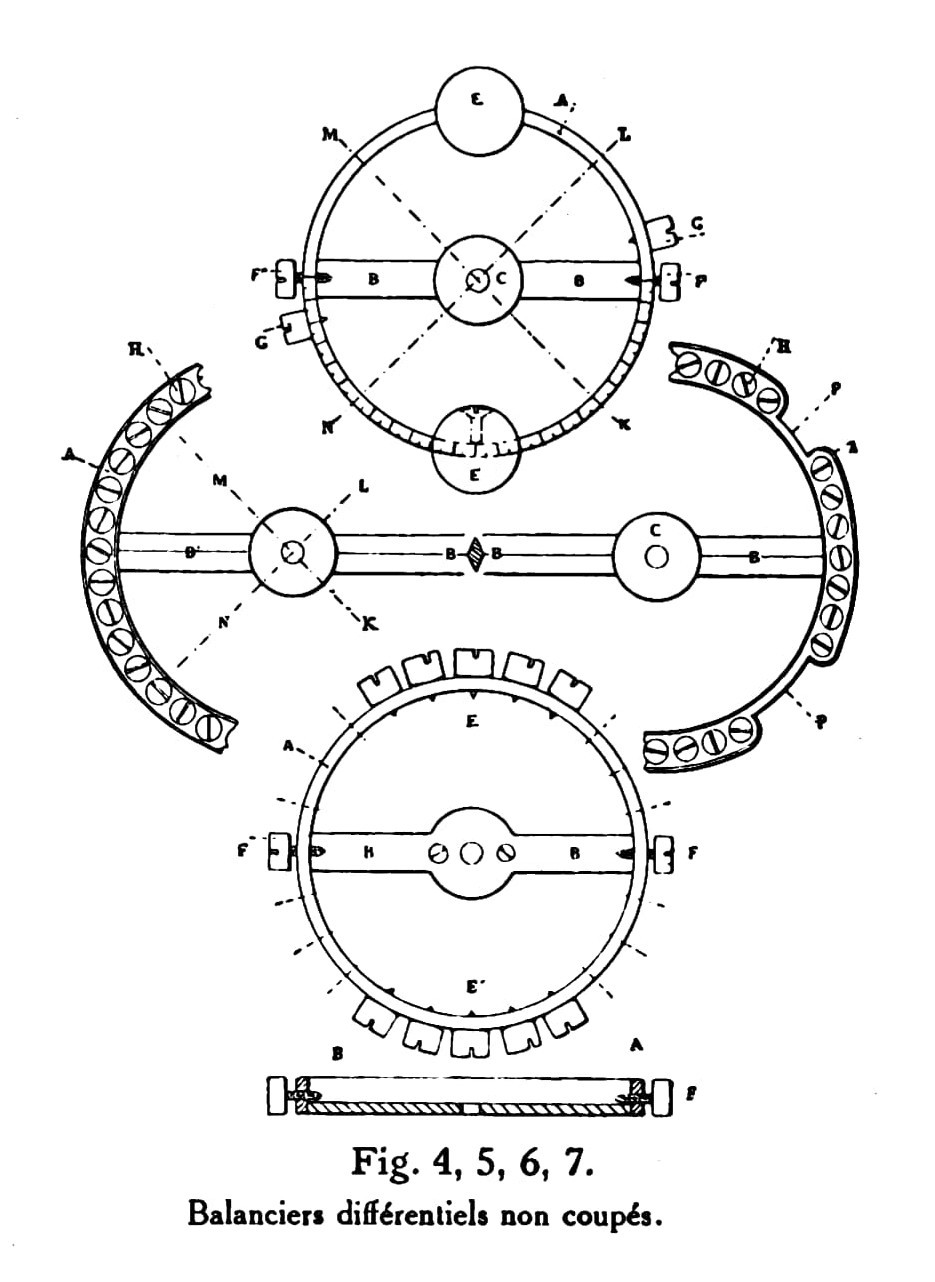
Volet’s figure of uncut differential (ovalising) balances: Click image to enlarge
In his article, Volet did not claim to have invented these balances himself, but remarked;
Le deuxième type de balancier différentiel que nous nous proposons de décrire, construit comme le précédent avec la collaboration des Ateliers Paul Ditisheim, se distingue en ce que la serge n'est pas sectionnée ... Sous l'influence d'une variation de la température, la serge s'ovalise très légèrement, ses différents points s'éloignent ou se rapprochent donc de l'axe de rotation dans des proportions inégales.
[The second type of differential balance that we propose to describe, built like the previous one in collaboration with the Paul Ditisheim Workshops, is distinguished by the fact that the rim is not sectioned ... Under the influence of a temperature variation, the rim becomes very slightly oval, and its various points therefore move away from or towards the axis of rotation in unequal proportions.]
From this it seems clear that Ditisheim got to know about the ovalising balance when Volet asked him to make one, presumably to experimentally verify the concept, and assumed that it was an invention of Volet’s. However, it seems most likely that, rather than inventing the ovalising balance completely independently, Volet learned of Paul Perret’s invention from Guillaume.
Swiss patent number 99077 for various designs of compensating balances, including the ovalising balance, was granted to Ditisheim and Volet on 16 May 1923, with a priority date of 4 February 1922.
The ovalising balance that has been described in so many books as Volet’s invention was, in fact, invented in 1897 by Paul Perret.
Two further instances of ovalising balances are interesting.
Straumann
Reinhard Straumann searched for a material with thermal anisotropy, i.e. with different rates of thermal expansion in different directions. After extensive studies and metallurgical experiments he found this property in a zinc cadmium alloy. Zinc crystals have a coefficient of expansion along the longitudinal axis that is about 5 times greater than that at right angles. For the measurements of the effect, Straumann developed a highly sensitivity “microdilatometer” or micro-expansion meter.
The zinc cadmium alloy was rolled into sheets, which caused the crystals to arrange longitudinally in the direction of rolling, and consequently the sheet to have a greater coefficient of expansion along the line of rolling than at right angles to it. Balances were cut from the sheet with the arms in the direction of rolling. Increasing temperature caused the arms to lengthen more than the rim expanded, so the rim became oval.
It appears that Straumann's anisotropic zinc alloy ovalising balance didn't go into production, there are no known examples of such a balance.
Hamilton
During the Second World War, the American Hamilton watch company produced their Model 21 marine chronometer. The US Naval Bureau of Ships specification for the contract called for the design to be closely based on a chronometer made by Ulysse Nardin, including a fusee, a steel balance spring and a cut bimetallic brass-and-steel compensation balance. Hamilton had no experience of making marine box chronometers and declined to accept the contract unless they could use their own “Elinvar Extra” balance spring material and an uncut balance.
The Bureau of Ships had little option but to accept Hamilton's conditions, which turned out to be the right decision. Hamilton used an ovalising balance with arms made of Invar and a rim of stainless steel, which has a similar rate of thermal expansion to brass. The use of a balance with an uncut rim allowed both the diameter and the amplitude of the balance to be increased, which contributed to the exceptional timekeeping of the Model 21 Marine Chronometer.
In the late 1920s, Paul Chamberlain visited Paul Ditisheim in Paris. He was so impressed with Ditisheim’s work that he convinced the president of the Hamilton Watch Company and his son to visit Ditisheim in Paris. This resulted in a consultancy agreement between Hamilton and Ditisheim, with Hamilton subsequently acquiring the American rights to the use of Elinvar. Under the consultancy agreement, Ditisheim would no doubt have told Hamilton about Paul Perret's ovalising balance (although he would have called it Volet’s invention). William Ogle Bennett, the chief physicist for the Hamilton Watch Company from 1932 to 1946, was granted a US patent for an ovalising balance in 1944, which he assigned to Hamilton.
Although the same invention sometimes occurs to completely unconnected people, there is a thread running through the story of the ovalising balance that forms a connection. Here's the story as I see it. In 1897, when Paul Perret invented the temperature compensating nickel steel balance spring, he realised that a little adjustment would be required, although far less than provided by a compensation balance, so he invented the ovalising balance. He communicated this invention to Dr Guillaume in September 1897. Around 1920, Charles Volet was working as an assistant to Dr Guillaume at the BIPM on the properties of Elinvar balance springs and monometallic balances. In the course of this work, Guillaume told Volet about Perret's ovalising balance. Volet modelled Perret's ovalising balance mathematically, and asked Paul Ditisheim to have one made to verify his theory. Ditisheim assumed that Volet had invented the ovalising balance. When he was contracted to Hamilton as a consultant, he told them, or at least Bennett, about the ovalising balance. When Hamilton were working on the design of the Model 21 Marine Chronometer, Bennett suggested that an ovalising balance be used, and since the invention had never previously been patented, he secured a US patent on the idea in 1944, 47 years and an ocean away on a different continent from its original inventor.
If you have any comments or questions, please don't hesitate to get in touch via my Contact Me page.
Copyright © David Boettcher 2005 - 2026 all rights reserved. This page updated June 2026.
Back to the top of the page.