Blog: Elinvar
Copyright © David Boettcher 2005 - 2026 all rights reserved.First published: 18 September 2024, last updated 24 June 2025.
The most surprising thing about Elinvar is that it doesn't have invariable elasticity, despite its name being derived from “elasticity invariable”.
If Elinvar really did have invariable elasticity, it would not be a suitable material for balance springs. The article in this blog explains why this is, and why Dr Guillaume gave Elinvar its misleading name.
The article in this blog is from a series explaining how temperature compensation is achieved in modern watches without bimetallic compensation balances. This is achieved by using an unusual property of nickel steel alloys to make balance springs that, unlike steel springs, get stiffer as their temperature increases.
The breakthrough occurred in 1897, with the invention by Paul Perret and Dr Guillaume of the first nickel steel compensating balance springs. The development of nickel steel balance springs began with these first Paul Perret balance springs, leading to Elinvar, and ultimately to Nivarox in the 1930s.
Six articles in this series are currently planned;
- The Discovery of Invar,
- Paul Perret Balance Springs,
- Dr Guillaume Spirals,
- Elinvar balance springs,
- Variable Rate Balances and
- Nivarox balance springs.
The highlighted links will jump straight to the ones that have been published.
The articles are from the page about Temperature Compensation by Nickel Steels.
As always, if you have any comments or questions, please don't hesitate to get in touch via my Contact Me page.
Elinvar Balance Springs
Elinvar was a breakthrough in nickel steels alloys for balance springs, the first that could challenge carbon steel in observatory trials. The most surprising thing about Elinvar is that it doesn't have invariable elasticity, despite its name being derived from “elasticity invariable”.
If Elinvar really did have invariable elasticity, it would not be a suitable material for balance springs. This article explains why this is, and why Dr Guillaume gave Elinvar its misleading name.
As the importance of nickel steel alloys to the Imphy steelworks increased, Henri Fayol, the managing director of the company, recruited talented engineers to improve its technical capabilities. The most outstanding was Pierre Chevenard (1888–1960) who had graduated from the École Nationale Supérieure des Mines de Saint-Étienne in 1911. Chevenard set up a laboratory at Imphy for metallurgy, and he equipped it with precision instruments to measure the properties of alloys using small samples. In this way, a large number of alloys could be studied without making large castings.
In 1912, Chevenard experimented with adding significant proportions of manganese to nickel steel alloys in the Invar range to improve their casting properties. He discovered that nickel steel would accept much greater amounts of manganese, copper and chromium as alloying elements than had been thought possible. This also had interesting effects on the thermoelastic characteristics of nickel steel alloys.

Figure 1 : Thermoelastic variations of nickel steels alloys with zero and 12% chromium: Click image to enlarge
A nickel steel alloy with 10 to 12% chromium and small amounts of nickel, tungsten, carbon, manganese and silicon as solid solution hardening elements as before, was found to have better thermoelastic characteristics than the nickel steel alloy for which Dr Guillaume and the Société des Fabriques de Spiraux Réunies had been granted a patent in 1911, as well as greater hardness and lower internal friction than the simple nickel steel alloys used for Paul Perret balance springs.
The thermoelastic characteristics of nickel steel alloys with 12% chromium are shown as curve 2 in Figure 1. In contrast to curve 1, which cuts the zero line sharply at two points, curve two has a much flatter peak around the zero line. This is useful when making alloys with low thermoelastic effects, because they are less sensitive to the exact ratios of nickel to steel. As well as being less sensitive to chemical composition, this alloy also has a thermoelastic coefficient that varies less with temperature, meaning that its rate of change of stiffness over the temperature range of concern for watches is lower.
It is well known that Guillaume coined the name ‘Elinvar’ for this alloy from ‘invariable elasticity’. However, Elinvar is a misleading name, and the intersection of curve 2 with the zero x-axis is not representative of Elinvar, which has a much lower thermoelastic coefficient than steel, but it is not zero as the curve suggests.
It is also important to know that the stiffness of a spring is a property defined by Hooke's Law and depends not only on the modulus of elasticity of the spring's material but also on its shape, its geometry and dimensions.
Although Elinvar-type alloys can have a range of moduli of elasticity, the Elinvar of balance springs does not have invariable elasticity. It has a positive thermoelastic coefficient, which means that its elastic modulus increases with temperature, just like the nickel steel allop used for Paul Perret and Guillaume balance springs. Elinvar also expands when heated, increasing its stiffness. Dr Guillaume stated that the rate of thermal expansion of Elinvar is 8×10⁻⁶ or 8 parts per million per degree Celsius, which is about three-quarters that of steel and slightly less than half that of brass.
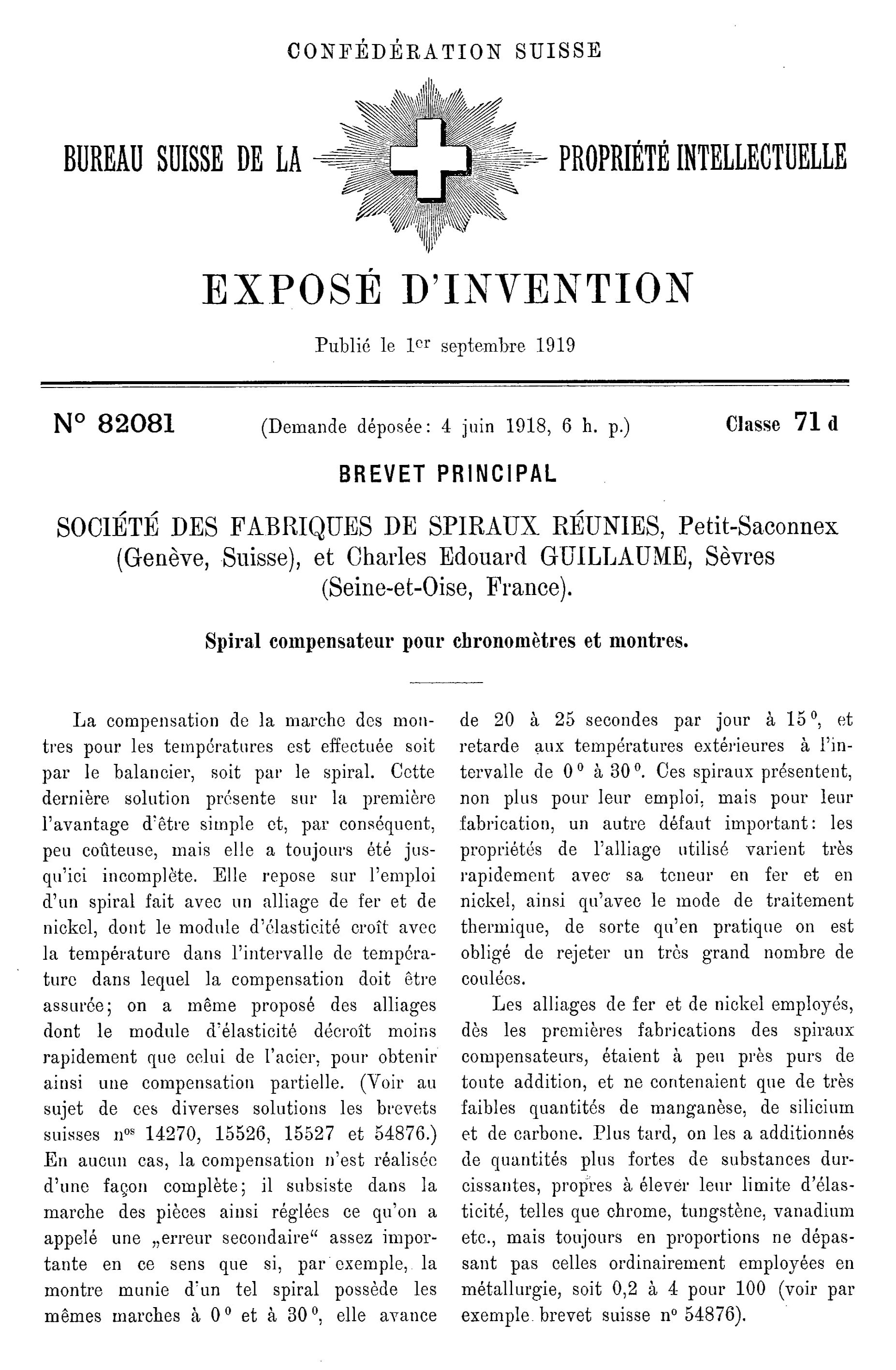
Figure 2 : Elinvar patent CH 82081, priority date 4 June 1918: Click image to enlarge
Even if Elinar did have invariable elasticity as a material, it would not make a balance spring that had invariable elasticity. The elasticity of a spring depends on the elastic modulus of its material and its physical dimensions. A thicker spring is stiffer than a thinner one. Elinvar expands as it is heated, which increases the dimensions of a spring and makes it stiffer.
In fact, Elinvar has positive thermoelasticity, which means that its modulus of elasticity increases and, as a material, it gets stiffer as its temperature increases.
When an Elinvar spring is heated, the two effects of an increase in its modulus of elasticity and thermal expansion cause the spring to get stiffer and exert a greater restoring force for a given angle that it is wound.
As with Paul Perret balance springs and Dr Guillaume spirals, Elinvar balance springs are used with monometallic, uncut, balances that expand when heated. The increase in stiffness of the balance spring compensates for the increase in the moment of inertia of the balance.
Elinvar springs are usually used with balances made of Maillechort, also called nickel silver, an alloy of copper with zinc and nickel that is non-magnetic, oxidation-resistant and harder than brass, although having the same thermal expansion rate.
The Elinvar alloy was discovered in 1913, but the Imphy steelworks could not produce it commercially before the First World War broke out in 1914. After that, the French army needed all the nickel steel produced by Imphy. Consequently, Elinvar balance springs were not manufactured until after the war.
The Société Des Fabriques De Spiraux Réunies and Dr Guillaume applied for a Swiss patent on 4 June 1918, which was granted number 82081 on 1 September 1919, Spiral compensateur pour chronomètres et montres, Figure 2.
A Misleading Name
The name Elinvar often leads to an erroneous assumption. Knowing that it is derived from élasticité invariable or invariable elasticity, it is assumed that a balance spring made from it will not change in stiffness with temperature changes. But this is wrong. In choosing the name Elinvar, Guillaume meant only to imply that the modulus of elasticity was invariable, not that a spring made from it would have invariable stiffness; he knew perfectly well that Elinvar expands when it is heated, which causes a spring made from it to increase in stiffness.
Guillaume was a scientist, a metrologist, and not a professional horologist, which may have influenced his thinking. For many applications, Elinvar can be regarded as having a modulus of elasticity that does not alter significantly with temperature changes, and after the fame he had gained from his earlier discovery being named Invar, another similar, catchy name would have been very tempting, even if it was not strictly accurate. But watches are very sensitive to changes in the stiffness of their balance springs, and Elinvar cannot have invariable elasticity when it is used for a watch balance spring, just as Invar cannot be taken as having zero thermal expansion when it is used as a pendulum rod.
Guillaume knew that nickel steel balance springs could not be made with invariable elasticity. Swiss patent 54876 of 1911 begins, ‘It is known that for several years, escapements have been constructed with balance springs whose elastic force increases with temperature, which largely compensate for the increase in the inertia of the balance with the temperature rise.' It is, therefore, strange that in some articles, Guillaume stated that Elinvar has invariable elasticity. However, in a paper about Elinvar presented to the French Academy of Sciences in July 1920, he added the following explanatory remark,
It should be noted, in fact, that the indication … of a zero value of the thermoelastic coefficient was intended, above all, to simplify the presentation. What we must look for in reality is an alloy endowed with a thermoelastic coefficient with very low linear variation and of a value such that its action, associated with the sum of the effects of expansion, acting in the opposite direction, of the balance spring and balance, leads to the perfect equalisation of the rate of chronometers throughout the temperature range of their use. [emphasis added]
So that’s it. Guillaume’s description of Elinvar as having a zero thermoelastic coefficient and the derivation of its name from invariable elasticity was intended to simplify things. Instead, it has caused more than a century of confusion.
In addiiton to the confusion caused by Guillaume's description and name for Elinvar, it must be remembered that a spring's stiffness depends on its elastic modulus and dimensions. Even if Elinvar did have invariable elasticity, it would not make a spring of invariable stiffness; thermal expansion would make the spring stiffer even if its modulus of elasticity did not alter.
Watches with monometallic balances do not achieve temperature compensation by using a balance spring with invariable elasticity and a balance with a low thermal expansion. Instead, they use a balance spring which increases in stiffness as its temperature increases, due to a combination of thermal expansion and thermoelastic variation, to compensate for the increasing inertia of the balance due to thermal expansion.
Ditisheim No. 44811
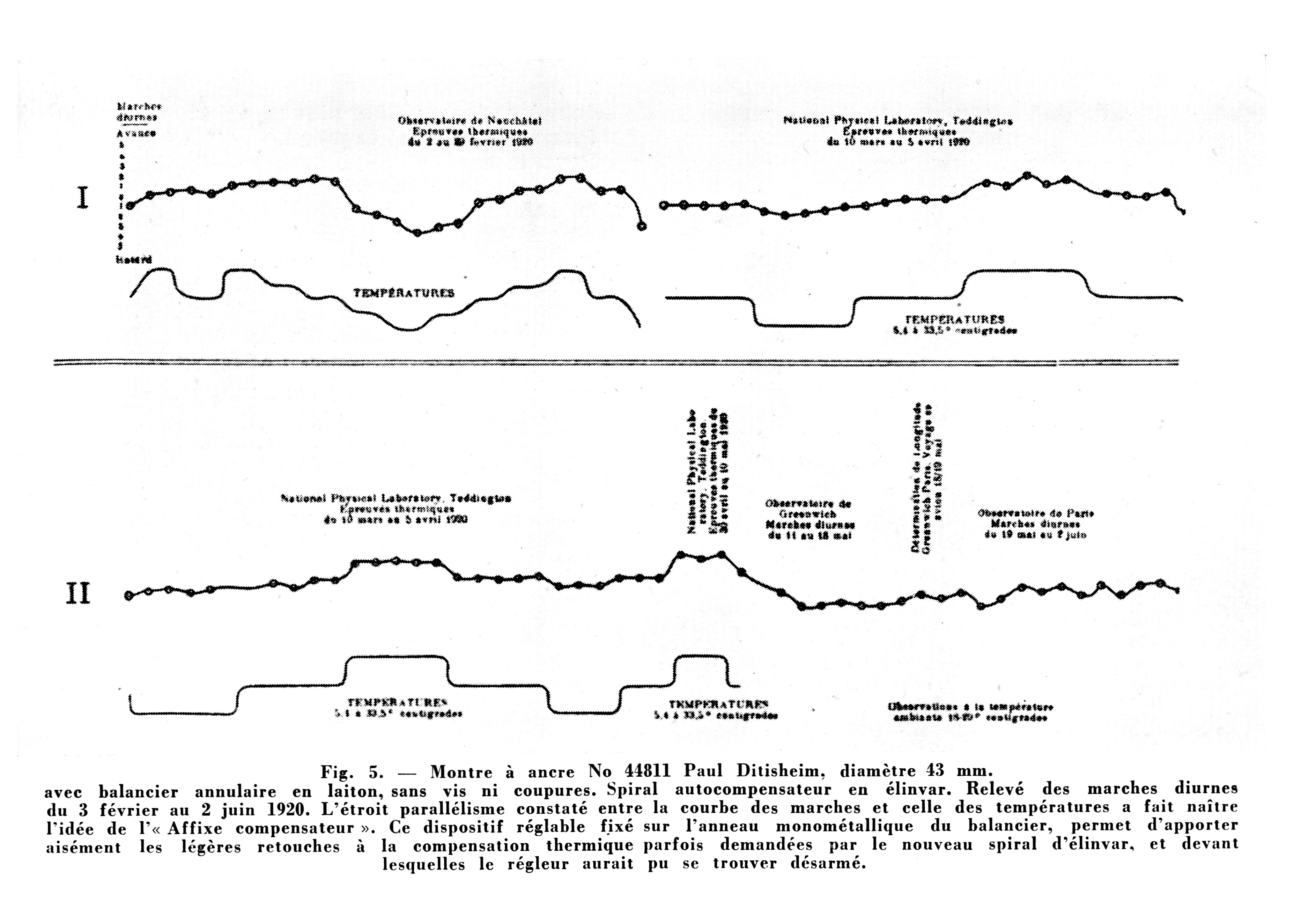
Figure 3 : Rate of Ditisheim 44811 at different temperatures: Click image to enlarge
The earlier nickel steel Paul Perret and Dr Guillaume balance springs did not perform well enough to be competitive in observatory trials, but Elinvar had a more linear thermoelastic response to changes in temperature. In 1920, Dr Guillaume gave one of the first Elinvar balance springs to Paul Ditisheim, who fitted it to a watch with his serial number 44811.
No. 44881 was a Ditisheim pocket watch, 43mm diameter with a lever escapement. The Elinvar balance spring was paired with a monometallic uncut balance made of brass that had no temperature compensation effect.
The watch was tested at different temperatures at the National Physical Laboratory (NPL), Teddington, from 16 March to 10 May 1920. The Kew/NPL records state “Special test for temperatures only – Copy of daily rates throughout given. 5 days ran at 67, 42, 67, 92, 67, 42, 67, 92, 67”. That is nine periods of five days, a total of 45 days. From 16 March to 10 May is a period of 55 days, which allowed one day between tests at different temperatures for the watch to acclimatise to the new temperature. The figures are temperatures in Fahrenheit.
The results of tests at the Observatory of Neuchatel in February 1920, and at the NPL and Greenwich Observatory are shown in figure 3. The tests at Neuchatel and the NPL at different temperatures are shown in the top part of the figure. In the lower part of the figure, the test at the NPL are shown to have been followed by period at Greenwich Observatory when the daily rate was recorded at room temperature. After this, the watch was taken to Paris by Ditisheim, along with 12 other watches with standard temperature compensation, in an experiment to measure the difference in longitude between the Greenwich and Paris observatories. The rate of the watch was then observed at the Paris Observatory between 19 May and 2 June.
The tests showed that the watch ran slightly faster at higher temperatures. The increasing stiffness of the Elinvar spring as the temperature increased was overcompensating for the expansion of the brass balance.
Guillaume suggested that this could be resolved by making a balance from brass with a higher zinc content, which would have a greater rate of thermal expansion. But Paul Ditisheim had a different solution, which will be discussed in the next article in this series.
Unfortunately, the current location of Ditisheim watch No. 44881, a very important watch in the history of precision horology, is not known.
If you have any comments or questions, please don't hesitate to get in touch via my Contact Me page.
Copyright © David Boettcher 2005 - 2026 all rights reserved. This page updated June 2025.
Back to the top of the page.