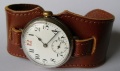
Errington Watch Company
Copyright © David Boettcher 2005 - 2026 all rights reserved.Charles Huton Errington was born at Matlock, Derbyshire, in July 1853. His father, Miller Errington, a miller by trade, moved the family to Coventry where he worked for Robbins and Powers of City Flour Mills, Coventry, for many years. In the 1920s, Robbins and Powers developed a pre-packed flour which they called Homepride.
Charles Errington went to King Street British School, Coventry, and afterwards was apprenticed to Franks and Ball, watch engravers. The 1871 census records Charles and his older brother William Miller Errington living as lodgers with the Dunn family on Peter Street. Charles is 17 and his occupation is watchmaker's engraver, William is 23 and his occupation is a miller's stone dresser. He would have cut the radial grooves in millstones that cut the corn. In later censuses and trade directories, William is recorded as a watchmaker in various locations in Staffordshire.
When Charles Errington completed his apprenticeship as an engraver in 1874, he was sworn in as a freeman and admitted to the freedom of the city of Coventry. He then set up as a watch engraver on the upper floor at 2B Holyhead Road. He shared the space with some watch trade workers and, from them, began to learn about the watch industry.
The 1881 census lists Charles H. Errington, living at home with his parents, as a Watch Engraver. Cutmore says Errington is shown in Kelly's directories in 1875 and 1887 as a watch case engraver and in 1892 as a movement maker.
On 19 April 1883, Charles Huton Errington entered a sponsor's at the Birmingham Assay Office giving his occupation as a Watchcase & Pendant Maker with the address 8 Spon Street, Coventry.
Some time later, Charles Errington moved to a workshop in the Plough Yard, where he developed a trade as a manufacturer of parts of watches with eight employees. He then began to buy rough movements from James Berry, a movement maker in Prescot, to finish.
Charles Errington was granted a number of patents for improvements in watches, which give an idea not only of his technical capabilities but also what areas of movement manufacturing he was involved in at the time.
| Year | Number | Description |
|---|---|---|
| 1881 | 1,433 | Method of setting hands from the pendant |
| 1881 | 5,636 | Centre-seconds stop watch |
| 1891 | 6,617 | Device for raising the barrel ratchet click and readily letting down the mainspring. Letting down the mainspring in a keyless watch without removing the watch from the case. Dated 17th April, 1891 |
| 1892 | 10,356 | Watch bolt and spring in one piece. ‘Improvements in watch bolts’, C. H. Errington, Coventry, 31st May, 1892. |
| 1892 | 18,766 | An arrangement to prevent the barrel ratchet when removed from damaging the centre wheel |
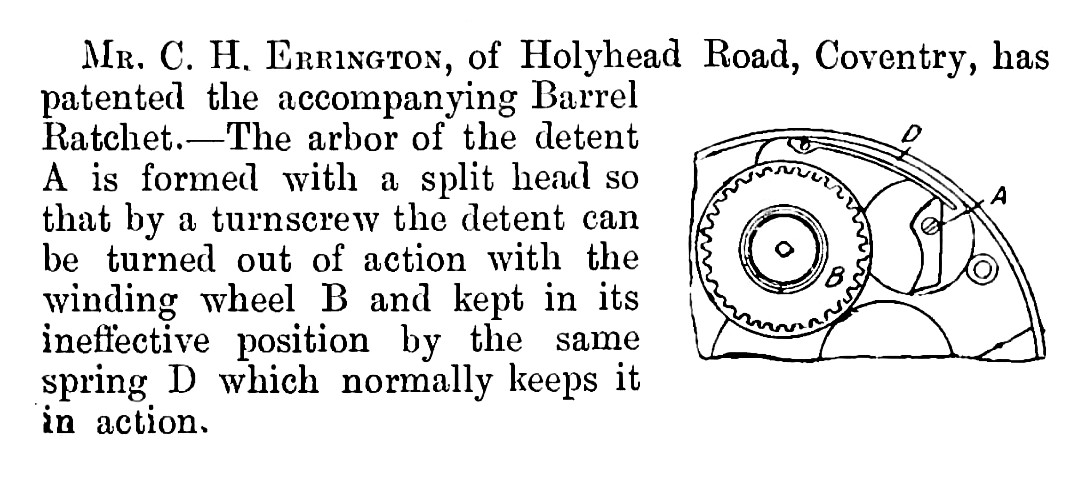
Errington patent 6,617:
Click image to enlarge
The figure reproduced here shows the method of operation of Errington's patent 6,617.
A detent, usually in this context called a click, stops the mainspring barrel from turning backwards when the mainspring is wound. The click acts as a pawl on the ratchet wheel. It is shaped so that the wheel can be turned in the winding direction, when the click rides over the teeth of the wheel, making the sound which gives its name. When the barrel tries to unwind and reverse the ratchet wheel, the click bears against a tooth of the wheel, pressed against if by the click spring, and prevents it from turning.
A click is usually held in place by a shouldered screw, which allows it to turn. Errington's invention was to provide the click with an arbor or shaft on which to turn. The arbor has a slot in the end, which allows the click to be turned away from the ratchet wheel using a screwdriver, called a ‘turnscrew’ in the text accompanying the illustration. This allows the mainspring to be let down.
Normally, a click like this is simply held out of the way by a piece of pegwood, but with a movement that has the ratchet wheel on the bottom plate, that means the movement has to be out of the case. In Errington's invention, the arbor extends through the top plate, allowing the click to be moved from the top plate side without removing the movement from the case. A clever feature is that when the click is turned past the position shown in the illustration, the click spring that normally holds the click in contact with the ratchet wheel then holds the click away from the wheel.
Errington Watch Factory

Watchmakers' Cottages Lower Holyhead Road from Google Maps: Click image to enlarge

Manager's House Lower Holyhead Road from Google Maps: Click image to enlarge
In 1890 Charles Errington purchased land at the rear of a row of watchmakers' cottages on Holyhead Road, and erected a factory for making watches by machinery. At the time, this was the northern edge of the Coventry watchmaking quarter, which grew up between 1800 and 1840 and extended southwards to the Butts Road. Errington intended to bring the front of his factory right up to Holyhead Road, but he was unable to buy the cottages.
The cottages still stand today on what is now Lower Holyhead Road, next to the ring road. The workshops or “topshops” were on the top floor and the large windows that admitted lots of light onto the work benches are still in place. These are the oldest surviving watchmakers' workshops in Coventry, dating from around 1820. A plaque recording the location of Errington's factory is attached to the cottage on the left of the image.
The second image of the Lower Holyhead Road shows, on the left, a double-fronted house that, after 1894, appears to have been used as the manager's house, and possibly the company's office, for the Errington watch factory. The entrance to the factory is between the house and the Co-Op building next door. The row of cottages shown in the first image are to the right of the Co-Op. Some work from the factory would have been performed by out-workers in these cottages.
In 1890, C. H. Errington was present at the annual meeting of shareholders in the Coventry Watch Movement Manufacturing Company, Limited, held on Wednesday evening, May 21, at the company's offices, 17, Hertford Street, Coventry. Mr. S. Yeomans, chairman of the directors, presided, and there was a large attendance, amongst those present being Messrs. T. J. Mercer, R. Waddington, C. Read, T. Kinder, E. Denny, E. Welsby, C. H. Errington, R. J. Pike, C. Shufflebotham, S. W. Read, T. Gardner, W. Flowers, Bales, E. T. Peirson (auditor), and the secretary (Mr. E. F. Peirson), etc. Letters of apology were read from Mr. Rowland Hill and Mr. I. J. T. Newsome.
The 1891 census records Charles Errington living at Northfields Farm, Allesley, with his wife Harriet. His occupation is give as ‘Watch Movement Maker & Farmer’. The Kelly's Directory of Warwickshire for 1896 lists Charles Huton Errington as a farmer.
In the terminology of the time, a watch movement maker made rough movements, which were passed on to watchmakers who finished them by fitting the escapement, balance and balance spring, engraving, jewelling, gilding etc. This work was usually put out to individual specialists and the watchmaker didn't sign the watch. If any name was put on, it was usually that of a retailer.
In April 1894, Charles Errington attended the annual meeting of the Coventry Watch Trade Association at the Hen and Chickens Hotel, Butts, Coventry. In presenting their report for the year 1893, the committee regretted that the depression in trade, mentioned in their last report, still continues, not only in Coventry, but in all parts of the country where the watch trade is carried on. Mr. C. H. Errington thought it would be wiser to teach the young men at home to respect the foreigner rather than to despise him, and to urge them to attend the technical classes. He also threw out the very practical suggestion of a local museum of watches, English and foreign, ancient and modern, for the instruction of apprentices in the trade. Watchmakers could not depend on a Merchandise Marks Act alone. (Hear, hear.)
Errington Sponsor's Marks
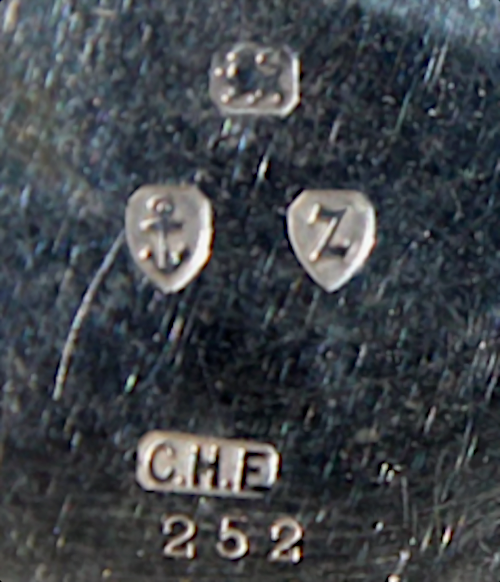
Sponsor's mark entered by Charles Huton Errington in 1898.png:
Click image to enlarge
On 19 April 1883, Charles Huton Errington entered a sponsor's mark CE in cameo within an oval surround at the Birmingham Assay Office. He gave his occupation as a Watchcase & Pendant Maker with the address 8 Spon Street, Coventry.
In May 1898, the sponsor's mark in the photo here, C.H.E in cameo within a rectangular surround with cut corners, was entered at the Birmingham Assay Office by Charles Huton Errington.
Takeover by Williamson
The Horological Journal November 1895 announced that H. Williamson, Limited, of Farringdon Road, London had taken over the watch manufacturing concern of Charles H. Errington, Holyhead Road, Coventry, remarking that “Although his establishment is of considerable extent, Mr. Errington was probably but little known outside of Coventry, except to the factors with whom he did business.”
Errington's Later Life
Charles Errington remained on as general manager of the factory, which retained the name of the Errington Watch Factory, and he continued in that position till 1910. The factory was much expanded, and at one time employed between 700 and 800 hands.
Charles Errington had considerable interests in property, land and buildings. He played an important part in the development of the upper Holyhead Road district. He created Melville Road and Waveley Road, building 28 houses on the left-hand side of the Melville Road and several villas on the Birmingham Road.
Charles Errington disposed of all his properties, including a row of tenements on the Stoney Stanton Road, and retired to Ilfracombe, where he died in October 1926.
If you have any comments or questions, please don't hesitate to get in touch via my Contact Me page.
Copyright © David Boettcher 2005 - 2026 all rights reserved. This page updated December 2025.
Back to the top of the page.