P & A Guye
Copyright © David Boettcher 2005 - 2026 all rights reserved.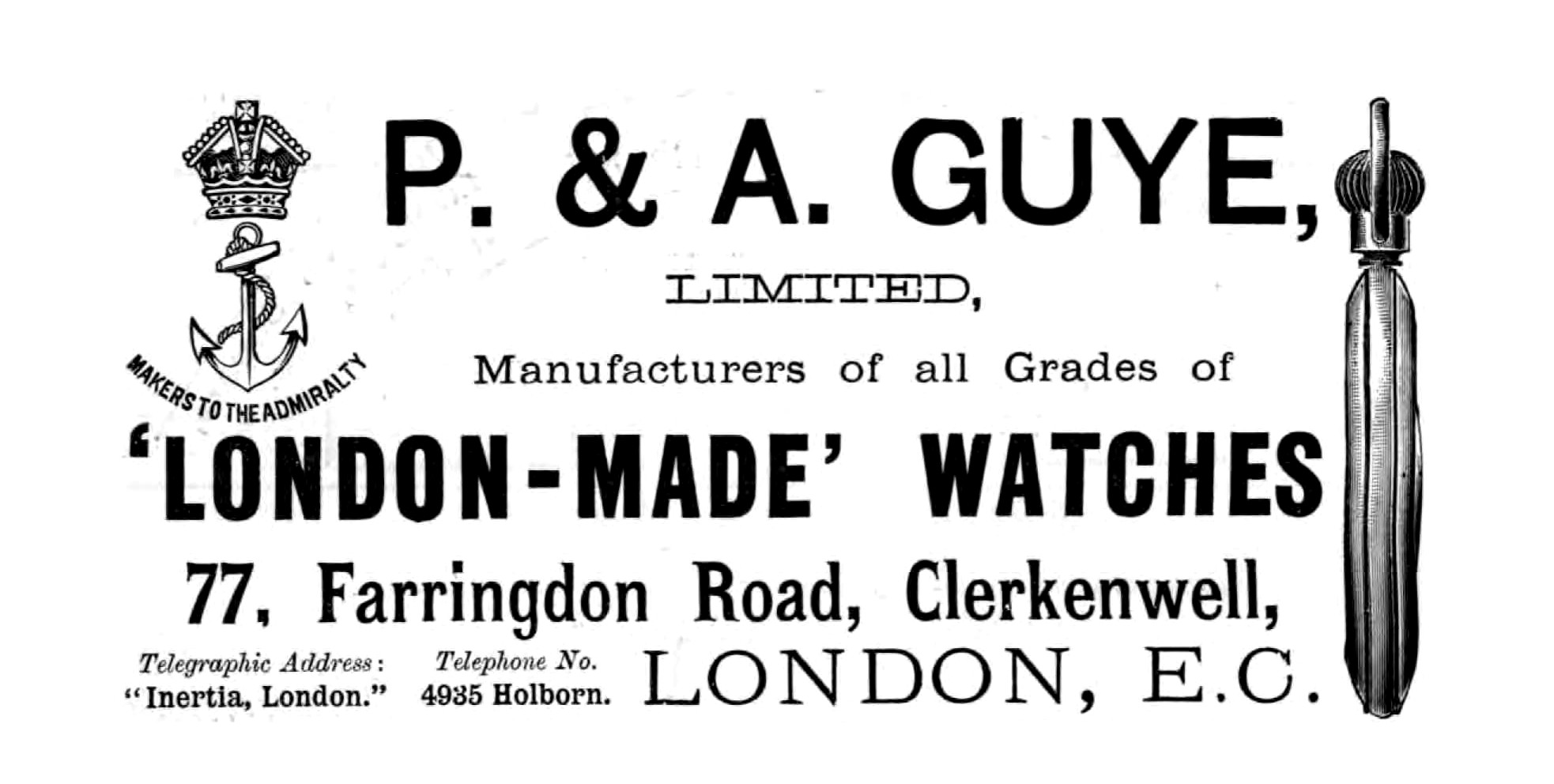
P & A Guye advert in Horological Journal June 1906: Click image to enlarge
P & A Guye was a London company that made watches by machinery. One of the most advanced watch factories, it was said to be the first in England to make watches with parts that were interchangeable throughout.
Philippe (1828-94), Auguste (1835-93) and Fritz Guye were sons of Louis-Auguste Guye, an ‘établisseur’ in Geneva. In 1856, Auguste Guye emigrated to London and established a similar business. He was joined by his younger brother Fritz.
In 1861, the company P & A Guye was established as a partnership between Philippe and Auguste. Philippe remained in Switzerland where he ran Ph. Guye & Cie of Geneva making balance springs.
The first workshop in London was in Guilford Street, after five years moving to 13, Northampton Square, where watches were manufactured for the American market. The company expanded to St. Bride Street, E.C., where the system of manufacture by machinery was instituted.
The company initially purchased Swiss ébauches (rough movements) from Reymond Brothers and finished them in London. These are marked RB on the bottom plate. They were made by Le Coultre using English steel and brass supplied by Reymond Brothers. This was before the company became established and installed its own machinery to produce rough movements.
P & A Guye later said that their watches were entirely made in London; that is without using rough movements from Prescot or Coventry. P. & A. Guye used a registered trademark with the slogan ‘BUY ONLY LONDON MADE WATCHES’.
In September 1858, August Guy was granted British patent 2003 for ‘Improvements in the Escapement of Chronometers and Watches’.
On 15 December 1865, Auguste Guye, trading as P & A Guye, entered a sponsor's mark ‘AG’ in cameo within a rectangular surround at the London Assay Office. The business was stated as Pendant Maker, 13 Northampton Square, Clerkenwell. This mark was withdrawn on 5 Feb 1880, when a sponsor's mark ‘F.G’ in cameo within a rectangular surround with cut corners was entered at the London Assay Office by Fritz Guye trading as P & A Guye.
In 1871, ‘Guye, P. et A.’ were listed as fabricants de spiraux (balance spring makers) at 47, Route de Frontenex, Geneva. By 1877, the address had changed to 26, Boulevard de Plainpalais, Geneva. By 1883, the address had changed to 17, Place Cornavin.
In 1877, beginning in October, an paper by Auguste Guye ‘On the Theory of the Isochronous Motion of the Balance’ was published in the Horological Journal.
Business was not entirely plain sailing. In June 1879, a notice of proceedings for liquidation by arrangement or composition with creditors was issued. It is recorded that this was ‘instituted by Philippe Guye, of St. Jean la Tour, Geneva, in the Republic of Switzerland, Auguste Guye and Fritz Guye, both of Macaulay Road, Clapham Common, in the county of Surrey, carrying on business in partnership under the style of P. and A. Guye, at 13, Northampton square, Clerkenwell, in the county of Middlesex, 14, St. Bride Street, Ludgate-hill, in the city of London, and at Geneva aforesaid, as Wholesale Watch Manufacturers.’ A satisfactory arrangement appears to have been quickly agreed, because there are no further records of this case.
In 1882, P. & A. Guye's offices were removed to 1, Boy Court, Ludgate Hill, London.
Some time between 1882 and 1887, the company moved to 77, Farringdon Road. The address was on the western side of the road, on the opposite side to the Metropolitan Railway Station. The workshops had a superficial area of 3,300 square feet and occupied the top floor of the building, with natural light from the top and sides.
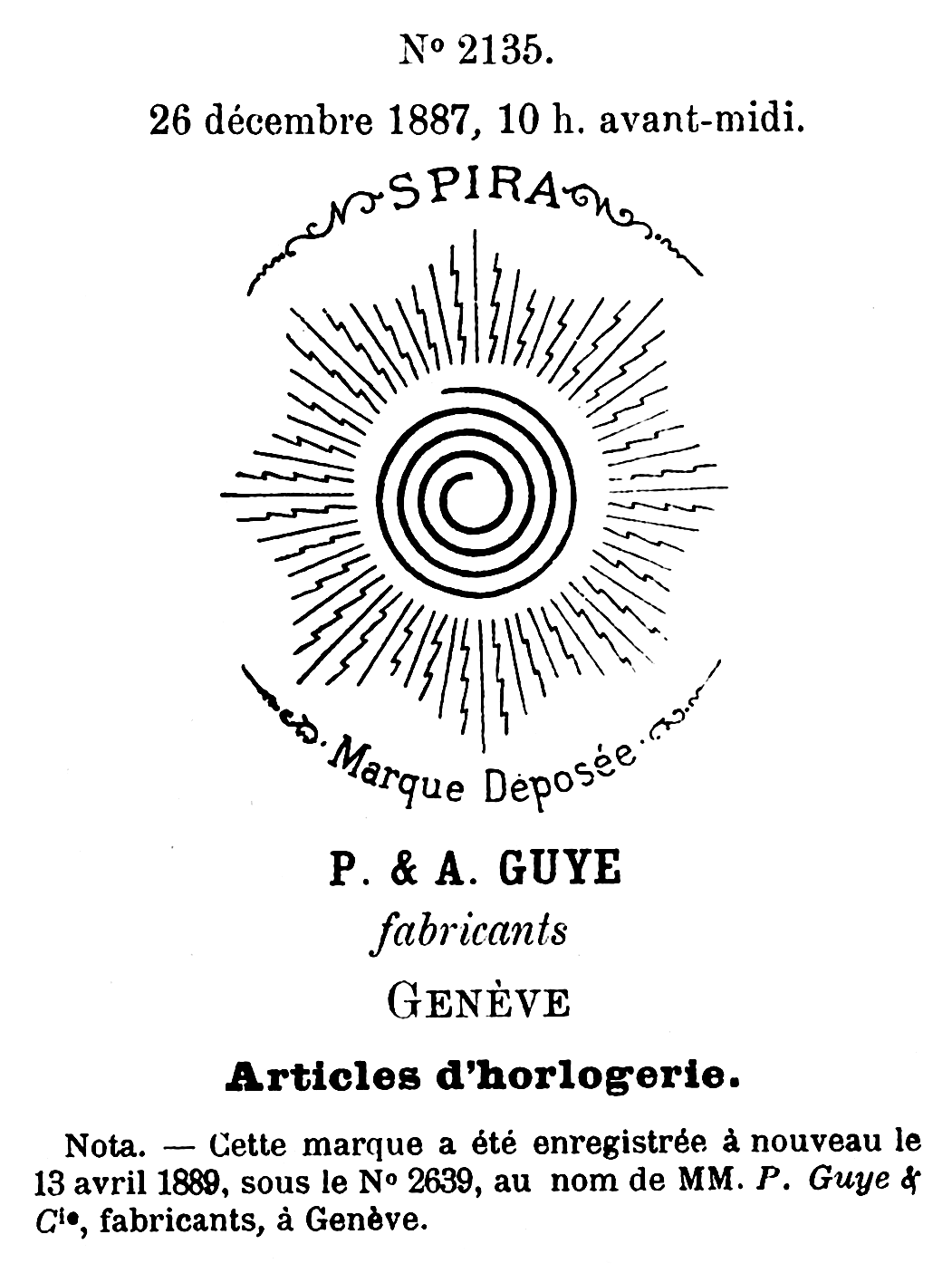
Registration of ‘SPIRA’ in 1887
Click image to enlarge
In 1887, P. & A. Guye in Switzerland registered the trademark SPIRA for horological articles. The name and illustration of a spiral tie in with the business of making balance springs. The note at the foot of the record says that the same trademark was registered as a new mark on 13 April 1889 under the name P. Guye & Cie.
The 1887 Merchandise Marks Act effectively stopped the use of Swiss rough movements and significant amounts of Swiss parts in watches described as English from 1 January 1888. In December 1887, it was reported that, at the watch factory of Messrs. P. & A. Guye, 77, Farringdon Road, E.C., preparations were being made for complying with the watchmaking clauses of the Merchandise Marks Act, and for generally extending the manufacture. Although the factory system had long been in operation with them (nearly 100 operatives being employed), the firm had hitherto used certain foreign materials and parts for economical and other reasons. But all this was now to be altered, and the new and improved plant would enable them to turn out in future the complete watch, from the movement to the case, on the most approved methods, besides doubling the number of hands employed.
Auguste Guye stated that they were bringing out a cheap watch of a new calibre which, by increasing the output, would still further enable them to economise in the different processes, and that all the parts of their watches were strictly interchangeable.
Most likely as a result of the Merchandise Marks Act reducing the amount of imported Swiss parts that could be used in a watch described as ‘English made’, the Partnership between Philippe Guye, Auguste Guye, and Fritz Guye, carrying on business as Watch Manufacturers at No. 77, Farringdon Road, Middlesex, and No. 17, Place Cornavin, Geneva, under the style of P. and A. Guye, was dissolved by mutual consent on 31 July, 1888. Subsequently, P. Guye & Cie at 17, Place Cornavin, advertised as ‘Manufacturer Of All Types Of Spirals’ and ‘specialising in hardened balance springs that defy all competition thanks to their superior tempering’.
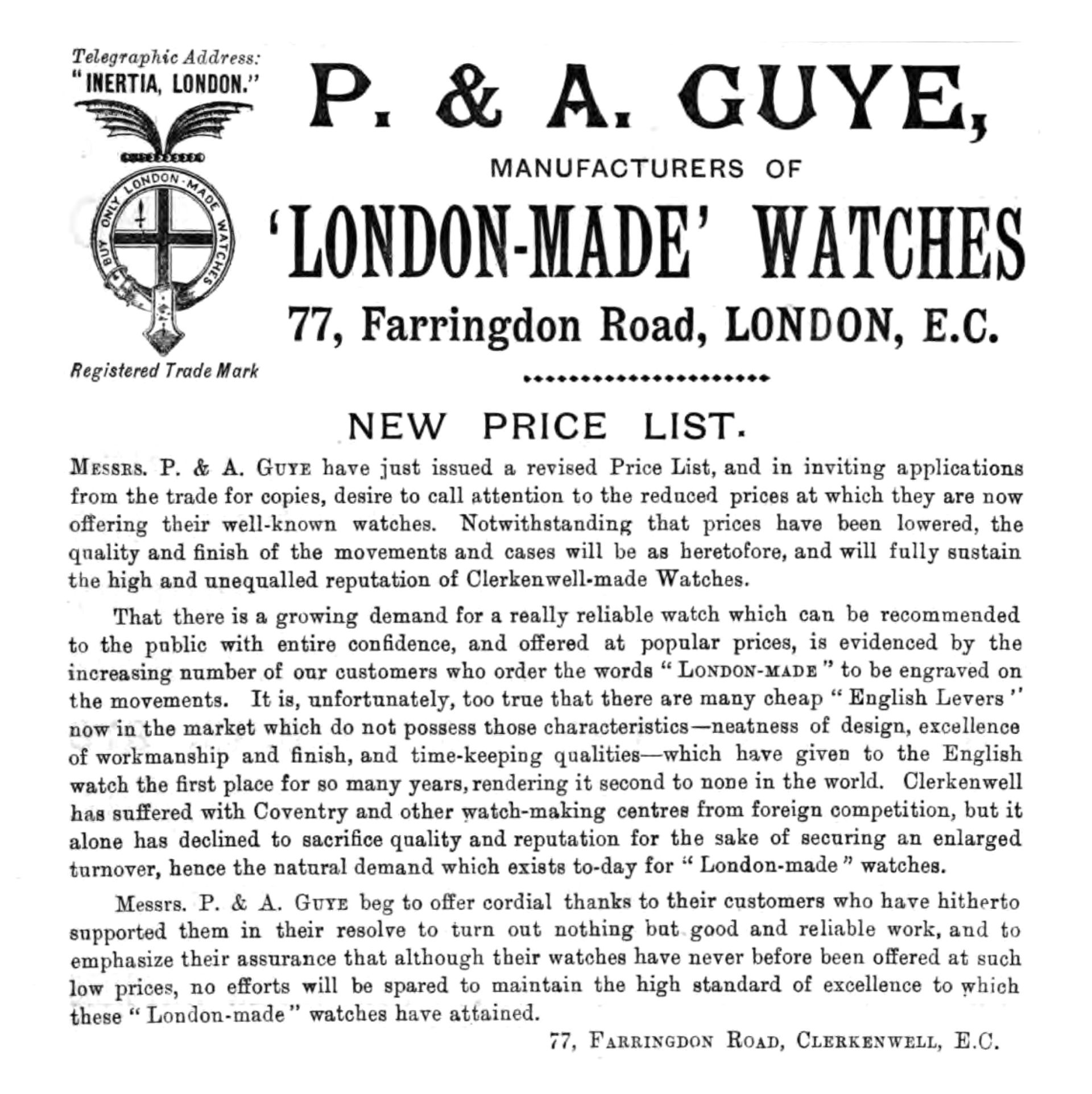
Advertisement by P & A Guye, Horological Journal August 1896
Click image to enlarge
In 1896, P & A Guye advertised that they had reduced the prices of their watches, whilst maintaining the same quality.
In January 1897, the Horological Journal reported that,
So far as the London watch machine trade goes, Messrs, P. & A. Guye, who, owing to the extent of their output, have the most right to speak on the subject, report that business has been very satisfactory during the past year. It would seem that in spite of all the competition of Swiss and American watches, the cycle industry and other drains upon the purses of the people, a well-made and reliable watch still retains the post of honour. This may no doubt be attributed to the large reductions in price which the Messrs. Guye have made in the past year, and must have considerably influenced trade. Messrs. P. & A. Guye further report the great success which their new " K " watch has met with in the trade. It is a lady's keyless ¾-plate movement, ruby jewelled in eight holes, compensation balance, in single bottom case.
The company was incorporated as P & A Guye Limited in 1897.
In February 1898, the Horological Journal reported that, ‘Messrs. P. and A. Guye, Limited, have made important improvements in their factory and have issued a new edition of their "Specifications and Prices," for the trade only.’
During the nineteenth century, Swiss watchmakers became the dominant manufacturers of repeating mechanisms, to the extent that English watchmakers stopped making repeating work and instead sent rough movements to Switzerland to have repeating work fitted. In 1899, it was reported in the Horological Journal that P & A Guye had begun producing minute repeaters and other complicated pieces.
The advert from the Horological Journal of June 1906 reproduced here seems to be the last time the company advertised in the Horological Journal.
In April 1947, a meeting of creditors of P & A Guye Limited was held. At an Extraordinary General Meeting of the Members of the Company held on 15 May, 1947, a Special Resolution was passed ‘That the Company be wound up voluntarily’ and liquidators were appointed. By November 1947, its property had been disposed of and the company wound up.
P & A Guye Pocket Watch 59336
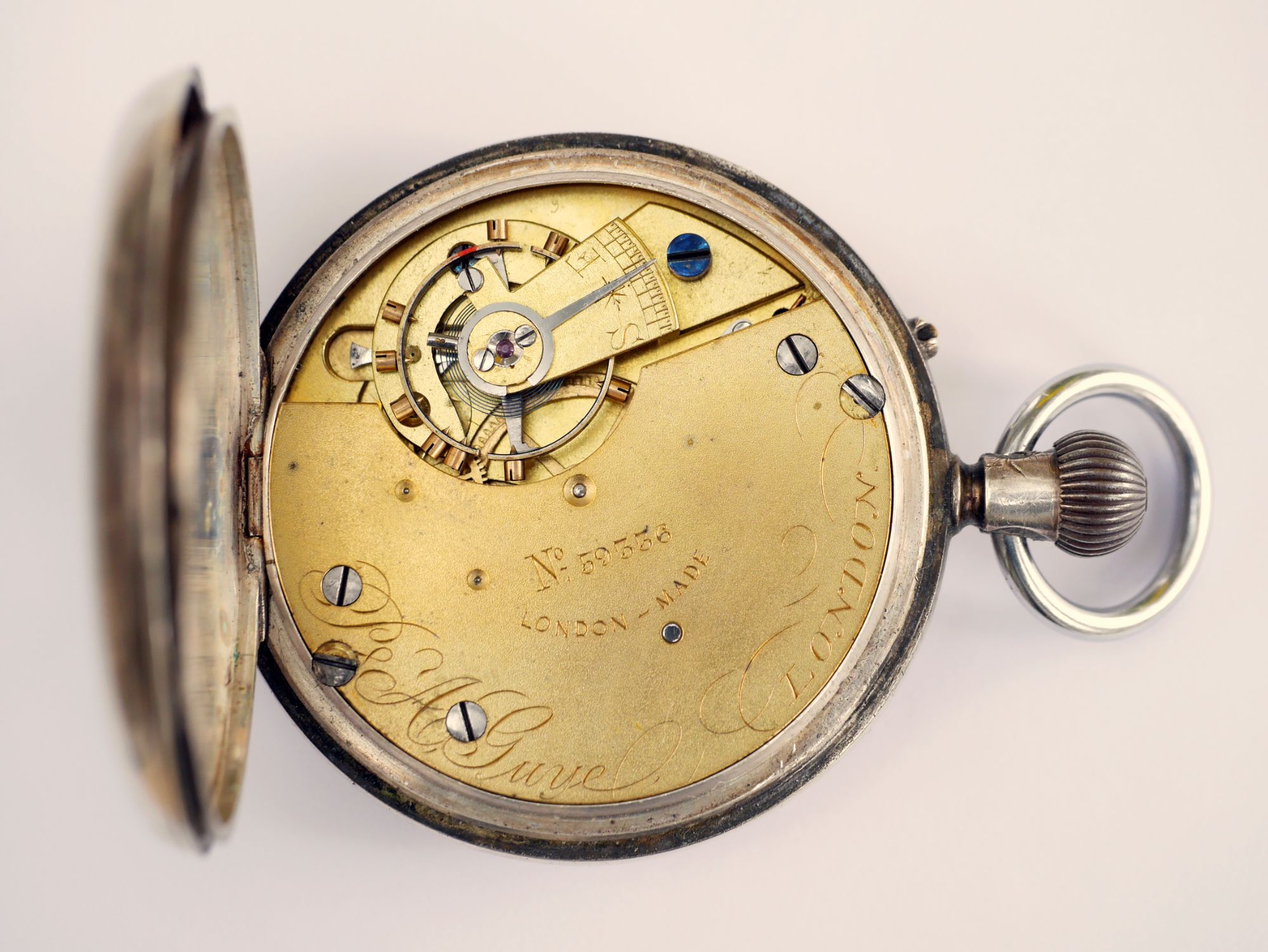
P & A Guye watch No 59336
Click image to enlarge
The photo shows a three-quarter plate keyless pocket watch marked ‘P & A Guye London No 59336 London-Made’.
The movement has an English style right angle lever and pointed tooth escape wheel. The bearings of the train wheels and lever pivots are not jewelled. There are four jewels for the balance pivots, two bearings and two end stones, an impulse jewel two jewels in the lever fork, giving a total of seven jewels.
It is rare to find a watch marked P & A Guye with its original case. Many P & A Guye watches originally had gold cases which have subsequently been melted for their bullion value. However, this lower priced seven jewel movement was fitted with a cheaper sterling silver case, which has fortunately survived.
The case has London Assay Office (leopard's head) hallmarks for sterling silver (lion passant). The date letter is the ‘T’ of the London Assay Office hallmarking year from May 1894 to May 1895.
The sponsor's mark ‘JW’ in cameo within a surround of two conjoined circles was entered at the London Assay Office on 7 November 1876 by John Woodman of 33 Smith Street, Northampton Square. The mark was erased on 14 September 1897.
Production Rate
There is no known production data for P & A Guye, so without a hallmarked case it is difficult to date a movement. Most of Guye's movements are not identified with the company name, which makes it difficult to identify Guye movements. Most Guye movements are marked with a retailer's name such as J. W. Benson. It is not clear whether the serial numbers on those movements are Guye's or Benson's.
However, movements marked with the P & A Guye name must carry their own serial number. I have a pocket watch with the movement marked P & A Guye and the serial number 59336. The silver case has London Assay Office hallmarks for 1894 to 1895. Assuming they started at serial number 1 in 1861, which is a big assumption - many companies started at a higher number to make it look as if they were well established - this would equate to 1,800 movements per year over the preceding 33 years, or 35 per week. This is unlikely and it must be that the initial production over the first few years was only a few movements per week, accelerating as time went past and the workforce and level of automation increased.
In the Horological Journal in 1884 it was said that ‘one large American watch factory can turn out 1,100 watches in a day, whereas Messrs. Guye will take two or three months to produce the same number.’ If two or three months was taken as roughly 11 weeks, then Guye's rate of production would be around 100 per week. This would be a large number for a purely manual process, but small for a fully automatic mass production factory, showing that although Guye used machines, these were not fully automated and skilled hand finishing was still used.
In July 1889, it was reported that P & A Guye had upwards of 100 employees and that 80 or 90 automatic machines were in constant use. The machinery was driven through overhead shafting by a powerful ‘Otto’ gas engine. The output then was 200 watches a week or .
In the Annual Trial of Deck Watches, 1897-98, a watch by P & A Guye, number 11989, came second, with number 11990 seventh and 11991 sixty third. These three serial numbers are out of line with the serial number 59336 from 1894 or 1895, suggesting that P & A Guye used a separate set of serial numbers for deck watches.
If you have any similar data that can help to determine the production rate of P & A Guye movements, please let me know.
Patent No. 4658
Movements made by P & A Guye are often seen with ‘Patent No. 4658’ stamped on them. This patent was granted in 1881 to S. M. Morgan for a heavy dust ring. It is not clear whether Morgan worked for Guye or for J. W. Benson, on whose watches the legend is most often (only?) seen.
In patent 4658, the bottom plate is made larger in diameter than the top plate. The dust ring sits on the outer edge of the bottom plate, surrounding the space between the plates where the wheels and escapement are located, and the smaller diameter top plate.
As the movements are key wound and set, it is questionable how much dust this would keep out, and therefore dust excelusion was most likely not its principal purpose, but dust ring was an established name for rings like this.
The patent 4658 ring is much wider in section and heavier than most dust rings, which are usually made of thin sheet. Its most likely purpose is to act as a carrier ring for the movement. The movement is held in the carrier ring with what would usually be called ‘case screws’, and the carrier ring is then secured to the case by separate screws.
The patent 4658 carier ring adds weight and gives an impression of strength and solidity which was promoted by J W Benson in their adverts, ‘Keeps better time than, and is double the strength and value, of any watch made.’ If a watch was to be run over by a steam roller, that claim might hold true. However, given that the escapement is the most delicate part of the movement, which can be broken simply by dropping a watch onto a hard surface, it is doubtful that the carrier ring was of any actual benefit.
P & A Guye's Customers
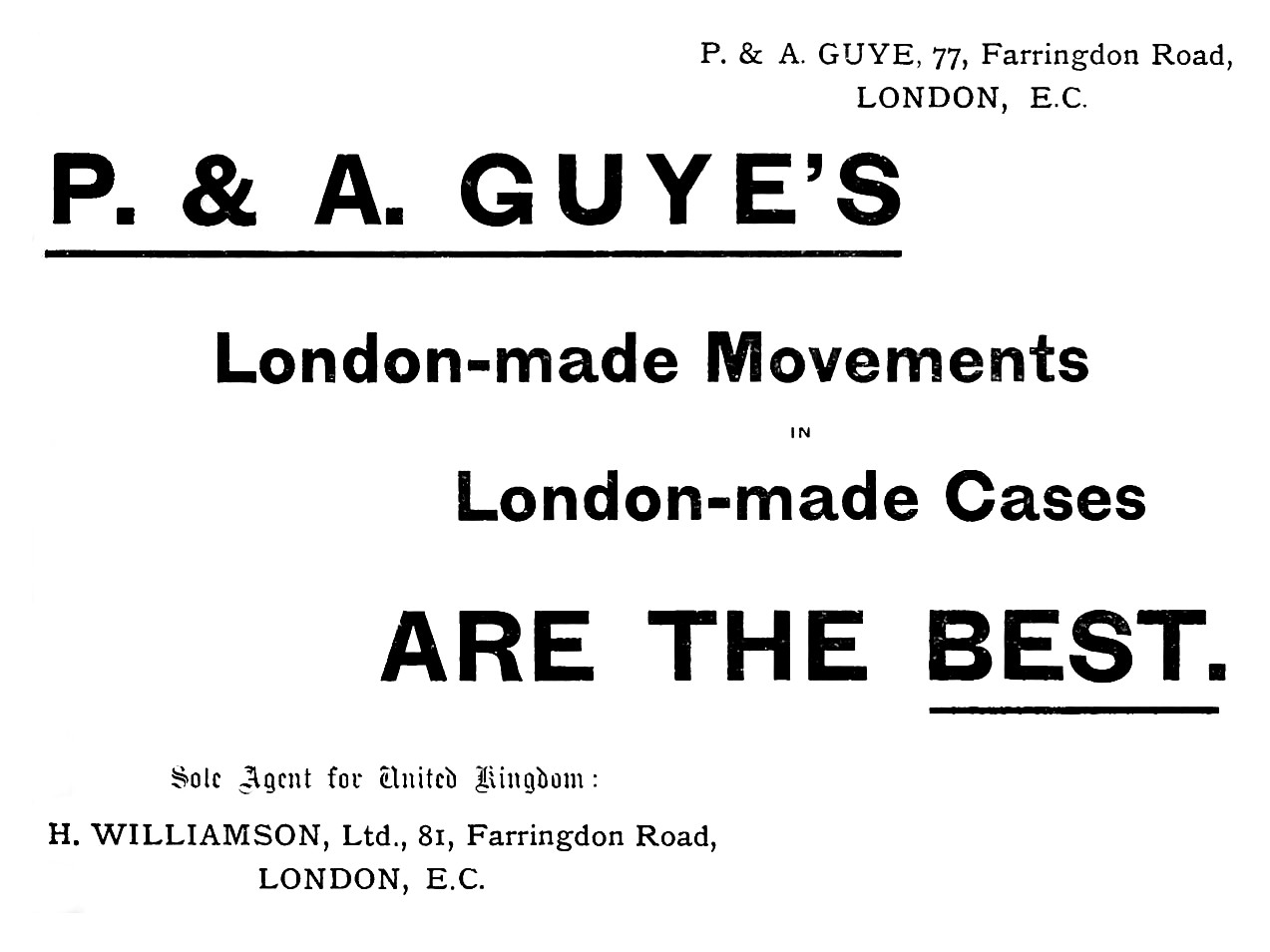
Guye and Williamson
Click image to enlarge
The address of P & A Guye at 77 Farringdon Road is interesting, because Grace's Guide lists H. Williamson's address in 1922 as 77-81 Farringdon Road. There was obviously some connection between Guye and Williamson.
The advertisement reproduced here from The Watchmaker, Jeweller and Silversmith of June 1893 says that H. Williamson, Ltd., 81 Farringdon Road, London are the sole agent for the United Kingdom for P & A Guye's movements in London made cases.
Culme shows that two punch marks ‘HW’ in cameo within an oval surround were entered at the London Assay Office in 1888 by Henry Williamson. H. Williamson were having watch cases made for them in London, hallmarked under their own registered sponsor's mark (which was a common practice) and fitting them with movements from P & A Guye.
One of P & A Guye's largest customers was J. W. Benson. Whether this was directly or via H. Williamson, Ltd, as the Williamson advert implies, is not known, but the latter seems likely.
Small Movements
Guye made a zero ‘0’ size movement, slightly over 13 lignes, which they said was smaller than any English hand made movement. They are one of a small number of English watch manufacturers to produce such small movements.
A zero size, or 13 ligne, movement is a very suitable size for men's wristwatches, although no wristwatches with this movement have been seen.
Stop Work
In 1881, Henry Ganney, a member of the British Horological Institute and forthright commentator on horological matters, reported,
Noticing the absence of stop-work from Mr. Guye's second quality work, I was told they only put it to their best work in deference to general prejudice on the stop-work question ; but as a matter of fact the watches kept a better rate without stop-work, as fewer main-springs broke, as the extra width obtained by the suppression of the stop-work gave a strength and elasticity unobtainable otherwise. With such testimony it is useless to contend, and the sooner watch buyers and wearers are enlightened on the subject the better, and with the stop-work will disappear a cause of much trouble to repairers.
Stop work was provided to prevent excessive force from the mainspring when it was fully wound. Stop work prevented the spring from being fully wound, but was a complicated way of achieving it, and also stopped the watch if the owner was late in winding it. The invention of the recoiling click, which allowed the mainspring barrel to reverse slightly after the spring was fully wound, achieved the same end with much less complication and cost.
If you have any comments or questions, please don't hesitate to get in touch via my Contact Me page.
Copyright © David Boettcher 2005 - 2026 all rights reserved. This page updated February 2026.
Back to the top of the page.