The Lancashire Watch Company
Copyright © David Boettcher 2005 - 2026 all rights reserved.
Lancashire Watch Co Ltd: Click to enlarge.
At the end of the nineteenth century an attempt was made to produce finished watches in Prescot by machine mass production in a factory. A company called the Lancashire Watch Company was formed in 1889, bringing together and into one factory a number of separate businesses.
The core businesses were Wycherley and Hewitt & Co., both owned at the time by Thomas P. Hewitt. Other businesses that were persuaded to go in with the venture were Isaac Hunt & Co., E. Beesley & Sons, H. Dagnall & Son, and Wood & Morton of Prescot ; J. Watkinson and Ralph Greenall of St. Helen's and J. Basnett of Coventry. A number of machines were purchased in America.
The Lancashire Watch Company started producing watches around 1890. The company was initially successful. One of its largest customers was J. G. Graves, the Sheffield pioneer of mail-order selling, who is estimated at one period to have taken 70% of the factory's output. Another large customer was H. Samuel, a retailer begun in Manchester by Harriet Samuel.
The Lancashire Watch company never quite achieved success. It suffered from making too many models of very similar watches, and poor marketing. Stocks of unsold watches and debts mounted. The company ran out of capital and failed in 1910. Closure of the factory was announced in January 1911, and an auction was held in March to liquidate the remaining stock and the tools, machinery and factory fittings. During the First World War the factory building on Albany Road in Prescot was used as a barracks for the Lancashire ‘Pals’ regiment, accommodating hundreds of soldiers from Prescot and the surrounding area. The 1st City Battalion K.L.R (King's Liverpool Regiment) was the first of all the Pals Battalions, raised by Lord Derby at the old watch factory on the 29th of August 1914. The Grade-II listed building, built in 1889, has now been converted into apartments.
Safety Features
Steel mainsprings are prone to break and in a going barrel watch this can result in serious damage to the wheel train and jewels. One method of preventing damage was to fix the centre pinion to the centre arbor with a left-hand thread. When the watch was working normally this thread was held tight, but if the mainspring broke the sudden reversal of force would cause the thread to unscrew. This was known as a ‘safety pinion’ in American watches and a ‘reversing pinion’ in Lancashire Watch Company movements, which are stamped with this on the top plate, presumably to impress customers or to warn watch repairers that the centre pinion was loose on the arbor.
An alternative safety device, which also reverses the direction of winding, was a small wheel on a hinged arm between the barrel and centre pinion. Normally this wheel was held in place between the barrel and pinion by the force of the mainspring, but if the mainspring broke and the force reversed the small wheel would jump out of mesh. Hewitt was granted British patent No. 21,412 for this invention in 1895. Lancashire Watch Company movements with this feature are marked ‘Patent Trip Action’.
Commercial Problems
One of the reasons that the Lancashire Watch Company failed was in making too many different types of movement, trying to cover the entire spectrum of what they thought that customers might want, instead of concentrating on making a few up to date products. The quality of the products was high, but the company fell down on understanding how to make money in a competitive market.
The watch illustrated here encapsulates some of the many problems that beset the Lancashire Watch Company. It has an English lever movement that is key wound from the back, and the time is set from the front by opening the bezel and applying a key to a square boss on the minute hand. This was the way English lever watches had been made since the early nineteenth century, but by the end of the century was old fashioned.
The case has Chester Assay Office hallmarks for sterling silver, the date letter "Q" is for 1899 to 1900. The sponsor's mark is TPH in cameo within a rectangular surround, which was entered at the Chester Assay Office in May 1899 by Thomas Peter Hewitt of the Lancashire Watch Company, Prescot.
The dial has “English Watch Co. Birmingham” on it, referring to a company of that name operating in Birmingham at the time, described at English Watch Co..
John Platt has written a very comprehensive history of the Lancashire Watch Company. In there I found on page 288 two LWC watches with 'English Watch Co.' and 'Famous Premier' on their dials that are virtually identical, with silver cases hallmarked 1899 and 1900 with the same TPH sponsor's mark. This watch was made and cased by the Lancashire Watch Company in Prescot and sold to the English Watch Co., who then presumably sold it on to a jeweller for retail.
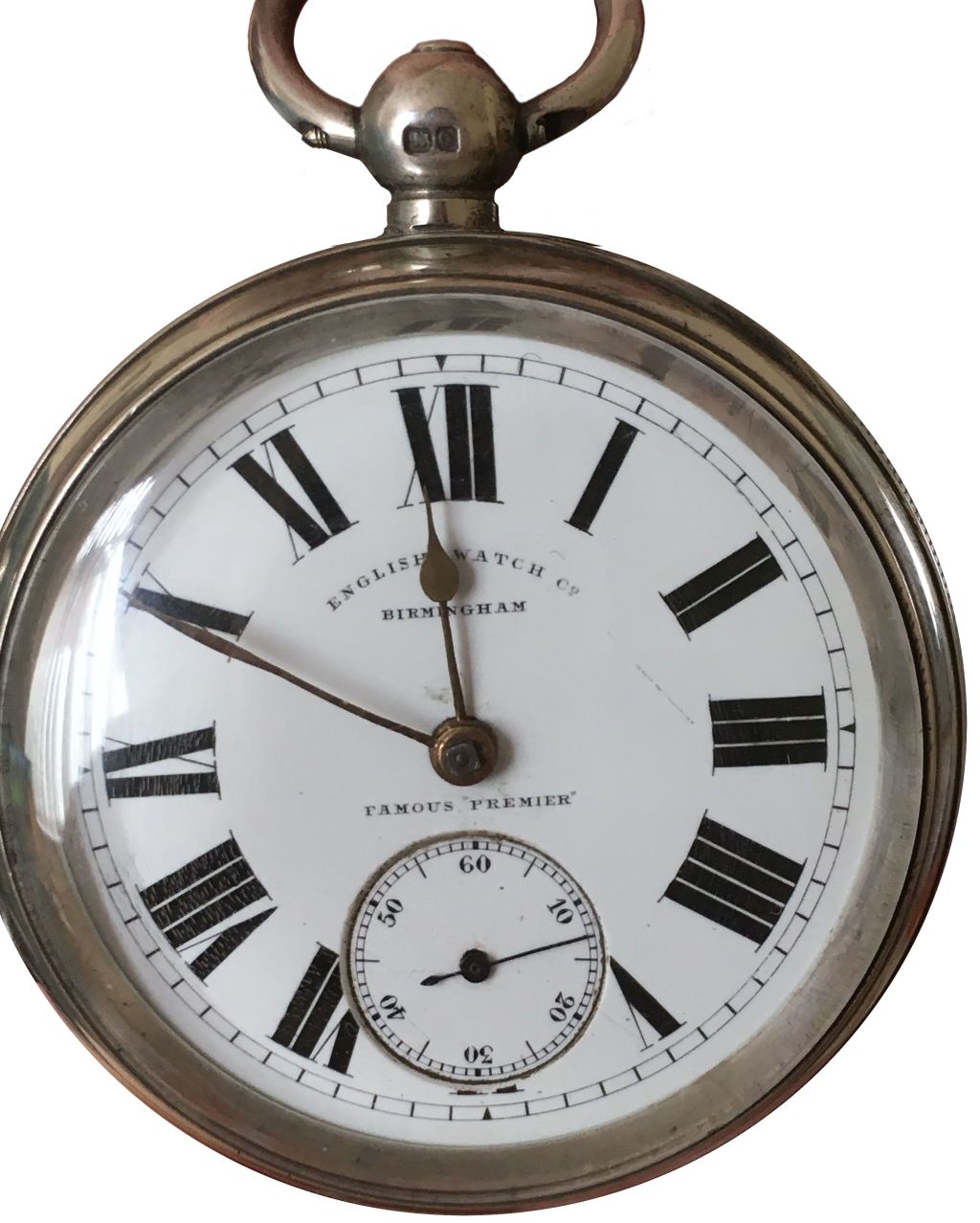
LWCo. Watch Face: Click image to enlarge.
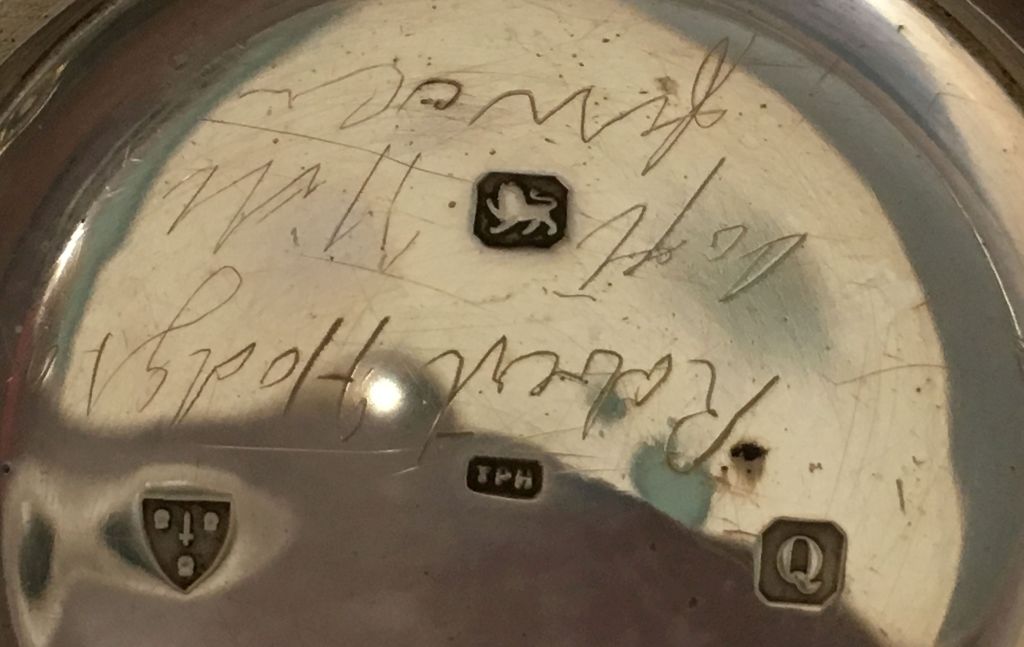
LWCo. Hallmarks: Click image to enlarge.
The problems for the company that this watch sums up are (1) old fashioned products and (2) lack of marketing. A watch that was key wound and set, and not even set from the back but by opening the bezel and applying the key to the minute hand, was looking very old fashioned by 1900, when stem wound and set watches were pouring into the country from Switzerland and America.
The mail order company J. G. Graves took up to 70% of the output of the factory. Graves was very successful in selling by mail order, part of which success came from holding prices down. He advertised an English lever watch in a silver case at 50 shillings, which could be paid for in five instalments of 10 shillings. This was much cheaper than such watches were usually sold. Taking such a large proportion of the output of the Prescot factory meant that Graves could drive them down on price.
The fact that the Lancashire Watch Company also sold completed watches to other manufacturers, such as the English Watch Company in Birmingham as shown by the watch illustrated here, shows that they had a lack of marketing and sales channels. Simply creating a factory that could mass produce watches was not a recipe for success, the products needed to be sold to retailers, which required a marketing and sales operation that the Lancashire Watch Company did not possess. Hans Wilsdorf of Rolex showed only a few years later how a successful watch business could be created. He ordered watches from existing companies and created a demand for them by advertising.
If you have any comments or questions, please don't hesitate to get in touch via my Contact Me page.
Copyright © David Boettcher 2005 - 2026 all rights reserved. This page updated April 2026.
Back to the top of the page.