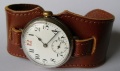
J. W. Benson
Copyright © David Boettcher 2005 - 2026 all rights reserved.The retailer J. W. Benson began as a partnership between the brothers Samuel Suckley Benson and James William Benson. The company became a prestigious London retailer of watches, clocks, jewellery, diamonds, silver and gold wares.
Samuel and James were sons of William Benson, a jeweller, and Phoebe Suckley. Samuel was the older of the two, born in 1822 in London. James was born on 12 April 1826 in Reading, Berkshire.
The Benson brothers purchased the businesses of several established companies in London at Cornhill and Ludgate Hill. From one of these, James Benson later claimed a date of foundation of 1749.
Early History
In 1847, Samuel Benson was a jeweller in partnership with a Mr. Thoms at 43, Ludgate Hill, between Farringdon Road and the Belle Sauvage coaching inn.
Number 43, Ludgate Hill, had been a jewellers shop for a very long time. Before Benson and Thoms it was occupied by Joseph Turner, who was declared bankrupt in August 1846. The lease and stock were sold by auction on the premises in September 1846. This was most likely when Benson and Thoms took on the shop.
Before Turner, the shop had been occupied since about 1831 by Edward Lamb, ‘Goldsmith, Jeweller and Watch Manufacturer’.
In 1838, Edward Lamb advertised ‘Flat Horizontal Watches Jewelled in Four Holes, with Silver Dial and Seconds, in Strong Double Bottom Silver Cases, £4 15s. each. Warranted to perform correctly.’ and also ‘Patent Lever Watches, Four Holes Jewelled in Engine-turned Cases, Hard Enamel Dial, and Seconds, at Six Guineas, warranted.’
After Edward Lamb's death in 1839, the business was run by his wife, and then by George Lamb, Edward Lamb's brother. Joseph Turner took over the shop in 1844, describing himself as ‘successor to the late Edward Lamb’. Turner didn't advertise watches, preferring to rely on the sale of silver and plated goods. Perhaps this was why his business didn't prosper.
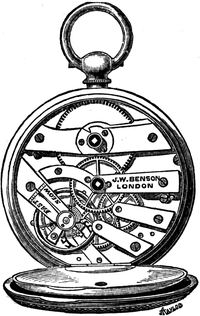
Illustration of a J. W. Benson horizontal watch in Time & Time-Tellers
Click image to enlarge
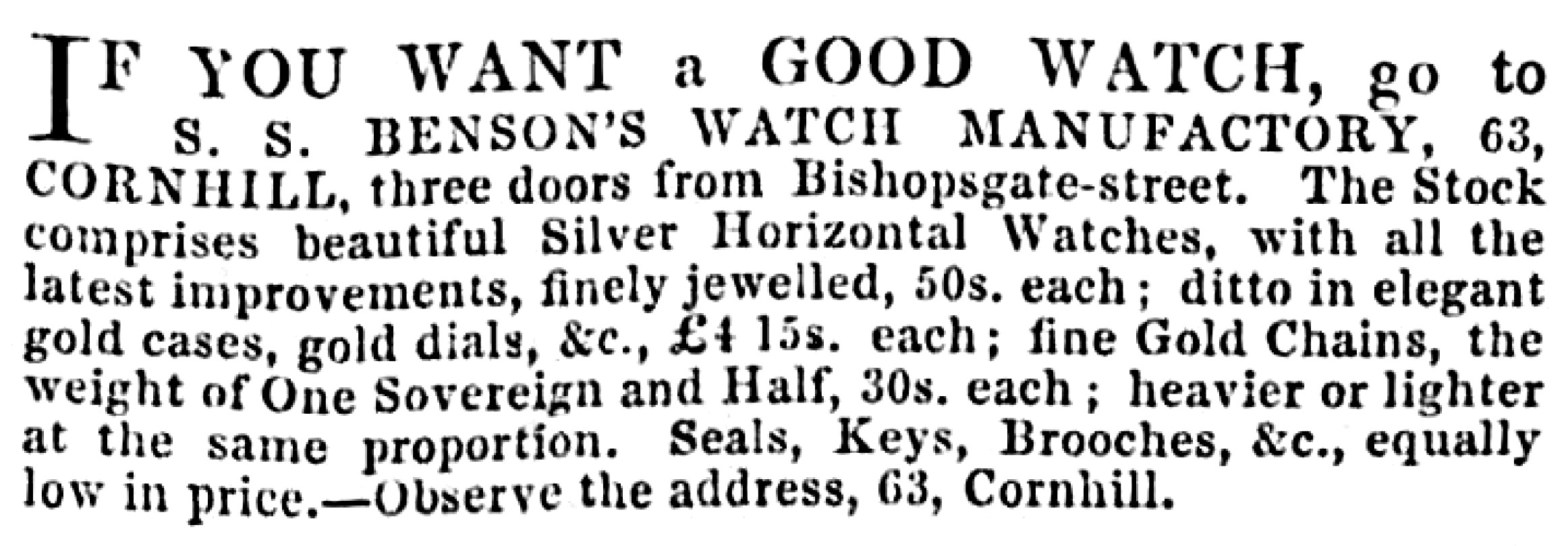
Advertisement by Samuel Benson, 1848
Click image to enlarge
The Benson and Thoms partnership didn't last very long. The advertisement by Samuel Benson from 1848 shows that he had gone into business on his own at 63, Cornhill. The advert implies that watches were made there in ‘S. S. Benson's Watch Manufactory’. The range of stock on offer appears quite limited, comprising ‘Horizontal Watches’ in silver cases at £2 15s, and in gold cases at £4 15s, gold chains in various weights and ‘seals, keys, Broochs, etc’. A limited range of stock is to be expected if Samuel had only recently started his business.
A horizontal watch is one with a cylinder escapement, which were not made in England at the time. The Swiss made hundreds of thousands of cylinder escapement watches every year. It therefore appears that Samuel was retailing imported Swiss watches.
This is made evident by the illustration of a horizontal watch in a booklet published by J. W. Benson in 1875 entitled Time & Time-Tellers. This watch has a cylinder escapement and, from the shape of the movement cocks and bridges, is clearly Swiss in origin.
An advert by Samuel Benson in 1849 for the same £4 15s gold watches states that ‘The large profits usually charged upon watches has induced the proprietor to manufacture the whole of his stock, and the great quantity sold enables him to make them at very low prices.’ This claim is baffling. The watches are clearly Swiss; how can Samuel claim to manufacture them himself? It would have been possible to import Swiss movements and put them into English cases, which would have qualified for the claim, but the prices being charged, £4 15s for a gold watch, are too low for this. Swiss watch cases were made of less fine gold and were lighter than hallmarked English cases, making them cheaper. It seems likely that Samuel was buying complete Swiss watches, and the manufacturing claim had very little truth behind it.
S. S. and J. W. Benson
By 1851, the business had evidently prospered, and Samuel had been joined by his brother James. Watches were sold under the name S.S. & J.W. Benson. The following is taken from an advert in November 1851.
GRAND EXHIBITION OF WATCHES, GOLD CHAINS, &c, at S. S. AND J. W. BENSON'S MODEL CRYSTAL PALACE, 16 CORNHILL. Visitors to London will do well to call at this magnificent establishment and inspect Messrs. BENSON'S large and beautiful stock of GOLD AND SILVER WATCHes with highly-finished movements, four holes jewelled, rich gold dials, and every improvement, 4l 15s each. The same movement in silver cases 2l 15s each. Also BENSON'S stock of patent DETACHED GOLD LEVER watches jewelled in eight and ten holes, gold or enamelled dials, double backed gold cases, at 8l 8s each. Ditto in silver cases, 3l 10s each. ... The Messrs. BENSON have much enlarged the above premises, which is now their principal manufactory for Watches; and the above Watches can now be selected from 60 different patterns at either of their Establishments, Nos. 16 and 63, CORNHILL.
The address now includes number 16, Cornhill, in addition to number 63. The range of stock on offer appears to have increased significantly, with 60 different patterns of watch available, and ‘patent detached lever’ watches being added. The same claim to manufacture watches is made, but now at an enlarged number 16 Cornhill.
An advert in 1853, by ‘S.S. & J.W. Benson, Watchmakers, etc., 16, 63 & 43 Cornhill & 33, Ludgate Hill’, lists several types of watches. The first are ‘Benson's highly-finished £4 15s Gold Horizontal Watches.’ The description says that the horizontal watch is ‘of English invention’, which is true; the cylinder escapements was invented in 1695 by Thomas Tompion and perfected after his death by George Graham - but it is significant that it was felt necessary to say that it was an English invention, implying that the horizontal watches have something English about them. The advert goes on to say, ‘Messrs. Benson have devoted particular attention to this watch, every one being carefully examined by their own workmen, and can thus confidently recommend them as sound and accurate timekeepers.’ These two statements show that the watches were not made in England, even though the cylinder escapement was invented there, and they were inspected rather than made by Bensons.
Partnership Dissolved
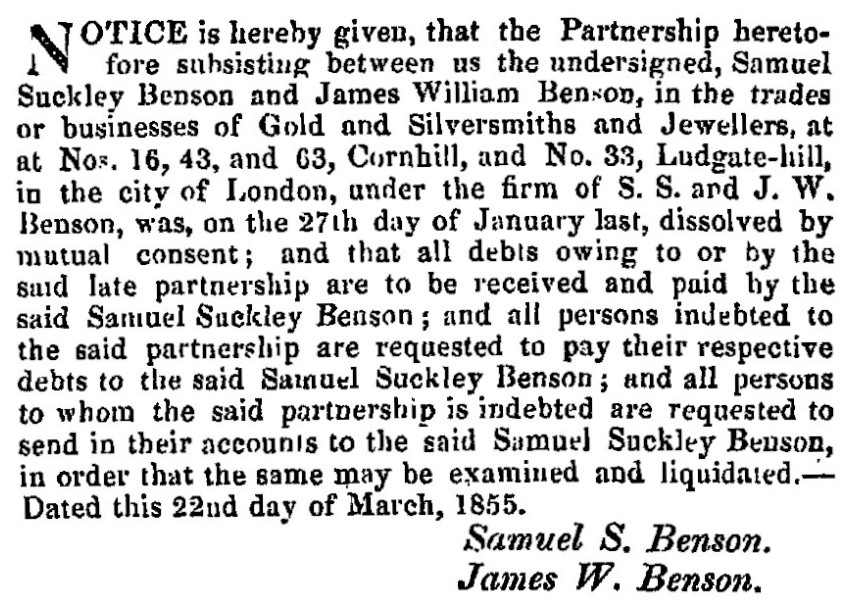
Dissolution of Benson partnership.
Click image to enlarge
The partnership between Samuel and James was dissolved on 27 January 1855. The notice published in the London Gazette shows that Samuel took charge of winding up the affairs of the partnership, calling in any money owed, paying off debts and liquidating the accounts held by the company.
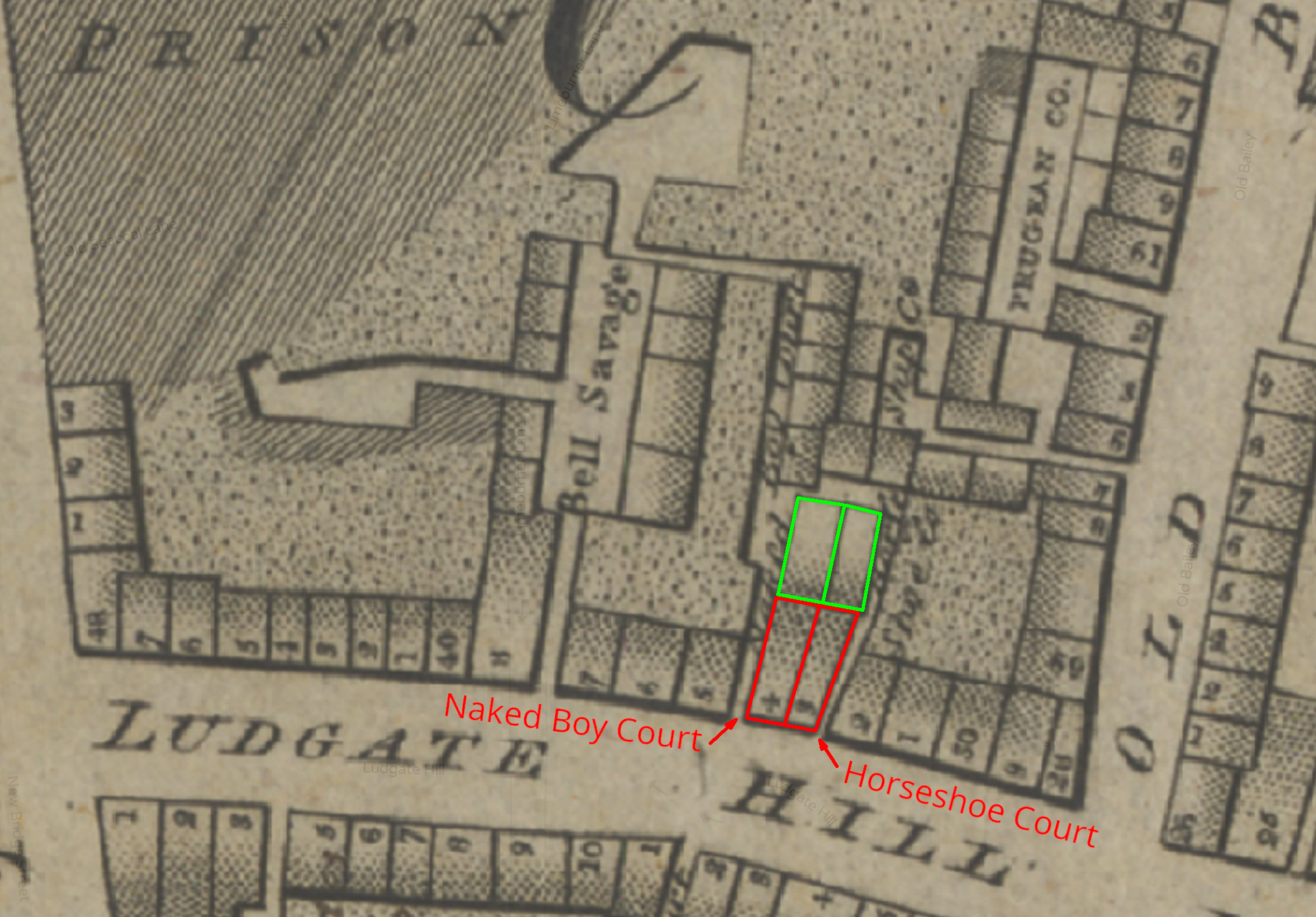
Horwood's 1799 map of Ludgate Hill
Click image to enlarge
After the dissolution of the partnership, James continued as J. W. Benson at 33 Ludgate Hill. He later acquired the adjoining premises at No. 34.
Samuel retained shops at 47 and 63 Cornhill. However, Samuel died on 3 April 1857 and James took on the shops at 47 and 63 Cornhill.
The figure extracted from Horwood's 1799 map of Ludgate Hill shows the location of numbers 33 and 34, Ludgate Hill, outlined in Red. At that time, Ludgate Hill ran from Fleet Market on the left of the figure to Old Bailey on the right, after which it became Ludgate Street, which ran to St. Paul's Cathedral. The street numbering ran from right to left, from 28 on the corner of Old Bailey to 48 on the corner of Fleet Market. Numbers 33 and 34 are between two courts; Naked Boy Court to the side of number 34 and Horseshoe Court to the side of number 33.
In 1864, James acquired the two houses at the rear of 33 and 34 Ludgate Hill, outlined in green in the figure, which were used to increase the size of the showrooms. By this time, Fleet Market had become Farringdon Road, and Naked Boy Court had been renamed Boy Court.
In 1864, adverts became more specific about the origin of horizontal and skeleton lever watches, saying that they were made by the best workmen in Switzerland and examined by in London by ‘skilled artists’. A skeleton lever watch was one made on continental lines with separate cocks and bridges rather than a full or three quarter plate. These are often called ‘Swiss bar watches’.
In June 1864, under the heading ‘Church, Turret and Stable Clocks’, J W Benson announced that steam power and improved machinery for clock making had been erected at the Manufactory, Ludgate Hill. Estimates and Specifications were offered to Clergymen, Architects, and Committees for every description of ‘Horological Machine, especially Cathedral and Public Clocks Chiming Tunes on any number of Bells’.
The address of the ‘Steam Factory’, as Benson later referred to it, was not given, but later adverts imply that it was adjoining Norton House in the yard of the former coaching inn called Bell Savage, or La Belle Sauvage.
J W Benson had retail outlets at various addresses in London, and several addresses on Ludgate Hill. The different addresses on Ludgate Hill all referred to the same physical premises. Benson did not relocate several times, it was the street numbers on Ludgate Hill that changed due to rebuilding and plot consolidation.
Retail addresses in London included: 25, Old Bond Street, 99, Westbourne Grove and 164, Tottenham Court Road. Later the Westbourne Grove and Tottenham Court Road shops were closed and 28, Royal Exchange was added.
Mail Order
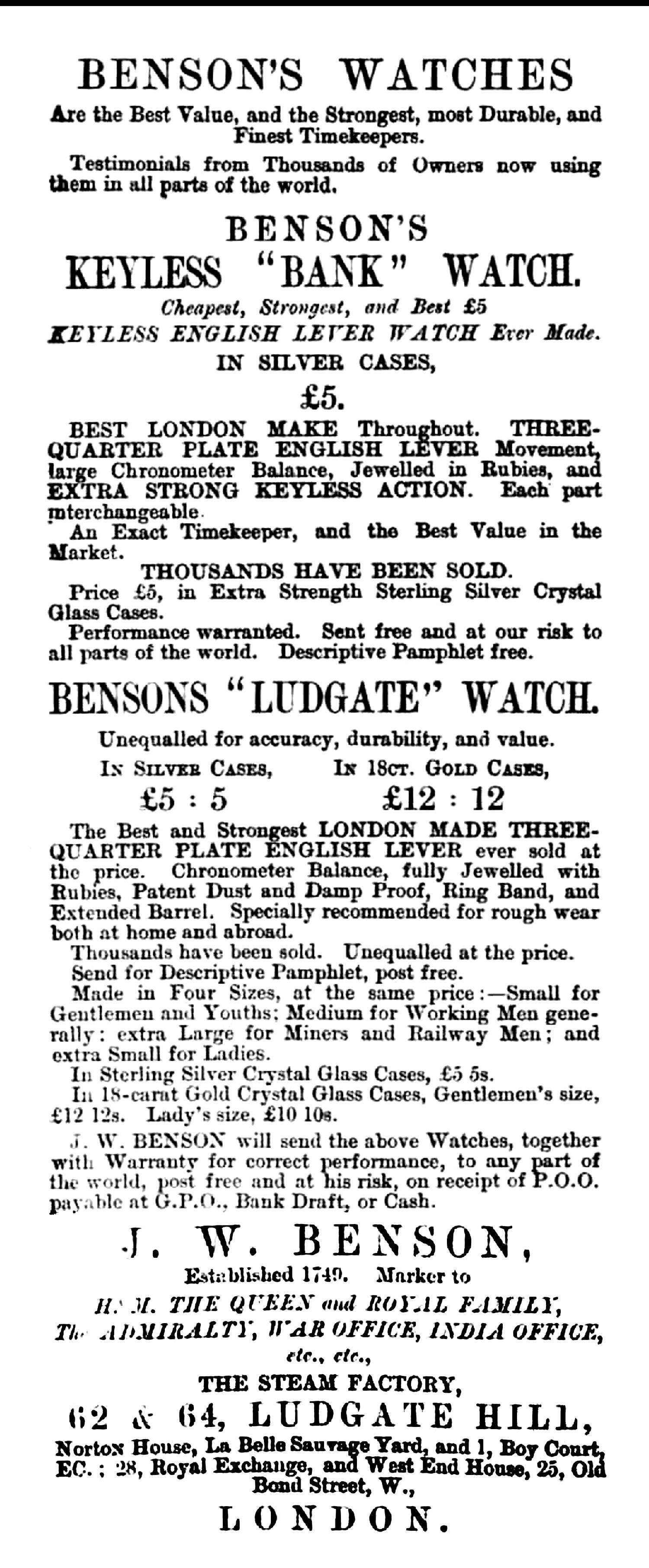
J W Benson advert December 1890
Click image to enlarge
J. W. Benson ran extensive adverts in newspapers across Britain and the Empire, and developed a large mail order business.
By 1866, the address of J W Benson was 58 & 60, Ludgate Hill. Rather than an actual, physical, move from numbers 33 and 34, this change of street numbers was due to the existing premises being renumbered. This was probably a result of Ludgate Hill and Ludgate Street being merged and widened in 1864 at the time of the creation of Ludgate Circus.
Changes on Ludgate Hill
The first James William Benson died on 7 October 1878, aged 52, and his three sons James William junior, Arthur Henry and Alfred took over the running of the business.
In 1880, Benson announced that they had taken over the premises previously occupied by the Prudential Insurance Company. Benson's address was then 58, 60, 62 & 64 Ludgate Hill and, for the first time, La Belle Sauvage Yard, Boy Court and Horseshoe Court. There was also 25, Old Bond Street.
Horseshoe Court was only included in the address during 1880, when Benson was occupying 58, 60, 62 and 64 Ludgate Hill. In 1881, the address changes to 62 and 64 Ludgate Hill, the old premises at numbers 58 and 60 had been sold off or let. Horseshoe Court was adjacent to number 58, which had previously been number 33 before the renumbering in circa 1864.
Benson advertised that they sold 10,000 watches annually. Levers, Horizontal (cylinder), Keyless, Centre Seconds, Chronograph, Chronometer, Astronomical, Marine, Presentation, Railway and Repeaters, at prices from two to eight hundred guineas.
The 1890 J. W. Benson advertisement reproduced here features the addresses 62 & 64 Ludgate Hill, Norton House, La Belle Sauvage Yard, and 1 Boy Court. These refer to different parts of a single integrated premises. The Ludgate Hill numbers were the public retail frontage and showroom, while Boy Court and La Belle Sauvage Yard lay immediately behind and contained the firm’s manufacturing accommodation. Norton House was the factory building within that yard, described in advertisements as Benson’s ‘steam factory’ for watch and clock production.
It is said that Benson made watches at the Belle Sauvage Yard factory during the nineteenth and twentieth century. However, no evidence for this claim is known, or whether Benson actually made watches. In 1866, the Steam Factory was advertised for clocks and watches. Clocks and watches require very different types of machinery and workshops.
The workshop might have been an assembly operation where watch movements and parts were assembled, cased and tested. Bensons did not make watch cases but ordered them from watch case makers who stamped them with Bensons’ own sponsor’s mark for hallmarking. The movements, dials, hands and cases would have to be brought together somewhere and the completed watch tested, and Bensons might have done this. However, it is also possible that the workshop at Belle Sauvage Yard was for service and repairs of customer's watches and that Benson did not actually manufacture watches.
Ranges of pocket watches sold by Bensons were named Bank, Ludgate and Field, and often engraved with ‘Best London Make’ and ‘By Warrant to HM The Queen’. These names were used for different types of watches, e.g. Ludgate was used on key wound and set watches as well as stem wound and set ‘keyless’ watches.
Benson bought in movements or watches from Nicole, Nielson & Co, especially repeaters, P & A Guye, Kullberg and others. Marine box chronometers were obtained from Usher & Cole. They were all signed J W Benson.
Watches marked ‘Patent 4658’, which was usually applied to Benson's Ludgate watch, were supplied by P & A Guye. Patent 4658, granted in 1881 to S.M. Morgan, refers to an integrated dust ring and movement carrier.
The Field watch was so named after the Hunting Editor of the Field magazine, Arundel, wrote,
I have used the watch for four months, and I have carried it hunting sometimes five days a week, and never less than three. For most weeks I have had one day, sometimes two, with hounds on foot ; and with this strong test I have found it an accurate timekeeper. I recommend Messrs. Benson's hunting watch as one that can be depended on. The Field, 22 March 1893.
J W Benson also imported Swiss watches. To give comfort to customers who might have been reluctant to buy a foreign rather than an English watch, these were marked ‘Inspected by J W Benson.’ In common with other British retailers, J W Benson did not allow the names of foreign manufacturers to appear on the dials.
The company J. W. Benson and its subsidiary Hunt & Roskell, acquired in 1889, were converted into separate limited liability companies J. W. Benson Ltd. and Hunt & Roskell Ltd. in 1897.
In 1935, a visit to ‘J. W. Benson's London Watch Factory’ observed the manufacture of watch movements. Whether this was definitely the Benson Steam Factory at Belle Sauvage Yard or one of the factories that supplied Benson, such as P & A Guye or Nicole, Nielsen & Co, is not clear.
Manufacture of only one calibre was described,a ¾ plate movement with an English right angled lever escapement. It was said that various grades of movement were manufactured, the differences being in the jewelling and finish, with ruby jewels and diamond endstones in the higher grade movements, so it must be assumed that by 1935 Benson were making only this one calibre. Only high-class Venetian dials and hand-made hands were used in cases of solid construction in either gold or silver.
This watch was by then very old fashioned, with an English style ratchet (pointed) tooth escape wheel, pallet stones inset into the lever and a single roller. It operated at 16,200 vibrations per hour, a low frequency compared to the then almost universal 18,000 vph. It was said that every part of the movement was made so as to be interchangeable and considerable expenditure had been incurred in acquiring the most up-to-date machines. This sounds like the factory of Nicole, Nielson & Co.
The machines described were mainly presses used to blank out components from sheet, there was no mention of e.g. automatic lathes, which had been operating in American and Swiss factories since the nineteenth century.
Philip Priestley records that J. W. Benson had watch cases made by Benson Brothers of Liverpool, who were not relations. The sponsor's mark used on these cases, J.W.B, was entered at the London Assay Office by J. W. Benson. The Benson Brothers case making business was purchased by the Dennison Watch Case Company in the 1930s.
The factory at Belle Sauvage Yard was destroyed by bombing in 1941, including 12,000 watches in stock at the time and the company's records. Benson did not resume making watches after the war, carrying out only repair work. Sometimes this event is erroneously said to have taken place during the First World War.
J. W. Benson continued until 1973 when it appears that the name was sold to Garrard, and then subsequently to Mappin & Webb.
If you have any comments or questions, please don't hesitate to get in touch via my Contact Me page.
Copyright © David Boettcher 2005 - 2026 all rights reserved. This page updated February 2026.
Back to the top of the page.