Trench Watch Straps
Copyright © David Boettcher 2005 - 2026 all rights reserved.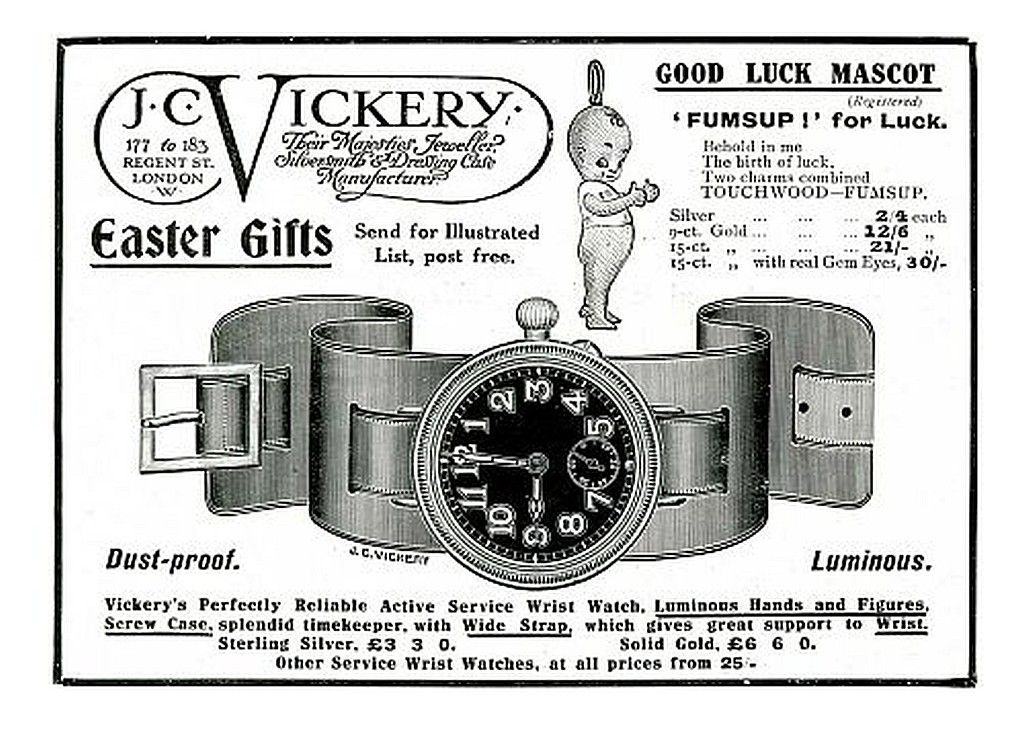
J C Vickery Advert for Trench Watches from 1916: Click image to enlarge
This page describes in detail the designs of the authentic replica First World War trench watch strap designs that I supply. The straps are one piece straps that pull through the wire lugs of early wristwatches or “trench watches” of the First World War era (1914-1918).
Examples of customer's watches fitted with these straps can be seen on the Customer’s Watches page.
Old customers please note that the disaster in the old workshop in January 2024 means that the range of designs I now offer, and the leathers, have changed. Vintage Watchstraps has gone back to its roots in supplying only authentic replica First World War trench watch strap designs and authentic leather RAF type straps.
To buy one (or more!) of these new straps, please scroll down to “How to Place an Order”. All the other details you need about the designs are on the way.
If you already know what you want, use this link to send me your requirements. If the link doesn't pop up a new email when you click on it, please use this link: Order Instructions.
To place the order, I will send you an electronic invoice by either PayPal or Stripe. You don't need to have an account with PayPal or Stripe, the invoice can be paid easily using a credit or debit card. I will send instructions on how to do this.
If you have any questions or comments, please don't hesitate to contact me via my Contact Me page.
Designs

F-Type authentic replica trench watch straps: Click image to enlarge

S-Type authentic replica trench watch straps: Click image to enlarge
The replica trench watch strap designs have authentic back pads like the one shown in the advertisement by J C Vickery. Further details of trench watches are given in the section about Authenticity, and on the page about trench watches at Trench Watches.
The strap pulls through the lugs of the watch and through the back pad so that the watch and back pad are held in place. The back pads make the strap look better on a man’s wrist, and the back pad makes the narrow straps of trench watches more comfortable to wear.
These designs are made especially to fit the fixed wire lugs of early wristwatches and trench watches. They are available with modern base metal buckles, or with hand made and hallmarked gold or sterling silver buckles, which are accurate replicas of period buckles.
How authentic are my straps with hallmarked sterling silver buckles? Good enough. A watch was advertised by a dealer, who I won't mention, with one of my straps. The advertisement said “Fitted with what appears to be the original leather strap, which is still in incredible condition. The solid silver buckle with London hallmarks for 1913 is exceptional and even has a tiny hallmark on the tang.” The date letter for 1913 is an “s”, which is also the date letter for 2017, the year when I made this buckle. It is not my intention to deceive people into thinking that my straps with sterling silver buckles are actually originals, my sponsor’s mark is clearly visible on the buckle. But this instance shows that they are convincing replicas.
The two photos here show the two designs:
- The F-Type design has a back pad that flares out behind the watch to a round section with a notch for the crown
- The S-Type design has a back pad with straight sides
The straight sections of both designs of back pad are 28 millimetres wide. The round section of the F-Type back has a radius of 20 millimetres.
Both designs are available in black and brown leathers, as shown in the photos.
Watch Sizes
These designs are for men’s trench watches. The watches shown attached to two of the straps in the photo have cases about 35 millimetres diameter, the standard size for a trench watch case.
If a watch is smaller than 35 millimetres across the case, the F-Type strap may not be right for it. The F-Type looks right on cases down to about 33 millimetre, but on a watch with a case less than 32 millimetres, the crown will not fall into the notch intended for it. The S-Type strap is a better fit on smaller watches.
Note that the watches are shown for illustrative purposes only. The one on the brown straps is a Longines with a Borgel case, the one on the black straps also has a Borgel case and was retailed by S. R. Elliot in Trafalgar Square.
Strap widths and lengths
The F-Type and S-Type designs have 12 millimetre wide, 2 millimetre thick straps. This is the authentic width and thickness for standard First World War trench watches.
If you are not sure whether a one piece strap like this will fit your watch, check the Strap Width and also the Strap Path.
The straps are 240 millimetre long, not including the buckle, which is a comfortable size for most men’s wrists. At the moment, other lengths are not available.
Buckles
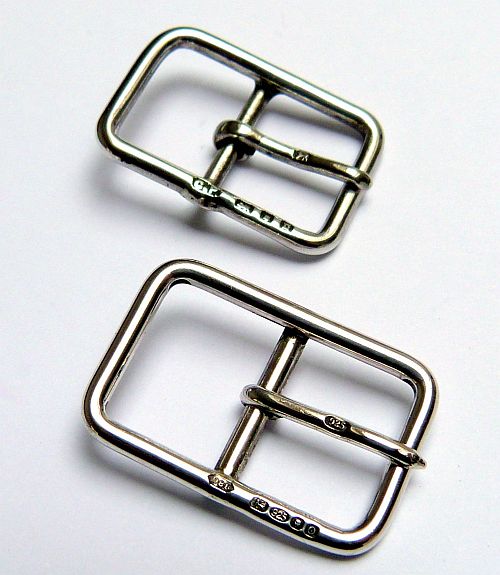
Sterling silver Type GW Buckle, with original in background: Click image to enlarge
There are several options for buckles;
- Type GW authentic replica of First World War period buckle in hallmarked sterling silver
- Type GW authentic replica of First World War period buckle in hallmarked 9 carat gold
- Base metal modern buckle chrome plated
- Base metal modern buckle gold plated
- Your own 12 millimetre buckle
The photos of the straps show both chrome plated and sterling silver. The two with watches attached have Type GW sterling silver buckles, the other two have chrome plated base metal buckles.
The Type GW hallmarked buckles are accurate replicas of period buckles used on trench watches during the First World War. Buckles like this were used on early men’s wristwatches with fixed wire lugs, until this type of lug began to be superseded in the 1920s. Although the hand made Type GW buckles add to the cost, they also add period authenticity to a strap for a trench watch or wristwatch with fixed wire lugs.
More details of the Type GW sterling silver and 9 carat gold buckles are on the page Sterling Silver Buckles.
Gold plated base metal buckles are available for a small supplement.
Type GW buckles in 9 carat gold are now in stock again. Details of these can be found at 9 carat gold buckles.
It is also possible to attach your own buckle to a strap. If it is a spring bar buckle, the end of the strap can be made ready for you to attach the buckle. If it is a solid buckle that has to be stitched-in, depending on the keeper arrangement, it might be possible to be stitched into a strap. Reusing one of my Type GW sterling silver or gold buckles is no problem.
Leathers
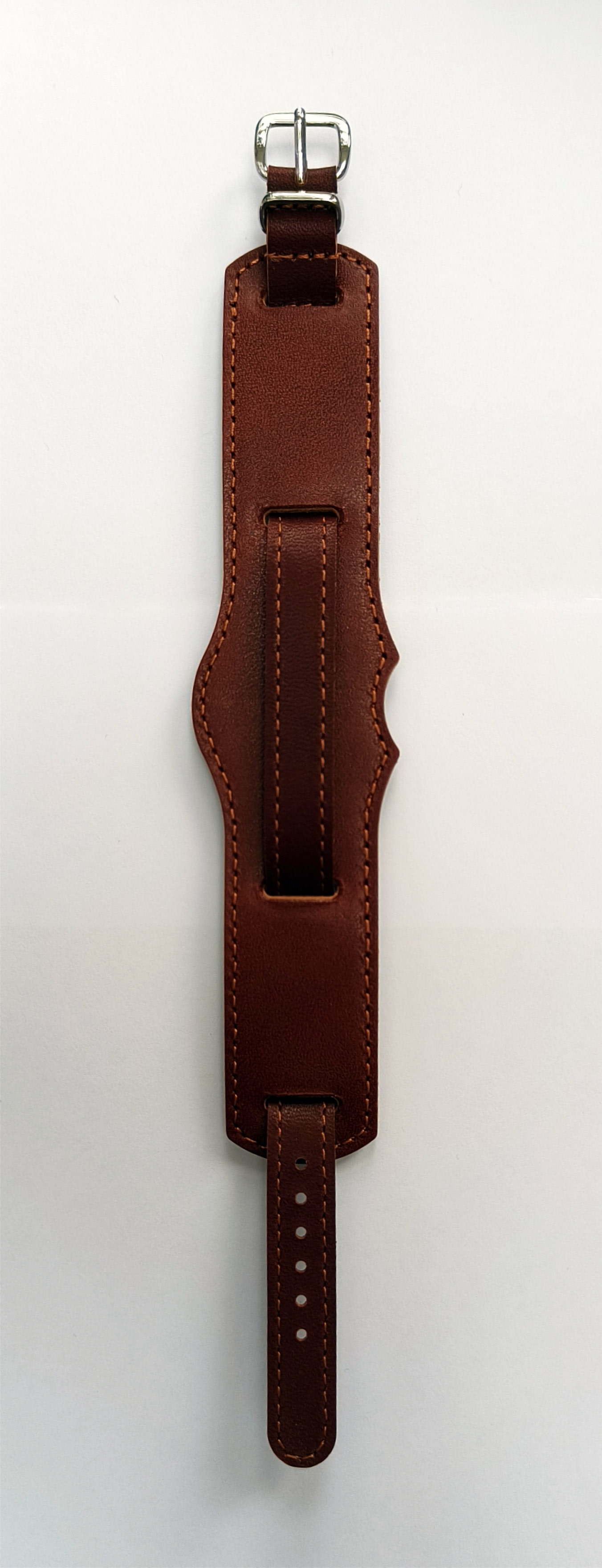
F-Type in dark chestnut leather
Click image to enlarge
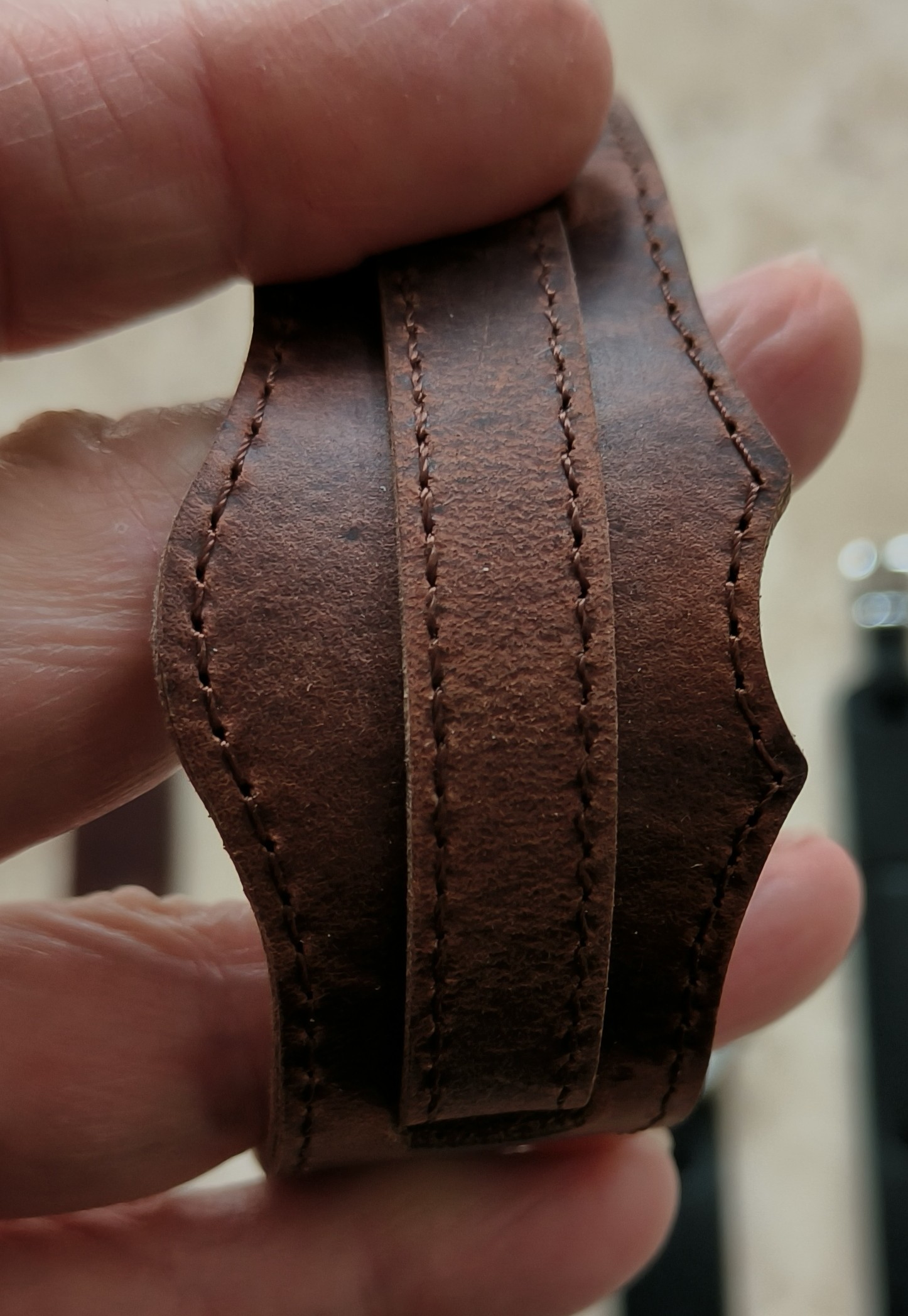
Brown oiled waxy pull-up leather
Click image to enlarge
The brown oiled leather is a top quality, full grain, high-grade oiled pull-up leather. This treatment gives the leather great character which is particularly appropriate for First World War trench watches.
If you are not familiar with pull-up leathers, their characteristic is that they change colour as the are distorted or “pulled up”, but relax back to the base colour. They show marks as part of their character, which can usually be removed by stroking the surface, or by using a waxed-leather cream. The photo here gives an idea of the effect. This is a more expensive grade than standard dyed leathers.
An alternative brown, for the F-Type strap only at the moment, is the dark chestnut shown here. This is a high-grade full grain leather in dark chestnut. It is not a pull up leather, so the colour does not change as it is bent. This leather is a more dressy alternative to the brown oiled leather.
Please note that only the F-Type design is available in the dark chesnut leather.
The black leather is a full grain soft leather with a fine matt finish.
Examples of customer's watches fitted with these straps can be seen on the Customer’s Watches page.
Prices
The F-Type and S-Type designs are the same price depending on the choice of buckle.
- with base metal chrome plated buckle £30
- with base metal gold plated buckle £35
- with hallmarked Type GW sterling silver buckle £65
- with hallmarked Type GW 9 carat gold buckle £205 (out of stock)
Type GW buckles are also available to purchase without a strap for your own special project.
- Type GW buckle in sterling silver £35
- Type GW buckle in 9 carat gold £175 (out of stock)
Postage Costs
EU customers please note: Due to the EU GPSR - General Product Safety Regulation 2023/988 - I can no longer deliver to the European Union, the compliance requirements are not practical. If you know someone who lives outside the EU, orders can be shipped there.
USA customers please note: US Customs Duty now has to be paid before dispatch. This is paid to Royal Mail as part of the postage. The duty is 10% of the value of the goods, plus a 50p handling fee.
- UK post: First Class £3.70, Royal Mail Tracked®: £4.30
- Not available due to GPSR - see note above
- Outside Europe: Standard Airmail £5.00, tracked £12.00
Standard post and airmail is not tracked. If you want a tracked service, please let me know. Straps with 9 carat gold buckles are sent Special Delivery within the UK, or tracked airmail.
How to Place an Order
Orders are initiated by email. Please send the following details.
- The design you want; the F-Type with a flared and notched back pad or the S-Type with a straight back pad
- The leather colour; black or brown
- The type of buckle you want; gold, sterling silver, chrome plated or gold plated.
- The postage zone or country for delivery, and whether you want a tracked service.
If you want to add Town Talk silver cleaning cloths or storage strips, described below, they don't add to the postage.
To place your order, send an email to me at with your requirements. If the link doesn't pop up a new email when you click on it, please use this link: Order Instructions.
I will send you an electronic invoice by either PayPal or Stripe to place the order. You don't need to have an account with PayPal or Stripe, payment can be made easily with a credit or debit card.
Make sure your address details in your PayPal account are correct, or let me know exactly where you want the package to be delivered.
Cleaning and Storing Silver

Town Talk Silver Storage Strips £2.50

Town Talk Silver Polishing Cloth £3.30
Silver doesn't oxidise like base metals. It will however pick up sulphur from the atmosphere and form a black layer of silver sulphide on the surface, this is called tarnish.
For cleaning my sterling silver buckles, or anything else made of silver, I find that the polishing cloths made by Town Talk are really good. They are ideal for cleaning my sterling silver buckles, and also for silver watch cases, because there is no messy liquid to get onto the leather strap or into the watch case, just a rub with the dry cloth brings up the silver beautifully clean and with a really good shine.
Town Talk have been making polishing cloths since 1895, that’s 128 years, so they have really got the hang of it. Town Talk’s high quality cotton silver polishing cloths are impregnated with silver cleaner and an anti-tarnish agent. They remove tarnish from silver leaving it really sparkling, and the anti-tarnish agent helps to keep it that way for longer.
I find the 5 x 7 inch (125 x 175 mm) Town Talk polishing cloths are the perfect size for polishing the silver cases of trench watches, and for polishing my Type GW hallmarked sterling silver buckles.
Have you noticed that silver items go dull when they are in storage? Make sure your fine silver items stay shining bright by storing them with a Town Talk Silver Storage Strip. The Strips absorb atmospheric pollutants and help keep your silver shining bright. Store your silver item with a Silver Storage Strips in an enclosed space. The Storage Strips do not prevent tarnishing but slow it down and they do need to be replaced from time to time depending on storage conditions. Town Talk Silver Storage Strips come in packs of 36.
You can add these to your order for no increase in postage charge. A polishing cloth is £3.30, a pack of storage strips is £2.50. If you are going to purchase only one of these, choose the polishing cloth. The Storage Strips do not prevent tarnishing; they slow it down but you will eventually need to polish.
Back to the top of the page.
There are additional details below of the background to my designs, and also further information about strap lengths and widths and how the straps are made.
Authenticity
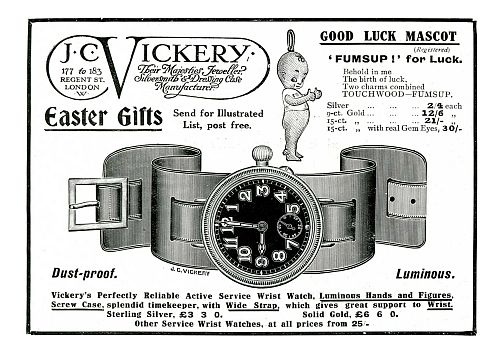
J C Vickery Advert for Trench Watches from 1916

From J W Benson advert in "The Sketch" 15 Dec 1915.
As I explain on my page about the First World War Trench Watches, there was a huge surge in demand for men’s wristwatches during the First World War (the First World War or the First World War, WW1 - 1914 to 1918). Before this, most watch manufacturer were making pocket watches or ladies bracelet watches and hadn't anticipated the sudden demand for men’s wristwatches. Men’s wristwatches had been made before the First World War, but there was little demand for them except from military men.
The first purpose made wristwatches had narrow wire lugs, and most wrist straps were single continuous pieces of leather which passed through the wire lugs and across the back of the watch. This was the type of wristwatch that was produced in huge quantities during the First World War and became known as a "trench watch", as shown by the advert reproduced here.
Because the lugs on trench watches are 12mm, wide they have to be fitted with a narrow strap. Sometimes that’s all they get fitted with, a narrow strap not much wider than a decent bootlace. Although this is authentic - there are plenty of pictures showing men wearing watches with very narrow straps, to modern eyes a narrow strap on a man’s wrist looks completely wrong and ruins the appearance of the watch. And if you have ever worn a watch with a strap like this, you will know that it is also very uncomfortable to wear.
There is evidence, such as the J C Vickery advert from 1916 reproduced above, that the benefits of a wider strap were soon recognised. These had to be have a narrow strap to pass through the lugs of the watch and were made wider with a separate back pad for comfort and improved appearance.

Strap witness mark on 1916 Omega
My designs of straps with cuff type back pads are authentic replicas of period military pieces like the one shown in the 1916 advert by J C Vickery here. They look good and chunky on the wrist, they are comfortable to wear, and they show off your vintage timepiece at its best. No man’s fixed wire lug watch looks right without one of these style of straps.
I originally wanted a strap like this so that I could wear my grandfather’s 1918 silver Rolex watch but I couldn't find any of satisfactory design and quality, so I had some made! The image below shows what one of my straps looks like when it is strapped to my wrist, in this instance carrying a rather nice Borgel wristwatch with a sweep centre seconds hand, unusual for the period.
Trench watches were sometimes fitted with straps that are stitched onto the fixed lugs rather than looping through the lugs and across the back of the watch. Again, this is authentic, there are adverts from the period that show watches with this type of strap, but it is impossible to use a back pad with this type of strap. But most trench watches were used with one piece straps, which is what I prefer for period authenticity - you can often see witness marks on the back of the case where the one piece strap used to run, as in the picture of the 1916 Omega shown on the right. It’s a bit tarnished, but that’s when the witness marks show up best.
Back to the top of the page.
What Width Strap or Band Do I Need?

Lug & Strap Width
The designs that I can now supply have 12mm straps, because that size fits the wire lugs of just about every First World War trench watch.
The strap should fit the lugs snugly, or else the watch can wander off to one side and it becomes annoying pulling it back to the centre all the time. If your watch has a strap currently fitted that doesn't fit the lugs snugly, then it is the wrong size. When new, the strap should fit the lugs tightly because as you wear the strap and it stretches lengthwise, it also shrinks slightly across the width, and if it only just fitted the lugs when new, it soon goes sloppy.
The picture shows an Electa trench watch with a correct size 12mm strap, see how it snugly fits the wire lugs. To find out whther a 12mm strap is the correct width for your watch, either carefully measure the inside width of the lugs on your watch, or cut a strip of card so that it just slides through the lugs, and then measure the width of the strip.
Working with leather is not like precision machining metal; an accuracy of 1mm in cutting out the leather is about as good as can be achieved given the nature of the material, and it will stretch or squash in use. This is one of its great qualities which has not yet been replicated by artificial materials, so please bear this in mind when you are thinking about a strap. Talking measurements of +/-0.5mm doesn't have any real meaning for leather.
Leather straps will fit lugs up to 1 millimetre narrower with a bit of care: leather is a marvellous material which will squash down to fit the lugs - see the advice about fitting a one piece strap if you think it will be really tight. This looks a lot better than a narrow strap that leaves your watch slopping about from side to side. And also leather straps always get slightly narrower as you wear them, because as they stretch slightly in length they also contract in width (the Poisson effect), and you don't want it to go sloppy after a few wears.
Back to the top of the page.
Strap Path
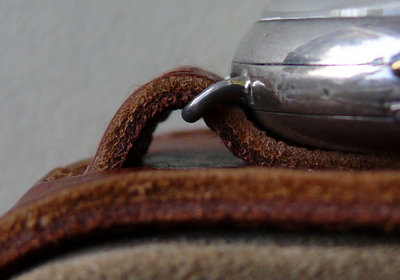
Fixed wire lug showing path of strap
These straps are designed for First World War era watches that have narrow fixed wire lugs which take a one piece strap that passes through the lugs and across the back of the watch case as shown in the strap details picture here. The wire lugs of these early watch cases are simply made from bent pieces of wire soldered to the case, shaped to allow the strap to loop across the back of the case. Wire lugs usually have a dropped shape to guide the one piece strap across the back of the case, and also leave plenty of room between the case and the lug for the strap to slip through as shown in the picture. The back of the case is also rounded so that the strap doesn't need to make a sharp bend to go across the back of the case.
To be sure that your watch will take a one piece strap you need to look at the path the leather will take through the lugs and across the back of the case. If the lugs are sized and positioned so that the strap can take a gently curved path like the one in the picture, and there is at least a 2 mm gap between the case and the lugs for the strap to pass through, then it will be fine. usually it is obvious if the case and lugs were intended to take a one piece strap. If the path that the strap would have to take has sharp or right angled bends, then it is probably not suitable for a one piece strap and you should take a look at my open ended straps described below.
One piece leather straps are intended to fit a watch whose lugs and case were designed so that a leather strap can strap pass easily through the lugs and across the back of the case. The trench watch shown in the picture here illustrates this, the gap from the case allows a 2mm thick strap to pass, and the shape of the lugs allows the strap to take a nice smooth curve through the lugs and across the back of the watch case.
If the strap of your watch takes a more convoluted path than the one shown, or has sharper bends because the lugs don't droop as much or the case is less rounded, then a longer strap might be needed to follow the path. Conversely, if the lugs allow the strap to take a straighter path, then the strap might need to be made shorter.
If the lugs are very close to the case, or curved, or both, then it might not be possible to fit a one piece pull through leather strap at all; some watches, e.g. those with wide curved lugs close to the case, were originally supplied with fabric or silk straps and the lugs won't take a leather strap.
Back to the top of the page.
Wrist Size and Strap Length
From experience I know that the standard length of my one piece pull through straps suits most men, with wrists between about 165mm / 6½" to 195mm / 7½" around, and this is the length that the straps are made for. At the moment, I can't supply other lengths.
Back to the top of the page.
Strap Thickness
Fixed Wire Lug Watch and Strap
The finished thickness of my standard pull through one piece leather straps is 2 mm (two millimetres).
This is the thickness that straps for trench watches with fixed wire lug were originally made. The way that the straps are made and the reason for the 2mm being the thickness is explained below. The traditional process or making trench watch straps results in straps that are authentic and strong while being also supple and durable. Trench watches were designed for a one piece pull through strap and a suitable gap was made between the lugs or bars and the case.
If you have a trench watch and the wire lugs are closer to the case than 2 mm then they are bent and should be restored as shown in the image here. This is easily done by carefully bending the lugs, although first make sure that the joints where the lugs are soldered to the case are sound. Before using pliers, try using your fingers; I have corrected bent lugs using finger pressure alone.
If your watch is old and really does need a strap thinner than 2 mm, then it originally might have had a silk strap, often a moiré silk which was very fashionable for ladies' watches. If it is a modern watch, then it might have had a Perlon or nylon strap, a two piece strap, or a metal bracelet. Any of these can mean that the lugs, or horns and bars if it is a modern watch, are not designed to take a one piece pull-through leather strap. Modern watches with horns and spring bars that are designed to take a two piece strap or metal bracelet have the bars close to the case so that there is not a large gap visible when the strap or bracelet is fitted, but this does not leave room for a one piece pull through strap.
Please look carefully at the gap between the bars and the case, and also at the strap path to establish whether a one piece pull through leather strap will work.
Back to the top of the page.
Fitting One Piece Straps
Fitting a leather strap to a modern watch that was not specifically designed to take a leather strap, or to a wire loop watch where the strap is tight in the lugs, can be a bit tricky. However, don't despair; leather is a very accommodating material and once you get it in place it will settle in just fine. Here is a tip about how to get the strap in place without damage.
Some modern watches have a narrow gap between the bars and the body which, although wide enough to take a leather strap, can make fitting difficult but not impossible. This is usually because the location of the lugs and the shape of the case makes the strap take a sharp bend to turn across the back of the case.
Modern watches are not designed with leather straps in mind, and the watch case often has razor sharp edges that can damage the leather as you pull it through. In this case, the strap needs some protection even if it is not a very tight fit in the lugs.
One of my customers had some problems fitting a G10 strap because his watch has quite a narrow gap between the bars and the body. You can see the notes by Mike on the customers page about how he tackled this, but basically he wrapped the strap in aluminium foil which enabled him to slide it through the bars without damage.
In my experience, the best method is to use a piece of plastic film, e.g. a piece cut from a carrier bag. Simply cut a strip of plastic just over twice the width of your strap from a carrier bag, wrap this tightly around the strap and secure with sticky tape. Leave a couple of inches of empty plastic surplus at the end as a "leader" and feed this through the lugs. Because it doesn't have the strap in it it will go through easily. You can then use the leader to gently pull the rest of the plastic containing the strap through the lugs. After the strap is in place, just hold the buckle end of the strap and pull the plastic out.
You can use this technique to fit a one piece leather strap or a leather NATO G10 to a modern watch easily, and without damaging the surface finish of the leather. The plastic bag method also works for Texas cowboy boots or any other footwear that doesn't have any laces or zips, and it is very effective. You just cut the end off a carrier bag to make a tube, slip this into the boot, slide your foot in, and then pull out the carrier bag, which comes out easily because you cut the end off.
Back to the top of the page.
Making Straps
Each of my straps is each made in the traditional way that British wristwatch straps have been made for over one hundred years, since before the First World War. Two pieces of full grain leather, an outer and lining, are glued together. The parts of each strap, the back pad and the wrist strap itself, are then cut out from this leather sandwich using press knives. Each part is then stitched all the way round for extra security and durability.
Why are straps made like this? A leather hide has two sides, an outer side where the hair or fur was, which is called the "grain" side, and an inner side which is called the flesh side, for obvious reasons. The grain side has close knit fibres made of inert cells which is dense and strong, because the outer skin layer needs to protect against cuts and insect bites. As you move through the leather towards the flesh side, the lower layers are where new skin cells grow and the fibre structure gets progressively looser and weaker.
Raw hide is very thick and hides are “split” before tanning to make them thinner. The grain side leather is ideal for watch straps. The layers of flesh side leather that are split off from the grain side are used for less demanding applications where strength is not important, such as suede. Split hides from the tannery are often too thick to be used to make watch straps and are further split or "skived" down to a usable thickness. Skiving is the term used in the leather industry for shaving down the thickness of the leather. So yes, the leather industry does employ professional skivers!
To make a watch strap that is as strong and durable as possible, yet still flexible so that it is comfortable to wear, two pieces of the grain side leather are used. These are glued back to back before being cut into the strap parts using press cutting knives as I describe above. They are then stitched all round. The stitching stops the two parts from separating, and also helps to make the finished strap stronger, with less "stretch".
The minimum thickness that full grain hide can be reduced to and still retain good strength is about 1mm, so the thickness of a finished double sided, glued and stitched, leather strap is 2mm.
If the lugs on your watch are very close to the case, less than 2mm gap, which on a trench watch means they are bent and can be restored, or the shape of the case means that a one piece strap would have to make very tight bends that a normal thickness leather strap will not make (See section about this "One Piece Strap for Fixed Wire Lugs" above) then you probably have either a cushion case or a modern watch with horns and bars and you should consider a two piece open ended strap. These straps attach to the case either with spring bars or by wrapping around fixed bars.
Cutter Limitations - Why I Can't Make Just Anything
I can only supply the designs of the shaped back pads that I actually have cutters for, called “press knives”. These cutters are used to cut out the basic shapes of the parts from the leather before stitching. If I don't have the cutter, I can't make the strap. Cutters can be made of course, that’s how I got mine; but they are expensive to make.
The straps and back pads are made from two pieces of top grain leather that are glued back to back. The two pieces of leather are glued together before the shaped pieces and straps are cut out using a powerful hydraulic press that pushes press cutters through the leather. To cut out the shaped back pads and straps, each piece needs to have a cutter of the correct shape.
These cutters are, in principle, just like the pastry cutters that cooks use to cut shapes out of pastry, but the difference is that these cutters are made from tool steel, very strong and sharp, and they are pressed through the leather using a hydraulic press which exerts tons of force. Each cutter is made by a specialist toolmaker, and they can be quite complicated; cutters for straps include punches for the pin holes, cutters for back pads include punches for the slots. The cutters take time to design and make, and they are expensive. That’s why I can't just make anything.
It simply isn't possible to cut the glued double sided leather neatly any other way, scissors and knives just don't make a neat job. This is also the reason why I can't cut down any of the back pads that are too long, it simply doesn't result in a neat job. Straight cuts in leather are in principle reasonably easy to make manually, but when it comes to small pieces of leather such as straps, holding the material can be a problem. The press cutters are designed to make nicely shaped back pads and a straight cut on one of them would look like what it was, a hack.
Back to the top of the page.
Single Thickness Leather
A leather strap made from a single piece of leather rather than two pieces stitched together is not very satisfactory, because it only has one grain side and no stitching. You will often see straps like this advertised as being "soft" and "flexible", which is true; but for some reason they don't say that they are "stretchy" and "weak".
I prefer to supply leather straps that will last, which means made in the traditional way, from two pieces of leather glued back to back and stitched all round. I have in the past, against my better judgement, supplied straps made from a single thickness of leather, but due to general dissatisfaction, mine and customers, with these I will not supply any more; as an engineer by training, experience and at heart, I prefer things made in a way that I feel comfortable with.
Back to the top of the page.
Colour Fidelity
Please bear in mind that because leather is a natural material, not only does colour vary from hide to hide, it even varies across a single hide depending on the way it takes up the dye. It also is very difficult to get an accurate colour reproduction using a digital camera and also on a computer screen. Because of this the colours shown in these pictures must be taken as a guide rather than an absolute reference.
Back to the top of the page.
Big Stitches
My straps are machine stitched which produces fairly small but neat and even stitches. Big stitches made with heavy gauge thread are usually done by hand sewing. This requires different tools and techniques that I don't have. So I can't supply straps with big stitches.
Back to the top of the page.
Cushion Cases and Wide Lug Cases

Cushion case wristwatch with incorrect width strap
Cushion cases and wide lug cases with lugs that are a significant proportion of the width of the case, like the wristwatch shown in the photo from eBay, are not fitted with straps that have back pads for exactly the reason illustrated by the watch in the image.
The strap is much too narrow for the lugs and is clearly wrong. During wear, the narrow strap does not hold the watch in place and allows it to constantly wander off to one side or the other, which becomes very annoying.
To correct this, a wider strap that fills the width of the lugs is be needed, but then the back pad would not be wide enough - there would only be very narrow strips of leather either side of the holes that the strap comes through. To correct this, the back pad would have to be made wider, much wider than the watch, which would look very bulky and in practice just doesn't look right.
Whether the case is a cushion case or any other shape with lugs that are wide compared to the case, the principal problem for a strap with a back pad remains the same. In order to look right, the back pad needs to be 20mm or more wider than the strap. This means that 10mm of the back pad is visible on either side of the strap. Any less than this and the strap looks too wide for the back pad.
Cushion cases usually have 16mm, 18mm or wider lugs and were originally fitted with a strap without a back pad. A strap of 16mm or greater width generally looks and feels fine on a man’s wrist, so I recommend that you use a simple one or two piece strap without a back pad on a cushion cased watch.
Back Pads for Small Watches
There is a natural tendency to think that a strap with a back pad might make a small watch “look” larger, which is more wearable today. However, this doesn't work. The end result looks like what it is; a small watch on a back pad that is too wide for it. For the best appearance, the overall design of the strap and back pad need to be in harmony with the watch.
With cushion cased watches, it is obvious to think that if, in general, a back pad needs to be 20mm wider than the lugs, then just add 20mm to the width of the strap and make a back pad that width. There are two problems with this. The first is that I can't simply make back pads of any size, only sizes that I already have press knives (cutters) for. However, the second problem is more significant; this approach simply doesn't look right.
If you are thinking along these lines, try making a mock up to see how it would look. This doesn't have to anything elaborate, a couple of strips of appropriately coloured paper are quite adequate, one cut to the width of the lugs to represent the strap and the other cut 20mm wider to represent the back pad. You will soon see that it just doesn't look right, the back pad is out of proportion to the watch and dominates it, making it look smaller than it really is.
Curved Lugs
There is an added difficulty if the watch has curved lugs or bars. Because the ends of a two piece leather strap are square, they are not easy to fit to curved lugs, and the curvature of the lugs means that the stress in the strap is carried at the outer edges, which which can cause it to split or tear from the edges inwards.
Curved lugs often show that the watch was designed to be worn with a fabric or silk strap, often silk moiré which was very fashionable at the time.
Back to the top of the page.
Modern Horn with Spring or Fixed Bar Strap Fixings
After the early fixed wire lug watches, more modern watches have "horns", projections fixed to side of the case, and "bars", either spring bars or fixed bars which engage with these horns. The bars usually come closer to the case than fixed wire lugs, and often they either don't leave enough space for a one piece leather strap to pass between the bars and the case. Also the placement of the bars on the mid line of the case often doesn't allow a one piece strap to wrap easily around the bars and then across the back of the case. The straps are wider and a back pad is not needed.
If you have a watch like this, then I can supply a two piece strap that fits directly onto the bars instead of looping across the back of the case. This type of strap fits the horn and bar configuration better than a one piece strap, which is more correct for wire lugs. These can be either open ended for fixed bars or closed end for spring bars.
Back to the top of the page.
Wristlets: Wrist Straps for Pocket Watches
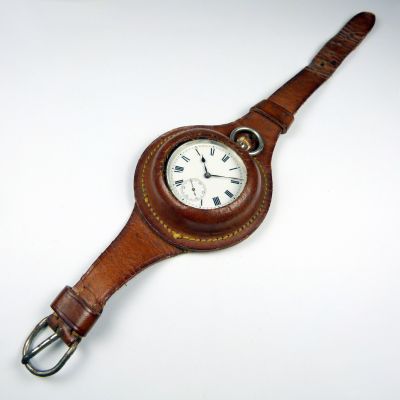
Wristlet strap for pocket watch
I have occasionally been asked if I can supply wristlets or wrist straps for pocket watches. At the moment I have nothing like this available.
Update December 2019: When I originally wrote this section, over 10 years ago, I was quite keen to go into this in more depth. But in the years since I have had very few, if any, inquiries, so I have decided not to pursue it any further. These type of straps do come up at auction fairly regularly, so if you really want one, keep a look out for them.
Back to the top of the page.
Wristwatch Straps with Protective Covers
I don't make straps with a cap or protective cover that goes over the watch.
I do get asked for them very occasionally, certainly much less than once a year, so I imagine that the market for them would be tiny.
I not keen on straps with covers over the watch for two reasons:
- The purpose of wearing a wristwatch was to make it quick and easy to read without using both hands, but a strap with a cover needs you to fiddle about with both hands every time you want to read the time; this defeats the object of wearing a wristwatch in the first place, and is the same reason that wristwatches with hunter lids fell out of favour during the First World War - see Hunter Wristwatches. These are rare, but like many things that are rare today it is because very few people wanted them when they were made.
- If you have a nice vintage wristwatch, why hide it under a cup rather than showing it off?
I don't make them and I don't have any intention to.
Back to the top of the page.
If you have any comments or questions, please don't hesitate to get in touch via my Contact Me page.
Copyright © David Boettcher 2005 - 2026 all rights reserved. This page updated April 2026.
Back to the top of the page.