Gay Frères
Copyright © David Boettcher 2005 - 2026 all rights reserved.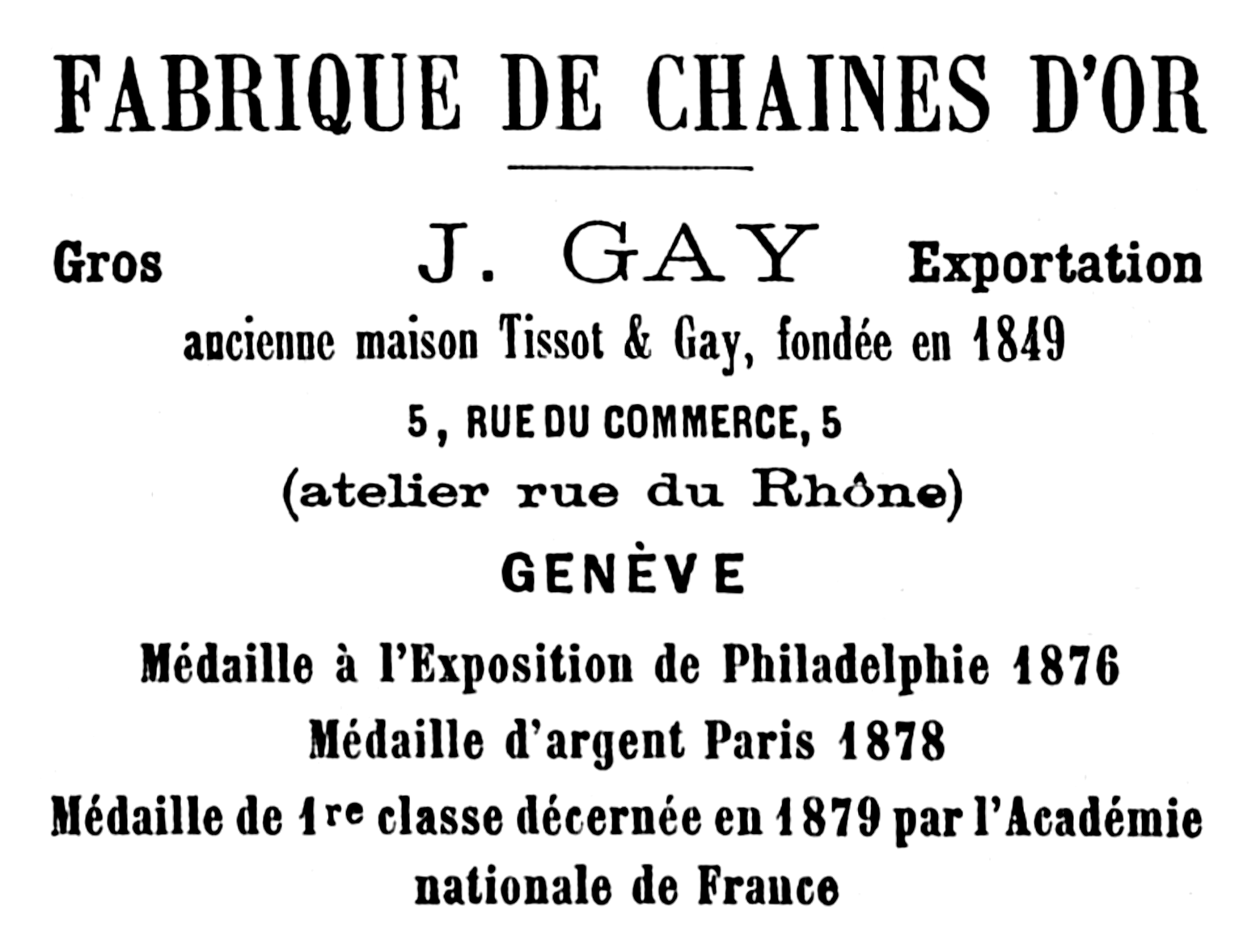
Jean Gay advert, 1879
Click image to enlarge
The first member of the Gay family to enter the Swiss jewellery chain and bracelet industry was Jean-Pierre Gay. His father was a farmer in a small rural locality along the Drize river, in the canton of Geneva. However, Jean Gay didn't follow his father into farming but entered another line of business through a family connection.
Jean-Pierre Gay was born in 1835. He was apprenticed to a company in Geneva that made gold chains for the watch and jewellery industries. This company had been founded in 1835 by an uncle of Jean Gay named Gaspard Tissot, the husband of one of Jean Gay's aunts. Apprenticeships in skilled trades were often obtained through personal connection and patronage rather than open competition, and an uncle already established in business was a natural route in. Without that family link, it would have been difficult for a boy from a farming background to secure a place in a Geneva gold chain workshop. In 1865, Jean Gay became a partner in the business, which was renamed Tissot & Gay.
The advertisement reproduced here gives a founding date for Tissot and Gay of 1849, which aligns with Jean Gay's likely age. He would have been fourteen in 1849, which was the customary age at which a boy began his apprenticeship, typically lasting seven years until he reached twenty-one. This suggests that 1849 marks not the founding of the original firm, or the date at which Jean Gay became a partner, but the date at which started his apprenticeship. Gay Frères advertisements from the twentieth century give a founding date of 1835, which refers to the establishment of the Tissot business by his uncle, which Gay joined as an apprentice fourteen years later.
In 1872, Jean Gay took over the company from his uncle, which was then renamed J. Gay, as shown in the advert. Jean Gay expanded the business considerably. In addition to his organisational skills, Jean Gay was said to possess a particularly affable and obliging nature, and his employees considered him more of a friend than a boss.
In 1880, Jean Gay was awarded a silver medal at an Exhibition in Groningen. In 1883, Jean Gay was awarded a silver medal at the Amsterdam World's Fair. At the Swiss National Exhibition in Geneva in 1896, Jean Gay was a member of the jury judging entries in the jewellery, enamel and goldsmith category. Although as a member of the jury his entry was not judged, a report of the exhibition said ‘Several chains by Mr. J. Gay had links adorned with enamels and precious stones, giving them a very distinguished character.’
Jean Gay died in Geneva on 7 November 1898 at the age of sixty-three. The business was taken over by his three sons, Charles-François Gay, Gaspard-Édouard Gay, and Victor-François Gay, who formed a general partnership under the name Gay Frères, commencing on 1 January 1899. This partnership assumed the assets and liabilities of the previous business. Its declared activity was gold chain manufacturing, with offices and premises at 5, Rue du Commerce, Geneva.
A report of the Paris Universal Exposition in 1900 said, ‘The Gay Frères' factory, successors to the Jean Gay firm, founded at the beginning of the century, maintains its leading position in the production of gold chains. A wide variety of models, solid or hollow, from 9 to 20 karats, specially designed for export overseas and to the continent, are displayed in its showcases. This firm has earned a strong reputation for its lightweight chains, without compromising their durability.’ A brochure published at the time said that the company had 150 employees and produced 800 kg of gold items annually.
The general partnership Gay Frères was dissolved as of 30 June 1912. A limited partnership was then formed under the name Gay Frères et Cie, commencing on 1 July 1912, which took over the business and the assets and liabilities of the dissolved partnership. The partners were Charles-Félix Gay, of Geneva, residing in Thônex, and Victor-François Gay, of Geneva. The limited partner was Gaspard-Édouard Gay, of Geneva, residing in Cologny, with a limited liability of two hundred and fifty thousand francs (250,000). The business was described as a gold chain factory at 12, Rue des Glacis-de-Rive.
The factory on Rue des Glacis-de-Rive constructed for Gay Frères was one of the first reinforced concrete buildings. It was constructed on the Rive glacis, that is, on the site of the former fortified walls of Geneva.
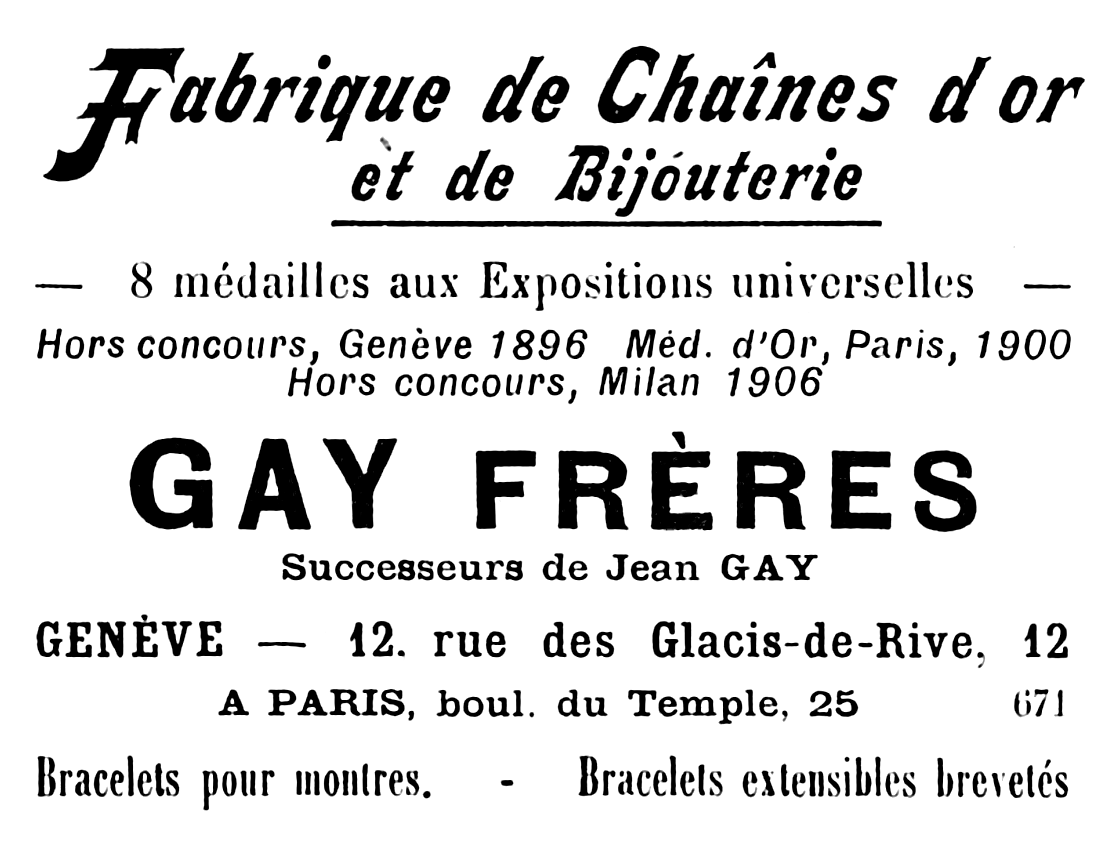
Gay Frères advert, 1913
Click image to enlarge
In 1913, an advert by Gay Frères said that the company had been awarded eight medals at universal expositions, including a gold medal at the Paris exposition in 1900, and had been ‘Hors concours’ (out of competition due to being on the jury) at the Geneva exposition in 1896 and Milan in 1906. In addition to gold and jewellery chains, the advert mentions bracelets for watches and patented expandable bracelets.
The limited partnership Gay Frères et Cie was dissolved on 12 June 1926 following the death of Victor-François Gay. The business was continued under the name ‘Charles Gay, Gold Chain Factory, successor to Gay Frères’, by the surviving partner Charles-Félix Gay, of Geneva, residing in Thônex. The activity remained that of a gold chain factory at 12, Rue des Glacis-de-Rive.
On 22 May 1929, the company Charles Gay, Gold Chain Factory, successor to Gay Frères, was struck off the official register of Swiss companies following the transfer of its operations. Three sons of Charles Gay — Jean Gay, Hubert-Jean-Marie Gay, and Noël-Paul-Marie Gay — then formed a second new general partnership under the name Gay Frères, commencing on 1 January 1929, which took over the business Charles Gay and its assets and liabilities. The declared activity was the manufacture of gold chains, bracelets, and watch cases, the first time bracelets and watch cases had been explicitly mentioned. The address remained 12, Rue des Glacis-de-Rive.
The general partnership trading as Gay Frères was dissolved in 1943, and its assets and liabilities were taken over by the incorporated company Gay Frères S.A. Gabrielle-Marie Gay (née Quinson) was appointed sole administrator, with Jean Gay as director and Hubert Gay as authorised signatory. At the same time, a separate company, Gay Frères, Vente et Exportation S.A., was established to handle sales and exports, its purpose being to separate commercial and export risk from the manufacturing company. Jean Gay and Noël Gay were appointed directors.
Gay Frères was acquired by Rolex in 1998, bringing bracelet production in-house as part of a broader strategy of vertical integration.
‘Army’ Bracelet
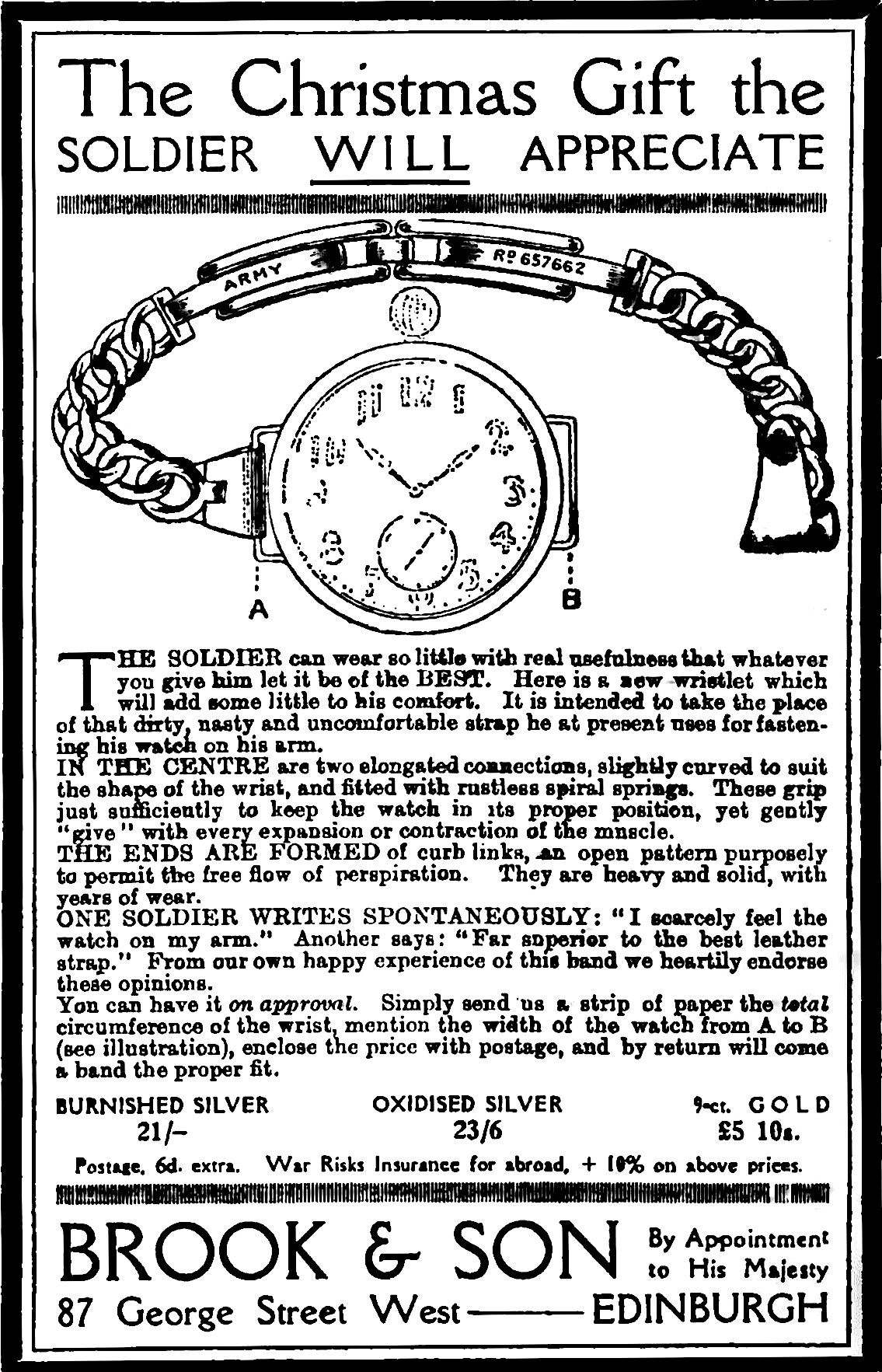
Brook & Son advertisement for ‘Army’ Bracelet, December 1918
Click image to enlarge
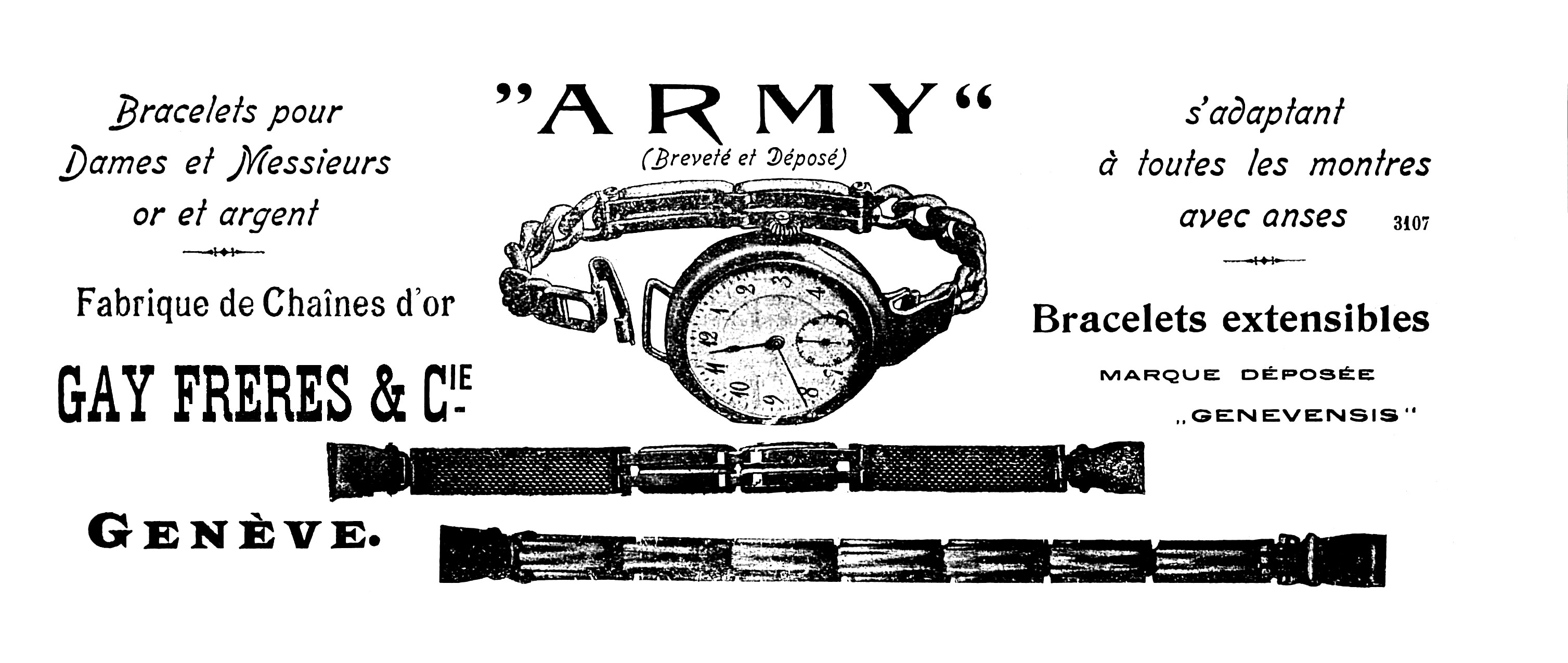
Swiss trade press advert for Gay frères ‘Army’ Bracelet, November 1917
Click image to enlarge
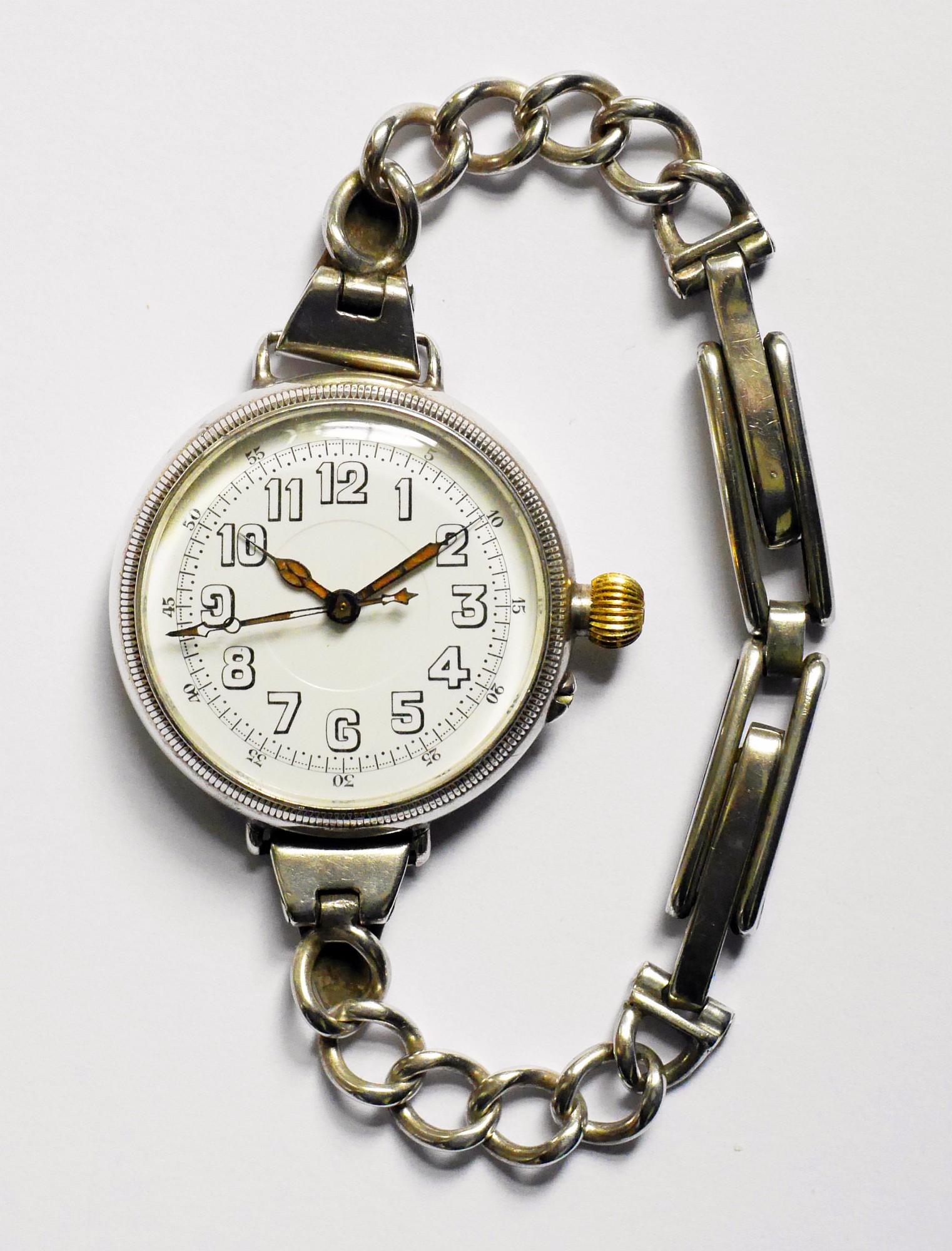
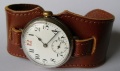
Watch with silver ‘Army’ Bracelet
Click image to enlarge
On 20 September 1916, Gay Frères registered the word ‘Army’ as a Swiss trademark. This was used for expanding bracelets intended for trench watches.
The advertisement from a Swiss watch trade newspaper by Gay Frères in November 1917 says that the design was both patented and registered (breveté et déposé).
Gay Frères were granted a number of patents for expanding bracelets or ‘bracelets extensible’, two in 1911 and one in 1913.
The Army bracelet design was registered in Britain, receiving the Registered Design (RD) number 657662 on 22 September 1916. This can be seen stamped onto one of the expanding links of the bracelet in the advert from 1918 by Brook & Son of Edinburgh, with the trademark ‘Army’ on the other expanding link.
The bracelet consists of two lengths of chain that clip onto the lugs of a watch case. Joining these chains are two hollow sections, each made of two pieces, one of which can slide within the other. Between the sliding sections are spiral springs which compress as the watch and bracelet are slid over the hand, and then expand to provide the tension that holds the watch on the wrist.
Advertisements for the Army bracelet appeared quite late in the war. The earliest known mention of the bracelet by Brook & Son was in June 1918, advertisements with pictures appear to have begun in December 1918, after the war was over. The Army bracelet was also advertised by Birch & Gaydon, the earliest known advert from April 1918.
Two of these bracelets have been seen, both made of silver, although not marked as such. The Gay Frères advert shows two alternatives for the clip that secures the bracelet to the watch's lugs. Only the type shown on the right, and in the Brook & Son advert, has been seen.
Despite the effusive claim in the Brook & Son advert that the bracelet is ‘Far superior to the best leather strap’, they are quite rare, which suggests that they didn't sell very well. One reason for this may be that, although the name and design were registered in 1916, it seems to have been some time before the bracelet was advertised. The earliest known adverts are from 1918. The other reason might be that it looked like a lady's bracelet and, given that men were only just getting used to the idea of wearing wristwatches, anything that made them look delicate and feminine would not appeal to the majority of men.
Stainless Steel Bracelets
In the 1930s, Gay Frères pioneered the use of stainless steel for bracelets.
In an article in the Journal de Genève in April 1934, Philippe Werner, professor at the School of Watchmaking, is reported as showing various objects made from stainless steel to an audience of Geneva industrialists. These had been created by manufacturers of chains, jewellery, and watch cases, whose traditional production of gold and silver items had slowed down due to the economic crisis. They had determined that stainless steel could be used in the same way as precious metals, but at lower cost.
Stainless steel is much harder than gold or silver and the machining difficulties initially caused them despair, but they managed to overcome the challenges thanks to their experience, and research conducted by the steel mills themselves, which created stainless steels with 12% nickel and 12% chromium, exhibiting a particularly beautiful colour.
After outlining the difficulties encountered and the machining processes that had been perfected, Mr. Werner presented to the audience various objects from the Gay Frères chain factory, the A. and É. Wenger jewellery factory, and the Taubert and fils watch case factory.
The first stainless steel watch bracelet made by Gay Frères was their model number 5912.
Gay Frères Trademarks
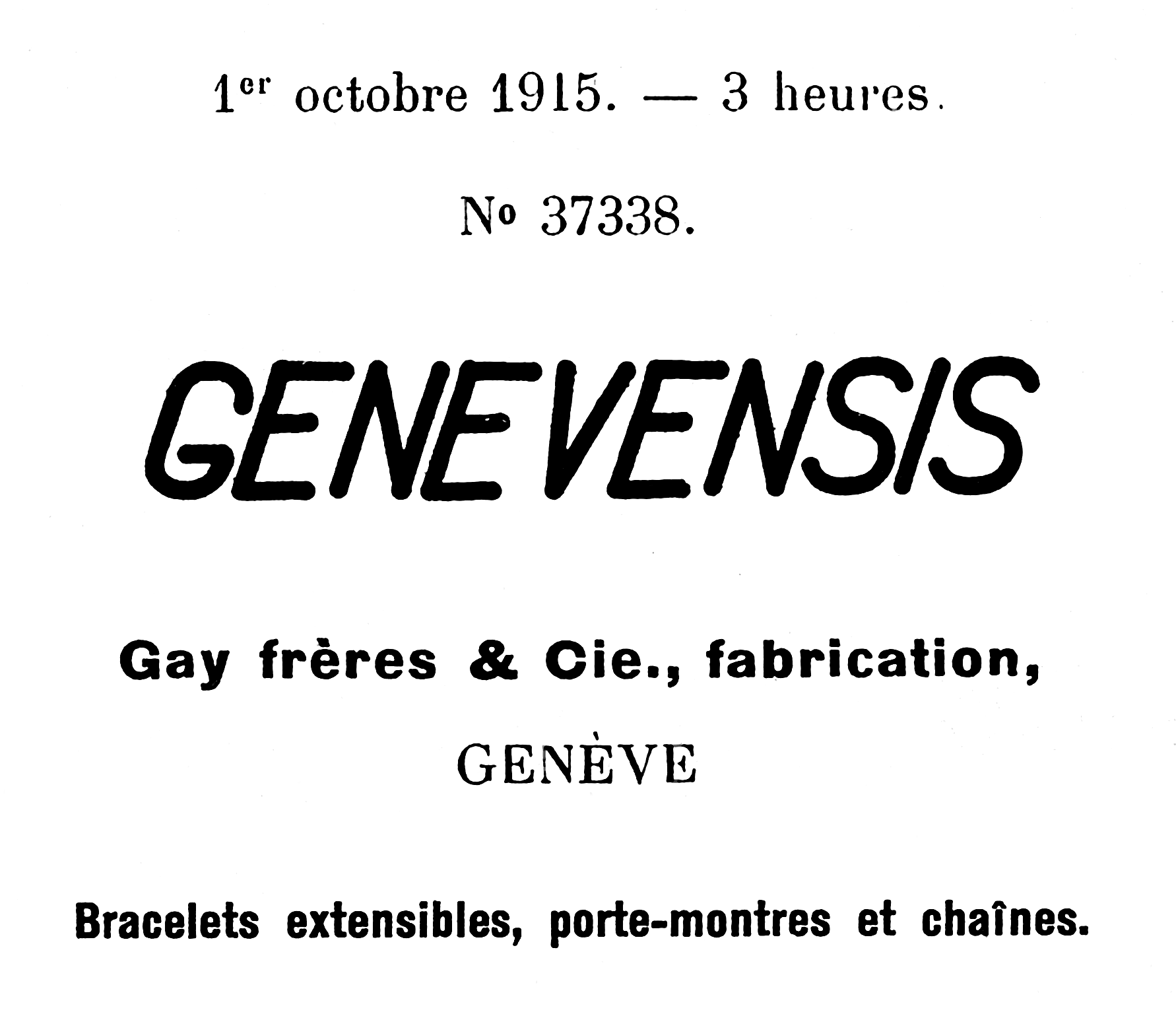
Gay Frères Genevensis trademark, October 1915
Click image to enlarge

Chamois goat
Click image to enlarge
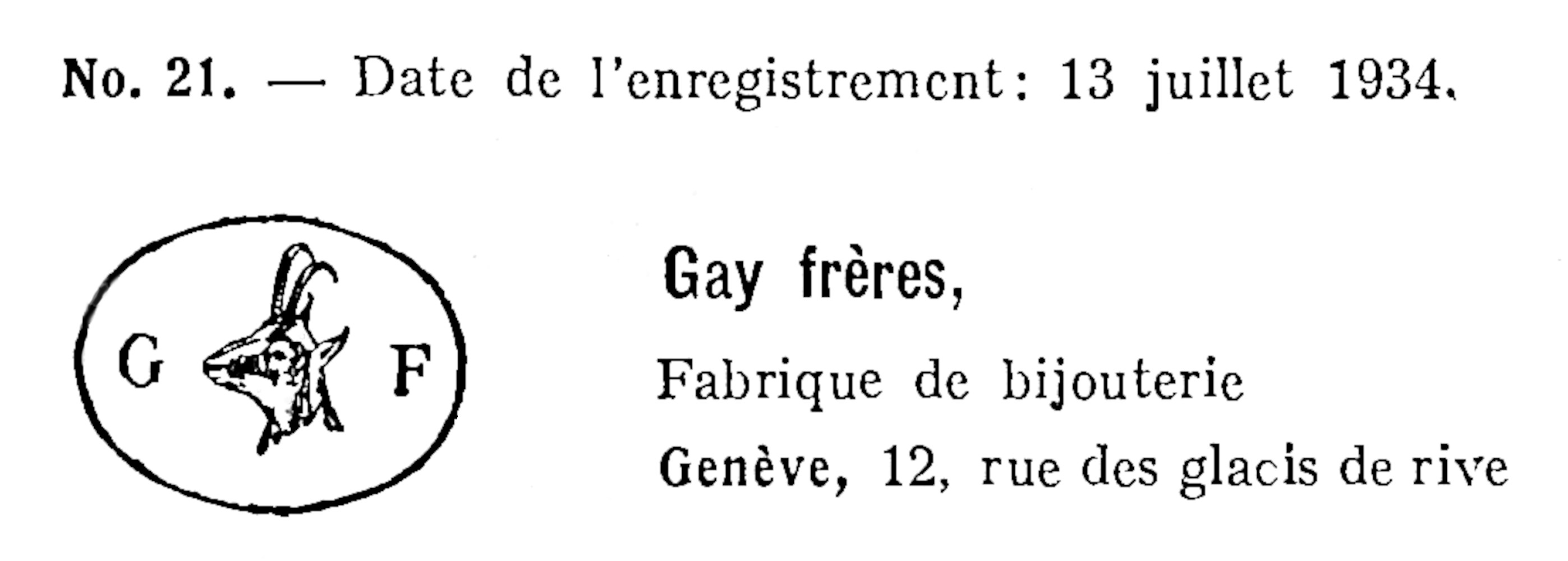
Gay Frères chamois trademark, July 1934
Click image to enlarge
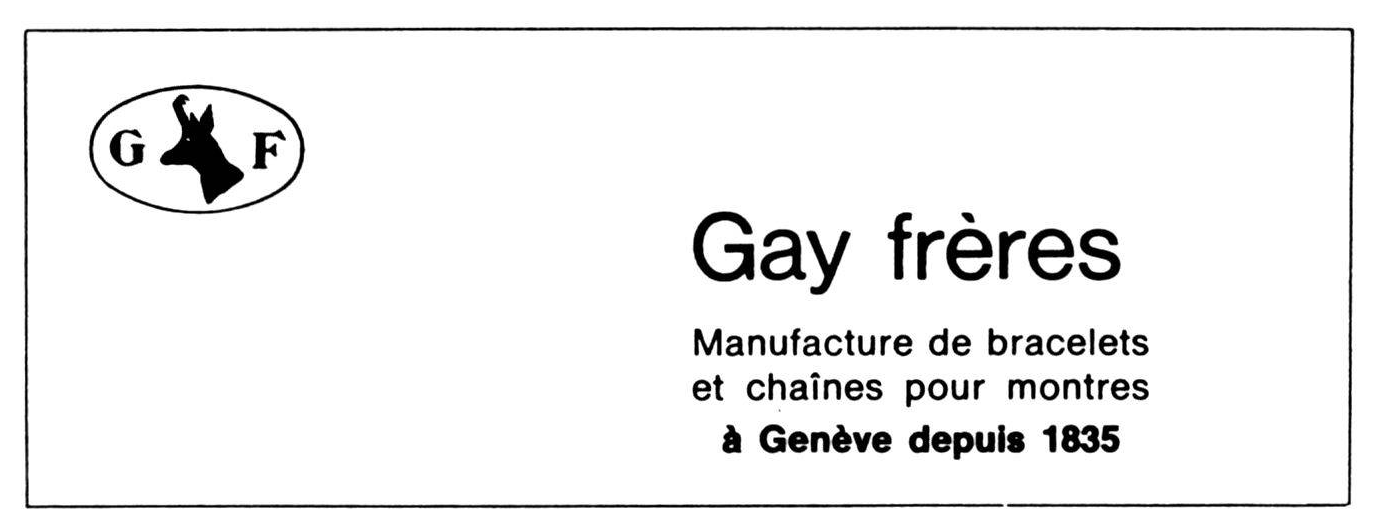
Gay Frères advert in 1988
Click image to enlarge
In October 1915, Gay Frères registered the word Genevensis as a trademark. This appears to be the first trademark registered by the company. It is referred to in the advert for the Army bracelet.
In July 1934, Gay Frères registered the trademark of a head of a goat and the initials G F within an oval. The backward curving horns are those of a chamois.
In the later Gay Frères advert from 1988, the goat is blocked in and the shape of the horns made less obviously curved. This has led to the animal being sometimes called a deer. However, comparison with the earlier mark makes it clear that it's actually the same chamois goat.
The legend in this advert states that Gay Frères had been makers of watch bracelets and chains since 1835. This seems at first sight to conflict with the advert by Jean Gay published in 1879, which refers to a company called Tissot and Gay founded in 1849. The date of 1835 refers to the company founded by Jean Gay's uncle Gaspard Tissot, from which the later firms of Tissot & Gay, and ultimately Gay Frères, developed.
If you have any comments or questions, please don't hesitate to get in touch via my Contact Me page.
Copyright © David Boettcher 2005 - 2026 all rights reserved. This page updated April 2026.
Back to the top of the page.