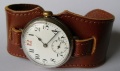
Jaeger Le Coultre
Copyright © David Boettcher 2005 - 2026 all rights reserved.Le Coultre was a Swiss watch parts and ébauche manufacturer set up in 1833 by Charles Antoine Le Coultre (1803-1881).
In 1826/1827, Le Coultre invented a pinion making machine that cut pinion leaves automatically. This was very successful. Le Coultre also invented other machines for making parts of watches. He also invented of a micrometer that could measure to a micron, that is a thousandth of a millimetre.
In 1833 a new factory was founded to produce the machines. In 1835, this factory started to also produce watch ébauches.
Le Coultre developed a specialisation in the machine manufacture of complicated ébauches which they supplied to Mathey-Tissot, Audemars Piguet, Patek Philippe and Vacheron & Constantin. Until the 1930s, Patek Philippe's ébauches were mostly made by Le Coultre, many finished to the same or nearly the same quality. In 1929 Le Coultre tried to take over Patek Philippe having been their main suppliers of ébauches since 1905, but they did not succeed.
A prosecution under the 1887 Merchandise Marks Act revealed that Le Coultre had supplied rough movements to English watch makers via a company in London called Reymond Brothers.
Reymond Brothers
In 1891, the London Watchmakers’ Trade Association initiated a prosecution under the Merchandise Marks Act, alleging that the use of a rough movement of foreign manufacture in a watch described, by implication by the retailer's name and address, as ‘English-made’ was an infringement of the statute.
Messrs Gent and Bettle, trading under the style of George Carley and Co., were summoned for having in their possession for sale a watch bearing the name ‘Campbell and Co., Smithfield, Belfast’, which was said to be a false trade description under the Act because, in the absence of any other mark, it represented the watch to be of British manufacture. The company had been well known in the trade for many years and had established a reputation for turning out the very best class of English watch. Like most English watchmakers, they didn't put their name on the watches they made, but instead put on the name of the retailer who ordered the watch from them.
The rough movement, consisting of two plates, two cocks, the barrel, and the train wheels, was made in Switzerland, and was purchased from Reymond Brothers of St. John's Street Road, Clerkenwell.
During the hearing, Samuel Yeomans, a practical watchmaker, carrying on business at Coventry, said he had had thirty-six years’ experience in the manufacture of English watches. Before the passing of the Act he had used hundreds of Reymond's movements. Yeomans said that Swiss made movements were inferior to English ones and would last only five years, a view endorsed by Thomas H. Hewett, of Prescott, managing director of the Lancashire Watch Company. However, David Glasgow, a watchmaker, of Myddelton square, formerly a vice-president of the British Horological Institute, was of opinion that Reymond movements were good and durable. He thought, class for class, they were as good as English.
James Gent, one of the defendants, gave the following evidence: ‘I am a member of the firm of Carey and Co., which consists of myself and Mr. Bettle. I have been in business for myself since 1865, manufacturing watches of the highest class, I was for some tine in the habit of obtaining my rough movements from Messrs. Reymond Brothers, who were really the pioneers of improvements in watch making. The movement of the watch in question was purchased of them. There is no difference whatever between the price of an English and a Swiss movement, I paid 19 shillings. for this one. In my judgement a Swiss rough movement is decidedly as good and as durable as an English one. The barrels are clearer finished and larger in diameter, and the stop works are more accurately planted, The shapes of the pinions and wheels are altogether better adapted for smooth running. I have a watch here, dated 1871, with a Swiss movement. It is still in excellent condition, and is no exception to the rule. It is absurd to say that a Swiss movement would only last five years. Reymond Brothers used pure brass. £17 has been expended on the watch in question already, but £16 1 shilling was spent in Clerkenwell. When finished the watch would have cost me altogether £22, only 19 shillings of which would have gone for the movement.’
A rough movement consisted of the bottom plate and top plate or bridges and cocks, together with the wheels and pinions and, in a rough movement for an English watch, the fusee. It also included steel parts such as clicks and the fusee stop work. A rough movement required a considerable amount of finishing, which included jewelling holes for the arbors, fitting the escapement, balance and balance spring, engraving, gilding and finally fitting the dial and casing. Gent says that although the movement cost him 19 shillings, the finishing work cost another £16 1 shilling.
When Gent said that Reymond Brothers were the pioneers of improvements in watch making and the shapes of the pinions and wheels are better for smooth running, he is referring to the pinion and wheel teeth cutting machines developed by Le Coultre.
When cross examined, James Gent said that a Swiss movement was ‘Far, far, far superior to an English one. I placed the name of Campbell and Co. upon this watch because I had a conditional order from them last April for a watch with a Kew certificate. I should not get a Kew certificate unless the name was upon it. I have not sold watches with Reymond movements since the passing of the Act because they are not obtainable, Messrs. Reymond Brothers are out of business due to the passing of the Act.’
Julian Reymond said he was a Swiss and had carried on his business in Clerkenwell from 1868 to 1887. He used to supply rough movements to watchmakers. The movement in question was supplied by him to Messrs. Carley and Co., and was made of brass from Birmingham and steel from Sheffield, so it was made from English material.
Reports of the trial said that the brass and steel were sent to Switzerland, where the rough movements were made by ‘Messrs. Lecontre’. This is a reference to the Swiss company Le Coultre.
Reymond said that he considered a Reymond ‘R.B.’ movement superior to an English movement. He had discontinued his business because no orders came in after the Merchandise Marks Act was passed.
Mr. Horace Smith, presiding, said be was of opinion that there had been a false trade description in this case. The watch was described as a watch made in England. The meaning of that was that it was substantially made in England, and he was of opinion that this watch was not substantially made in England. He fined the defendants £10 with £5 costs, and declared the watch to be forfeited under the statute.
It is not clear when Le Coultre started making complete watches, but it appears to have been in the twentieth century as a result of collaboration with Edmond Jaeger.
In 1900 Jacques David Le Coultre, grandson of the founder, met Parisian based Edmond Jaeger (1850-1920), originally from Alsace. Le Coultre supplied Jaeger with ébauches, tachometers and revolution counters. In 1917, Jaeger started distribution in Geneva and Paris of watches with Le Coultre movements, which were cased in Le Sentier using cases bought from a watch case making company. In 1926 a holding company Jaeger-Le Coultre was established to formalise the relationship between the two separate companies. In 1937, Le Coultre and Jaeger merged to form one company.
If you have any comments or questions, please don't hesitate to get in touch via my Contact Me page.
Copyright © David Boettcher 2005 - 2026 all rights reserved. This page updated May 2026.
Back to the top of the page.