Nicole, Nielsen & Co.
Copyright © David Boettcher 2005 - 2026 all rights reserved.
Nicole, Nielsen Watchmakers, Pierantonio Maragna, 2025. Private publication limited to 70 copies. Click here to email an order.
Click image to enlarge

Nicole, Nielsen & Co, Ltd – High Class English Watches: Click image to enlarge
Available from David Penney's Antique Watch Store.
Nicole & Capt
In 1837, Swiss born watchmakers Charles Victor Adolphe Nicole (b. 1812) and Jules Philippe Capt (b. 1813) set up a watchmaking workshop as Nicole & Capt in Le Solliat in the Vallée de Joux.
In 1840, Nicole and Capt set up an English watchmaking workshop. They initially traded as Nicole & Capt from 80B Dean Street, Soho, London. By 1858 the company had relocated to larger premises at 14 Soho Square.
It is not known when Capt left the business, but Nicole & Capt were awarded a silver medal at the Exposition Universelle in Paris in 1867.
Nicole, Nielsen & Co.
Around 1870, Danish born Sophus Emil Nielsen joined Adolphe Nicole as a partner and the name of the company was changed to Nicole, Nielsen & Co.
For a period of about 60 years from circa 1870, Nicole, Nielsen & Co. manufactured some of the finest and most complicated English watches ever made. It remained at 14 Soho Square until it finally closed in 1934. The company made movements or watches for E. J. Dent, Charles Frodsham and others. Robert Roskell & Co Ltd of Liverpool was an important customer.
A new comprehensive history of the company, Nicole, Nielsen Watchmakers, was published in 2025 by Pierantonio Maragna. Tony has been researching the company since buying a watch made by Nicole, Nielsen & Co. in around 2000. This is the only history of the company that has been published. It is a private publication and a limited edition of 70 copies has been printed. It is only available direct from the author. To place an order, Click here to email Tony. If the link doesn't work for you, contact me and I will pass on your details.
The catalogue shown in the photo here is a reprint by David Penney of a circa 1910 original. It illustrates a wide variety of high quality watches made by Nicole, Nielsen & Co at the time, including tourbillions, chronographs and ‘special order’ items, with an introduction to the firm written by David.
Charles Victor Adolphe Nicole died on 7 Aug 1876.
In 1876, Nicole, Nielsen & Co, London was given an award for watches at the Philadelphia Centennial Exhibition. In 1881, Nicole, Nielsen & Co, was give a second class award at the Melbourne International Exhibition for pocket watches and chronometers.
In 1890, in a lecture on recent progress in watch and clockmaking, Julien Tripplin remarked that ‘In the important matter of watchmaking by machinery we have, during the past ten years, vigorously pushed ourselves to the front rank in quality and organisation, for, besides the large factory of Messrs. Rotherham, we have in London those of Messrs. Guye and Company, and Nicole, Nielsen, and Company.’
Nicole, Nielsen's production methods were half way between a very high-quality traditional craft watchmaker and a machine based mass-production factory. They made their own movements, rather than buying them in from a movement maker. Their machines were initially powered by foot or hand in the traditional way, but at the Soho factory, an Otto gas engine was installed in the basement and drove line shafting. Parts were made to gauged sizes so that they were interchangeable.
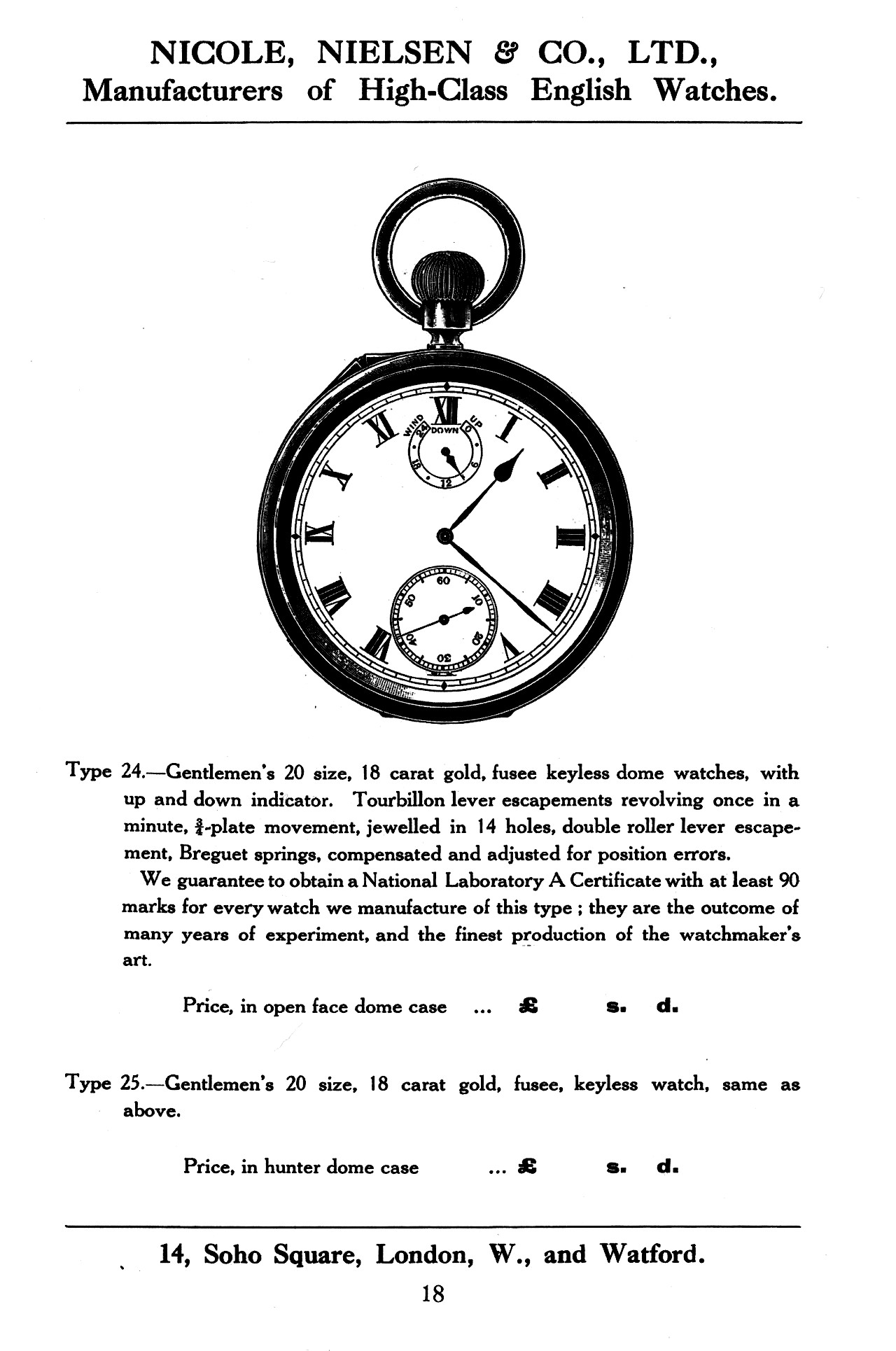
Nicole, Nielsen & Co, Ltd – High Class English Watches: Click image to enlarge
The page from the catalogue reproduced here shows a Type 24 Gentlemen’s 20 size, 18 carat gold, fusee keyless dome watch with up and down indicator. It has a tourbillon lever escapement revolving once a minute, a ¾-plate movement jewelled in 14 holes, double roller lever escapement, Breguet balance spring and is temperature compensated and adjusted to minimise position errors.
It is interesting that the description continues ‘We guarantee to obtain a National Laboratory A Certificate [A Kew A Certificate] with at least 90 marks for every watch we manufacture of this type ; they are the outcome of many years of experiment, and the finest production of the watchmaker’s art.’
The factory differed from a typical mass-production factory where large numbers of identical parts were turned out by automatic machinery. In the Nicole, Nielsen factory, watches were customised for each customer so that they had their own unique design. This meant that different jigs and dies were required for each customer and consequently fewer parts were made in each batch. Adding to the difficulty was that in addition to simple time-only watches, minute recording chronographs, split seconds chronographs and a variety of other complicated watches were produced.
Unlike other companies that made watches by mass-production methods, Nicole, Nielsen & Co did not publicise their use of machinery, preferring to be more associated with the traditional hand craft methods of English watchmaking.
This firm did not desire any notice of the merits of their tools and machinery given to the world, as they did not wish their watches to be known as machine made, their business being of a select and aristocratic character.
As far as it can be established, Adolphe Nicole did not retire but he became very ill and, after a short period, died on 7 August 1876. The company was then run as a partnership by Sophus Emil Nielsen, who had married Adolphe Nicole's daughter Harriet Victoire, and Adolphe Nicole's two other children, Charles and Zelia Louise.
In July 1885, it was announced that the partnership had been dissolved by mutual consent on 31 December 1884 and that Charles and Zelia had left. The business was continued by Sophus Emil and Harriet Victoire Nielsen.
In 1888 the firm was sold by Sophus Emil and Harriet Victoire Nielsen to Robert Benson North. The business was converted into a limited liability company under the title Nicole, Nielsen & Co Ltd.
In June 1889, a report of a visit to the factory by students of the Horological Institute included a description of the case-making department where cases with snap on bezels and backs were being made. Case bottoms were formed by spinning. To make crowns, a steel core was turned and a disc of gold drawn round it. This tantalising detail does not explain how the flutes of the crown were formed, or how the gold foil was pressed into them.
Sophus Emil Nielsen died, after a long illness, in June 1899. In his obituary it was said that ‘under his guidance the machine system of manufacture was introduced’.
In 1891, at the Kew watch trials, a watch entered by Nicole, Nielsen & Co, London, came 10th of the 27 watches that obtained the highest marks during the year with 82.7 marks. The watch had the serial number 10115 and had a duo-in-uno balance spring, a double roller and a going barrel. It gained 31.8 out of 40 marks (79.5% of the possible total) for daily variation of rate, 36.2 out of 40 marks (90.5%) for change of rate with change of position and 14.7 out of 20 marks (73.5%) for temperature compensation. This was a respectable result because the watch had the complications of a minute and split seconds chronograph, which made it more difficult to achieve high accuracy than a simple time-only watch.
Invention of the Chronograph
In 1844, Adolphe Nicole was granted patent No 10,348 for keyless work for fusee watches. Included in the patent were details of chronograph work, including a heart shaped cam that allowed the seconds hand to be returned to zero by a push of a button, the flyback mechanism still used today. However, this was an early stage or prototype design, and the castle wheel that controls the reset action was not yet present. No example of a watch embodying the 1844 patent is known.
Unlike earlier centre seconds chronograph watches, which stopped the train when the chronograph function was used, and hence stopped keeping time, in Nicole's invention the chronograph train was independent of the time train. The chronograph seconds hand could be started, stopped and returned to zero without affecting the timekeeping of the watch.
This was the first really useful chronograph. As a result, Adolphe Nicole is regarded as the inventor of the modern chronograph.
In 1862, Nicole was granted patent No 1,461 for an improved chronograph with a castle wheel ratchet. During a lecture delivered to the Manchester and North of England Horological Society, Charles Guignard said that the first Nicole, Nielsen chronographs were exhibited at the London Exhibition of 1862, and again in Paris in 1867. They had the chronograph mechanism under the dial.
In the early 1870s, minute recorders and split-seconds hands were added, with part of the mechanism mounted on the bottom plate in the space beneath the dial, and part mounted on the top plate. On the most complex watches with a minute recorder and a split-seconds chronograph, the entire mechanism was placed on the top plate because of the space it required.
In 1896, Henri-Féréol Piguet claimed that he had invented the modern form of the chronograph in 1861. This was refuted a few days later, as follows,
Contrary to the assertions of Mr. H.-F. Piguet, the watchmaking houses Nicole, Nielsen & Co in London and Capt & Meylan in Solliat claim the invention of the chronograph as being the work of Adolphe Nicole, who in 1844 took out a patent for a watch with a seconds hand starting from a point, stopping at will, and returning to its starting point. In 1862, he took out a second patent for an improved chronograph, and shortly after, added a split-seconds hand and a chronograph minute counter.
Robert Benson North's Flying tourbillon
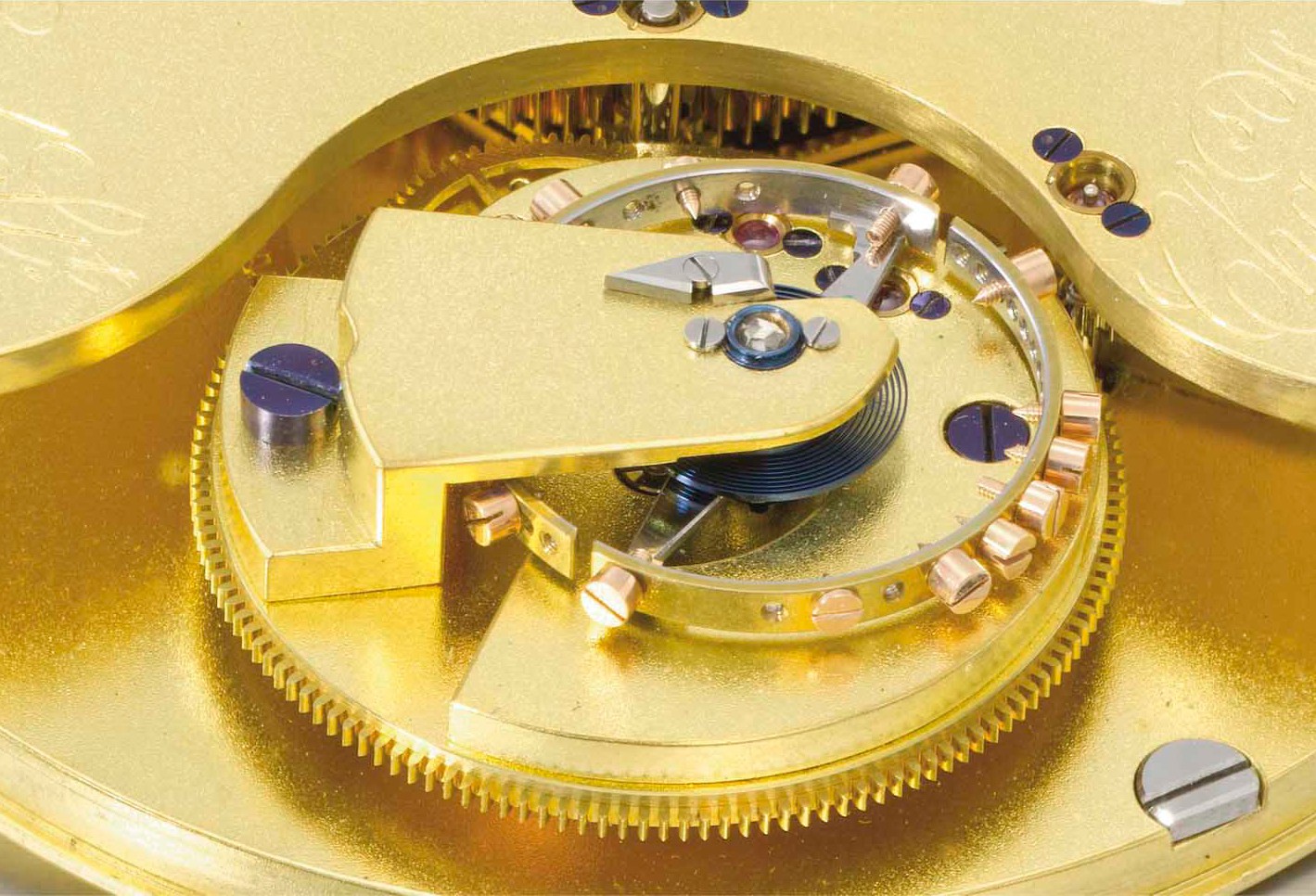
Robert Benson North's Flying tourbillon. Image credit: Christie's.
Click image to enlarge
Sketch of North's Flying tourbillon
Click image to enlarge
On 23 March 1904, Robert Benson North was granted Patent No 6,737 for ‘Improvements in Revolving Escapements for Watches and other Portable Timekeepers’. The application for the patent was lodged on 23 March 1903.
The invention was a slow-moving tourbillon which rotated in twelve minutes. In appearance, it looks somewhat like a Karrusel. However, unlike a Karrusel, the escapement is driven by the revolving carriage or platform, so this is a true tourbillon.
The photo here shows one of North's tourbillons fitted to a watch supplied by Nicole, Nielsen to Charles Frodsham & Co. The watch was auctioned by Christie's in 2011.
This watch, Frodsham number 08895, was tested twice in Class A at Kew. The first time, between 17 May and 30 June 1902, it achieved 76.6 marks. The second time was between 16 September and 30 October 1902, when it achieved 80.3 marks and was awarded a Class A Certificate endorsed ‘Especially good’.
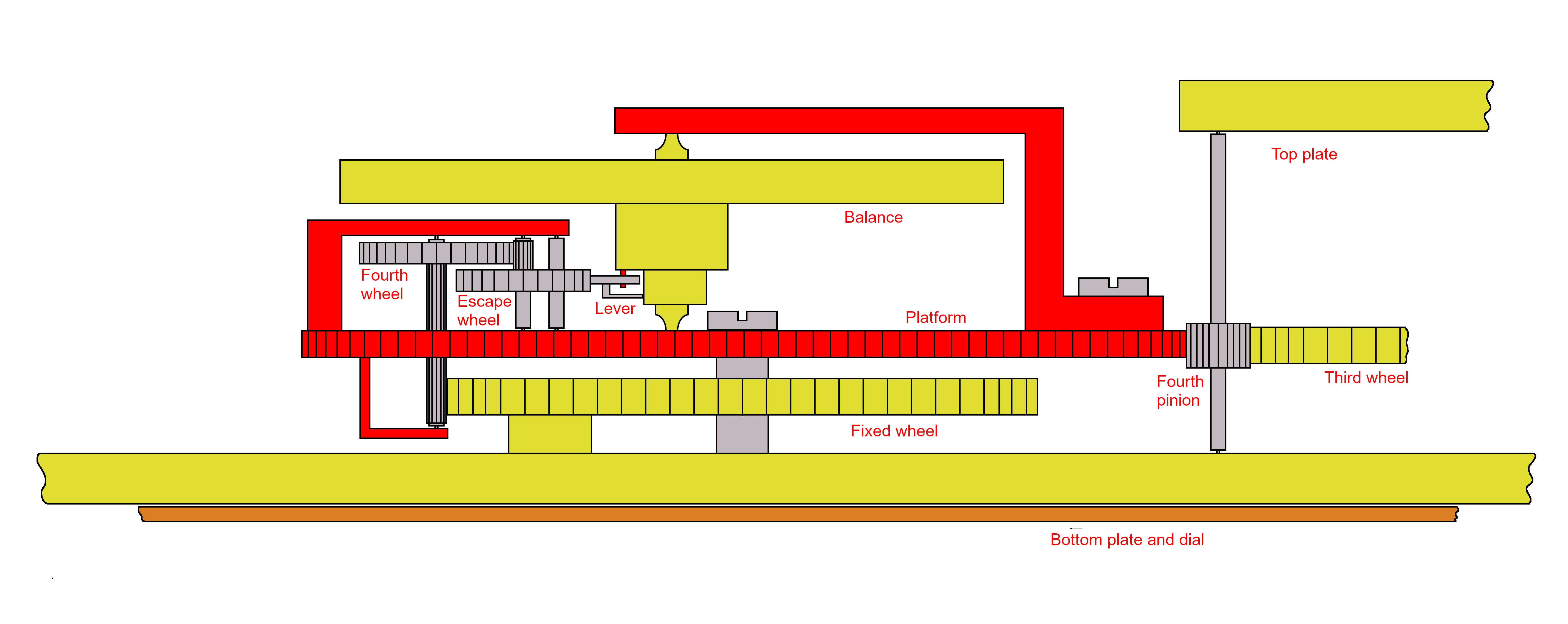
The sketch shows a cross-sectional view. The fourth wheel, escape wheel, escapement, balance cock, balance and spring are mounted on a platform, coloured red in the figure, which revolves around an arbor fixed to the pillar plate.
The platform is driven by the fourth pinion and rotates over a period of several minutes. The fourth pinion would normally be on the same arbor as the fourth wheel, but here the fourth wheel is mounted on the revolving platform.
In the photo, the fourth arbor that drives the rotating platform can just be seen, with its upper pivot carried by a jewel bearing in a chaton near to the edge of the top plate. The arbor of this pinion carries no wheel. The fourth wheel and escape wheel are on the far side of the platform underneath the balance. Their top bearing jewels are visible in the photo.
The pinion of the fourth wheel, which is not the same as the fourth pinion, is driven by rotation of the platform to roll around a wheel fixed to the plate, causing it to drive the escape wheel and escapement.
At first glance, the imposition of the fourth arbor between the third wheel and the rotating platform appears to be unnecessary. The pinion doesn't alter the relative speed of rotation of the two wheels, and it would therefore have been possible to drive the platform directly from the third wheel. However, that would cause brass onto brass contact between the third wheel and the platform, which would lead to rapid wear and was strictly avoided by watchmakers. The imposition of the steel fourth arbor between the two wheels gives the much better wearing brass onto steel contact.
There is no upper support bearing for the rotating platform, so this is a flying tourbillon. North's invention preceded the flying tourbillon invented by the German Alfred Helwig by over twenty years.
Nicole, Nielsen Tourbillons
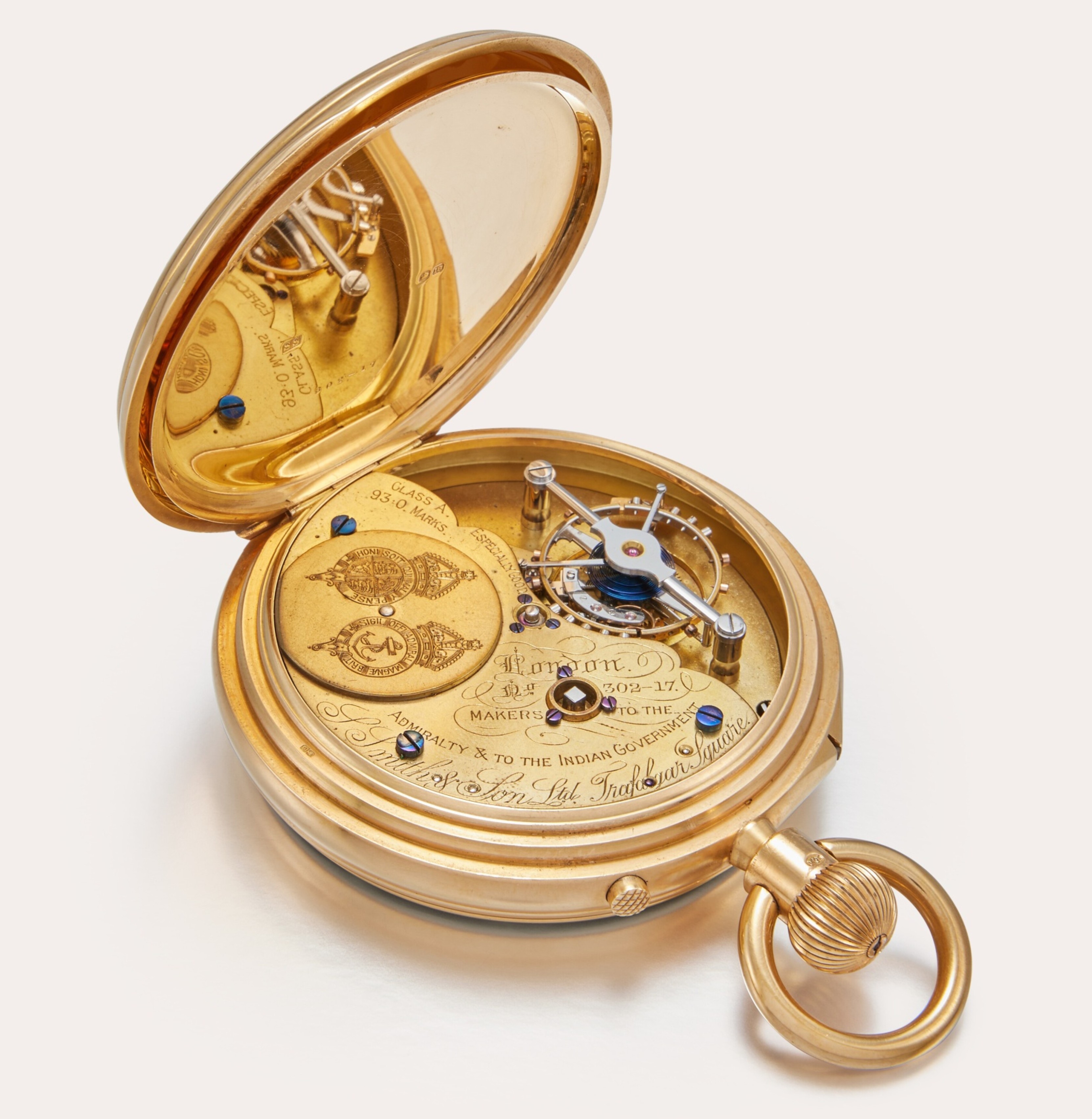
S. Smith & Son No. 302-17. Image credit: Sotheby's
Click image to enlarge
Nicole, Nielsen continued to make classic tourbillons after Robert Benson North's invention of his slower rotating flying tourbillon, which was easier to make and more robust. The classic tourbillon, with its rapidly rotating carriage, required the highest levels of skill in its manufacture, and was highly appreciated by customers who understood this.
The photo here shows the movement of an 18 carat gold open-face keyless fusee one-minute tourbillon watch with up-and-down winding indication and Guillaume balance made by Nicole, Nielsen for S. Smith & Son. The watch was sold by Sotheby's.
The watch was awarded 93 Marks ‘Especially good’ in Class ‘A’ at the 1917-1918 Kew Trials. The gold case was hallmarked in 1920 or 1921. It was common practice to submit watches for trial with temporary cases made of silver or nickel. If the watch achieved a good trial result, it was then fitted with a more appropriate case for sale, and an excellent result of 93 marks warranted a high quality gold case.
Sponsor's Marks
Adolphe Nicole entered two sponsor's mark punches at the London Assay Office, the first on 4 June 1844 and the second on 6 November the same year. The marks were his initials AN in cameo within a rectangular surround. The registered address was 80B Dean Street, Soho.
A further AN cameo punch, this one with an oval surround, was entered on 29 November 1854, the address 80B Dean Street, Soho, being amended on 13 April 1858 to 14 Soho Square, Soho. Another punch of the same description was entered on 6 May 1873.
On 6 August 1878, Charles Nicole, the son of Adolphe Nicole, and Emil Nielsen, trading as Nicole Nielsen & Company, 14 Soho Square, Soho, entered a sponsor's mark at the London Assay Office of the initials CN over EN in cameo within a rectangular surround with cut corners. A second punch of the same description was entered on 15 November 1883.
On 27 July 1885, a cameo punch with the initials EN within a rectangular surround with cut corners was entered at the London Assay Office by Emil Nielsen, 14 Soho Square, Soho. Two further punches of the same description were entered on 6 September and 4 October 1889.
On 2 July 1901, a cameo punch with the initials RN within a rectangular surround with cut corners was entered at the London Assay Office by Robert Benson North trading as Nicole, Nielsen & Company, Watch Manufacturer, 14 Soho Square, Soho. A second punch of the same description was entered on 30 October 1901.
If you have any comments or questions, please don't hesitate to get in touch via my Contact Me page.
Copyright © David Boettcher 2005 - 2026 all rights reserved. This page updated May 2026.
Back to the top of the page.