Blog: Aegler Rebberg Déposé
Copyright © David Boettcher 2005 - 2026 all rights reserved.First published: 27 January 2023, last updated 29 December 2025.
I make additions and corrections to this web site frequently, but because they are buried somewhere on one of the pages the changes are not very noticeable. I decided to create this blog to highlight new material. Here below you will find part of one of the pages that is either completely new or I have recently changed or added to significantly.
Rebberg Déposé is a term that is seen on movements which sometimes is mis-attributed. It refers to either a registered trademark (marque déposée) or a registered design (modèle déposé), both of which were registered by the Swiss watchmaking company Aegler in 1903.
Evidence suggests that these Rebberg calibres were the first movements made by Aegler with lever escapements. It appears that before 1903, Aegler made only cylinder escapement movements.
The section below about the term Rebberg Déposé is from my page about Aegler - possibly the most important watchmaker that many people have never heard of.
Only three renewals or extensions of a modèle déposé were allowed, so the 1903 registration was struck off the list of protected designs in February 1918. This prompted Aegler to register two virtually identical calibres in August of the same year.
These Aegler calibres are very familiar to anyone who collects or is interested in early Rolex wristwatches.
As always, if you have any comments or questions, please don't hesitate to get in touch via my Contact Me page.
Rebberg Déposé

Rebberg Calibres Registration 1903
Click image to enlarge

Rebberg Trademark Registration 1903
Click image to enlarge
The word Rebberg, the German word for vineyard or wine growing district of Bienne where the Aegler factory was located, was registered as a trademark by the company Witwe Jean Aegler on 21 January 1903. It was given the number 15427 in the Swiss register of trademarks.
The official notice of this registration reproduced here shows that in the German language the Aegler company was a Fabrikantin (manufacturer) of uhren and uhrenbestandteile, watches and watch components, and in French étuis, which means cases. Traditionally in Switzerland, watch cases were called boxes or boîtes, but around 1900 the term cases or étuis began to supersede the older term. This appears to have coincided with the introduction of wristwatches.
A term that is often seen on Aegler movements is Rebberg Déposé. In Swiss/French, déposé means to file, lodge or deposit. In this context it refers to either a registered trademark (marque déposée) or a registered design (modèle déposé).
The second official record shown here records that on 25 January 1903, the company Witwe Jean Aegler registered two designs of calibres for pocket watches (Taschenuhren), Lépine and savonnette versions Nr 1 and Nr 2 respectively. This registration was given the number 9284 in the Swiss register of designs. Gottfried Furrer was the vertreter or representative who handled the registration process.
The term Rebberg Déposé is seen on Aegler movements, which refers to the two registered designs, which in consequence are usually referred to as Aegler Rebberg calibres.
Aegler Lever Movements
Aegler advert June 1904 new lever calibres
Click image to enlarge
The Rebberg calibres registered in 1903 are lever escapement movements. The top bearing for the escape wheel is planted in the central bridge alongside the bearings for the centre, third and fourth wheels. This can be compared to the Calibre Special cylinder escapement movement, where the top bearing for the escape wheel is beneath the balance. In the drawings of the Rebberg calibres, the cock for the upper bearing of the lever staff is visible beneath the escape wheel.
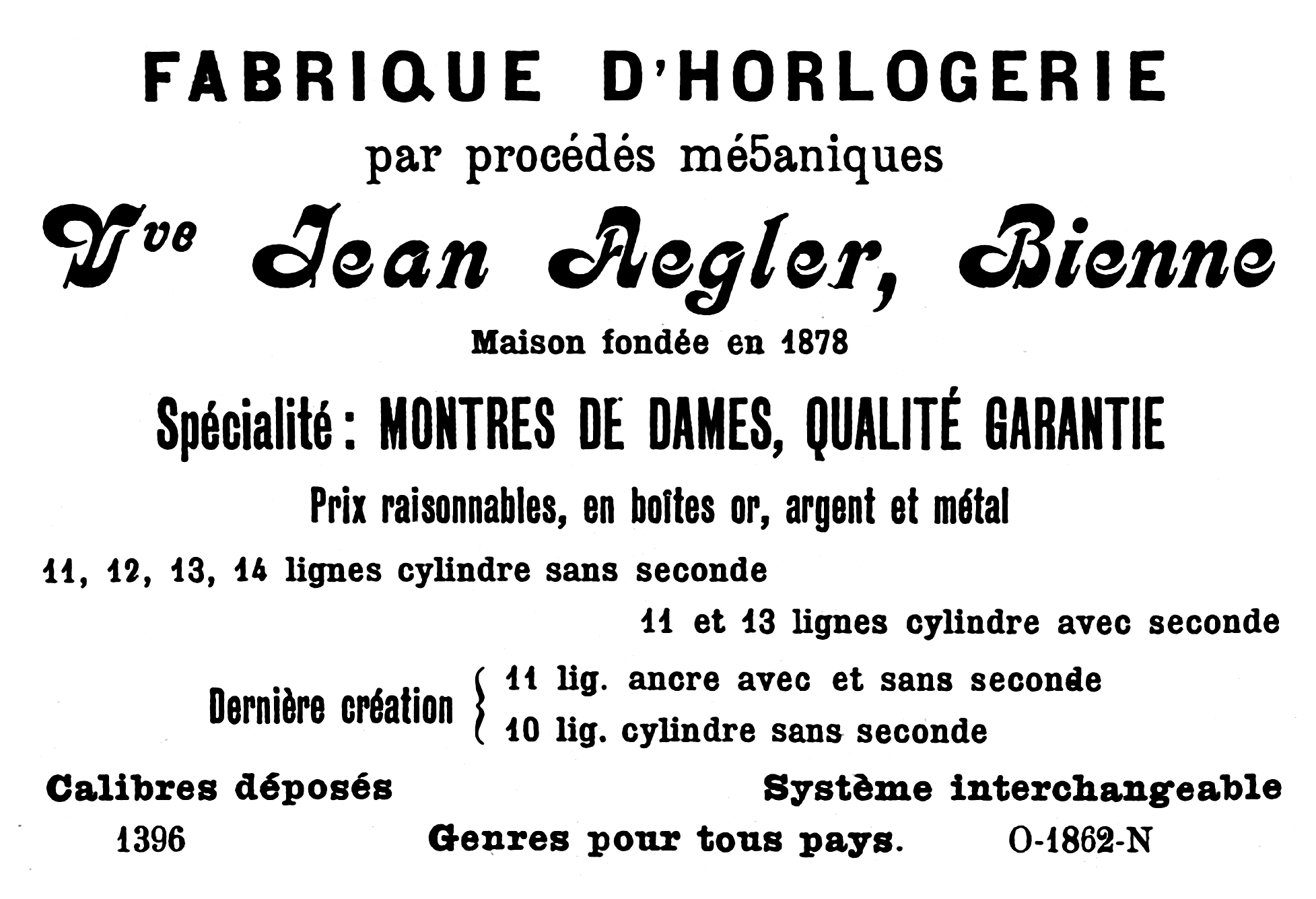
The Rebberg calibres registered in 1903 appear to be the first lever escapement movements made by Aegler. The Aegler advert from June 1904 contains some very interesting information, so it is worth going over the wording in detail.
WATCHMAKING FACTORY
by mechanical processes
Vve. Jean Aegler, Bienne
Founded in 1878
Speciality: LADIES' WATCHES, QUALITY GUARANTEED
Reasonable prices, in gold, silver, and metal cases
11, 12, 13, 14 ligne cylinder without seconds
11 and 13 ligne cylinder with seconds
Latest creation: { 11 ligne lever with and without seconds
{ 10 ligne cylinder without seconds
Registered calibres. Interchangeable system.
Styles for all countries.
The most interesting statement concerns the company's ‘latest creations’. The 10-ligne (~22.6 mm) cylinder movement is 2.2 mm smaller than the smallest 11-ligne (~24.8) movement made previously. However, the inclusion of 11-ligne lever calibres as the company's latest creations implies that before 1903, when the Rebberg lever escapement calibres were registered, Aegler made only cylinder escapement movements.
No mention of Aegler making lever escapement movements before 1903 has been found in any contemporary advertisement or record.
In the Rolex Jubilee Vade Mecum, Wilsdorf writes,
In 1902, during my stay in La Chaux-de-Fonds, I heard that Hermann Aegler of Bienne had started the regular and mechanised manufacture of ébauches (or rough movements) for a small lever escapement movement.
Taking all these factors into account, it appears that before 1902, Aegler made only cylinder escapement movements. Wilsdorf's evidence shows that Aegler started to manufacture small lever escapement movements in 1902. Designs of Lépine and savonnette lever escapement movements, and the trademark Rebberg, were registered by Aegler in January 1903. An advertisement by Aegler in 1904 describes 11-ligne lever escapement movements as the company's ‘latest creations’.
By 1913,
Renewal of Rebberg Calibres registration

Aegler Calibres registered August 1918: Click image to enlarge
A Swiss modèle déposé or registered design had a term of five years, after which it could be renewed or it would be automatically struck off the list. The registration of modèle déposé 9284 was renewed for the first time in 1905. In July 1906, the registration was transferred to the newly reconstituted company Les Fils de Jean Aegler Fabrique Rebberg. The registration was renewed for a second time in 1908 and for a third time in 1913. Only three renewals or extensions were allowed by Swiss law, so modèle déposé 9284 was struck off the list of protected designs in February 1918.
The striking off of modèle déposé 9284 in February 1918 prompted Aegler to register two virtually identical calibres in August of the same year. These are shown in the figure from the registration reproduced here. Rather strangely, the train bridges and balance cock are shown blank, without the bearing holes for the train wheels and balance.
Aegler became a Société Anonyme (S. A.), a French term for a public limited company or Aktiengesellschaft (AG), in 1913, and here the trading name is given as Aegler S. A. Rolex Watch Co., showing how important Rolex had become as a customer, although Gruen was an equally important customer and Aegler was also supplying many other établisseurs with movements. In the engravings, the name ROLEX can be made out on the ratchet wheels of the two calibres.
If you have any comments or questions, please don't hesitate to get in touch via my Contact Me page.
Copyright © David Boettcher 2005 - 2026 all rights reserved. This page updated December 2025.
Back to the top of the page.