Blog: Platnauer Brothers
Copyright © David Boettcher 2005 - 2026 all rights reserved.First published: 21 April 2025, last updated 06 June 2026.
I make additions and corrections to this web site frequently but, because they are buried somewhere on one of the pages, the changes are not very noticeable. I decided to create this blog to highlight new material.
Note that these articles also get updated, especially soon after they are posted when additional information may be added. Check the “last updated” date to see when the article was last updated.
One reason for interest in Platnauer Brothers is Louis Platnauer stated his company was the first to have Swiss watch cases hallmarked in England. This is a significant historical claim because the practice was thought to have begun around 1874, based on testimony from Sir Walter Prideaux, Clerk to the Goldsmiths’ Company, to a Select Committee in 1878.
The Swiss made watch with the Platnauer Brothers’ sponsor’s mark and Birmingham Assay Office hallmarks for 1871 to 1872 is physical evidence that pushes this back by several years, and there seems no reason to doubt Platnauer’s claim of being the pioneer in this practice.
Note that a sponsor’s mark does not show who made an item. Although the sponsor’s mark is sometimes called a maker’s mark, or even a case maker’s mark, this is wrong, because the person who registered the mark may have had no role whatsoever in making an item carrying their registered mark. The sponsor's mark identifies a person or company registered with an assay office so that items can be submitted for hallmarking under their responsibility.
NB: The first issue of this post omitted to state that the watch and its case were made in Switzerland.
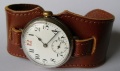
Another interesting factor is that in 1888, Louis Platnauer was wearing a wristlet watch. The wearing of wristwatches by men began in the mid-1880s by British officers on the north-west frontier of India and quickly spread throughout the army. Wristwatches were soon adopted by ladies, who had no objection to wearing a bracelet, and by motorists and balloonists, but this is an early account of a civilian man wearing a wristwatch.
As always, if you have any comments or questions, please don't hesitate to get in touch via my Contact Me page.
P·B·B: Platnauer Brothers
Letter from Louis Platnauer, February 1878: Click image to enlarge
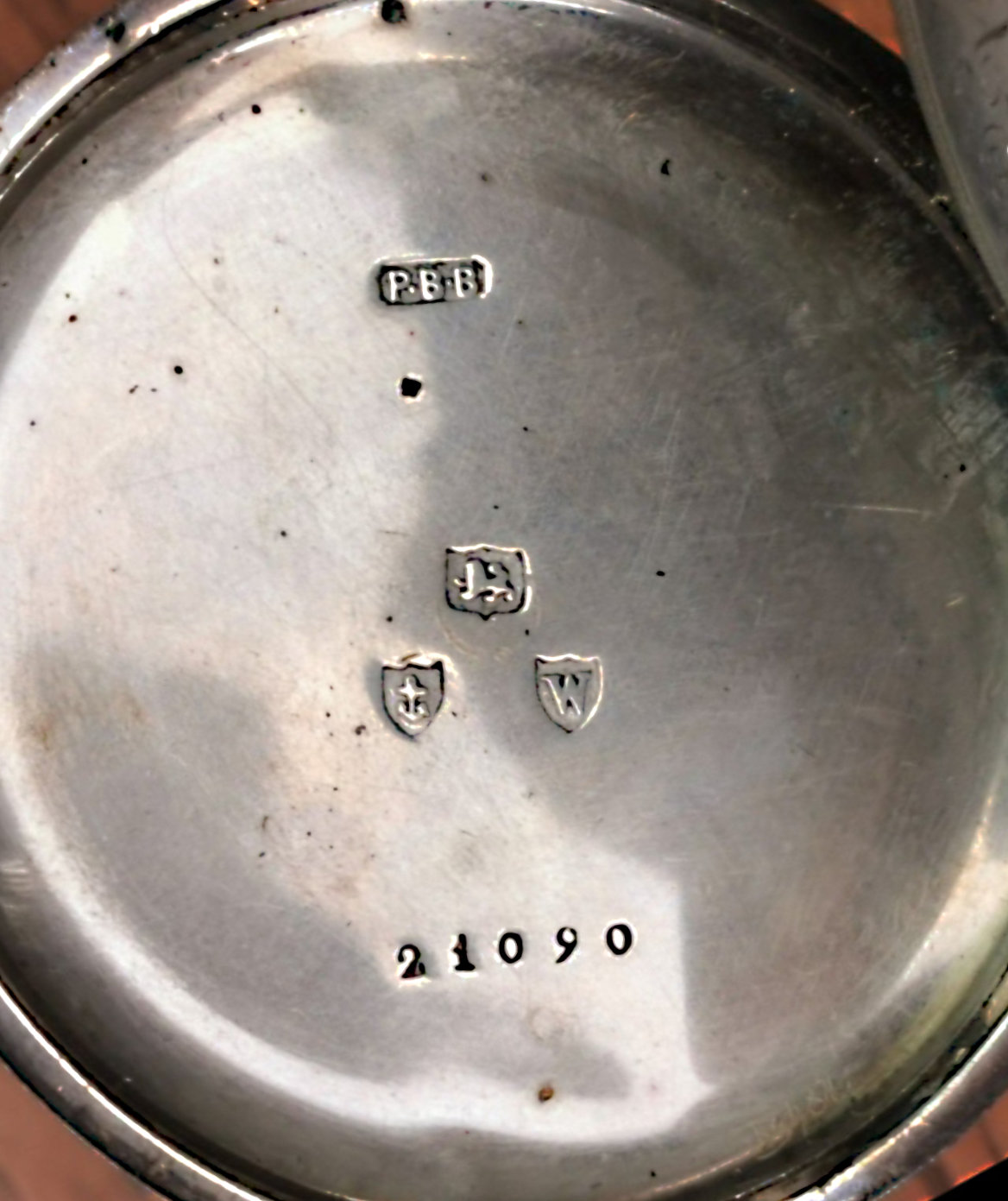
P·B·B: Platnauer Brothers. Birmingham hallmark for July 1871 to June 1872.: Click image to enlarge
The photo shows a silver case with a Birmingham Assay Office hallmark and the sponsor's mark of Platnauer Brothers. The date letter is the ‘W’ of the Birmingham hallmarking year from July 1871 to June 1872.
The watch is Swiss, with a cylinder escapement movement. The case was made in Switzerland and sent to England to be hallmarked. The 1871 or 1872 hallmark is the earliest known British hallmark on a Swiss watch case.
It was not only legal, it was required by British law, but most Swiss gold and silver watch cases from the period are not hallmarked. In the 1870s, a trend of increasing numbers of Swiss watch cases being hallmarked began, but the hallmark in this case for 1871 or 1872 is earlier than the practice is generally have believed to have started. However, hallmarks don't lie, so this watch is evidence that Swiss watch cases were being hallmarked in England earlier than previously thought.
Philip Priestley records that the sponsor’s mark P·B·B in cameo within a rectangular surround with cut corners was entered at the Birmingham Assay Office in 1877 by the Platnauer Brothers. However, the Birmingham hallmark for July 1871 to June 1872 shows that the sponsor’s mark was entered at an earlier date, certainly in or before 1872.
Craig O’Donnell, the curator at the Birmingham Assay Office, checked the records and stated that the Platnauer Brothers registered the mark on 20 November 1867.
The Platnauer family were originally from Prussia. The family emigrated in the early nineteenth century, probably due to antisemitism. There is a story that they went to study jewellery, watch and clock-making in La Chaux-de-Fonds, Switzerland, but no substantive evidence for this has been found. The family arrived in England around 1838. The father, Joseph, set up a wholesale watch and clock business in Bristol. In 1851, J & S. Platnauer, Clock and Case Manufacturers, Watchmakers and Importers of French and Americap Clocks, 11, Bath Street, Bristol, published an advertisement thanking their customers for nine years support, suggesting the business was established in 1842.
Four of Joseph’s sons; Michael Joseph, Samuel, George and Louis, subsequently took over the business. They established a branch in Birmingham as watch manufacturers and importers with addresses at 1 St. Paul’s Square, Hagley Road and Ludgate Hill.
In May 1878, Mr. Louis Platnauer, St. Paul’s Square, Birmingham, was elected a member of the British Horological Institute.
George Platnauer retired from the business on 31 December 1890. A notice in February 1891 recorded that ‘Mr G. Platnauer has relinquished his partnership in the business of Platnauer Brothers, of St. Paul's Square and Ludgate Hill, Birmingham, and also of Bristol and Chaux de Fonds, Switzerland, jewellers and watch and clock manufacturers.’ Platnauer Brothers’ address in Switzerland was given as Rue des Arts, La Chaux de Fonds.
In 1893, Samuel and Louis Platnauer suffered a cash flow problem and were obliged to come to an arrangement with their creditors. Considerable sympathy was expressed by the Birmingham trade. The assets of the business exceeded the debts and a payment schedule extending over 36 months was agreed, giving creditors full payment of money owed. This was evidently successful, because in 1894, Platnauer Brothers were listed at 10 Victoria Street, Bristol as Wholesale jewellers and manufacturers and importers of watches and clocks, with branches in Birmingham and Paris.
English Hallmarking of Swiss Watch Cases
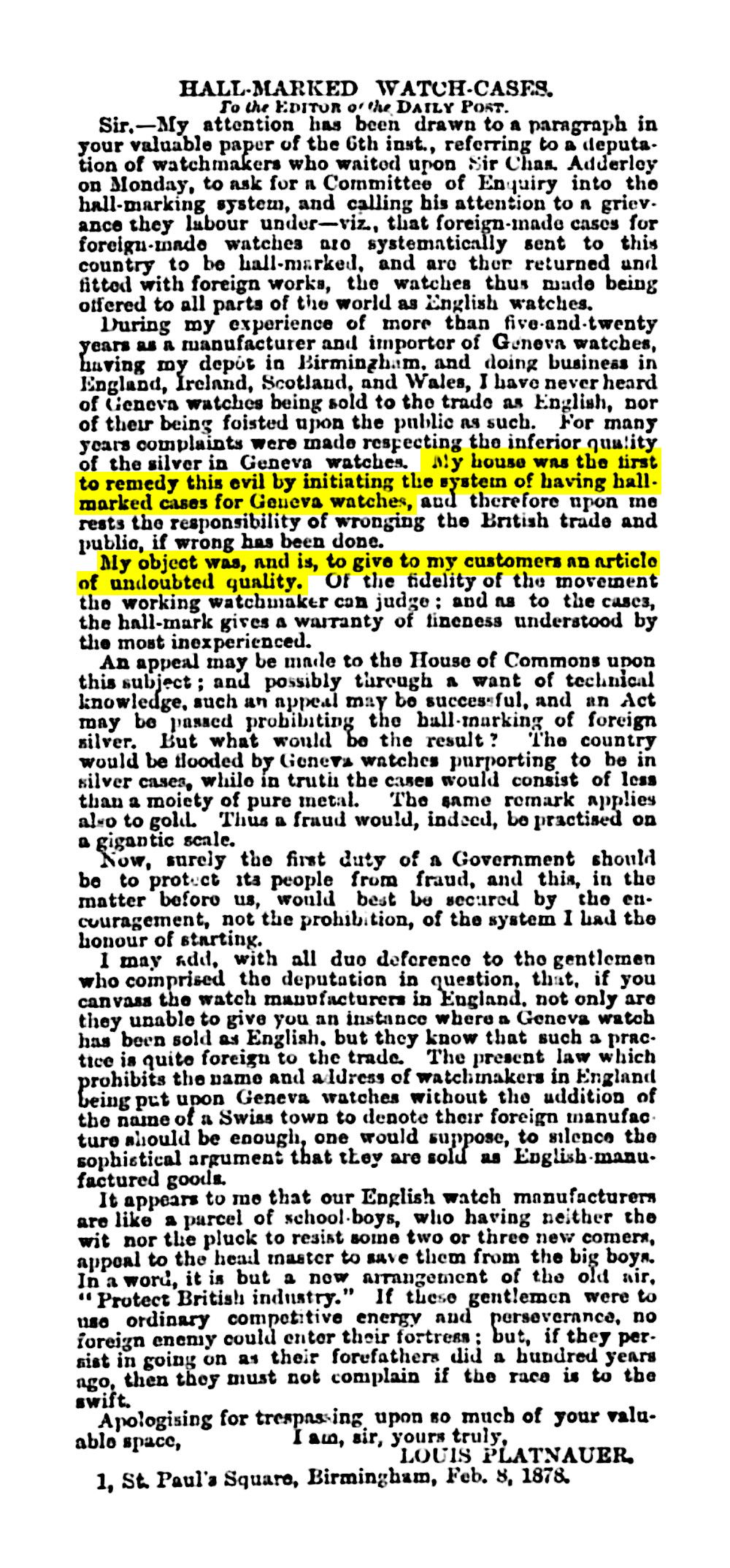
In February 1878, Louis Platnauer wrote the letter to the Birmingham Daily Post reproduced here. In it, he makes some interesting and valid points.
A deputation of some English watchmakers had visited Sir Charles Adderley to complain about foreign made watch cases receiving English hallmarks. They stated that foreign made watches with hallmarked cases were then sold as English made. The essence of their demand was that only English made watch cases should receive English hallmarks.
In his letter, Platnauer says that in twenty five years in the trade, he had never encountered an instance of Swiss watches, which he refers to as ‘Geneva watches’, being passed off as English on the basis of their cases bearing English hallmarks. However, it is possible that in trying to close a sale, a retailer might point to the English hallmark and not mention the Swiss origin. It is not nice, but who can say it didn't happen.
Platnauer states that his company was the first to have Swiss watch cases hallmarked in England. This is a significant historical claim, as until now the practice was thought to have begun around 1874, based on testimony from Sir Walter Prideaux, Clerk to the Goldsmiths' Company, to a Select Committee in 1878. The watch with the Platnauer Brothers' sponsor’s mark and Birmingham Assay Office hallmarks for 1871 to 1872 is physical evidence that pushes this back by several years, and there seems no reason to doubt Platnauer’s claim of being the pioneer in this practice.
The Birmingham Assay Office informed me that Platnauer Brothers registered the sponsor's mark used in the watch case on 20 November 1867. This doesn't mean that It was necessarily used from 1867 for the hallmarking of watch cases. Platnauer Brothers were retailers of other items of silverware and this sponsor's mark could have been used on any item submitted for hallmarking. However, to date it has only been seen on a watch case.
Platnauer says his company began having Swiss watch cases hallmarked because complaints had previously been made about the quality their silver. This was a valid complaint; at the time, Swiss watch cases were usually marked ‘Fine Silver’, which means 90% fine silver. This is below the British minimum legal fineness of sterling silver denoted by the lion passant, which is 92.5% fine silver.
Platnauer stated that by having watch cases hallmarked, his objective was to give his customers watches where the quality of the silver could not be doubted. The quality of the movement could be established by examination, but this is not the same for the fineness of the gold or silver of the case. This is exactly the purpose of hallmarks, to give a warranty of the fineness of the material that was easily understood.
Platnauer then points out that the real problem was that Swiss made watches were freely imported and sold with cases of inferior fineness that could not be hallmarked, which was illegal although nothing was done about it. He points out that to protect the public, the practice that he started of having cases hallmarked should be encouraged rather then prohibited. If a law was passed that prevented foreign made watch cases from being hallmarked, it would open the floodgates to watches with cases of greatly inferior fineness. However, it was clear that English watchmakers were only concerned to deny hallmarking of foreign made watch cases as a protectionist measure.
The Platnauer Brothers business was well regarded by other English businesses. Louis Platnauer’s letter demonstrates his focus on consumer protection through proper hallmarking practices, which stood in contrast to some English watchmakers who appeared more motivated by protectionist interests in their opposition to hallmarking foreign-made watch cases. However, these watchmakers certainly did not represent all the members of the English watch trade.
Early Wristwatches
In the week before Christmas 1888, J. W. Robertson-Scott, the Midlands correspondent for The Watchmaker, Jeweller And Silversmith, had a conversation with Louis Platnauer, who he described as the ‘Consul in Birmingham for Portugal.’
Louis Platnauer told Robertson-Scott that keyless watches were making considerable progress in popularity, to the detriment of key winders, which Robertson-Scott found surprising. A problem with keyless pocket watches is that the presence of the stem prevents the bow being attached by a screw passing through the pendant. If the bow is simply sprung onto the pendant, it not as secure and a wrench can pull it off, rendering the watch liable to being snatched or dropped. Platnauer had been granted a patent in France, Switzerland, America (14 January 1890; No. 419552) and Britain (16 November 1888; No. 16626) for an invention to better secure the bows of keyless watches. The principle of the invention was a steel sleeve with two slots inserted into the pendant where the slots engaged grooves on the ends of the bow. The Swiss patent was published in January 1889 with the number CH166. Swiss patent law became effective only in November 1888.
Robertson-Scott went on to say,
I was somewhat surprised to see on Mr. Platnauer’s wrist one of those wristlet watches. On indicating as much, its wearer waxed quite eloquent on their manifold advantages to gentlemen in wintry weather. In summer men may wear their watches in their pockets if they choose, but surely in winter time it is a convenience to be able to tell the hour of day or night by lifting one’s hand, instead of having to unbutton and re-button a couple of coats in the face of rain or snow. The Consul for Portugal, in the city of Birmingham, has this idea anyhow, and doubtless many other men-folk will soon be thinking with him.
It is quite evident that among ladies these watch wristlets, whether in the form of leather, silver, or gold bracelets, are having a good sale just now. As an ornament, ladies can, of course, wear them upon all occasions at any time of the year, but for shopping expeditions they are of particular service.
For both ladies and gentlemen the wristlets have another no small merit, Pickpockets would find watch-snatching almost an impossibility, were the practice of pocket-carrying of timepieces generally superseded by the use of the wristlet watch-holders.
I understand that military officers find these wristlet watches a great convenience upon the parade ground.
Already the wristlet watches have been largely gone in for on the Continent, where they are now seen quite frequently. It is, too, some time since the wristlets made their appearance at Brighton and such places.
It is interesting that in 1888, Louis Platnauer was wearing a wristlet watch.
The wearing of wristwatches by men began in the mid-1880s by British officers on the north-west frontier of India and quickly spread throughout the army. This is underscored by the remark that military officers were wearing wristlet watches on the parade ground. For Robertson-Scott to have heard about it, these must have been parade grounds in England.
Wristwatches were quickly taken up by ladies, who had no objection to wearing a bracelet at any time, and by motorists and balloonists, but not generally by civilian men. This is an early account of a civilian man wearing a wristwatch.
If you have any comments or questions, please don't hesitate to get in touch via my Contact Me page.
Copyright © David Boettcher 2005 - 2026 all rights reserved. This page updated June 2026.
Back to the top of the page.