Blog: Paul Perret Balance Springs
Copyright © David Boettcher 2005 - 2026 all rights reserved.First published: 11 July 2024, last updated 21 October 2025.
Paul Perret discovered the unusual thermoelastic properties of nickel steels in 1897 and invented the temperature compensating balance spring.
I make additions and corrections to this web site frequently but, because they are buried somewhere on one of the pages, the changes are not very noticeable. I decided to create this blog to highlight new material.
The article in this blog is from a series explaining how temperature compensation is achieved in modern watches without bimetallic compensation balances. This is achieved by using an unusual property of nickel steel alloys to make balance springs that, unlike steel springs, get stiffer as their temperature increases.
The breakthrough occurred in 1897, with the invention by Paul Perret and Dr Guillaume of the first nickel steel compensating balance springs. The development of nickel steel balance springs began with these first Paul Perret balance springs, leading to Elinvar, and ultimately to Nivarox in the 1930s.
Six articles in this series are currently planned;
- The Discovery of Invar,
- Paul Perret Balance Springs,
- Dr Guillaume Spirals,
- Elinvar balance springs,
- Variable Rate Balances and
- Nivarox balance springs.
The highlighted links will jump straight to the ones that have been published.
The articles are from the page about Temperature Compensation by Nickel Steels.
As always, if you have any comments or questions, please don't hesitate to get in touch via my Contact Me page.
Paul Perret Balance Springs

Paul Perret nickel steel balance spring and monometallic balance in a watch made by H. Williamson of Coventry circa 1910: Click image to enlarge
A watch’s rate is determined by the frequency of oscillation of its balance, which is principally determined by the rotational inertia of the balance and the stiffness of the balance spring. The effects of changes in temperature on the balance and spring were a problem for early watchmakers working with steel balance springs. As temperature rises, thermal expansion of the balance increases its rotational inertia, slowing the watch. The balance spring also expands. Increases in the length and height of the spring nullify each other, but the increase in thickness makes it stiffer which would cause a gain. But the most significant effect is that the spring’s modulus of elasticity reduces, lessening its stiffness, which also slows the rate.
A watch with a steel balance spring and plain brass balance loses about 11 seconds per day for each degree Celsius temperature rise. The magnitudes of the effects of temperature are quite different. Expansion of the balance and spring oppose and almost cancel each other; it is the reduction in the elastic modulus of the balance spring that is most significant.
John Harrison's invention of the bimetallic strip enabled the effects of temperature to be compensated. This ultimately resulting in the invention of the compensation balance. Compensation balances were expensive to make and adjust and delicate to handle, but remained the only way to compensate for changes in stiffness of a balance spring as a result of changes of temperature until the late nineteenth century.
In the 1890s, Dr Charles Édouard Guillaume worked at the International Bureau of Weights and Measures in Sevres, a suburb of Paris. A length standard made of nickel steel sent to the bureau by the artillery section of the French army for calibration was found to have a rate of thermal expansion significantly different from that predicted by the rule of mixtures from its proportions of iron and nickel, which attracted Guillaume’s attention. Other samples of nickel steel subsequently sent to the bureau were also found to have unexpected thermal expansion rates. Following these observations, Guillaume made a systematic study of the rates of thermal expansions of a wide range of nickel steel alloys with the assistance of the Société de Commentry-Fourchambault & Decazeville, the steelworks at Imphy in Burgundy that made the nickel steel alloys. One result of this investigation was the discovery of Invar, a nickel steel alloy with 36% nickel and a very low thermal expansion rate.
After presenting his findings to the French Academy of Science in the spring of 1897, Guillaume received a letter from Paul Perret, a watch springer and timer in La Chaux-de-Fonds, requesting a sample of Invar. Guillaume, having a spare piece of Invar wire, obliged. Two weeks later, Perret wrote again, requesting samples of all the other nickel steel alloys that Guillaume had studied. However, this time, Guillaume refused. A few days later, Perret arrived unexpectedly at Guillaume’s office in Sevres. Guillaume recounted their meeting:
Paul Perret said, ‘With the Invar specimen you sent me, I made balance springs and found results that astonished me.’
I said – I know.
Paul Perret (no doubt surprised by this reply) asked – How do you know?
I said – If you had not found extraordinary results, you would not be here in Sèvres.
Paul Perret replied – That’s true!
It’s not difficult to imagine an outbreak of mutual smiles or laughter.
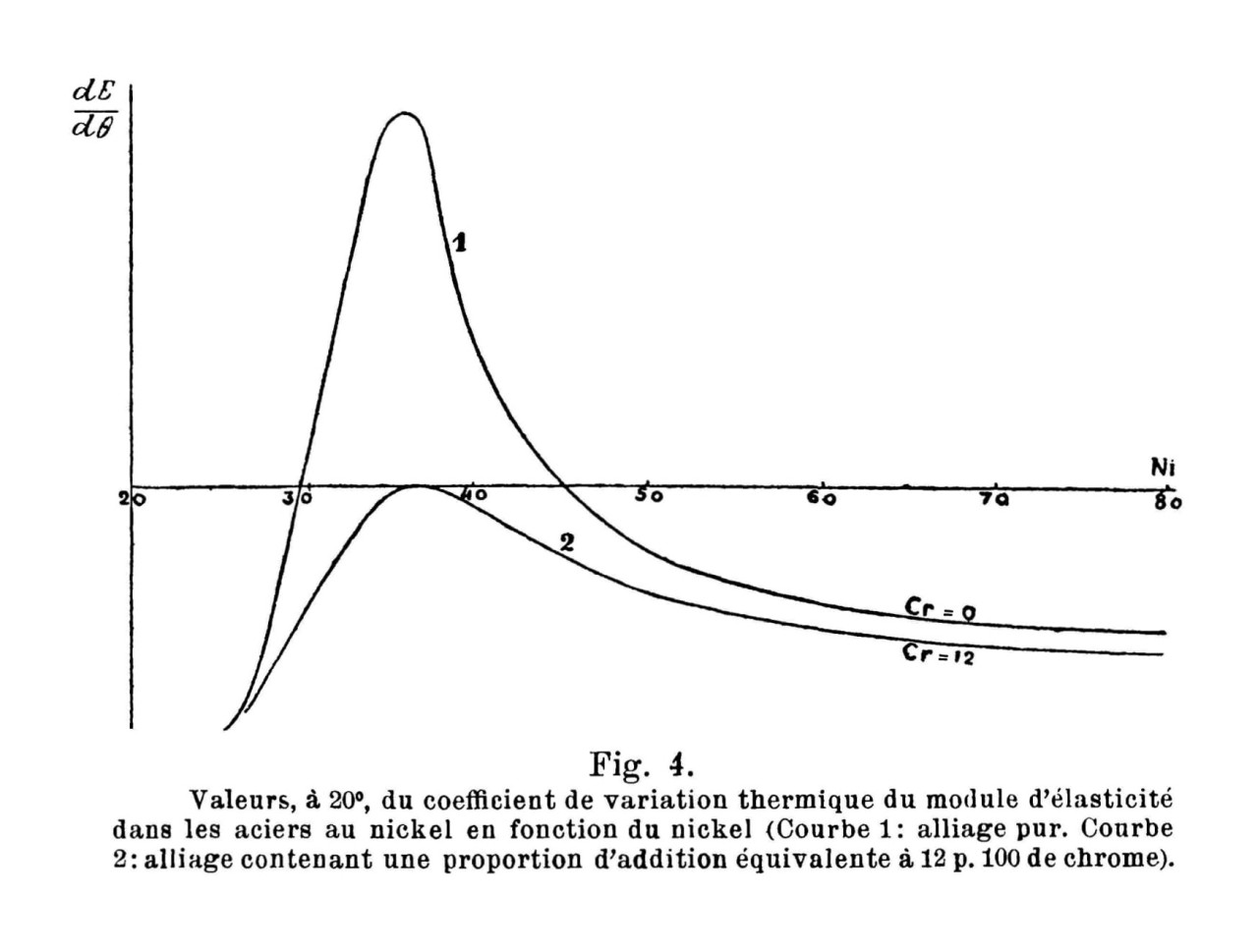
Figure 1 Thermoelastic variations of nickel steels: Click image to enlarge
Paul Perret had discovered that a watch fitted with a balance spring made from Invar gained significantly when its temperature increased, precisely the opposite of a watch with a steel balance spring.
A watch with a steel balance spring and plain brass balance loses about 11 seconds per day for each degree Celsius increase in temperature. The watch that Perret fitted with an Invar balance spring gained 18 seconds per day for each degree Celsius. This was so astonishing that Perret told Guillaume he thought he might have gone mad!
This discovery revealed that Invar has a positive thermoelastic effect, which means that its modulus of elasticity increases as it is heated. This is extremely unusual. Since the discovery of Invar, positive thermoelastic effects have been observed in a few materials, but the effect is uncommon; almost every metal alloy becomes less stiff when heated. A cantilever beam made of steel with a weight suspended from its free end bends further when heated, lowering the weight. A similar beam made of Invar straightens when heated, raising the weight.
Knowing that a watch with a steel balance spring loses about 11 seconds per day per degree and having discovered that a watch with an Invar spring gains about 18 seconds per day per degree, Perret reasoned that somewhere between steel and Invar, there should be a nickel steel alloy that would cause no variation in rate with temperature changes.
He explained this to Guillaume, and they agreed to collaborate. At the time, the best way to determine the thermoelastic effect of an alloy was to make it into a balance spring, fit this to a watch and record the rate at different temperatures, from which the thermoelastic coefficient of the spring material can be calculated. Perret and Guillaume worked together in the summer of 1897 to measure the thermoelastic effects of different nickel steel alloys in this way.
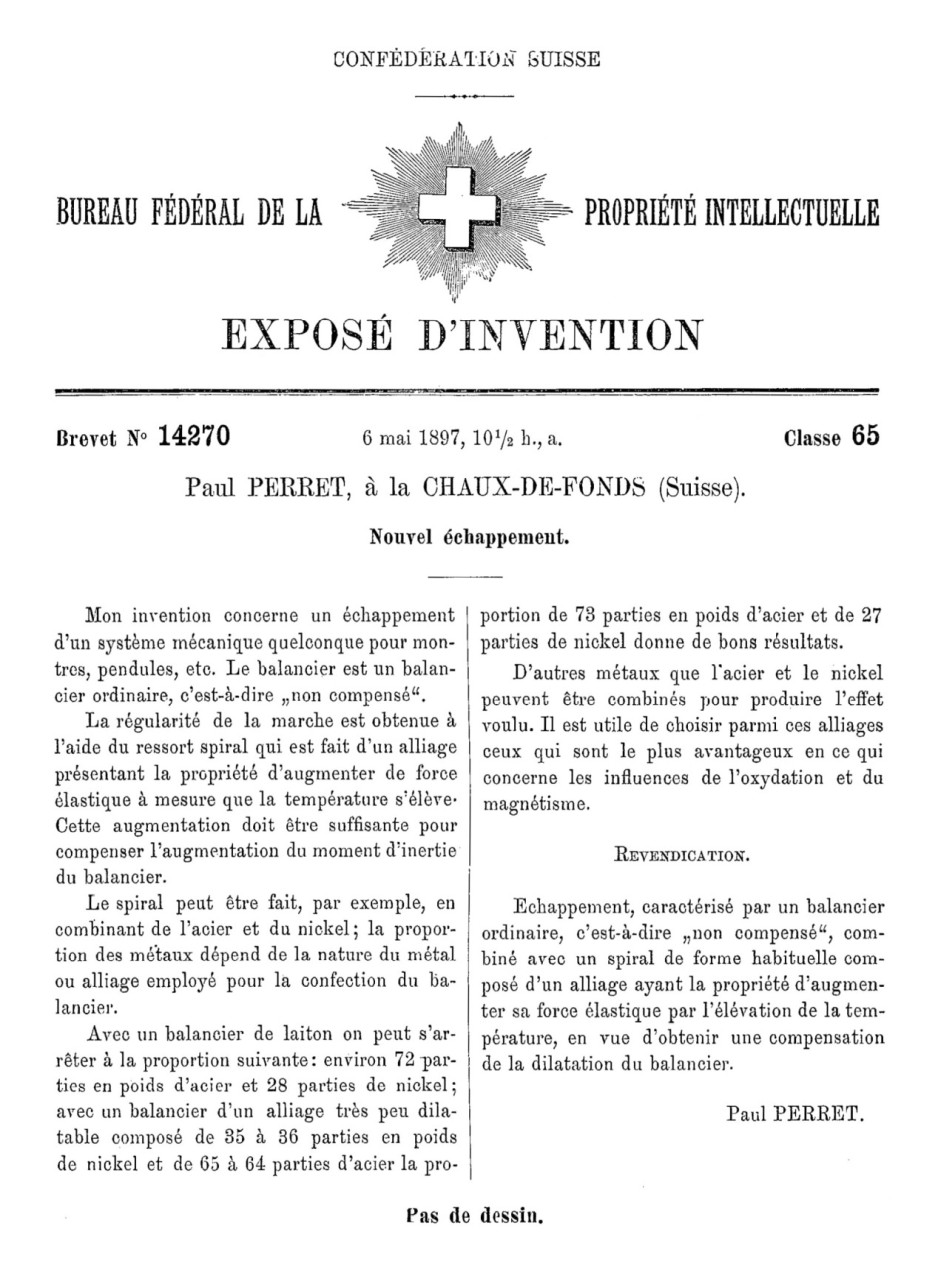
Figure 2 Paul Perret patent CH14270 for nickel steel balance springs: Click image to enlarge
The results are plotted as curve 1 in the figure reproduced here. This shows the thermoelastic coefficients on the y-axis plotted against increasing nickel concentrations on the x-axis. Curve 1 peaks in the positive region at around 36% nickel, corresponding to Invar, which caused the result that astonished Perret. It crosses the zero x-axis between 27% and 28% nickel and between 43% and 44% nickel. At these two points, the thermoelastic coefficient is zero and the elastic modulus of the alloy does not vary with temperature changes, another very unusual property.
On 6 May 1897, Perret applied for a Swiss patent on his idea, which was granted Swiss patent number 14270 on 15 January 1898, Figure 2. It only remained to put the idea into practice.
Guillaume subsequently recorded that on 20 August 1897, in Perret’s workshop in La Chaux-de-Fonds, he witnessed a watch with a plain, that is not compensated, balance and a nickel steel balance spring that ran at the same rate at temperatures of zero and 30 degrees Celsius. An uncompensated watch with a steel balance spring would run 330 seconds, or five and a half minutes, slower, so this was a significant breakthrough.
Invariable Elasticity?
It should be noted that the balance spring of the watch witnessed by Guillaume in Perret’s workshop did not have invariable elasticity; that is, it did not have an invariable modulus of elasticity.
The elasticity of a material is quantified by its modulus of elasticity or Young's modulus. This is defined as the ratio of stress to strain within the elastic region. Unfortunately, this definition means that a greater modulus of elasticity means that more stress must be applied to create a certain amount of strain, that is, a material with a greater modulus of elasticity is stiffer and less elastic than one with a lower modulus, which is in the opposite sense to what is meant by elastic.
A more elastic material is easier to stretch than one that is less elastic, and therefore has a lower modulus of elasticity. It would have been better and more logical if the modulus of elasticity was defined more normally as the ratio of the dependent variable strain to the independent variable stress, but it isn't and we are stuck with it.
It is sometimes thought that combining a balance spring of invariable elasticity, that is one having an invariable modulus of elasticity, and a balance with low thermal expansion would form an oscillator unaffected by changes in temperature, but that is not the case. It doesn't work because the stiffness of a spring is not determined solely by the modulus of elasticity of the material.
The modulus of elasticity of a material is a property that is independent of dimensions. A specific spring's stiffness depends on its elastic modulus and dimensions. A thicker spring is stiffer than a thinner one, even if their elastic moduli are exactly the same.
The stiffness of a flat spring such as a balance spring is proportional to the cube of its thickness, a factor that arises from the geometry of the spring's cross-section. This makes the spring's stiffness highly sensitive to changes in its thickness.
There are no materials with invariable elasticity and zero thermal expansion. This is why a material with invariable elasticity does not make a spring of invariable stiffness; thermal expansion due to increasing temperature makes the spring thicker, and therefore stiffer, even if its modulus of elasticity does not alter.
Guillaume summarised the problem and its solution very succinctly:
‘In practice, what one should look for is not an alloy whose thermoelastic coefficient is strictly zero, but an alloy such that the thermal expansion of the balance and the spring, and the thermoelastic variations of the latter, give a zero sum.’
This idea can be expressed algebraically, starting from the basic equation for the period of semi-oscillation of a balance from its moment of inertia \(I\) and the spring constant \(S\).
\[ T = \pi \sqrt{\frac{I}{S}} \]To make a balance spring oscillator whose frequency of oscillation is not affected by changes in temperature, the period must remain constant. When the thermal expansion of the balance and spring, and the variations in the elastic modulus of the spring, are included in the model, it is found that the materials of the balance and spring have to fulfil the following relationship,
\[ 2 \, \alpha_{\, balance} - 3 \, \alpha_{\, spring} - \gamma_{\, spring} = 0 \]where \( \alpha_{\, balance} \) is the thermal expansion of the balance, \( \alpha_{\, spring} \) is the thermal expansion of the spring and \( \gamma_{\, spring} \) is the thermoelasticity of the spring.
Creation of a temperature independent oscillator is then simply a matter of finding materials for the balance and spring that fulfil this condition.
Perret’s patent described two possible embodiments of the idea. The first features a balance spring made from an alloy of 28% nickel and 72% steel with a brass balance. The second uses a balance spring of 27% nickel and 73% steel with a balance made of an alloy of 35% to 36% nickel with very low expansion, that is an Invar balance.
In both cases, the balances are monometallic, made of a single metal, and uncut, not compensation balances. The only active thing they do is expand and contract with changes in temperature. The balance spring's combination of thermoelasticity and thermal expansion causes it to become sufficiently stiffer with increasing temperature to compensate for the balance's thermal expansion. To achieve this, the two nickel steel alloys Perret defined fall on either side of the point of zero thermoelastic effect between 27% and 28% nickel.
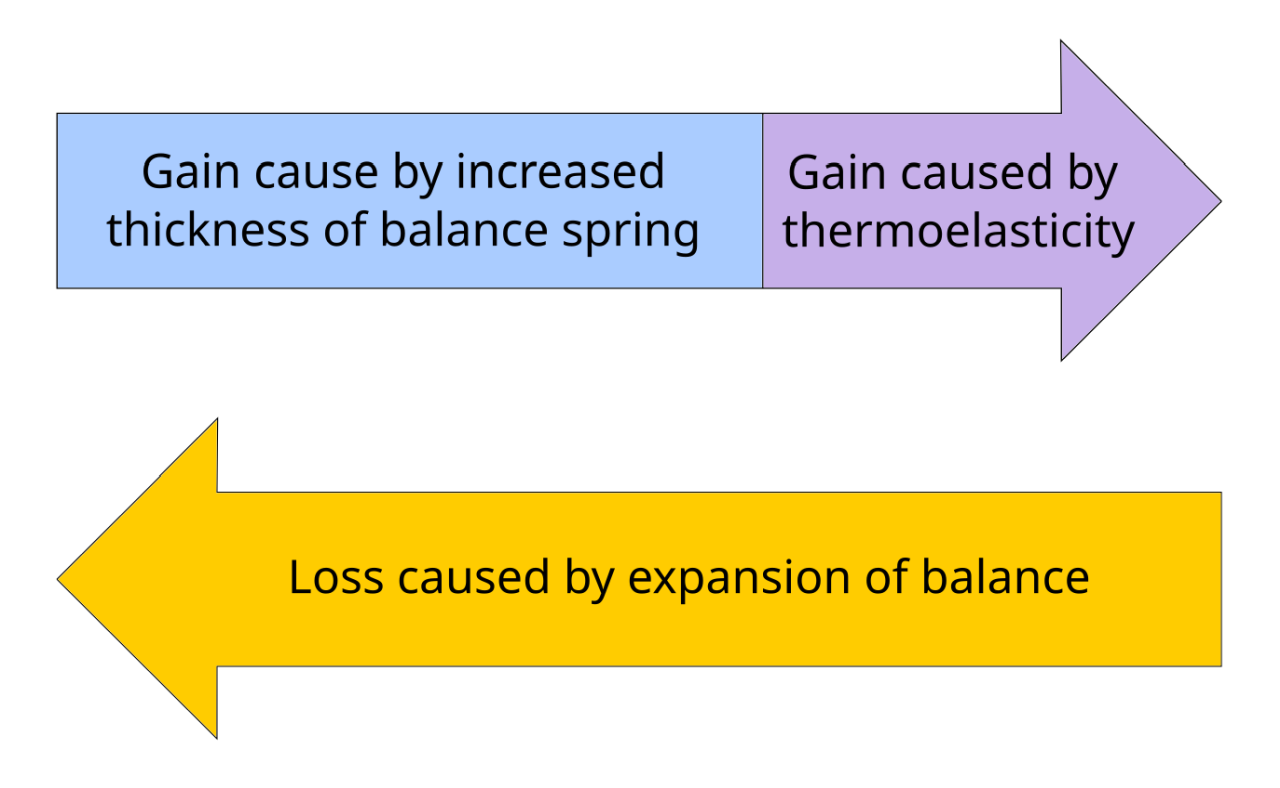
Figure 3 Thermoelastic and Thermal Expansion Effects: Click image to enlarge
The alloy with 28% nickel is in the region where the thermoelastic effect is positive. This effect, along with thermal expansion, increases the spring's stiffness to compensate for the expansion of a brass balance.
The thermal expansion of an Invar balance would be much less than that of a brass balance; thermal expansion of the spring causes a greater increase in stiffness than is necessary to compensate for this, which would result in a residual gain. The alloy with 27% nickel is in the region with a negative thermoelastic effect, reducing the modulus of elasticity to compensate for the excess increase in stiffness.
However, Perret dismissed the idea of making balances from Invar, saying that Invar presented no advantage over brass, because the nickel steel alloy for the spring could as easily be formulated to work with a brass balance as an Invar balance, and Invar has the disadvantage of being magnetic and difficult to work with. As a consequence, apart from a few experimental trials early on, Invar balances have never been used in watches.
Figure 3 shows the effects of thermal expansion and thermoelastic changes following a temperature increase of 30 degrees Celsius on the rate of a watch fitted with a 28% nickel steel balance spring and brass balance. Expansion of the balance causes a loss of 48 seconds per day, but the gains caused by the increase in stiffness of the balance spring, 29 seconds due to its thermal expansion and 19 seconds due to thermoelastic effect, compensate for this, resulting in an overall zero rate.
In 1897, Paul Perret was granted a British patent for this invention under international convention, which meant that Swiss patents were recognised in Britain and did not undergo a separate examination. This patent can be seen by clicking this link: British patent No 24,142. The invention is said to consist mainly of a balance spring made of “an alloy possessing the property of increasing its elastic force in proportion as the temperature rises”. The term “elastic force” is a poor and misleading description of what actually happens. The elastic force of the spring, the restoring torque or couple, is constantly varying at any temperature as the balance swings from one extreme of its rotation to the other, being a maximum at the extremes and zero at the neutral point. It is the stiffness of the balance spring that must increase to compensate for the increased moment of inertia of the balance and maintain a constant frequency of oscillation.

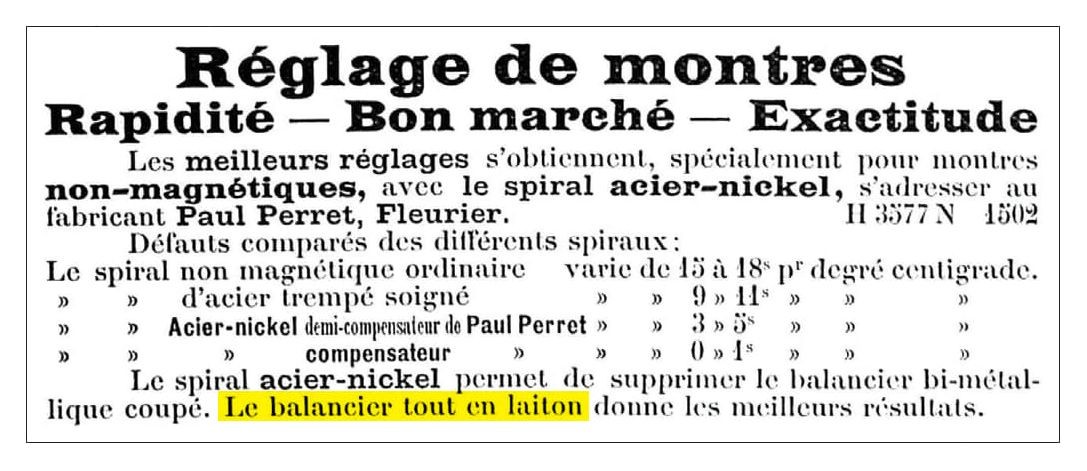
Figure 4 Advert for Paul Perret balance springs: Click image to enlarge
The first nickel steel balance springs were sold under the name of Paul Perret. Figure 4 is an advert for Paul Perret nickel steel balance springs from 1901. The statement at the bottom says that nickel steel balance springs make cut bimetallic balances, that is, compensation balances, unnecessary and that a balance made entirely of brass (‘tout en laiton’) gives the best results.
Paul Perret balance springs were relatively soft and had high internal friction. They also had a significant secondary error because their thermoelastic coefficients were not constant over a range of temperatures, making them unsuitable for the highest-quality watches. They were used to provide temperature compensation for millions of cheaper watches, which did not justify the cost of a compensation balance.
The quality of the alloy was improved significantly within a few years. One manufacturer of better-quality watches that was an early adopter of nickel steel balance springs was Tavannes. Many Tavannes watches from the First World War have monometallic balances and nickel steel balance springs.
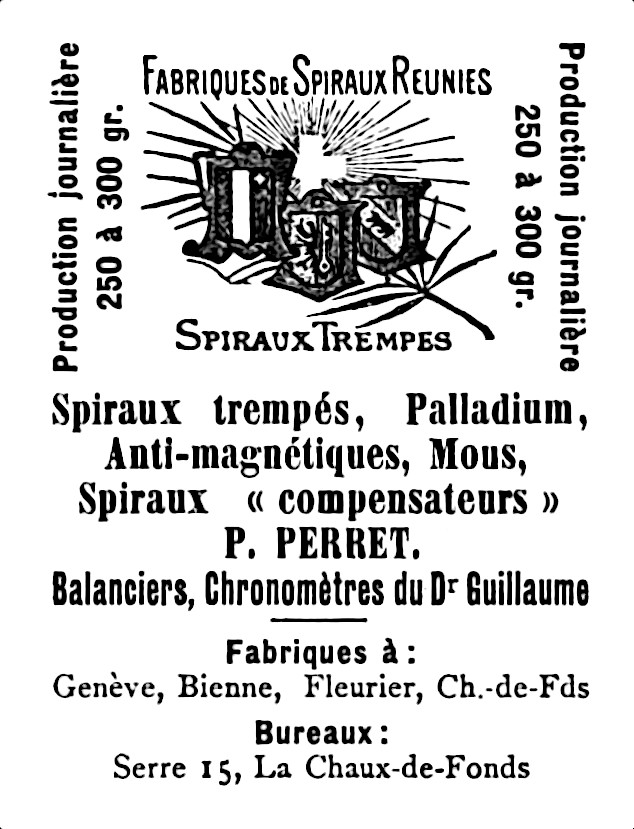
Fabriques de Spiraux Reunies advert, 1908:
Click image to enlarge
Manufacture of Paul Perret balance springs was taken over after Perret’s death by the Fabriques de Spiraux Reunies (United Balance Spring Manufacturers). An advert published by this company in 1908 is reproduced here, including “Spiraux « compensateur » P. Perret”. The combined daily output (production journalière) of 250 to 300 gross, where a gross is 144 units, that is 36,000 to 43,200 balance springs, about 10 million per annum, is impressive.
Many watches fitted with nickel steel balance springs have not survived, because of accidental damage to the balance spring during servicing due to the delicate nature of the spring. Lifting the balance away from the movement suspended from the balance spring, which many watchmakers do, is enough to distort a nickel steel balance spring. Even Elinvar springs can be damaged by this treatment.
An English company that used Paul Perret balance springs was H. Williamson of Coventry. Figure 5 shows one of their adverts from 1910 stating that patent Paul Perret nickel steel balance springs were used in their Coventry Astral watches. Figure 6 shows the balance and spring of a Coventry Astral watch from around that time.
The balance is monometallic, made from Maillechort, also called nickel silver, German silver or Argentan. Despite the word silver in some names, it does not contain any silver and the word refers to its appearance. It is a an alloy of copper, nickel and zinc.
Maillechort can be formulated to have a similar rate of thermal expansion to brass and is therefore suitable to be used as a balance with Paul Perret temperature compensation balance springs. It is harder than brass and doesn't tarnish, which is why Maillechort balances superseded brass. In Switzerland, nickel silver balances were frequently called simply nickel balances.
Figure 6 Paul Perret balance spring circa 1910: Click image to enlarge
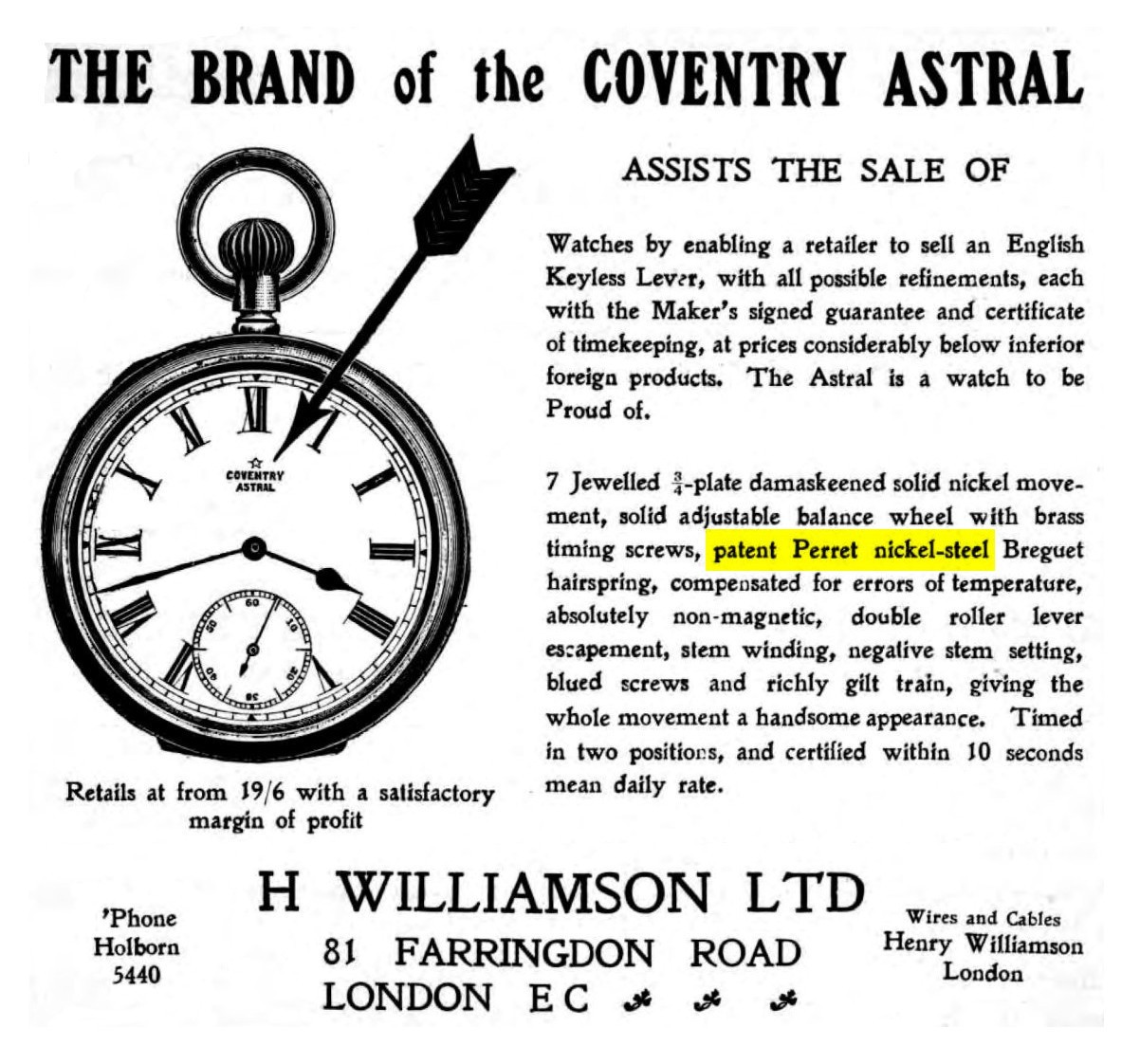
Figure 5 H Williamson advert 1910: Click image to enlarge
If you have any comments or questions, please don't hesitate to get in touch via my Contact Me page.
Copyright © David Boettcher 2005 - 2026 all rights reserved. This page updated October 2025.
Back to the top of the page.