Names on Dials
Copyright © David Boettcher 2005 - 2026 all rights reserved.
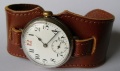
My grandfather's 1918 silver Rolex wristwatch. No Rolex name on the dial, and there never has been: Click image to enlarge
Throughout the nineteenth and early twentieth centuries, with very few exceptions, British retailers only allowed their own names onto the dials of watches they sold. The concept of a “brand”, which would conflict with the retailer's identity and reputation, was fiercely resisted. If there was to be any name on the dial, British retailers wanted it to be their own name.
It was not until the late 1920s that British retailers began to accepted Swiss manufacturer's names on the dials of the watches they sold, a move largely forced on them by Hans Wilsdorf's extensive advertising of Rolex branded watches.
Watches are often seen with the names of prominent retailers of the period such as Harrods, Asprey, Hamilton & Inches, Finnigans, etc., etc. These names are almost damaged to some degree, whereas the rest of the numbers and markings on the dial are still pristine. This is because the name was painted in enamel paint onto the fired vitreous enamel dial. The fired enamel dial is hard and shiny and the enamel paint does not stick well to it, so bits of paint drop off over the years.
The reluctance of British retailers to sell visibly branded watches is clearly demonstrated by my grandfather's and grandmother's Rolex wristwatches. Although the Rolex name is engraved onto the movements and stamped in the case back of both watches, the dials are completely plain. These watches have been in my family since they were purchased new and have never been altered, so I know that the dials have always been plain like this.
Brand names were invented in the nineteenth century for food, to give people confidence in the purity of products. The idea soon spread to other areas, such as Kodak for film and cameras. In other countries in Europe and around the world, brand names played an important role in selling watches, but British retailers stubbornly refused to entertain the idea. In the twentieth century some English watch manufacturers began to brand their watches. One of these was H. Williamson Ltd. who trademarked the name “Astral” and began to put this onto the dials of their watches around 1910.
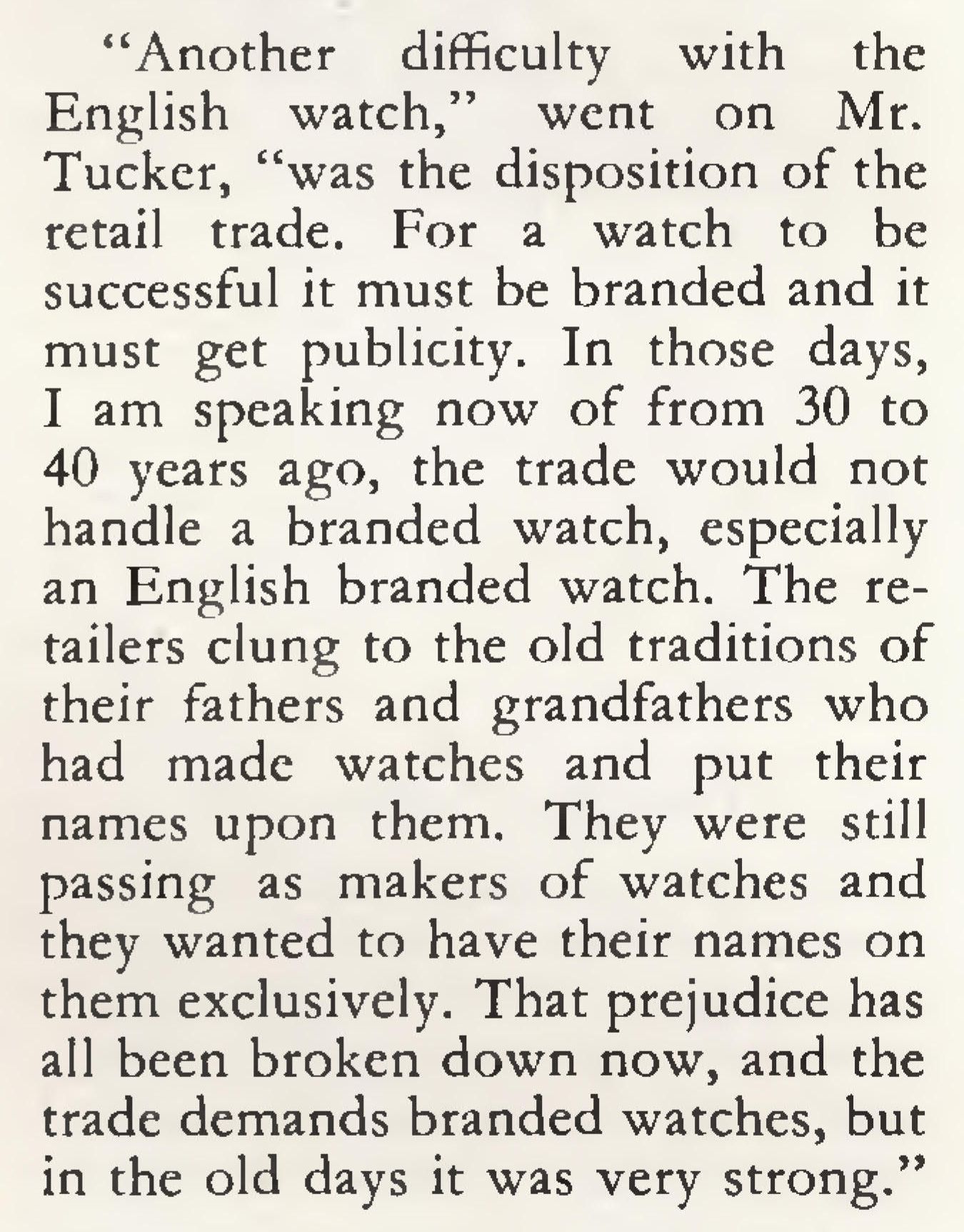
Mr W. E. Tucker, 1933: Click image to enlarge
This didn't meet with universal approval. Speaking in an interview in 1933, Mr W. E. Tucker, who had been a director at Williamsons, attributed this to the attitude of British retailers, who wanted to put their own name on the watches that they sold.
In the Horological Journal in 1916, Thomas Field, Managing Director, Field & Son, Ltd., Aylesbury, complained about “cheap, trashy American, Swiss and German "branded" watches” and stated “Speaking for my own firm, we have on principle never sold a "branded" watch of any description excepting those carrying the name of "Field & Son, Aylesbury."”
High end British retailers remained stubbornly resistant to the names of foreign manufacturers appearing on the dials of watches. This only changed in the late 1920s, when Hans Wilsdorf started to advertise the Rolex brand extensively in Britain, and people started asking for Rolex watches.
Wilsdorf said that when the Rolex Oyster was launched in 1927, he made the decision to insist that all Rolex watches carried the brand name on the dial. British retailers were suddenly faced with customers who had read about Rolex watches in the newspapers, and seen adverts for them, and started asking for Rolex watches by name. The retailers had no choice; they had to start stocking watches with the manufacturer's name and brand on them, or their rivals would and they would lose out. This was the start of a trend and other watch manufacturers soon followed.
In December 1927 the British Watch and Clockmakers' Guild held an open meeting to discuss “Pros and Cons of the Branded Article”. Hugh Rotherham kicked off the debate by saying that “in England watchmakers and jewellers insist, or most of them insist, on selling English watches with their own names on, and the public do not to-day, as a rule, look on the name as a guarantee of manufacture but as a guarantee of quality.” He noted that in Australia, New Zealand, India, Straits Settlements and South Africa, English manufactures would not sell a watch that had not got the manufacturer's name on it.
A letter from the editor of the National Association of Goldsmiths Journal was read out, stating “I am afraid you will find no one in particular opposition to the branded watch except some very out-of-date retailers.” Mr. G. E. Limmer said that there was not a single watch sold in America without a brand on the dial. Mr. Charles Tucker pointed out that a branded article had to be advertised very extensively to be successful, costing between £25,000 and £30,000 a year, which was possible in America where there was an enormous market, but he questioned who would pay for this in Britain.
The Secretary reported that Messrs. J. W. Benson, Ltd., of Ludgate Hill, E.C , had written to the effect that Mr. Benson was opposed on principle to selling branded articles, and that they were not sold by his firm. The meeting concluded without agreement, but the tide was clearly turning.
Vitreous Enamel vs. Enamel Paint
Before the late 1920s, dials were usually made of vitreous enamel. Vitreous enamel dials were made by fusing powdered glass to a copper plate by firing in an oven, usually between 750 and 850 °C. After the background was fired, the numerals and minute tracks were applied in vitreous ink, which was also fired. The surface of a vitreous enamel dial is permanent and does not wear or degrade with age. a name or logo fired onto the dial in vitreous enamel does not chip, flake or wear off.
Sometimes the retailer's name was later painted on in enamel paint. The importer might have offered this as part of his service to the retailer, or the retailer may have arranged himself for his name to be painted onto the dial. However, enamel paint is much less durable than the vitreous enamel of the dial itself and, in surviving examples, has usually more or less fallen off. One exception to this rule are watches with Mappin „Campaign” that was fired onto the dial when it was made. But note that Mappin was a British retailer, not a Swiss watchmaker.
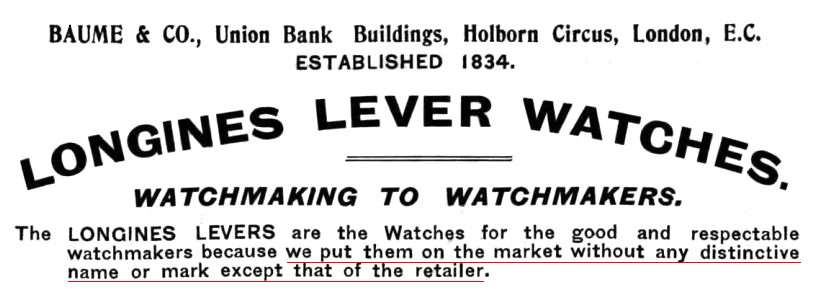
Baume Advert 1911: Click image to enlarge
The advert by Baume & Co. from the Horological Journal of 1911 reproduced here is evidence of this practice. Longines watches were very highly regarded by the watch and jewellery trade in Britain, and took numerous top places in observatory competitions. But the advert says that they are supplied “without any distinctive name or mark except that of the retailer”. This is not something that Baume or Longines wanted to do. If the Longines name were put prominently onto the watches, British retailers would simply refuse to order them. Baume and Longines were immensely proud of the quality of their watches, but they were also pragmatic; they needed to 'shift product' in order to make a sales and a profit. Given the intransigence of the British retailers, they made a virtue out of necessity and made it clear that they were willing, even if they were not happy about it, to supply watches without branding.
If you have a watch dated earlier than 1930 and it has a Swiss manufacturer's name or logo on the dial, you need to be aware that this might have been added later, even quite recently, by someone trying to give the value of the watch a boost. determine whether the name is fired vitreous enamel, and therefore definitely original, or enamel paint, which could have been applied at any time up until last week.
There is information on how to identify vitreous enamel names and enamel paint names at Enamel Paint.
This deception is most often found with early Rolex Watch Company items, where "Rolex" is painted onto the dials of not only actual early Rolex watches, but also the dials of Rolex's other brands such as Marconi, Unicorn, and other watches that would never have been called Rolex watches by the Rolex Watch Co. I explain why Hans Wilsdorf created brands other than Rolex at Wilsdorf's Other Brands. Before I started to expose this practice, there were few lengths that the unscrupulous would not go to. I have even seen a Marvin wristwatch from 1915/16 with Rolex laser engraved in the case back and on the barrel bridge, and Rolex painted onto the dial. Needless to say, the watch had nothing to do with Rolex.
If you have any comments or questions, please don't hesitate to get in touch via my Contact Me page.
Copyright © David Boettcher 2005 - 2026 all rights reserved. This page updated January 2025.
Back to the top of the page.